Uncategorized

“All great and precious things are lonely”. – John Steinbeck

I see what is beauty to me:
A few warm days in spring,
the smell of lilacs in the house,
the wetness that comes at night,
red sunsets.
Loneliness.
“Beauty to me,” from Moments, Mary Elyn Bahlert, published, 2026

I am not often lonely. But I have known loneliness, hard and deep loneliness. In my twenties, I worked in my first professional position, finally moving into public relations in both the Social Security Administration and the Food and Drug Administration. I had good friends. I lived in Milwaukee, where I’d grown up; I knew Milwaukee well, and I liked the life I had there. But I was lonely.

I was lonely, and it hurt. Some times, I’d come home after a day at work to my one bedroom apartment, furnished with furniture from the 1940’s, books lining the full bookshelves. This was the 1970’s; this was in the time before the Internet. Sometimes, in my loneliness, I’d call a good friend – a friend I’d called more than once that week – and chat for a time, until something else called to her to attend to. Was she lonely, too? I never told her I was lonely, and I never heard her talk about loneliness. But I was lonely.

During those years, I began to learn about the ministry. I’d been drawn to ministry since my late teens, when the thought arrived on its own, one day: I could be a minister. I had not seen or heard of such a thing as a woman minister; in the Lutheran Church in which I’d been confirmed, women were not allowed to speak in church. That – among other things – did not sit well with me. I started to learn about the ministry by reading books I’d borrowed from the library. I read about denominations. Until my mid-twenties, I did not find a church in which to connect. I began my learning in my own particular, introverted way.

And then, I did do some searching. I’d attend a church service at some congregation. More than once, as the unknown person – and as an unmarried, un-partnered woman – I’d be ignored. That was enough for me to not return. In my searching, I was led to visit a United Methodist Church across from the University I’d attended, on the East Side of Milwaukee. There, a kind older woman – Verdell de Yarman – looked right at me, asked if this was my first time at Kenwood United Methodist Church, and, after church, walked with me to the coffee fellowship, where she introduced me to the Rev. Harvey Stower. And it was Harvey who warmly invited me in, the way he warmly invited everyone in, to a circle of young people. And it was Harvey who asked me one day if I ever thought about seminary. And I told Harvey that I did – often – but that I just didn’t talk about it. After all, I had never seen a woman minister (although they did exist!).

I was grateful for Harvey and the community that formed around him. That community became important to my life in the years that followed. I’m always grateful.

The loneliness remained, until the mysterious and wonderful day I met Jeff Kunkel, my husband. In our marriage, I have not been lonely. I’ve heard about people who are lonely in their marriage. How hard that must be. Jeff is my true companion, my life partner.

As I reflect now on those times, many years ago, I look back at the quote of John Steinbeck that serves as the title of this blog post. I expect that Steinbeck knew loneliness, that he knew loneliness well enough to have clearly described it. And although he did not write of loneliness as I have – as a painful companion, a companion that brings tears and a complete emptiness into the mix – I expect he knew that of loneliness, also.

When I was a pastor, I spoke of loneliness in one sermon. And I have not forgotten: after worship, as people greeted me and sometimes commented on what they had heard (which is not always what I thought I had said!), a young woman shyly said to me: “thank you for talking about loneliness.”

“All great and precious things are lonely…”

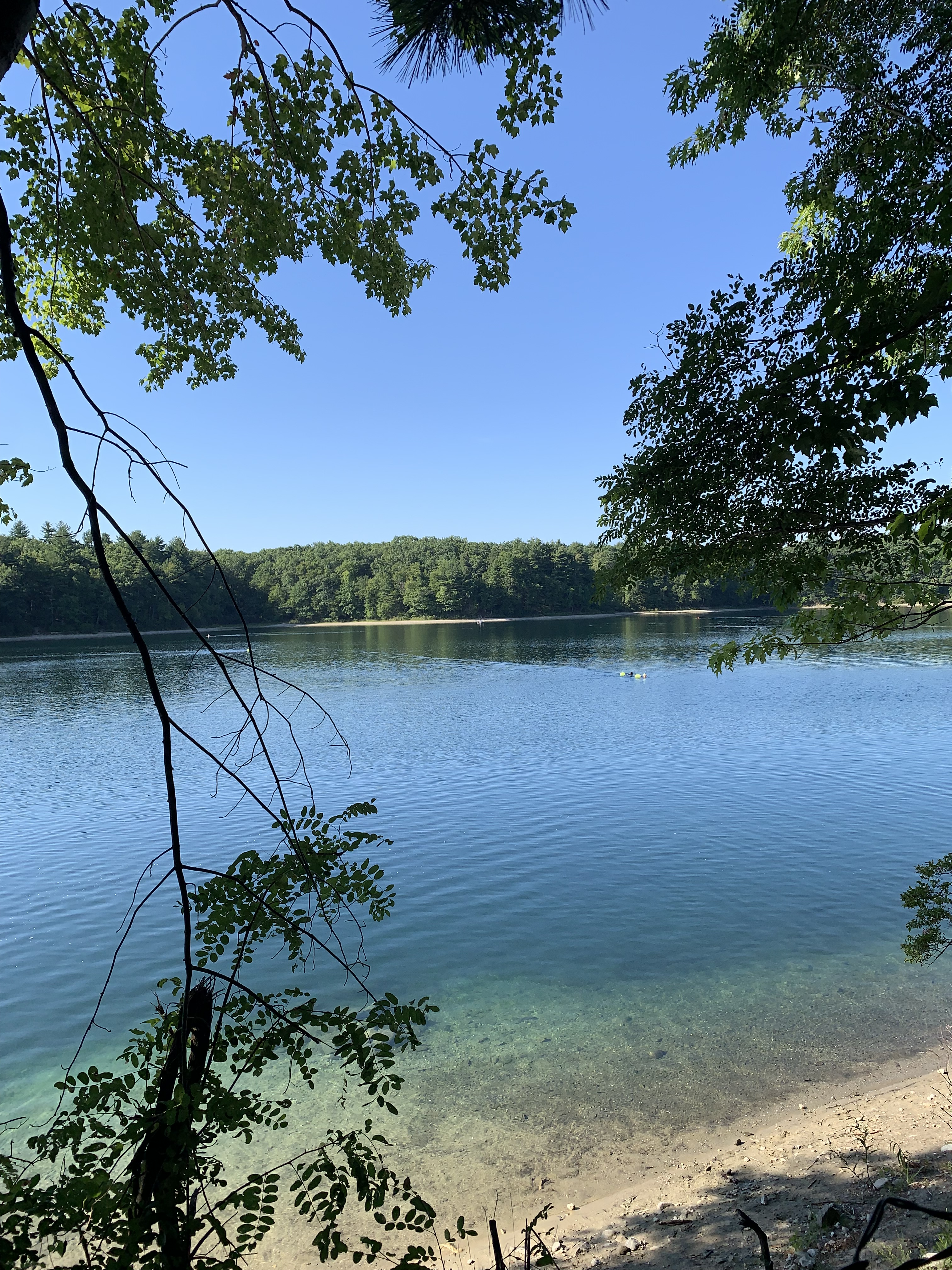
At Walden Pond, Massachusetts, where Henry David Thoreau lived in a small cabin, relishing his alone-ness. Photo by Mary Elyn Bahlert, 8/2026

reflecting

Me and Mister O’Reilly

Mr. O’Reilly was my Junior High Science teacher. I don’t remember much about him, except that he was old – most of my teachers were old by my standards… after all, I was in Junior High, and that he had gray hair and always wore a suit. Teachers dressed formally in those days. Other than the memory I’m about to share, all I remember about Mr. O’Reilly is that, on a warm, warm autumn day, when the windows of Peckham Junior High School were open to let in the clean, fresh air of the city, he sat at his desk, and – commenting on a fly that had flown into the window – told us a strange bit of information: if the fly were to land on a piece of food we were eating, whatever the fly had lit on before – the edge of a bedpan in a nearby nursing home, for example, and if said fly then landed on our hand, and if we did not wash our hands before we ate a meal – the germs that germy fly carried would transfer from the edge of the bedpan onto our food. And then into us/me.

Ugh. Enough of that memory – except to say: I’ve never forgotten that particular lesson. Wash your hands, people…

By the time I entered Junior High School, my school day began early and ended late in the afternoon. In Junior High I brought my lunch each day in a brown paper bag I carried along with my books. In each bag was a sandwich made with homemade bread, a piece of fruit, and maybe a sweet treat that Mom had baked. And by the time I entered Junior High, walked under the viaduct at 35th and Fond du Lac Avenue, I was in classes with young people who were, really, from the “other side of the tracks.” My classmates were no longer all the children of working class factory workers. My classmates often came from homes where Dad had a job that required a suit, and where Mom was not simply a housewife, but a woman who worked in an office, or who had been a nurse before she stayed at home, a home that the family owned.

And I was sensitive to all these things. I noticed.

One day, Mr. O’Reilly called my name as I passed him and another teacher, on my way to my assigned chair at a table in the cafeteria. I stopped in front of the tall teacher as he stood next to another teacher, a younger woman. They had been talking, and I somehow knew that they had been comparing the students they taught. Mr. O’Reilly – apparently to make a point – asked me where I lived. I understood completely in that moment that he expected me, a student of his in an accelerated program, to give him an answer other than the answer I gave: “I live on 28th and Locust.” Mr. O’Reilly looked at me with a surprised look on his face.

In Junior High, I was already sensitive to the homes and the kind of work my schoolmates’ parents had. I understood that I was not one of them. Later in college, I would take a class in the humanities about social class. In Junior High, I felt the tug of my difference, I saw the quality of the clothes my classmates wore – different from my often home-made clothes, and I expect I felt ashamed. I did not feel shame wash over me, wash over my body and mind as well as my emotions, in that moment in the school cafeteria, as I answered Mr. O’Reilly’s question. But I was keenly aware of what that moment was about.

In college, I would take a class about social class. These days, I’m rereading a text from that class: The Hidden Injuries of Class, Jonathan Cobb and Richard Sennet, 1972.

After my encounter with Mr. O’Reilly, I sat at the table with my friends and ate my lunch, ate my sandwich made of homemade bread. And I have never forgotten the sting of being from the other side of the tracks, for all the life of privilege I have lived.

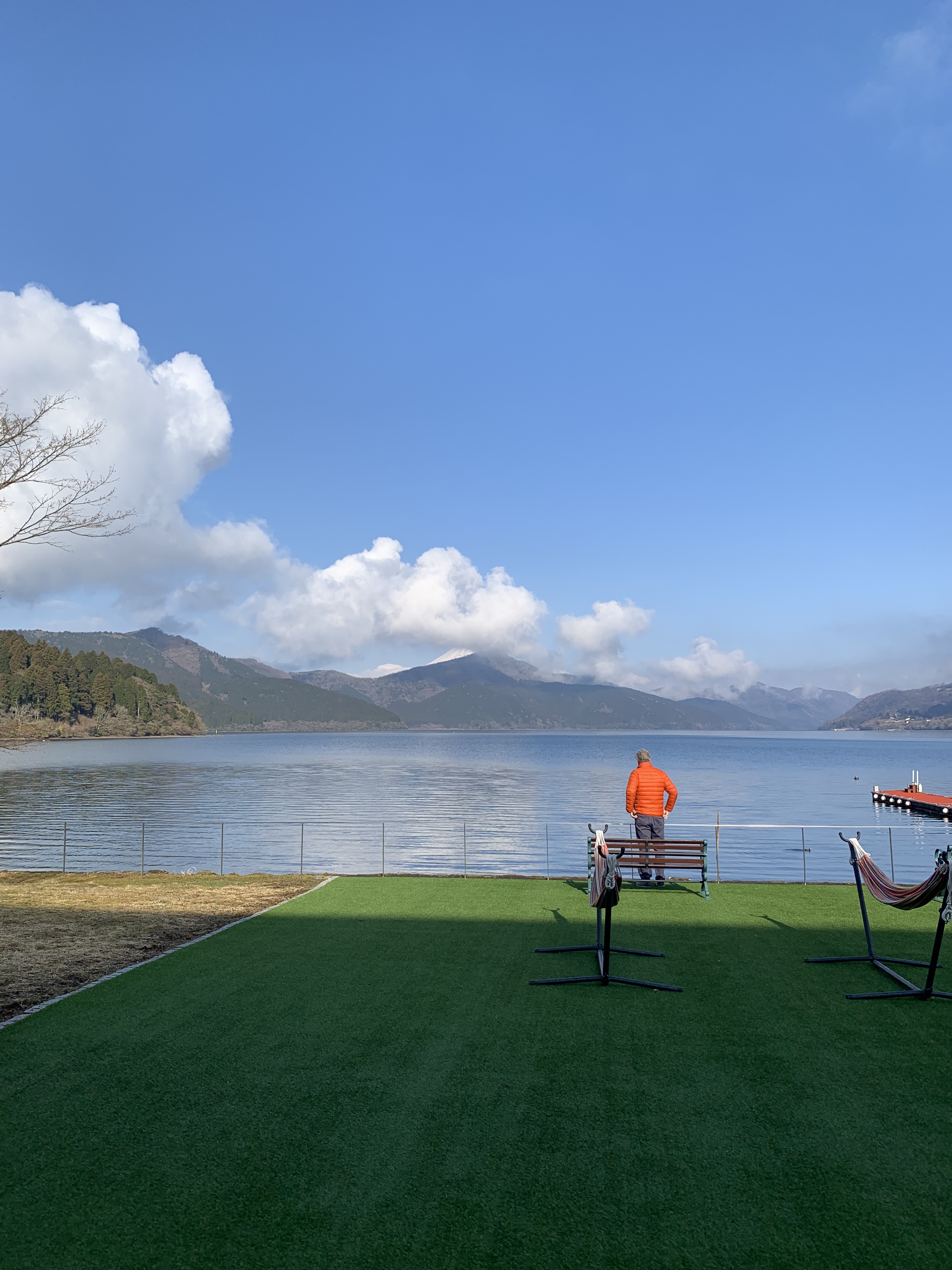
A view of Mt. Fuji from Hakone, Japan, 2026. That’s Jeff in the bright orange jacket, seeing “the shy one” as she chose to show herself to us before we left to travel to Kanazawa. My own photo.

memories, Uncategorized

Driving Through Chester

Rainier was going with Lia, a young woman who lived in the same apartment that they rented together with several other young women in San Francisco. At just the right time, Rainier and Lia started dating each other – and that was it. They were a couple. It was 2012.

Rainier lived with us in Oakland for the first few years of his studies at San Francisco State University, before he’d moved out to live in the City during his last year of school. He’d come to live with us almost from the day he’d graduated from High School on Oahu, calling to ask us whether the offer of a home with us we’d made some years before was for real. It was for real, and we were glad to have him. He lived in a small porch-like area with windows on two sides in a second story duplex before we moved into the beautiful Craftsman Style home we’ve owned and lived in since. In our home, Rainier’s space was down several steps from the kitchen, a small room with a low ceiling and access through sliding doors to the garden. During the move to our new house, he’d offered a strong helping hand. He’d joined us as we gathered a few friends to our new home for a house blessing.

While he was in college, Rainier had taken up bicycling, first using a second hand bike he’d found in the basement of the duplex on Sunnyslope Avenue, graduating to another bike and into a group of cyclists in San Francisco, competing for Mike’s Bikes by traveling to races. Now he’s got a stash of bicycles and parts in his workshop in the yard of his home in Seattle.

When the time to go out on his own came, Rainier moved to San Francisco, where he shared part of an old house with several young women.

We knew from the start that Lia was Rainier’s true partner, and we have enjoyed their company together ever since. Jeff officiated at their wedding. During COVID, we’d made the trip from our place in Oakland to their home in Seattle several times to spend time with them and their baby girl Celeste, born on the first day of COVID sheltering in place – March 17, 2020. Rainier and Lia and Celeste became the children of our own we did not have.

*

After they became a couple, we invited Rainier and Lia to join us at our friends’ Paul and Lana’s place in the Warner Valley, 5 hours north of the Bay Area, for a few days. The four of us had fun together: we watched the budding romance. When our visit was over, we packed up Jeff’s Forester and headed back to the Bay Area. We stopped in Chester, at the southern end of the Valley, dropped off a few days’ worth of garbage in a big garbage can in a driveway, and started West out of Chester toward Highway 5. We left the town limits of Chester. Jeff noticed first. He didn’t say anything to us, but he watched a police vehicle driving along behind us. Jeff is not one to speed, but he watched the speedometer anyway.

Just as we left the town limits, the red lights of the squad car went on and we pulled over. The four of us sat silent in the car as the officer came to the window and asked to see Jeff’s license. I’m sure the officer could read the faces of anyone he pulled over, because that day, he took his time to explain that we’d been seen dumping garbage in town. “I’ll give you a choice,” he said. “You can go back and get that bag of garbage, or I can take you jail.”

“We’ll go back to pick the garbage up,” Jeff said.

We were silent as Jeff turned the car around and watched as he didn’t go a bit over the speed limit as we returned to Chester. We found the garbage container where we’d deposited our garbage less than an hour before. Jeff stopped the car. Rainier got out to get the bag of garbage. We were silent, but I’ll bet we were watched by the neighbors who’d – apparently – watched us before.

And we were mostly silent on the long ride back to San Francisco.

When we drove into San Francisco, I’d taken the wheel, and we were almost at Rainier and Lia’s place. At the same moment, we all burst into laughter, unable to contain it any longer. We all burst into the laughter that followed our entanglement with the Law in Chester.

And you can bet we’ve told that story to one another many times since that fateful day…

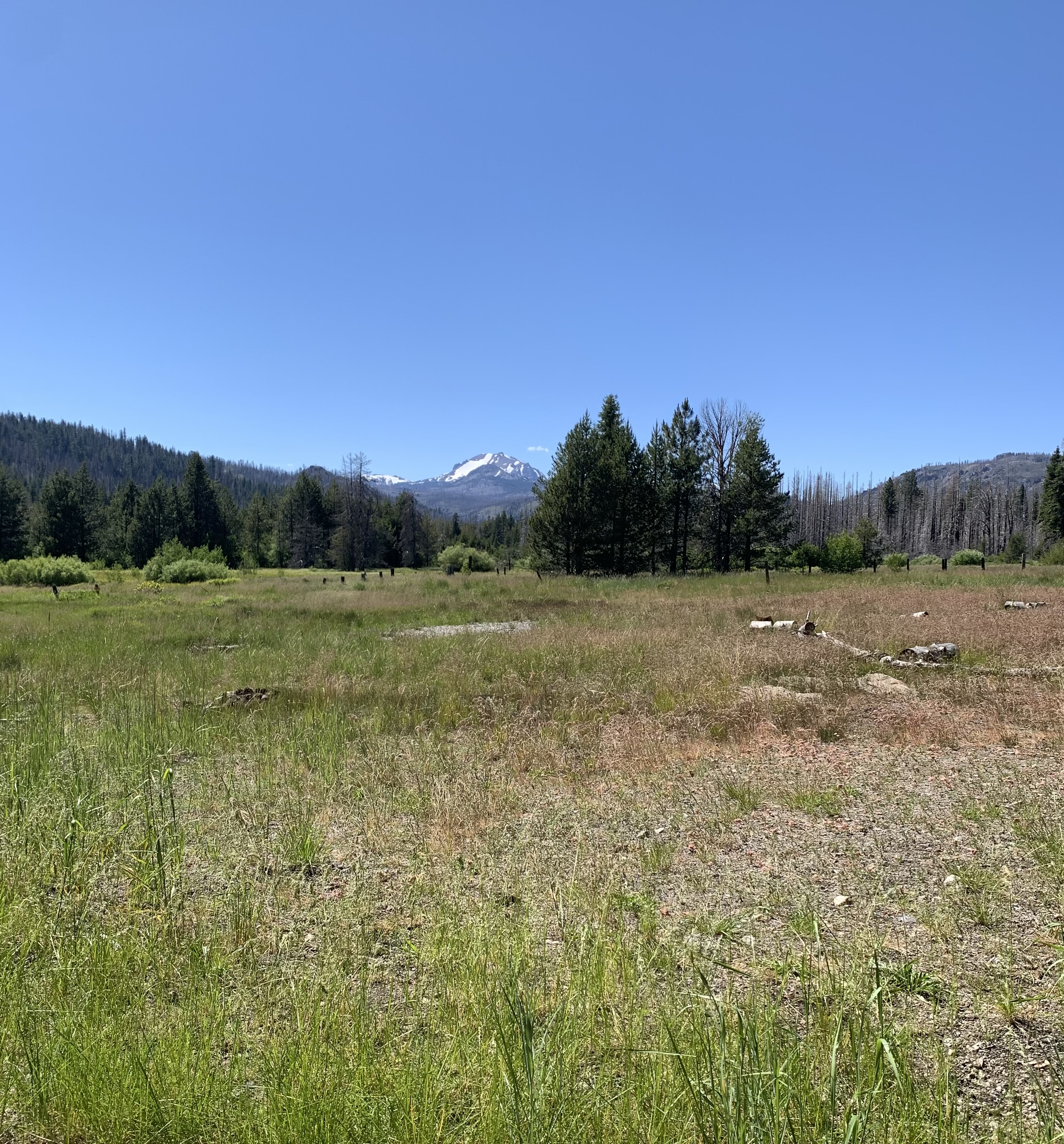
A view of Warner Valley now, Mt. Shasta in the distance. After fires several years ago, damaged trees stand amid trees that had escaped the fire. Paul and Lana’s first cabin was destroyed in the fire; the homes on either side of the cabin that burned still stand. Photo by Mary Elyn Bahlert, 6/9/26.

memories, nostalgia, remembering

Auntie Irene

Suzie called her “the hugger.” Yes, Auntie Irene – one of the extroverted Bahlert’s – loved to hug us when we arrived at her house on Old Lime Kiln Road in Baileys Harbor, Wisconsin. And she loved to hug us when we left. She was, indeed, “the hugger.” Like my dad, Frank Bahlert, Auntie Irene talked fast and kept on talking, no matter what. And she would cry sometimes, too. Her emotions came easily to her, and they couldn’t be kept quiet. It wasn’t quiet with Auntie Irene around.

When Dad had his two weeks off from the steel mill each summer, we’d drive up to Door County – 200 miles north of Milwaukee, a peninsula bordered by Lake Michigan on the East and Green Bay on the West – and spend a week.

Sometimes we stayed in a rented cabin, rented from the Kellstrom’s of Sister Bay, and sometimes we’d stay with my Uncle Fritz, Aunt Goldie, Bobbie and Susie. For several years, they lived on a farm East of Sister Bay, where they kept pigs. After a long day at the shipyards in Sturgeon Bay, Uncle Fritz, my Dad’s younger brother, would collect garbage from restaurants along the highway to feed the pigs. The fastest I ever rode in a vehicle – a small truck – was with Uncle Fritz. My cousin Bobbie in the middle, me on the passenger side, and Uncle Fritz at the wheel, he sped up to 100 miles per hour. I think I was too young to consider what could have happened at that speed – and without seatbelts. Uncle Fritz was one of the quiet Bahlert’s, like my Auntie Edna, Uncle Clarence, Uncle Ray, and my cousin Terry, Ray’s daughter.

Auntie Irene, like my Dad, was a talker – as well as a hugger. After college and after I had been hired as a Claims Representative in the Social Security Office in Green Bay, Wisconsin, I’d sometimes stay the weekend with Auntie Irene and Uncle Erdreich – others called him “Peggy.” They had an upstairs to their house, an upstairs reached by a narrow stairway built into the wall. I’d stay alone in one of the two rooms up that narrow passage, looking up from my bed at the trees that pressed against the windows as the wind blew. Food was always plentiful at Irene and Erdreich’s house. Auntie Irene would bring out dish after dish of good food, filling the table with her cooking along with her non-stop talking.

I liked to introduce friends to my family in Door County. Friends were always welcome. One day, I invited a friend who worked with me at the Social Security Office in Green Bay. We headed to Door County on Friday night. After we’d met Auntie Irene and Uncle Erdreich, Becky and I headed out for some adventure of our own. Becky surprised me as we pulled out of the driveway and onto the highway: “there’s no excuse for someone to be like that,” she said. My feelings about Auntie Irene did not change with her comment, but my feelings about Becky did. I had no excuse to be a friend of someone who judged these loving, kind folks so harshly.

Another friend traveled with me from California to Wisconsin, many years later. We, too, made the pilgrimage to Door County. In her way, Bonnie told me, “I’ve never met people like this before.” Together with my mother, Bonnie and I climbed the narrow steps to that simple upstairs room and stayed the night. We were recipients of a kind and gentle hospitality.

When I took my husband Jeff up to meet the Door County folks for the first time, his kind and open manner made him welcome from the start. He loved to meet the family I loved so dearly, and they welcomed him with kindness. Jeff gets excited about a lot of things – which is fun (but can be exhausting). Together with Auntie Edna and Uncle Werner, Auntie Irene and Uncle Erdreich, we went to take a look at the cabin that Werner used to house seasonal workers who came from the city to pick cherries every summer in his orchard. We walked through tall grass to the frame house, following one another on a narrow path. As we approached the house, Jeff was saying: “this is great! “

Behind me as we walked along the narrow path to the house, I heard Auntie Irene say, under her breath: “I feel sorry for Mary Elyn.” I can still hear her voice, saying out loud only to herself what she was really thinking…

I was hospitalized in the summer of 1996. Before Jeff and I had made the trip back to Wisconsin, I’d written a note to my beloved Auntie Irene, who was ill and in a care home. “Wait for me,” I’d written. When Jeff and I and my mother made it to Door County, Irene had already passed. I sat with the others in the narrow wooden pews of the Evangelical Lutheran Church. After the funeral, I stood on the steps of the church, looking over the heads of my Bahlert cousins, some of whom I had not seen for many years. I remembered what I’d written in my note to Auntie Irene. Auntie Irene had waited. And I had returned, just in time, as it turned out.

Irene Bahlert, circa 1923

memories, nostalgia, The Holy, Uncategorized

A dream

My dad loved life. He loved my mother, he loved us, and he loved his life. After having been diagnosed with colon cancer in the year after he retired from his work as a steelworker at age 65, he was always grateful for the life he was able to live during the 10 years after. He came to realize that he could live much as he had before the arrival of the cancer, and so he returned as much as possible to the life he’d had before the cancer diagnosis and the colonoscopy. He rode his bike all around his neighborhood in Milwaukee, and he and Mom drove clear across the country from Wisconsin to visit my mother’s brothers in California. Mom and Dad enjoyed every moment of that trip, my father at the wheel, my mother pointing out sites and reading from the AAA trip-tick that guided their trip. Both my parents – my father had an eighth grade education in a country one-room school house, my mother had received her GED when I was in college – were interested in life. As I remember them, I count the quality of having an interest in life as important, not only to them, but to me, as well. I’m grateful.

My dad loved life. He spent many weeks in a hospital bed at St. Joseph’s Hospital in Milwaukee, knowing he would not leave that room – ever. More than anything, he missed being able to ride his bike, especially now that spring was coming to the Midwest; it was April. He was 75; he would never make it to his 76th birthday. Now that I’m 76, I think of that fact – often.

Before I left his hospital room for the last time, before I traveled back to Pleasanton, California, where Jeff and I lived, I said to Dad: “Let me know you are all right.” I was clear: after he passed, I wanted a sign from him. As I said those words to Dad, he didn’t speak. He nodded. He understood.

The dream came some time later, months after Dad died in April of 1986. It was a simple dream, a clear dream. I saw my Dad, dressed in a suit, standing with a group of people, looking away from me. He had a humble look on his face as he stood with the others, his hands held together in a simple gesture, below his waist.

When I awoke, I knew immediately that Dad had kept his promise. He had come to me. And he had let me know that he was all right.

Uncle Johnny must be angry at Dad – he’s about to push him into the pool… They had fun together.
photo, circa 1983, San Jose, CA.