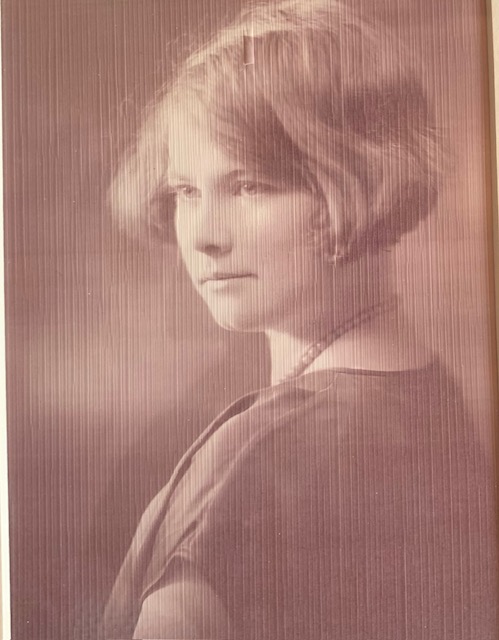
Mom liked to have fun. So did Daddy. In my Middle School years and beyond, while I was still at home, Mom would quickly clean the kitchen table after supper – we always had supper, except on holidays, when supper became dinner – and they’d get out the cards to play canasta all evening long, loudly calling to one another over the table.
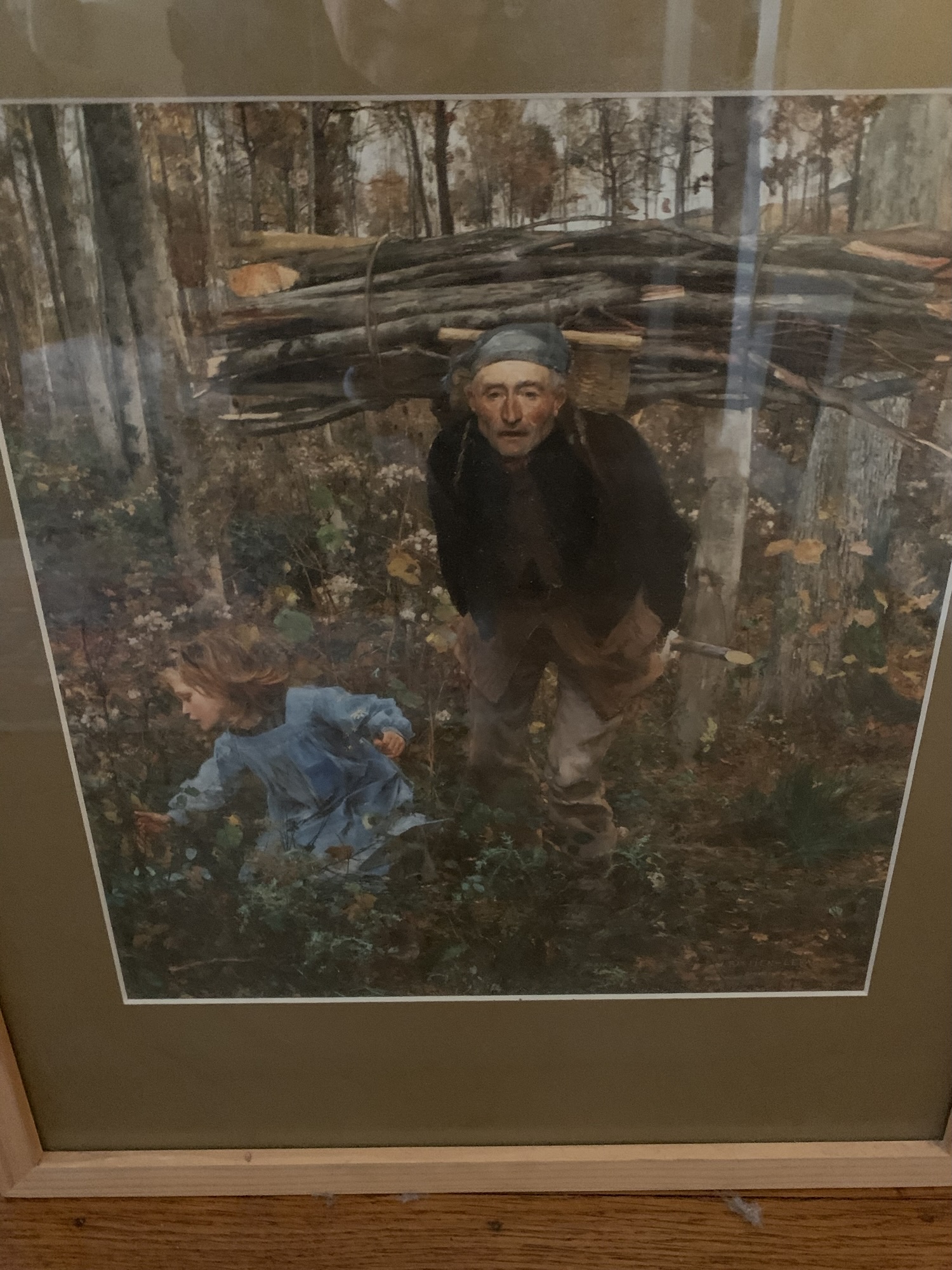
And it wasn’t until many years later that I learned the other things that Mom thought were fun. Volunteering at the hospital, where she made good friends among the other volunteers. Spending a whole day with me whenever I returned from moving West to Northern California. We’d spend the day driving around Milwaukee, looking again at the old neighborhoods on the North Side where we’d both grown up. Then we’d end up at the Milwaukee Art Museum, where Mom stood silently in front of her favorite painting -“Le Pere Jacques (the Wood Gatherer)”, looking closely, as if she was seeing it for the first time. We always had at least one meal out at a restaurant of our choosing. We had our favorites.
And Mom especially liked to bake. Every winter, in Christmas season, she’d bake the cookies we liked best – meringue dots filled with chocolate, Kris Kringles, sugar cookies in all shapes, carefully decorated and sprinkled with chocolate chips or plain cookies sprinkled generously with nonpareils. She loved to try new cookie recipes, too. She had her assortment of recipes – a collection of cookbooks across many years, holiday gifts from the Gas Company and Electric Company – and marked, with comments – i.e. “a favorite, try thisone!” The comments were meant for me, for the time I’d be baking my own cookies at Christmas. An event that has never happened: ask my husband.
I’d add my own comments now: “I’m not a baker, but I’definitely try this if I was a baker!”
And Mom had her own way of talking about those days of playing Canasta, about the days of baking cookies to be enjoyed by the whole family: “That’s the fun of it.”
I’m a different temperament from my mother. Gratefully, my own path has taken me through University and Seminary, following the leading of my temperament. And so, my comment holds: “I’m not a baker.” Every year, though, I bake three kinds of pies – sour cherry, pumpkin, and apple – to contribute to the holiday feast at Norman Bahlert’s and Cheryl Rouse’s long table on Thanksgiving Day. Mom would be proud of me, I’m sure.
My poor photo of a print of “Le Pere Jacques.” This print hung above the desk in my mother’s small room at Mathilda Brown Home in Oakland, 1998-2001.
I guess some people would call Uncle Pete a “blowhard”. He did have a tendency to talk loudly in a room filled with people, and to lend his certain extraverted charm to that room.
Even so, Uncle Pete was a favorite of mine.
I watched him as my Uncle Johnny – the smart one, the sibling with the “interesting” past – spoke. Then, Uncle Pete was quiet and listened, with a certain reverence, to every word. I’m not sure how I learned the secret, but word was that Uncle Pete only rose to the rank of Sergeant First Class in the Army because of Uncle Johnny. As I write now, I can see the look in Uncle Pete’s eyes as he listened. He held Uncle Johnny, his eldest sibling, in the highest regard.
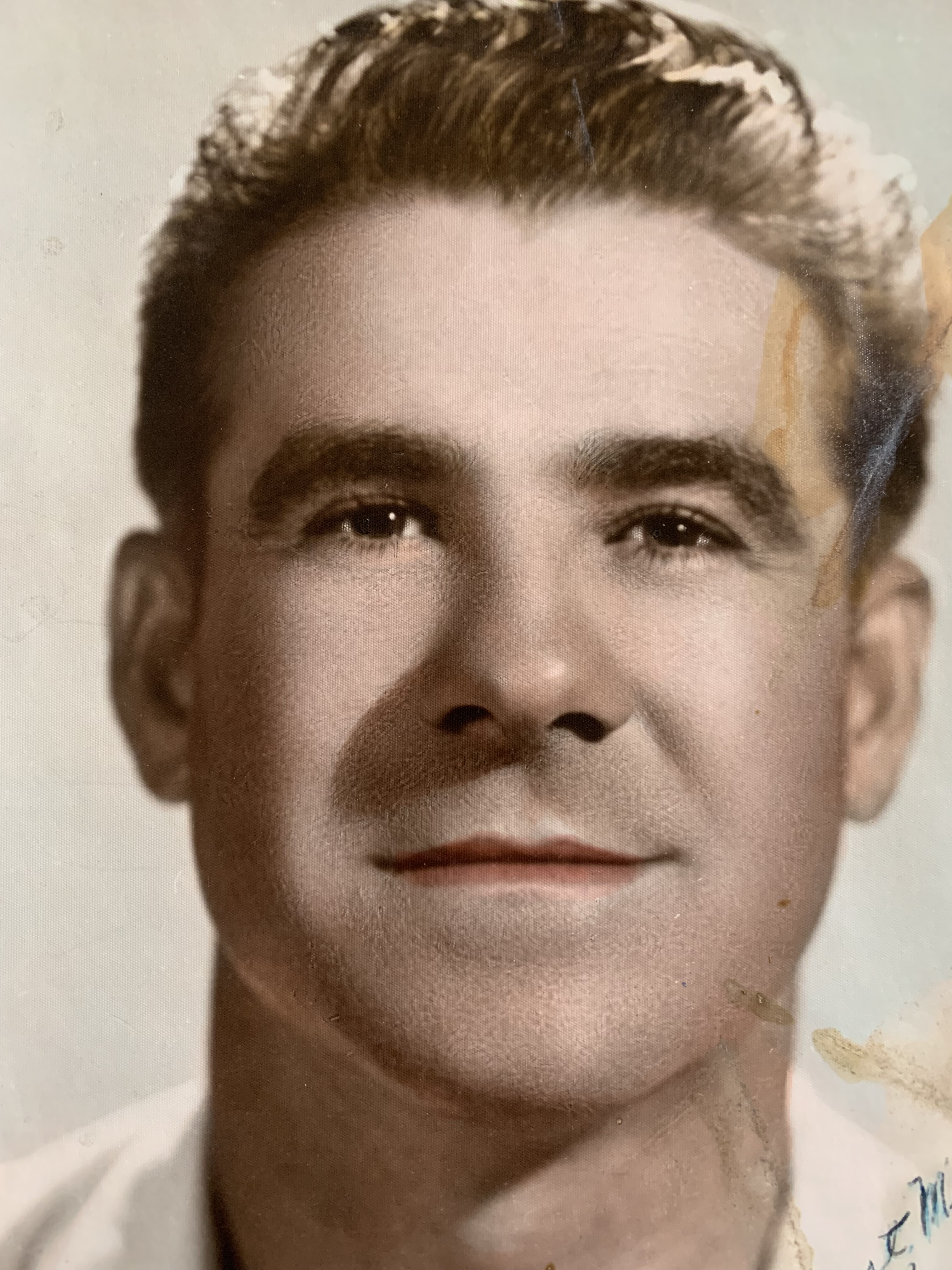
Uncle Pete was handsome. In my eyes, anyway, Uncle Pete was handsome. And Uncle Pete knew how to be an Uncle. That’s a difficult quality to explain. But Uncle Pete had it. When I was dating Jeff – who would go on to be my life partner, my husband, Uncle Pete quietly spoke to me one day: “I can see he’s showing more affection to you now.”
After I had moved to the Bay Area from Milwaukee, and after Jeff and I had moved around a fair amount, we lived in San Leandro. At the time, The Oak Knoll Navy Hospital operated in Oakland. My Aunt Athalie – Uncle Pete’s wife, the mother of their daughter, Michelle – was being operated on for the serious arthritis she suffered. I went to visit her, and when I arrived, Uncle Pete was there with her in the private room. He was quiet as she and I talked. After I’d been to seminary, I think some members of the family held me in some suspicion, and I count Uncle Pete among them. And so Uncle Pete – usually a boisterous presence in any room – stayed silent.
Still, after I’d visited with Aunt Athalie, as I left the room, Uncle Pete walked beside me to the elevator, then walked with me from the hospital to my car. He was quiet the whole way. He made sure I drove out of the parking lot safely before he returned to the hospital.
*
In 1995, I was sent by the Bishop to serve a small, half-time Church appointment in South San Francisco. I’ve always considered it a quirk of fate that the church to which I was sent was in a development of single family homes built in the hills of South San Francisco after World War 2. I say “quirk of fate” because the church had been built in the development where Uncle Pete and Aunt Athalie’s modest home stood. I can recite the address today. I’d known the address since I was a child, and had arrived at exactly the place where I’d arrived in my early teens; in a hot, humid Wisconsin summer, I’d taken an imagined trip from my family’s upper flat clear across the country to — Alta Mesa Drive, South San Francisco. The people of Aldersgate United Methodist Church (the church has since built a new building and changed its name), who made sure I had a nice lunch waiting for me every Sunday, would sometimes give me a meal to take over to Uncle Pete and Aunt Athalie.
My mother had never liked Aunt Athalie. I knew that, although I expect no words to that effect were ever spoken. And I think – again, these thoughts are my own – that my mother was jealous of Uncle Pete. Pete had been my grandmother’s youngest child and her favorite. My mother had grown up in a home filled with drinking and parties, their own kind of chaos. And while she loved her father, her relationship with her mother was more complicated. Maybe Mom had expected her mother to protect her from the abuse she suffered in her mother’s house. Still, the way these things happen, Mom was the one who carefully cared for my grandmother in her final years. But in my years getting to know Aunt Athalie, I came to love her. I miss her now.
When Uncle Pete developed Alzheimer’s, he would wander around the housing development. He might have been a nuisance, or worse, to other people. Instead, the men of the neighborhood, who knew Pete was a veteran, accepted and explained his wandering: “Pete fought in three wars,” they’d say. He was safe.
Aunt Athalie called me the day Uncle Pete turned violent – a symptom of Alzheimer’s – and asked for reassurance that if I called the police to help her, they would not take Uncle Pete to jail. I called the police local to the neighborhood and had their assurance. And so they came to take Uncle Pete to the hospital, and later a facility, where he would die.
And I have a fond memory of a visit Jeff, my mother, and I made to see Uncle Pete in the facility. He was safe there. His caregivers brought him into a small room where my mother, my cousin Michelle, her husband, Jeff, and I sat around a table. I don’t think Uncle Pete knew us at all, although he was loud and boisterous. When the visit was over, we walked outside together into the beautiful Bay Area day. As we walked away, my mother turned back. The rest of us waited as she stood again in front of her little brother, Pete, and as she gently reached up to touch his face.
“I can think of younger days, when living for my life was everything a man could want to do. I could never see tomorrow, for I was never told about the sorrow…” words and music by Barry and Robin Gibb, 1971
I am from frame flats with steep staircases, lining city streets. Daddy’s eyes, sparkling. Momma’s worries. Baby sister, big brother.
The smell of yeast bread as I climb the narrow steps, cozy. The smell of beer, always. Cereal for breakfast, peasant borscht for supper at five. On the back porch, tracing Sputnik across the sky.
Shame: “we don’t say that.”
I am from Steelworkers Union 19806, bargaining rights and hoping for overtime. Snow drifts. Winter winds. Slow springs, long-awaited, lilacs in big dishes, coleus leaves, hollyhocks.
Moving – again.
I am from up North and cooler by the Lake, humid nights, thunderstorms crashing from west to east, short, languid summers, sheets fresh from drying in the sun.
I am from hanging with the smart kids, the Center Street library, laughter, and lots of tears. Anger that never cooled. Warm and loving folks. Books. Books. Books.
Old World people and me – tiptoeing into the New World.
“I am from,” Mary Elyn Bahlert, from Moments, published 2026
Fourth of July has passed for another year. On Saturday night, Jeff and I fell asleep to the sound of booming skies, carried to us from around the whole Bay Area. For several years, we’d climbed to the strip of land that attaches itself to our property to the South East of our property – a strip of land that is almost sold to the people whose house behind ours faces a different street – to watch the fireworks from what we had come to call “The Panhandle.” Not this year. We started to go to bed earlier during COVID – waking earlier each morning, too – and so we were in bed at the end of daylight.
The booms from all over the area filled the air as I lay awake, always falling asleep later than Jeff, who falls into sleep soon after his head hits the pillow. I listened for a while before I, too, fell asleep. As I listened, the sounds took me back to a Fourth of July many years ago.
Some memories shine, as if lit by a magic light from within.
I was little, probably four or five. I lay on a hill in Washington Park on the North Side of Milwaukee, next to my Dad. I expect that my mother and the baby, Suzie, and probably my big brother, Ronnie, were with us, but they did not show themselves in the memory. It’s as if Daddy and I were alone on the hill. Of the five of us, Dad – I later took to calling him FRB, a nickname which stuck with the whole family – holds center stage in the memory. He was the one in our house who talked the most, an extravert who lived with four introverts.
Daddy watched the fireworks with his extraversion on full display, along with the fireworks. “OOOOOH,” he said, loudly. “AHHHH,” the sound followed. With each burst of light, a new sound escaped from Daddy. “OHHH…” he claimed, again. I lay close to his side on the side of the hill. While the fireworks flashed overhead, I turned to watch Daddy as enjoyment and wonder flowed from him.
*
Why do some memories stick, and not others? I’d like to know. Every Fourth of July, I think of those moments, moments now over 70 years old, as the fireworks boom overhead. I’m still there on that hill, laying close to my Daddy, his joy spreading along the grass to me.
*
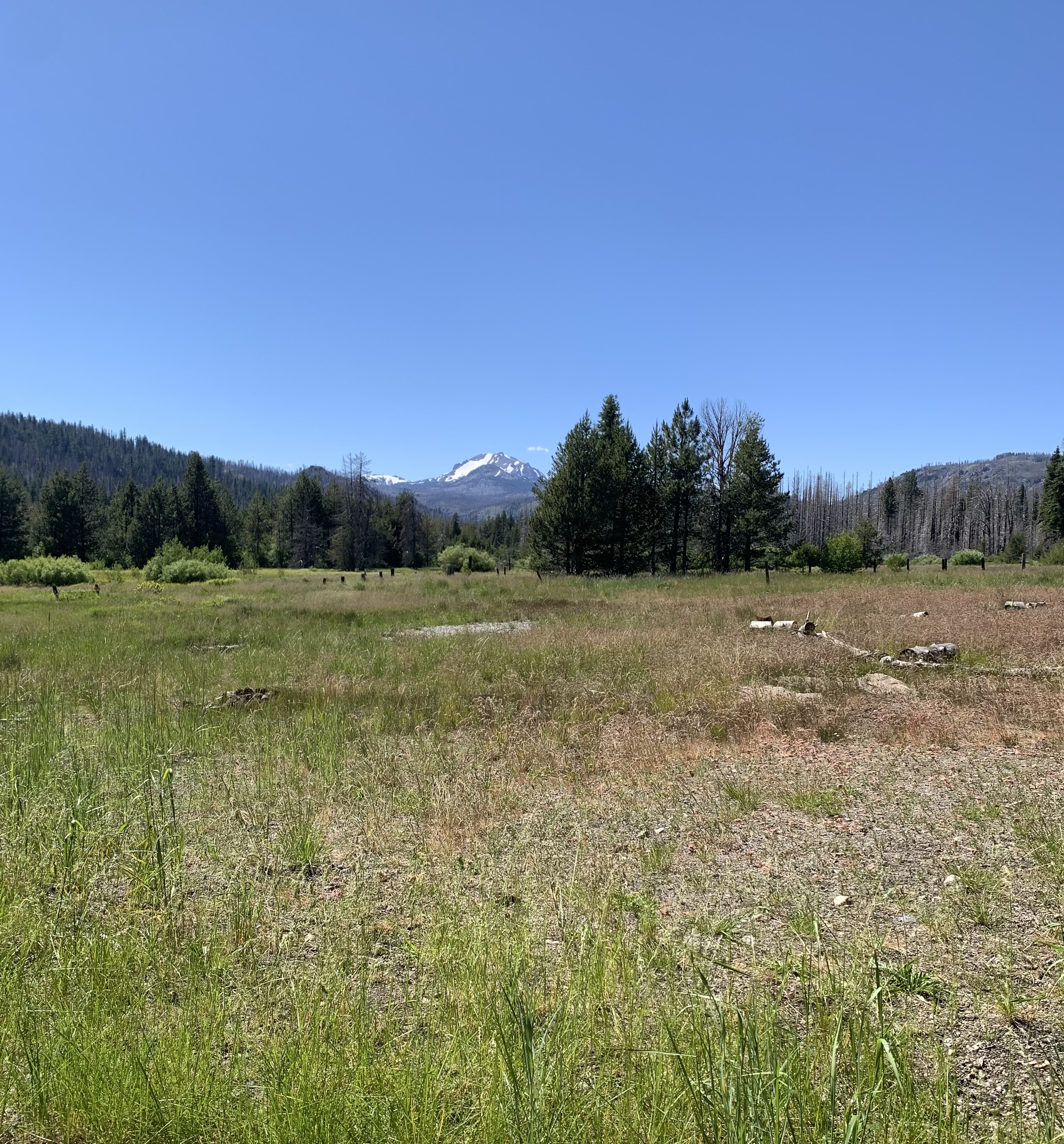
For many years now, the dry days of summer in Northern California surround me. Photo by Mary Elyn Bahlert, Mt. Shasta in the distance, from the Warner Valley, CA, 06/9/2026
Suzie called her “the hugger.” Yes, Auntie Irene – one of the extroverted Bahlert’s – loved to hug us when we arrived at her house on Old Lime Kiln Road in Baileys Harbor, Wisconsin. And she loved to hug us when we left. She was, indeed, “the hugger.” Like my dad, Frank Bahlert, Auntie Irene talked fast and kept on talking, no matter what. And she would cry sometimes, too. Her emotions came easily to her, and they couldn’t be kept quiet. It wasn’t quiet with Auntie Irene around.
When Dad had his two weeks off from the steel mill each summer, we’d drive up to Door County – 200 miles north of Milwaukee, a peninsula bordered by Lake Michigan on the East and Green Bay on the West – and spend a week.
Sometimes we stayed in a rented cabin, rented from the Kellstrom’s of Sister Bay, and sometimes we’d stay with my Uncle Fritz, Aunt Goldie, Bobbie and Susie. For several years, they lived on a farm East of Sister Bay, where they kept pigs. After a long day at the shipyards in Sturgeon Bay, Uncle Fritz, my Dad’s younger brother, would collect garbage from restaurants along the highway to feed the pigs. The fastest I ever rode in a vehicle – a small truck – was with Uncle Fritz. My cousin Bobbie in the middle, me on the passenger side, and Uncle Fritz at the wheel, he sped up to 100 miles per hour. I think I was too young to consider what could have happened at that speed – and without seatbelts. Uncle Fritz was one of the quiet Bahlert’s, like my Auntie Edna, Uncle Clarence, Uncle Ray, and my cousin Terry, Ray’s daughter.
Auntie Irene, like my Dad, was a talker – as well as a hugger. After college and after I had been hired as a Claims Representative in the Social Security Office in Green Bay, Wisconsin, I’d sometimes stay the weekend with Auntie Irene and Uncle Erdreich – others called him “Peggy.” They had an upstairs to their house, an upstairs reached by a narrow stairway built into the wall. I’d stay alone in one of the two rooms up that narrow passage, looking up from my bed at the trees that pressed against the windows as the wind blew. Food was always plentiful at Irene and Erdreich’s house. Auntie Irene would bring out dish after dish of good food, filling the table with her cooking along with her non-stop talking.
I liked to introduce friends to my family in Door County. Friends were always welcome. One day, I invited a friend who worked with me at the Social Security Office in Green Bay. We headed to Door County on Friday night. After we’d met Auntie Irene and Uncle Erdreich, Becky and I headed out for some adventure of our own. Becky surprised me as we pulled out of the driveway and onto the highway: “there’s no excuse for someone to be like that,” she said. My feelings about Auntie Irene did not change with her comment, but my feelings about Becky did. I had no excuse to be a friend of someone who judged these loving, kind folks so harshly.
Another friend traveled with me from California to Wisconsin, many years later. We, too, made the pilgrimage to Door County. In her way, Bonnie told me, “I’ve never met people like this before.” Together with my mother, Bonnie and I climbed the narrow steps to that simple upstairs room and stayed the night. We were recipients of a kind and gentle hospitality.
When I took my husband Jeff up to meet the Door County folks for the first time, his kind and open manner made him welcome from the start. He loved to meet the family I loved so dearly, and they welcomed him with kindness. Jeff gets excited about a lot of things – which is fun (but can be exhausting). Together with Auntie Edna and Uncle Werner, Auntie Irene and Uncle Erdreich, we went to take a look at the cabin that Werner used to house seasonal workers who came from the city to pick cherries every summer in his orchard. We walked through tall grass to the frame house, following one another on a narrow path. As we approached the house, Jeff was saying: “this is great! “
Behind me as we walked along the narrow path to the house, I heard Auntie Irene say, under her breath: “I feel sorry for Mary Elyn.” I can still hear her voice, saying out loud only to herself what she was really thinking…
I was hospitalized in the summer of 1996. Before Jeff and I had made the trip back to Wisconsin, I’d written a note to my beloved Auntie Irene, who was ill and in a care home. “Wait for me,” I’d written. When Jeff and I and my mother made it to Door County, Irene had already passed. I sat with the others in the narrow wooden pews of the Evangelical Lutheran Church. After the funeral, I stood on the steps of the church, looking over the heads of my Bahlert cousins, some of whom I had not seen for many years. I remembered what I’d written in my note to Auntie Irene. Auntie Irene had waited. And I had returned, just in time, as it turned out.