Saks is in the news this week. Apparently the company’s business – like so many other businesses, has suffered losses because of the use of online companies taking over the way we shop. I can’t remember when I learned about Saks Fifth Avenue for the first time in my life, but I expect that by the time I was in high school, I knew that my family were not people who would shop at Saks. We were Sears and Roebuck people. Saks did not have a store in Milwaukee, but when I took trips to the Loop in Chicago in my twenties, I was aware of Saks. Like my family, I didn’t shop at Saks.
But my mother shopped at Saks. On one of her trips to California to visit Jeff and me, I took Mom into San Francisco for an afternoon together. We walked around Union Square, happy to be together and to take in the City – the diversity of people, the busy streets. We had lunch at a cafe before we headed back to the BART station to catch our train back to the East Bay. But before we walked to the BART station, we separated for a time – at Mom’s request. She was on a mission.
Mom had a special gift in mind when we separated, although I didn’t know that. We parted ways for a time so that she could do her shopping while I nosed around the Square, looking at the people, looking at the store windows. I always love a new city, and San Francisco was on my long list of new cities I have visited over the course of my life.
When I met Mom at the appointed place and time, she was standing outside of Saks, looking at the people who passed her on the street. Like me, Mom loved the diversity of people she saw wherever she went. In San Francisco, she encountered people who brought a different kind of diversity than she was accustomed to in Milwaukee. And when I met Mom at the appointed place and time, she was standing, looking with interest at the passersby. She had a small bag – “Saks Fifth Avenue” stamped in elegant letters on the front, in her hand. She held the small bag close to her body.
Later that day, Mom handed me the little bag that held something special from Saks. When I opened the bag, I found a small bottle of Chanel No. 5. A gift for me.
That bottle of Chanel No. 5 was more than a gift. That bottle of Chanel No. 5 was a dream, a dream my mother held in her heart for me. She wanted me to have a life she could not have imagined, the life she did not have. She dreamed a life for me, and maybe it was in that bag, too. Maybe my life is even bigger than the dream Mom held. I will not ever know for sure.
*
Still holding on to my mother’s dreams for me, with help from St. Brigid on St. Brigid’s Eve. photo by Mary Elyn Bahlert, 2/1/2026
I grew up in the city – Milwaukee, Wisconsin, specifically, the North Side of Milwaukee. I expect my love of cities began there. I have many memories of riding city busses in Milwaukee, beginning when I was little, in the company of my mother. I thought all cities were like Milwaukee, its streets set out on a grid, making it easy to follow house numbers. That made it easy to figure out where friends lived, from the time I was little and walked those three city blocks from my house – we always lived in rented upper flats, a family in the flat below us, a full basement even further down, and a full attic. And I expect my love of that place has shaped my love as an adult, as my world has grown – and grown – and I’ve been privileged to travel, both in the United States and in cities around the world – I expect my love of the place I am from has shaped my love of cities in other places.
“You learn something new every day,” was a maxim my mother lived by, and that she bequeathed to me. Cities are a only one way to learn something new every day, of course, but cities provide strong evidence of cultures beyond the one in which I grew to adulthood.
I prefer large cities. I proved that to myself when, after receiving training as a Claims Representative for Social Security in Minneapolis for three months in early 1973, I was sent to work at the Social Security Office in Green Bay, Wisconsin. I lived in Green Bay for almost three years before I transferred back to Milwaukee in my government position.
As a United Methodist pastor, I was sent as a pastor to places I might not have chosen on my own, but which I came to love. And I was grateful to have spent most of my ministry in large cities. “A city girl in a city church,” Jeff said in his remarks at my retirement from a church in downtown Oakland where I had pastored for 16 years.
My travels outside of Milwaukee had started during my college years. One spring break, my mother gave me the $200.00 for a week trip to New York City. I was in love! And what you can find in New York City! Vicki, who had traveled with me and was my roommate, and I had second row tickets to see “Hair” on Broadway when “Hair” was all the rage. We found our way to out of the way delis for lunch, We walked and we looked at everything with all the joy of young women whose world was opening up – even if we didn’t know it then. We made mistakes; one evening, as dark was coming on, we hailed a cab whose driver told us that “you girls shouldn’t be walking in this neighborhood” as he delivered us safely to the street outside our hotel.
* Many years later, in 1988, I traveled to the then USSR – during the times of Gorbachev, when the country was beginning to open up. Communism was still in full effect, and our large group of faith leaders from the U.S. who were traveling to honor the 1,000th anniversary of the Orthodox Church, were divided into smaller groups upon arrival in the USSR, for the duration of our journey. Itineraries in each group were different. As often as I could during our stay, I walked with my roommate: in the streets of Leningrad, Moscow, Kiev, and Odessa. I took the subway – the same system as BART in the Bay Area – in Moscow. I looked at the people as I passed them on the streets. In Kiev I carefully looked at the people who passed me as I walked, looking for the eyes, the bearing, the faces of my people. I found them there. I experienced some of the government control of the people when a citizen of the USSR who sat in the seat beside me on a plane, told me that the people were not allowed to travel outside the USSR, and when a small group of fellow travelers and I met to talk about our next outing in the hall of a hotel, we were told to disband our group by an employee of the hotel.
*
Over the years, I’ve traveled to many of the great cities of the world. I have not ever forgotten the privilege my life has been, how I’ve seen places that even my mother could not dream of seeing. Part of my travels is the simple joy of walking and watching, and I’ve done so in Paris, London, Washington, D.C., Seoul, Berlin, Dublin, Minneapolis, Chicago,Istanbul, San Francisco. There are many others. Each city has its particular feel, its own personality. Each city is beautiful, in its own way. Like the stamps on the pages of my passport, each city has left its own mark in my heart. I hope to be a guest in other cities in the next few years.
I’m grateful for the privilege that has brought me to this place, and to this reflection, to this time of easy days and remembering. And to the ancestors who traveled from their own places to bring me to this life, to this place.
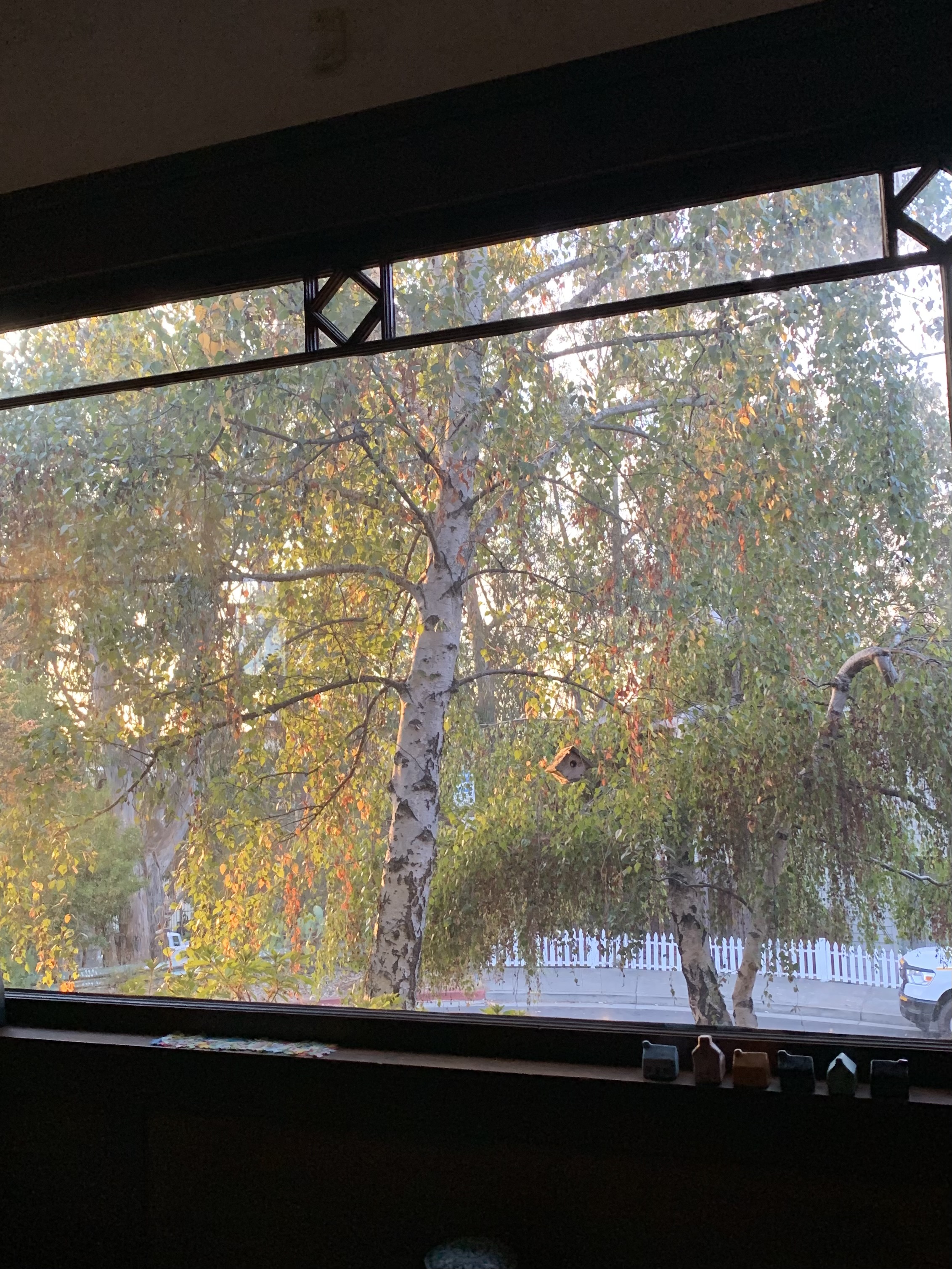
From the kitchen window of our home in Oakland, I can see through the trees in our yard, I can see across the Bay, the sky and the skyline of San Francisco, as if it is framed by the trees. Each evening at sunset, the colors over the City are different. Sometimes the City sits beneath a pink sky, sometimes it is invisible through the fog that falls over San Francisco Bay, sometimes white clouds float over a blue and gray sky. From my own city – Oakland – I see that other great City. This place suits me. The sky, the sunset, the view through the trees, they all seem to agree.
Coming into Oakland from San Francisco on the Bay Ferry, photo by Mary Elyn Bahlert, 1/2026
Summers in Wisconsin can be thick with humidity, languid – enough to suck the air out of you. I was about 13, on summer vacation from Junior High School. I was free of schedules and homework and the hard work of fitting in that takes place at that age. I wasn’t lonely – or was I? Maybe I was lonely in my family, the family beginning to itch against my skin, against my blossoming mind, against my teenage years. I was beginning to argue with Mom, who had her own controlling way of being a mother.
But I was free in my own mind. When I wasn’t reading or riding my bicycle all over the north side of Milwaukee, the long summer days stretched ahead of me. The days stretched ahead of me until they didn’t, and I had to begin another awkward school year in my classes with the smart kids. I had long, sunny, humid afternoons to myself – often.
The upper flat on Medford Avenue had varnished wooden doors and window frames. A small room faced the street and led to the front porch, where I could get a sun tan, where I could lie in the sun, slathered with lotion, reading a book. Sometimes I was alone in the small room, the screen door keeping the creatures of a humid climate outside. Across from the door to the porch was an old, old stuffed chair. I’d sit in that chair, reading, reading, reading. Sometimes, I’d curl up in a ball on the chair, my back to the screen door. I’d day dream.
I had a recurring day dream, a day dream that startles me and fills me with wonder now, all these years later. I was on a journey. The journey began at the front of the porch, facing the street. There, I would step into a moving, escalator-like contraption – vehicle (?) and find a seat with big windows that allowed me to see everything below. My ride took me from that front porch, and it headed west. The moving vehicle with comfortable seats took me clear over the Rocky mountains, across deserts and green farmland, across the Sierra mountains, to a house in South San Francisco, California. I ended my journey at 313 Alta Mesa Drive, South San Francisco.
That was the address of one of my favorite uncles, Uncle Pete, and my cousin Michelle, a few years older than me. I had never been much further west than Madison, Wisconsin. I didn’t know Michelle – I was little when she and Aunt Athalie and Uncle Pete had last been to Milwaukee – but she was the older girl I aspired to be – pretty, wearing the latest trends. She had boyfriends (I was sure of that). I admired Michelle long-distance.
*
After I graduated from high school and university, my world grew, in many ways. I traveled with friends when I could. I had my own apartment. I was lonely, but I was putting my life together, step by step. I had a successful career, first with the Social Security Administration, and then in the Food and Drug Administration. A year after I began work at FDA as a Public Affairs Officer for the State of Wisconsin, I finally took the step to enter seminary. Becoming a pastor was a dream that had taken hold in me during my college years, and it took me a few years to turn toward to that dream. After all, I had not seen or heard of a woman minister – although they did exist – outside my circle of experience.
In 1984, I graduated from seminary at the Pacific School of Religion in Berkeley. That spring, I married Jeff Kunkel. I began my service as a pastor by commuting from Pleasanton, California to downtown San Jose. Then I worked with Jeff in two churches – one in Pleasanton, California, and another for two years in Tracy, outside the Bay Area. As one-half of a clergy couple, I seemed to be the one that the Bishop couldn’t quite satisfy. So I took a leave of absence, and I tried my hand at career counseling, working in a small business with a good friend from seminary.
We were living by then in the parsonage at San Leandro. Jeff came home from church one day in the spring and announced that he was going to take a sabbatical year, to begin July 1, 1995. I was stunned. We made a quick visit to his Superintendent, Nadine de Witt. Nadine had followed me as a pastor in San Jose, and when we met, she told me that the people there had spoken highly of me. Although most church appointments had already been filled, she’d do what she could.
Jeff and I found a flat to rent in Oakland – that was when we first moved to Oakland, where we have our home – and Nadine called with news that there was one small church appointment open. I had an appointment the next week at Aldersgate United Methodist Church in South San Francisco, California.
Some stories in life are too strange to be true. We say: “strange but true.” That little church was in a neighborhood in South San Francisco. Jeff went with me to the appointment with the Pastor Parish Relations Committee that spring, and on July 1, I started as a part time pastor at Aldersgate.
After World War II, that part of the peninsula south of San Francisco was developed, and the church was part of a community that had been built to serve the people in the homes that surrounded the church. The suburban community was filled small middle class homes built on curving streets that rose up the hills. In that suburban community was a small home, a home I’d thought about, years before: 313 Alta Mesa Drive.
I wonder now: did I dream that into being, or was I drawn into the dream? I’d like to know. Uncle Pete and Aunt Athalie are gone now, dead many years. During Covid, Jeff and I traveled to Riverside, California to be part of my beloved cousin Michelle’s memorial service. I’m retired, over 10 years. And I still wonder.
My cousin Michelle, with my cousin Dennis – cool teenagers
In March of 1973 I left Milwaukee for Minneapolis to be trained as a Claims Representative for the Social Security Administration. I lived in Minneapolis for three months until I was sent to my permanent station, the Green Bay District Office. At the time, I was happy to be sent to Green Bay; I had marked in my mind Rhinelander as the least happy assignment, and I had dodged that bullet.
And so I began my career in Federal Service. When I arrived at the office, I was the first woman to be assigned to that position in Green Bay; several months later Joanne Tlachac would return to the office after being promoted to CR from being a Service Rep. We immediately became friends, a friendship that continues to today. I was in training status for three years as I learned the ropes of government service, and as I adjusted to life in Green Bay. Finding my way around Green Bay proved easy for me; Green Bay is a small city that sits at the southern end of the Green Bay. I lived a few blocks from Lambeau Field, home of the Green Bay Packers; I’ve never been a football fan, and it seems my life in that small, cold city took the rest of whatever interest in the sport was in me away. I was often lonely in my small apartment in Ashwaubenon, but I made friends and explored that area of the State of Wisconsin while I lived there.
Google tells me that the first issue of Ms. Magazine was published in Spring of 1972. Later that year, I subscribed to the monthly magazine. In my lonely apartment I read each issue as it arrived – cover to cover. The rebirth of feminism in the 20th century had sparked something in me.
*
Some time later, the office of the SSA moved to a brand new building in Green Bay. That’s where we worked as my evenings were spent in my small apartment, reading and reading and raising my consciousness (I wish this description was in usage today). Feminists attribute the consciousness of white women as having been affected by the Civil Rights Movement of the 1960’s. A rebirth was occurring in many of us. I didn’t know it then, but I would be changed forever.
* Working at my desk in the Social Security office, interviewing claimants, adjudicating claims, I wasn’t aware of how women working as hard as men were underpaid. That was a fact that was entering my consciousness. In my position, I would reach journeyman status and have the same pay grade as the men I worked with. But something in me was coming to life. One day, a the slip of paper arrived on my desk again, several months after it had last landed there. On the paper were the names of all the women in the office, along with dates; every week, a woman was assigned to clean the break room on Friday afternoon.
Hmmmm…
I was ready. I waited for the next time that the paper with assignments would show up on my desk. I waited without saying anything to anyone else, including the woman who was the District Manager’s clerical worker. The paper originated with her and would end up on her desk after we’d all seen our date of service.
When the paper arrived on my desk, I picked it up without adding my initials, which would indicate my acknowledgment. I walked to the front of the office, to the desk that sat in front of the District Manager’s Office. I threw the paper on her desk and said: “I’m a CR. I have the same job as the men in the office. Unless their names are included in this list, until they are given assignments to clean the break room, my name doesn’t belong on this list.”
I walked back to my desk. I’d experienced a “feminist click,” that moment of what was called “consciousness raising.”
I wish I could say that the men in the Green Bay Social Security Office had their eyes opened with my small act of defiance. That didn’t happen. Instead, in negotiations with management (in which I did not participate… ahem…) it was ascertained that the woman who cleaned the office once a week would from now on also clean the break room on Friday afternoons.
I’ve always loved the Christmas season. I love the lights, I love unwrapping the ornaments from their paper shelters each year, I love the ritual of hanging each precious ornament on the tree. With the hanging of the ornaments come memories. Jeff and I remember where the oldest ornaments came from. We remember those we love so dearly who have been gone for many years. We tell each other, again each year, as if it was our first time decorating the tree with these colorful balls, the story of this ornament, the person who comes to mind as we hang another. We like the presence of the decorated tree in the room, the colored lights that circle the branches, lit for most of every day.
And then the day comes when the lights come down, and the window that looks over the street will be in view to us again. The day the lights come down must be the saddest day of the year. As each year passes, the decorated tree becomes more important to us. We’ve taken its presence in our lives for granted for a long time now, but as we see our friends’ and colleagues’ lives changing, we know our own are changing, too. There are fewer of these colorfully lit evenings ahead of us than are behind us. There are fewer precious holiday times when we enjoy so many friends at our table, when we play the Christmas carols again and again. Even in the mild climate of northern California, we manage as best we can to bring “cozy” into our house. The Christmas tree provides a sampling.
“And we’ll all sing hallelujah, at the turning of the year, and we’ll dance all day, in the old-fashioned way, ’tilthe shining star appear…” – Richard Thompson, “I Want to See the Bright Lights Tonight,” 1974.
Today is Epiphany, the festival of the Three Kings, a tale that is central to the Christmas story. My mother called this day “Russian Christmas,” her way of acknowledging the Orthodox celebration that follows our own holiday by two weeks. When I was young, my mother didn’t begin to take down the ornaments and the tinsel, the “icing” on the tree until Epiphany.
By the calendar, the days are already beginning to lengthen, and the celebration of Christmas marks that return to the longer days. We’ve begun to light the colored lights on the tree less, and tomorrow, we’ll take the ornaments off the tree, one by one, carefully covering each one with tissue and placing it gently in its storage box. Even the storage boxes and the tissue papers are old, having seen many Christmases past.
Just as we have seen many Christmases past, and passing.
And tomorrow, the tree will be gone. photo by Mary Elyn Bahlert, 1/6/2026