I will be the gladdest thing Under the sun! I will touch a hundred flowers And not pick one. — “Afternoon on a Hill,” Edna St. Vincent Millay
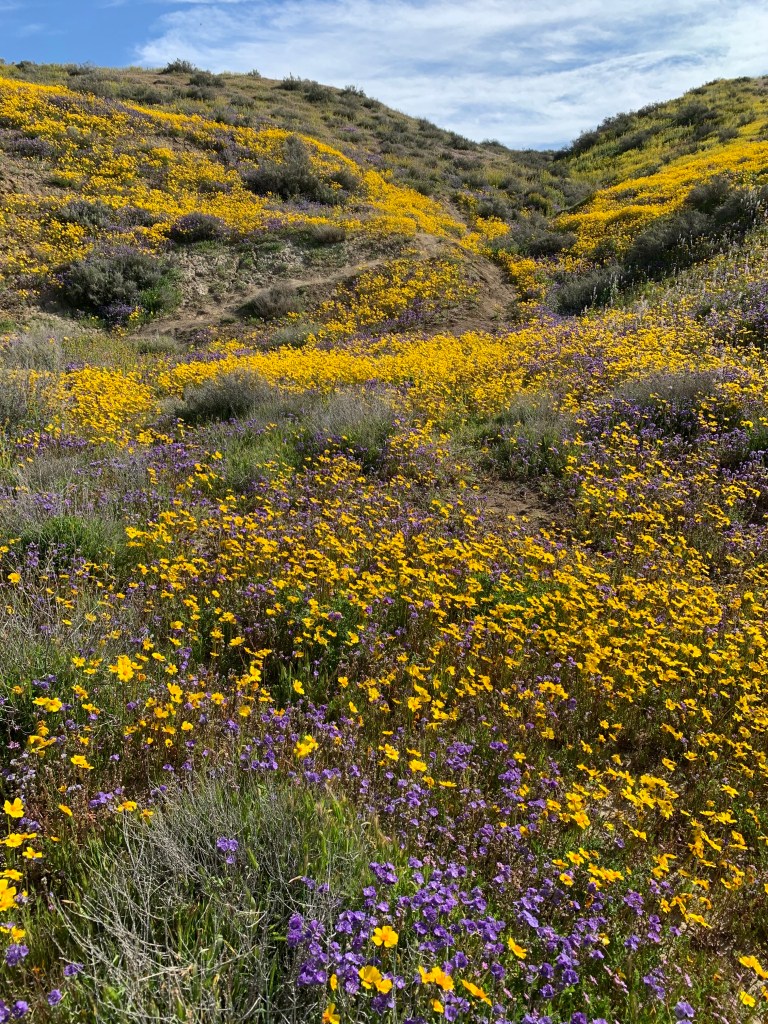
For a couple of days – for a few hours this week – my husband and I and two good friends were, indeed, “the gladdest thing under the sun!” We drove and we hiked up hills and we walked among the hills at Carrizo Plain National Monument in South Central California. The long drive was worth it!
Enjoy this tiny sliver of the beauty that was ours to savor, to enjoy, just for a time:
Carrizo Plain National Monument, photo by Mary Elyn Bahlert, April 11, 2023
Mom was diagnosed with cancer early in December of 2000. We took her home from the doctor’s office, Jeff and Mom and I silent as we made our way from his office to the elevator. We had all agreed to hospice care. When we took her back home to Mathilda Brown Home, the staff went into full gear as we all received an explanation about what hospice would entail. Jeff and I were grateful that Mom could stay in her little room, in the place she loved.
I visited daily then, and most days, I’d find Mom in her room, sitting in her chair, crowded next to her bed, or lying on the bed, resting. One day when I arrived, I found her on a wooden chair in the hallway, her bathrobe over a nightgown. She’d forgotten to change that day, so we went into her room and chose clothes more suitable for the day. “ I must be losing it!” she said. Another day, Mom was sitting on the edge of her bed, facing the window that overlooked an alley and the playground of Oakland Tech. When I came into the room, Mom said, without turning her head: “ I wish it would snow once, just for me.”
I wished it would snow, then, too. As tough as winter can be in the Midwest, we Midwesterners love its beauty, those days when the snow falls silently and without a wind to rustle it, to the earth. That winter, in the days before Mom died in mid February, weather reports on local radio announced that there had been a sprinkling of snow high on the hills over Oakland. I wished I’d been able to take Mom to see it, but by then, she was confined to bed.
When I’m talking to friends about our families, how we grew up, where we were from, about our siblings and our education, many of my friends refer to their parents in “formal” ways. I hear them speak about their “Mother,” and their “Father,” as opposed to how I refer to my parents: Mom and Dad.
Dad was an old school guy. Educated to the eighth grade in country schools, he was a worker. He was strong and he loved to work. When I describe him now, I say that he spoke in a dialect that is common to the northeastern part of the State of Wisconsin. When I travel to Door County now – a pilgrimage I like to take every year or so – I hear other folks who speak in the same dialect, even in my generation.
Dad was a Steelworker, a proud union man, proud of his strength and his long seniority at A.O. Smith Corporation in Milwaukee. The site of A.O. Smith remains to this time, but the place has changed names. Last Christmas, I received a large black coffee mug from my sister in Hawaii; across the sides of the mug, in big white letters: “AO Smith.” Most days, I use it now to have my morning coffee.
Dad was an old school guy, and in that era – I grew up in the 50’s and 60’s – that meant that he went to work and Mom stayed home to take care of the house – the flat – to cook, to tend to the children. Dad loved us, and he loved my mother. When I think about that now, those facts form a certain framework around my child, which like most childhood’s, had its share of losses, of sadnesses, of things lacking, even with my parents. In my middle years I had to take those relationships – mother to me, father to me, siblings to me – apart in therapy, but I came away with the love intact. I’m grateful.
When Dad retired at the age of 65, he left behind forty years of hard work as an inspector in a steel factory. He had been grateful to return to work after he suffered a heart attack in his early 60’s, and he credited his doctor with giving him that gift; Dad loved his work, hard as it was. When he’d been retired for several years, he told me that he still dreamt about his work at A.O. Smith from time to time.
Dad was an old school, hard-working laborer, and he loved us. His love and his pride for his family shone in his eyes – one blue, one brown. He loved to laugh, to share something fun with us. For all I lacked in childhood, love was not among the lack. He loved to talk – an extravert in a home of introverts.
A few years after Dad retired, I was living on my own on the other side of Milwaukee. Mom was away for the day and evening, and Dad invited me to dinner. He talked and talked as he and I sat in the kitchen, waiting for the chicken he had baking in the oven. I saw how he’d set the table for the two of us, and for the only time I remember, I sensed a formality about this invitation, about this dinner. For him – as it was for me – this was a special time.
A few weeks ago, I preached at a retirement center just out of the Bay Area. When the worship service was over, a man in a wheelchair came up to me to say a few words, to introduce himself and to thank me for being there that day. He had some thoughtful comments to say about my sermon, and then he surprised me by saying: “You did a lot of research to preach that sermon. You must come from a family of researchers.” Surprised, I simply told him that I was the first in my family to receive an education. I felt proud.
I love to be aware of the changing light as each season gives way to the next: spring to summer, summer to autumn, autumn to winter. Sometimes now, as I grow older, I note the times of sunrise and sunset in my calendar, watching one season gently curve into the next season.
It’s not a coincidence that the date of Christmas follows closely on the heels of the winter solstice. Through the ages, people have observed the changing seasons, the days with darkness fast on their heels, coming before it’s time for dinner. When I was younger and not conscious of how quickly one season rolls into the next, -and how unrelenting the changing of light was/is, I complained as I left work at 4:30 in the afternoon, the sky already in nighttime darkness. Night falls early in northern climates. It takes the strong spirit of a human being to hold on to hope when darkness is the longest part of each day. No wonder the ancient people honoured the darkest days. No wonder they lit fires, bringing warmth to the darkness. No wonder our ancestors danced in the darkness, dancing to remind the light to return!
No wonder that people of different faiths honor this time of darkness, before the Light comes!
Thankfully, each cycle of the year continues to roll in a circular fashion, bringing us back to the time of darkness, not stopping, but rolling on, the end of this year, the beginning of the next.
As Christians, we honor this season of darkness by telling the story of the Child, born into a dark world to bring Light to wounded hearts. We tell the story again and again, because, like human beings of all times and places – we need to be reminded. We hold on to hope, the promise of the child whose life lays before them, and in that way, we hold on to hope for ourselves. In a Season of darkness, we come with our begging bowls, begging for Light.
Merry Christmas!
Reflections at Sunset, 12/2022, photo by Mary Elyn Bahlert
In “Fiddler on the Roof,” there is a heart-wrenching scene of the Jewish people of the village Anetevka being forced to leave their beloved village, their home, during the Russian pogroms (massacre or persecution instigated by the government or by the ruling class against a minority group, particularly Jews). The people are packing the few belongings they can carry, along with animals, onto carts and make-shift vehicles. What to take? What can they leave behind? They will leave behind that place they loved – we all love our homes, don’t we? – not only the home, but the place, the land, the sight of light on those trees, the fragrance in spring – and walk away to where? Can somewhere else be home, surely? The tailor, a man with a young family, asks the Rabbi, then: “Rebbe, wouldn’t this be a good time for the Messiah to come?” The old Rabbi looks fully into his eyes and says: “We’ll just have to wait for him somewhere else.”
Wisdom, in the heart of tragedy, of horrific loss.
We wait for the Messiah these days, also, as the War on Ukraine – invaded by Russia – drives on, for many months. How long will the people suffer? We wait for the Messiah when we are ill, or when someone we love is ill, and there does not seem to be an end to it. We wait for the Messiah when the price of gas goes up an up and – up – and although it is expensive to us, it is too much for so many others. We wait for the Messiah to come into the lives of refugees fleeing from war in their own homeland or fleeing because there is no water in their land. Refugees who are walking now, today, this moment. They, too, must be waiting for someone to save them.
We wait for Someone – Something – to save us.
Deep Dusk, Oakland, 11/12/2022 – Mary Elyn Bahlert