They didn’t shake. Not one little bit. “The Shakers, officially known as the United Society of Believers in Christ’s Second Appearing, are a millenarian Christian sect founded in 1747 in England that later established communal utopian societies across the United States (wikipedia).”
And so Jeff and I – who were traveling in New England to visit the homes of American poets, Robert Frost, Edna St. Vincent Millay, and to see the very site of the very beginning of the Shakers, a religious group that originated in the United States – joined the Shakers in worship in Maine.
The simple worship, which we discovered after climbing the steep stairs in the main hall of the main building – we were not certain whether we had climbed the women’s stairs or the men’s stairs – had already started when we arrived at the Sabbathday Lake Shaker Village in Maine. The large building we entered was quiet, and we made our way up the stairs into the place of worship. Jeff and I found two chairs on the left side of the room, a room where almost 30 people were already gathered. We sat for a few moments, until a woman in the row of seats directly in front of us motioned with her head – a bob, and eyes meaningfully cast across the room – for Jeff to sit with the men, whose chairs sat facing the women’s section, across a space of about 15 feet. Finally, we got the message, and Jeff moved to the men’s section of worship.
We sang several hymns as we gathered there, hymns from a book of songs called: Original Shaker Music. A man who apparently was the leader – at least the leader of that particular worship service – sat in a chair at the front of the room and said a few words. I would call his speaking a sermon, or homily, although I’m not certain that is what his message is called among the Shakers.
After worship, we joined the gathered group of folks – men and women – in a large attached hall, for coffee hour. There, we enjoyed coffee fellowship with conversation, although not with anyone who appeared to be a real life Shaker. A few of the folks who stayed for coffee apparently joined the Shakers in worship every Sunday.
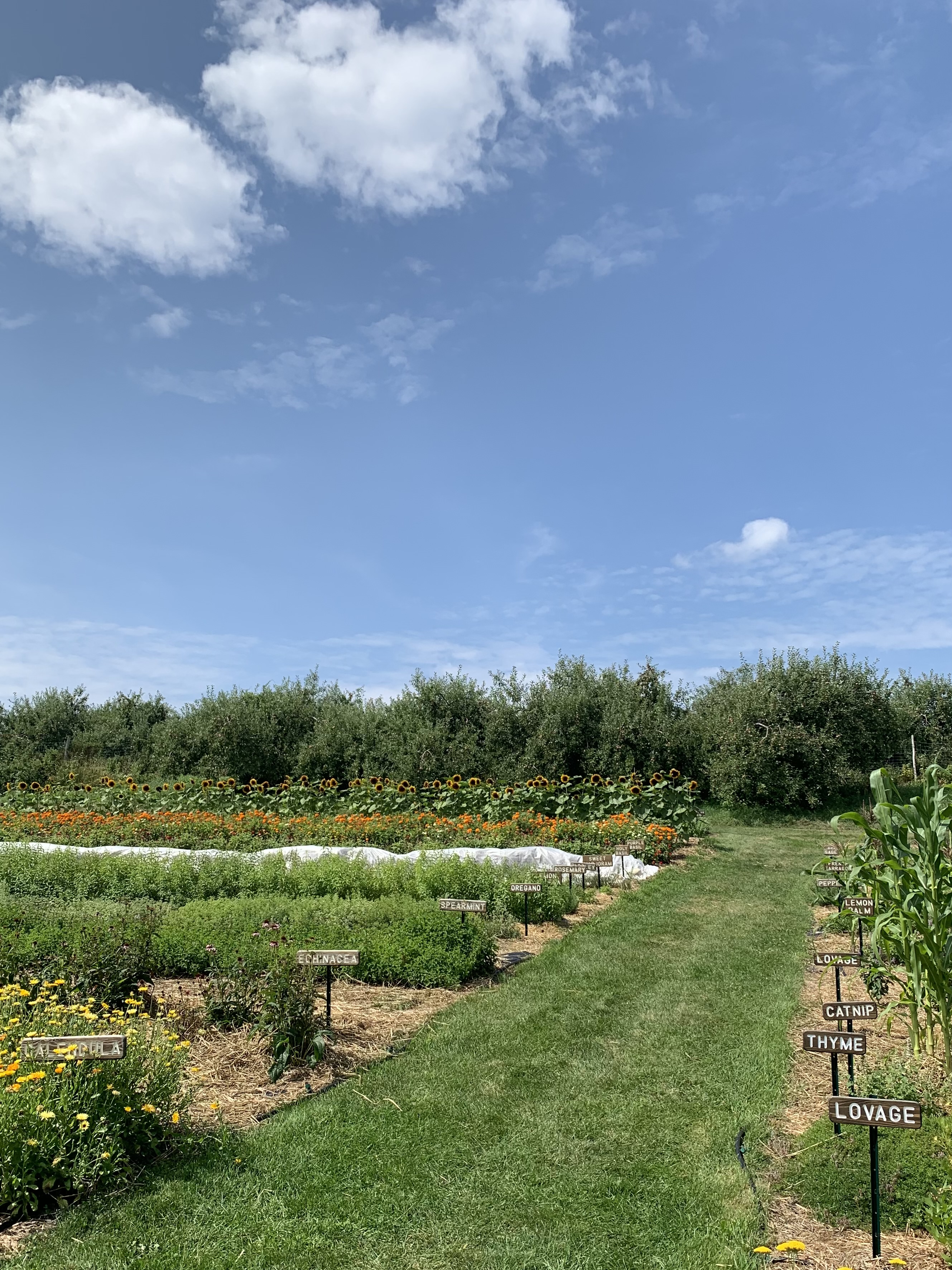
Later, we walked across the road and walked along the carefully laid rows of the summer garden. Everything in sight was beautiful, perfect. There may be as few as three Shakers in the community now. Like all denominations, their days of thriving worship are long behind them. It was Sunday, after all, and there were no workers in the garden.
We went to the car and drove away.
Shaker garden, New Gloucester, Maine, 8/16/2026, photo by Mary Elyn Bahlert
From the time I was little, I loved to go to Door County. I was lucky – my Dad (I called him FRB, a nickname that stuck with the whole family) had grown up in Door County – and I had aunts and uncles, favorite aunts and uncles, who still lived in the quiet country places of the Door Peninsula. I think of Door County as “my place” – the place I belong, the place I’m tied to. In these later years, I’ve still made the trip from California, flying to O’Hare Field and driving North into Wisconsin and further North Still, to the strip of land that is held by Green Bay on the West and Lake Michigan on the East. I tell people now that I know the “quiet” places in Door County, which is true; a favorite tourist destination now, many of the once small, quiet towns are hubs of activity all summer long and on autumn weekends.
I promised myself on a lonely drive alone from my little apartment in Green Bay along the Bay side of the peninsula, turning off at the junction of Highway 57 that follows the shoreline of Lake Michigan through Baileys Harbor and north, to connect again with Highway 42 in Sister Bay – “Sisters Bay,” in my father’s telling. It was 1974. I promised myself then, as I drove north toward the Peninsula, that I’d always return to Door County. I have. I’ve lived clear across the country in Northern California since the 1980’s, but I still return, as often as I can.
This week, Jeff and I were to be “lighthouse keepers” at the historic lighthouse – still in operation – along Highway 57, and now part of The Ridges Sanctuary, a ring of paths through the woods along the ancient, ancient shorelines of the Lake, shorelines where Lake Michigan has lapped ashore for all time. We had studied the written history of the lighthouse, in order to be prepared for whatever tourists might still come to the Peninsula in late October. We’d been ready to tell them about the history of the lighthouse, how it has been in use through many years, sometimes as a parsonage for the Lutheran Pastor at the Lutheran Church a few miles to the North.
I’d worshipped in that church more than once with my beloved Auntie Irene and her “Peggy,” Uncle Erdreich. They were old world people, from another time, Uncle Erdreich having grown up in a farmhouse less than a mile from the frame house surrounded by woods that he had built up over the years, putting his expertise as a carpenter to work in his own house. Auntie Irene, too, was from another time, an extraverted Bahlert, like my Dad, in a family that has its share of introverts. I’m one of them.
And so Jeff and I had prepared for the week in the lighthouse. I planned as I do for any trip: I thought daily about what I’d wear, what I’d need for the changing season we were sure to experience, making sure my long underwear was clean and ready to be packed. We prepared as we do for every trip, making plans for getting to the San Francisco airport for our flight to O’Hare Field, talking about our plans to stay overnight with long time friend, Joanne, and for our plans to spend a few nights in Shorewood with Randy and Michael before our return to California, to our home.
As the poet has written: “The best-laid schemes o’ mice an’ men / Gang aft agley.” (Robert Burns, “To a Mouse, 1785).
And so I’ve had a week – a week completely clear on my careful calendar – fall to me. I’ll be able to make it to my regular exercise class, and I can enjoy my neighborhood walks in these last days of a beautiful autumn in Northern California. Today was a car day: I had the oil changed and I had a car wash for my snazzy Ford Focus.
But I’ll miss my favorite place, the place I’m attached to, the place where I stand at the graves of the ancestors and talk to them. I’ll miss a week of autumn in the Midwest; the Midwest really knows how to do autumn. I’ll miss seeing so many people I love face to face instead of only hearing their voices over the phone.
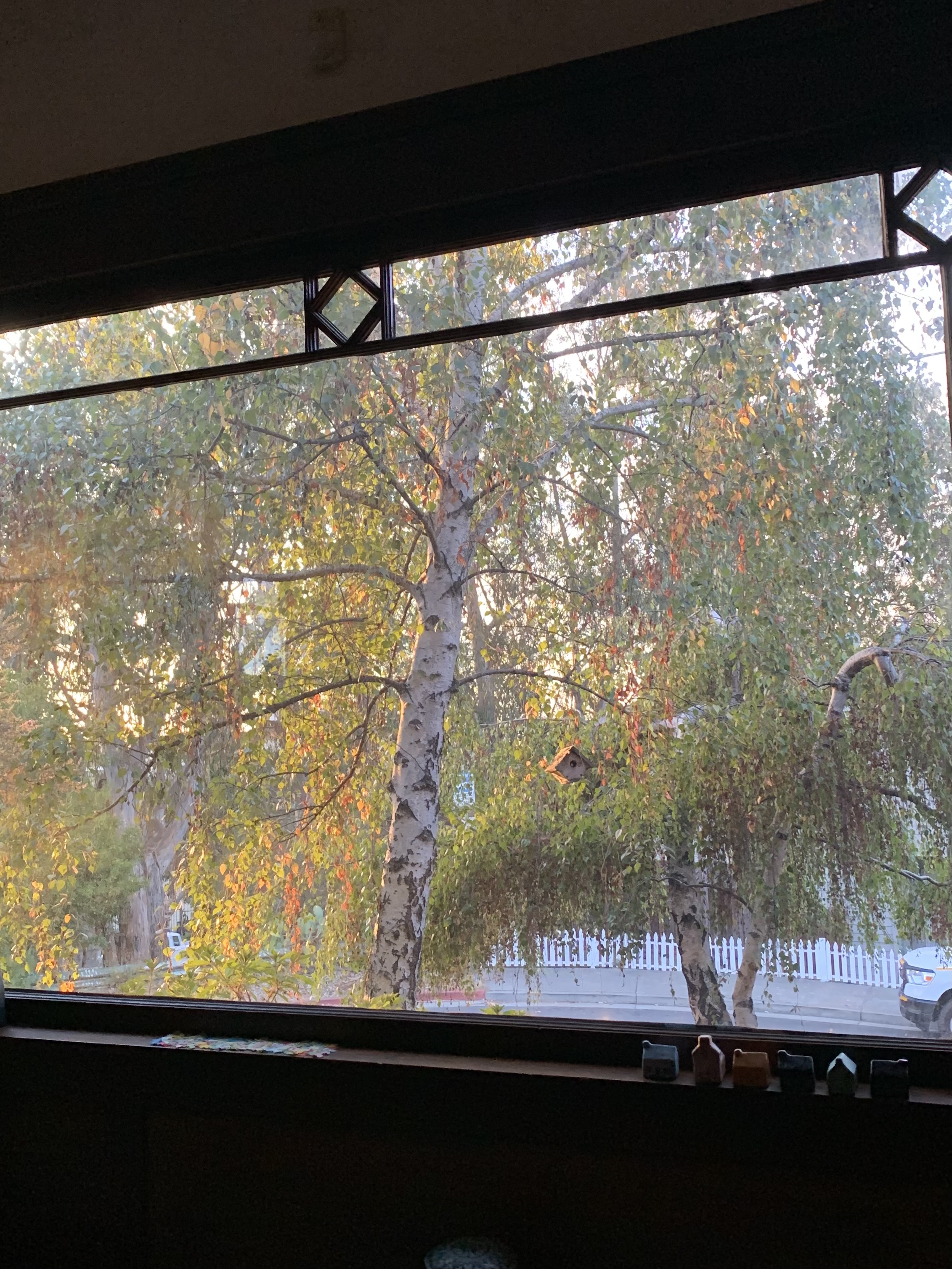
And I’ll take in autumn here in the Bay Area, its’ own kind of beauty, the changing light, the slow changing colors of the trees in this place.
Autumn sunset, Oakland, photo by Mary Elyn Bahlert, 10/19/2026
I’ve been a reader for many, many – many – years now, of course. And over the course of those years, I have also been a writer. I learned to write by reading the writing of others, I think. Words, and the sentences that hold words together, come easily to me. That particular gift allowed me to be a preacher, also. I loved reading and studying the scriptures, and over the years, I’d developed my own rhythm, a rhythm that formed the outline of my week for many years.
And I have written poetry since the days I watched my teachers carefully, studying their manners and idiosyncrasies carefully. I was a careful child, and I took that care to my studies. I faithfully memorized the poems of the great American poets in Miss Ross’ English class at Peckham Junior High School. Miss Ross gave me a great gift with her old-fashioned manner of teaching. I remember so little about her; she was an old-fashioned teacher who wore a navy blue, old-fashioned dress that was covered in little white dots, a dress that covered her knees, modestly. Was her name really Betsy Ross? I don’t know, although that’s the name I’ve carried with me all these years. I was sure she had her hair done at a beauty parlor every week. That’s how it looked to me, with my trained eye!
Every week, I studied a poet’s life and poems, and over the course of the semester I put together a book of my own, a three ringed folder with poems carefully written in my own hand, and pictures to visually bring the poems to life. I cut the pictures out of the pages of my mother’s women’s magazines. I wish I had those folders now. Those pages of poems were a treasure in my life.
The poems, the lives of the poets, the world that books and reading opened to me have been a priceless gift to my life.
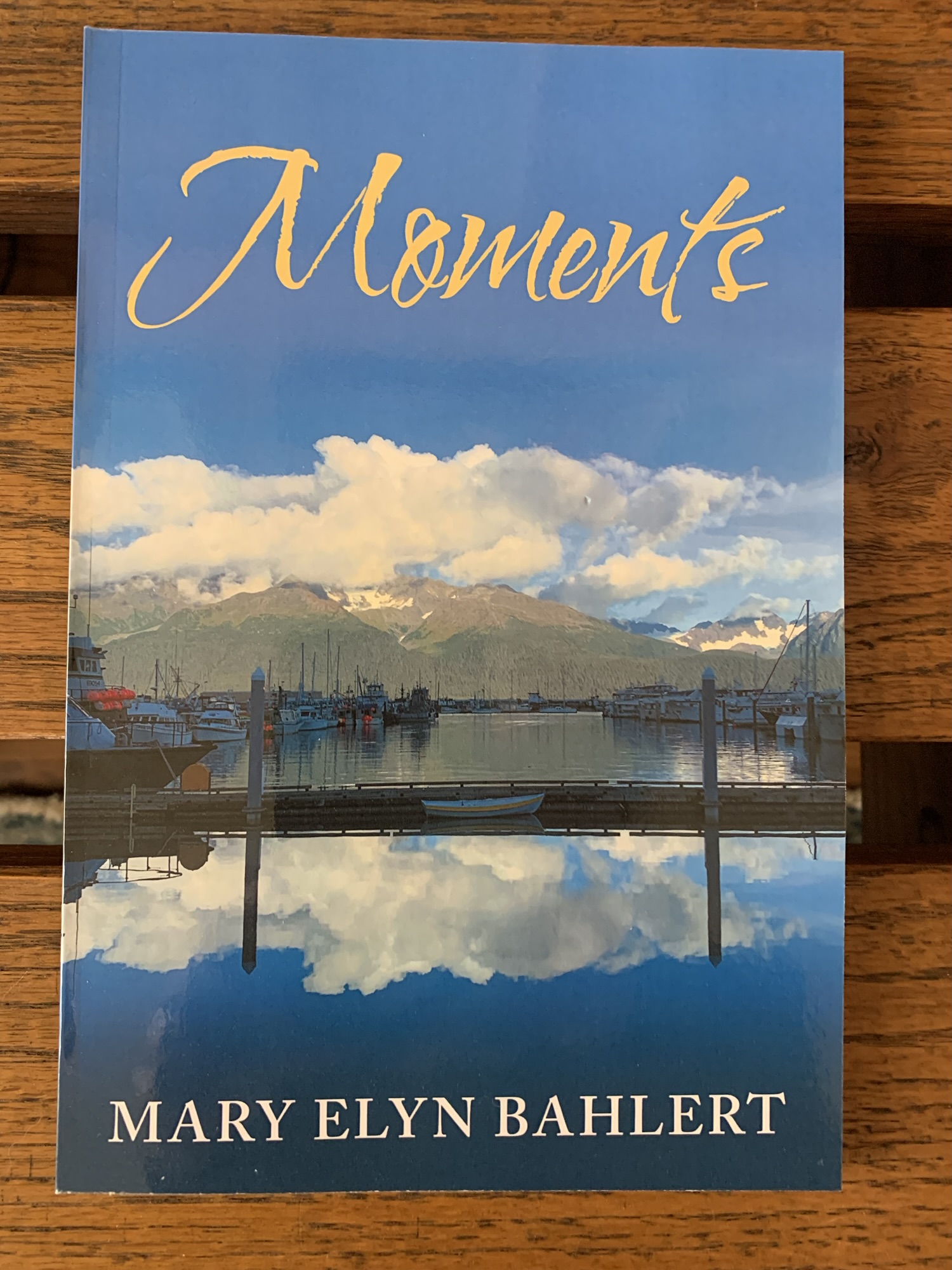
But the poems that I have written and collected – not carefully, but faithfully – have formed the book that my beloved husband, Jeff, encouraged me to have printed. I am a published poet now! That’s an identity I find I will have to grow into. Like the day Jeff’s first published book appeared at our house, he and I sat down and looked over the small printed volume of my own poetry, Moments (Balboa Press, 2026).
And I have survived my first reading! Carefully planned and executed, I read aloud to a group of other humans selected poems from my collection. The room – the Edwards Room at Lake Merritt United Methodist Church, the church where I had retired from as Pastor in 2014 after a 16 year stint (not bad for a Methodist!). There was a gathered group of people, mostly folks I know, a few I did not know. A woman I’d helped with a family matter a few years after my retirement joined the group. The pastor, Sunae, had made sure a flyer had been included in each Sunday’s bulletin.
And so, I am a published poet, and I am a poet who has survived a public reading. I am grateful. A gathering of friends, of beloved folks from many years in my life, colleagues, former parishioners, and even a man I did not know arrived to sit for an hour of poetry reading! So many of my poems, many written on scraps of paper and filed away in a manila file – these many years – were now properly printed and presented for public view. The pastor and a few faithful helpers set out a nice table of simple food for after the reading. A friend brought her dog and generously agreed to handle the selling of the books, of my book, which I signed for the waiting admirers.
And so I expect that a small part of me will have to take on a new – another – identity: published poet. I’m proud that a photo of mine graces the cover. I was delighted to see who showed up to hear me read, some folks I had forgotten would be interested at all.
Now, that day is in the past. I’ve had my collection of poems published – I’m a published poet now – and I’ve had a reading. I’m out there.
As a child, my family moved from rented upper flat to rented upper flat on the North Side of Milwaukee, every few years. We always lived in the upstairs flat. Because Milwaukee has cold, cold winters, each house had a full basement, usually divided in half, half reserved for the lower flat, and half reserved for the upper flat, each also boasting a coal furnace. Every winter morning, Daddy filled the furnace that heated our flat with coal, and stoked the flames as soon as he dressed, after the alarm which rang promptly at 6 AM, early enough for Mom to make his breakfast of bacon and eggs – every morning. I lay in bed until 7, when my little sister, Suzie, and I started our days at the kitchen table with a bowl of cold cereal. Then we walked the few blocks to school.
As a child, I knew the children in the neighborhood, those other children from working class families who walked the streets to school with me, who became my first playmates when the evenings were long, on the weekends, and during the hot, humid summers. I walked to school with those children, some who came from homes where another language was spoken at the table. Although Mom’s first language was Ukrainian, we all spoke English. Mom, Daddy, Ronn, me and Suzie.
What I don’t remember about the neighborhood is whether or not the neighbors were friendly. I don’t remember most of their names. Except for the children who lived within a block of our flat, my playmates in the summer time lived in the modest flats and modest single family homes that lined the streets for as far as I could see or could walk. My world grew a little when I became friends with Judy Hauser, whose family lived about a mile away, a house that her parents owned, and where her grandmother – who never spoke a word in my hearing – lived in the small upstairs of the bungalow, coming down to sit at the table with the family for lunch. Some Saturdays, I’d ride to Judy’s house to spend the day, or her dad would drop her at our house to spend the day with me. That’s how my world grew, inch by inch, block by block, school by school, buddy by buddy.
What I don’t remember about the neighborhood was whether or not we spoke to the neighbors we did not know, who walked those streets, who sat on the porches in the warm, humid evenings of the precious summers. I don’t remember if we even knew the names of all the neighbors. Of course we knew the names of the families on the next street whose kids were my playmates. It was Michelle Fralick who asked me one day as we walked to school: “are you Catholic?” I don’t know what I said to Michelle in answer to her question, but I know I asked Mom if I was Catholic when I got home from school that day. “No,” she said.
*
I suppose it’s because of those old Milwaukee neighborhoods that I love cities. The places I lived were modest places, and when I have the time to see them again, I take a look. I see the narrow streets. I see the streets, now more modest than they were then, some of the windows of those flats boarded up, some of the steps to the front porch broken, some of the strips of land that had been lawns now barren, brown, uncared for. Milwaukee is one of the cities who has suffered greatly from the racism that plagues the nation, that plagues the world. Milwaukee is a broken place in many ways, although it will always be my home.
“Feels like home to me…” (Randy Newman, “Feels Like Home”)
What I don’t remember is whether or not we greeted our neighbors. The cities I’ve lived in have changed – mightily – since those days of growing up. I love cities, love the city where I live now, and have lived for many years, and I love the cities of other places, of other lands, I’ve been privileged to see. This past spring, Jeff and I traveled to Japan for a trip with Overseas Adventure Travel. On the first morning after our arrival, as the group gathered to get a feel for our few days in Tokyo, I spent the morning alone, walking on the city streets. I was comfortable. I was happy. I enjoyed my time alone, to explore on foot the strange and wonderful new land I was privileged to visit.
But did we look at one another as we passed each other on the narrow sidewalks of Milwaukee in the 1950’s and 1960’s? Did we say hello to one another? Did we greet one another warmly, as neighbors? I don’t remember.
And so it is a small and wonderful joy to me when I walk in my neighborhood in Oakland now, and when someone looks at me – really looks at me – and when we say a few kind words to one another. One day, as I walked one of my well-worn routes to make sure I add to my tally of daily steps, I passed a short, gray haired old woman – she must have been my age, that is – and as I passed, she said a few words. More than a few words. She started a conversation. She told me she was new to the neighborhood, and since we passed one another on a street a few blocks from where Jeff and I lived, I don’t know where she lives. But I’ve looked for her ever since the day we passed one another, when I walk along that block. I think of her. I hope to see her again.
It’s good to see the same folks on my street, day after day. It’s good to hear voices sometimes, to see a dog out for a friendly walk on our street – on leash (of course). I know the names of some of the people I pass. And I often don’t know the name of someone I pass. Yesterday, as I walked up the last hill to my house along Pleasant Valley Avenue, the busy street that runs parallel to my own street, a young woman who I’ve seen once or twice came up to the curb to cross the Avenue. She turned to smile at me.
I’m old now. To her, I’m just another old woman. But maybe that’s why she smiled. I’m harmless, after all – I’m old now.
I hope to see her again. I’ll make sure to smile, to say hello. I hope we can make our own place just a little friendlier when we do.
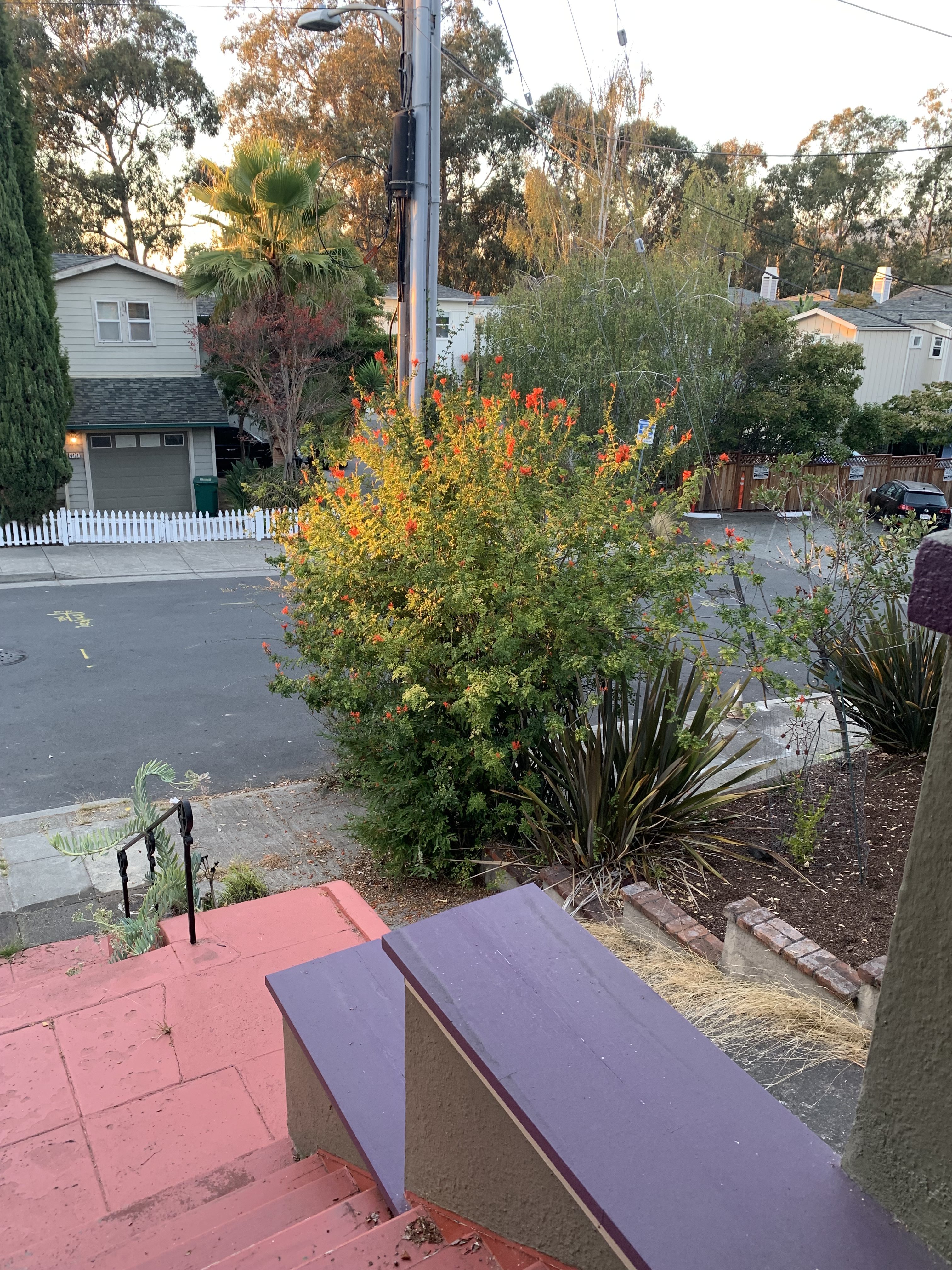
A fall sunset over our street. Photo by Mary Elyn Bahlert, 9/2026