Uncategorized

Aretha, Diane, Dolly, Gloria

I wasn’t on a first name basis with them, but each of these women – Aretha, Diane, Dolly, Gloria – were important to my life. Of course I knew their names. Even if they didn’t know mine.

My heart longs some times for those long, humid days of summer. I was in my college years, studying at University of Wisconsin-Milwaukee, on the East Side of Milwaukee. By some act of grace I had my parents’ car – a 1967 Chevy BelAir Coupe – for the day, as long as I showed up at the gate of A.O.Smith at 3:30 pm to pick up Dad from work. I had some money of my own – enough to pay tuition for each semester, enough to buy books, and my own room at home. Suzie had moved out early, getting married as soon as she graduated from high school. I had some money of my own, and time of my own, too.

Those were days of luxury, although I didn’t know it then. I was a few years off from graduating. I was free – in a way I would never be free again. After my summer class at the University, I’d take the long way home, driving south along the shore of Lake Michigan, WNOV playing “sweet soul music” on the radio, turned up, and me – singing along.

I loved that soul music. And I knew all the words. And a favorite of mine was Aretha Franklin. She’ll always be a favorite; sometimes when I’m working in the kitchen, I’ll prop my iPad up to the wall and play old albums. And I’ll sing along, just like I did on those languid summer days in Milwaukee. Aretha had been in my life forever – it seemed to me.

We were guests of my long time friend Joanne – I’d meet Joanne a few years later in the Social Security Office in Green Bay – when news came on tv that Aretha had died. “Oh…” I let out a small groan. I watched the news clips, Aretha’s familiar face and sweet soul music on the screen. Her death felt like a personal loss to me, a slice of my own story, my own journey, dying along with her. I had particular images of her in mind; I’d read that she arrived at each performance of her long career with her purse, which she placed on the top of the piano – to make sure she’d get paid. I won’t forget you, Aretha.

*

And there was Diane. I’d admired Diane Keaton since her breakout role in “The Godfather.” In my college years, I’d made a spring break trip to New York City, and my friend Vicki and I had second row seats to see “Hair” on Broadway. As part of the cast who threw off their clothes in the final scene of the production, Diane Keaton had come into public view – completely.

I kept up with Diane’s career. The Internet made that possible. I read about her private life; after a long life with various partners, she’d adopted two children of her own and she’d apparently taken to buying up real estate. Like so many admirers, I knew about these things.

I won’t forget you, either, Diane.

*

Dolly. Dolly Parton was admired – not only for her music, but for her big heart. To me, Dolly had a real, true presence. She never forgot where she had come from, from a poor family in the South, and a life she’d left behind when fame caught up with her. From time to time, I’ll watch her sing “Islands in the Stream” on youtube. Her glowing presence shows up, even years after she recorded the song. Her glowing, kind, generous, loving presence. I loved to read about Dolly’s life, how she gave books to kids who wouldn’t have a book. I watched again an interview with Barbara Walters, the differences between the two women visceral on the screen.

Dolly, Dolly, we miss you so.

*

Gloria. Gloria Steinem. From the time I purchased my first copy of Ms. Magazine while living in Green Bay, I’d known about Gloria and the others – the women who spoke up, the women who wrote, the women who lived their feminism. I admired them. I wanted to be them. In my own small way, I tried to leave my own imprint at work, where I worked among men who had not had a woman share their position, their rank, at work. Gloria’s work spoke to me. Her path opened the way for me – and millions of other women – to “raise their consciousness” – to become aware of the second-rate citizenship the women of the world lived – still live.

I knew then that my name would not change – ever – if/when I married. The idea that I’d have to have a partner who accepted that without question did not rise in me, although that’s the way life worked itself out.
Gloria’s work and Gloria’s voice gave me courage to face my life alone, to begin to trust myself, to see myself and other women in a new way. What I learned from Gloria’s modeling has never left me. I expect that how I live out my life has been shaped by Gloria and the others who had the courage to see things the way they were and to say: NO!

My own feminism is gentler now. I don’t know if Gloria’s feminism came to have a gentler edge. I expect that life’s unfolding brought something to her own journey, as it has to mine.

Thank you, Gloria. Thank you.

***

As I write, faces and feelings come to my mind about all the years that have passed since these women came into my life. And just like that – it seems – they are gone.

***

Uncategorized

Moving – again

I’ll always count the North Side of Milwaukee as my home. When folks ask where I’m from, I tell them: “Milwaukee.” And that was my home until I left Milwaukee to start my first job after college, when I trained in Minneapolis and was sent to Green Bay, Wisconsin as my first assignment in the Social Security Administration.

Now, when I return to Milwaukee for a visit to family or old friends, I skirt that part of the city, although I long to return again. I’d like drive down the streets I walked every morning on my way to school. But Milwaukee is a city that has suffered from its own racism, and after being deliberately bumped from behind in a rented car at a corner on the North Side, I don’t want to return again. I remember the days of Father Groppi marching from my neighborhood to the South Side of Milwaukee, across a viaduct, during civil rights days. Milwaukee was and is very racially segregated. The people have a right to be angry, but I no longer have a need to prove that I can do certain things.

Over the course of my childhood, my parents rented flats on the North Side. As an infant, I was taken home from Mercy Hospital to 9 and Juneau Avenue on the near north side, and over the years, we lived on many other streets – Ring Street, where I started school at La Follette Grade School, 2 short blocks away, 28 and Center, Medford Avenue at 26 street, which ran parallel to Fond du Lac Avenue, a major artery, and then a flat on 49 Street South of Burleigh, across the street from St. Joe’s Hospital School of Nursing. From there, I walked to Washington High School. And that’s where we lived when I graduated from High School and began university at University of Wisconsin-Milwaukee, on the East Side.

A city kid, I was familiar with buses and took them everywhere, until I got my driver’s license at 17. Then, I shared the Bel Air coupe with my parents – after Mom had driven Dad to work at A.O. Smith on Capital Drive – when I needed it to get to classes at UW-M.

When I was growing up in the 1950’s and 1960’s, the streets were still lined with majestic maple and elm trees until Dutch Elm disease cleared out the elms. And except for the months of winter, the trees met magically overhead across streets. For all its simplicity and even modesty, the streets were beautiful then. In the winter time, children – myself included – walked all the way to school along the top of snowbanks formed when city trucks shoveled the snow onto the narrow strip of concrete that marked the edge of the sidewalk. We’d climb the snowbank at the end of a block and walk clear along the top to the other end, which marked an alley or street.

But we moved a lot. I think it’s tough on a kid to move to another home, another school. And I think it was especially tough because my mother, who shouldered most of the responsibility for finding a place and for setting the move into motion, was anxious, always, about our safety. We always moved to a beautiful upper flat in a building that we called a “flat.” Another family lived below us; below the first floor was a full basement and above the upper flat was a full attic. Our flat was always beautiful because Mom preferred that the wooden frames around windows and doors not be painted over. And those flats – built some time after 1900 – had small rooms with a tiny inner hall with cupboards and where the doors to two bedrooms and the bathroom gathered together. We’d move when Mom had some beef with the landlord, the landlord, the person Daddy called, “Boss,” with a smile.

I shared a room with my little sister, Suzie, and until my brother Ronnie moved away to be married, and we always had a place with three bedrooms. Those old flats had a pantry with a window, cupboards on two sides. At Medford Avenue, the place had a lovely butler pantry.

We’d move when Mom was angry at the landlord for some reason, or we’d move when Mom wanted us to study at a different public school. In memory, it is always Mom who made the decision. I expect that’s accurate. Dad was a hard working, strong, union man, but he left the decisions to my mother. And if anyone could carry out what was needed, it was Mom. When Suzie was still in the stroller, I have a memory of walking in the neighborhood when Mom spotted a “for rent” sign on a house, and when she left me at the curb with my baby sister in her stroller. Mom marched angrily down the steps after the woman who answered the door spotted us waiting on the sidewalk and told Mom they didn’t rent to families with children.

I expect I felt a kind of shame at the simplicity, the poverty of those places. Once, walking to school with my friend Nancy, who lived down the street from me with her grandparents, on Medford Avenue, asked me why my parents rented their house. She had a way of saying things that are better left unsaid, I think. I don’t remember my answer, but I remember how I felt. I didn’t know the answer to her question. Now, I think that my parents had both grown up poor, although both were hard workers, and Dad was grateful to have landed a union job in the steel mill after the War. It would have been too big a stretch for them to own their own place. That was that.

In the summers, my family sat together on the front porch of our upper flat – wherever it was – after supper. Sometimes, Daddy would make popcorn, and we’d pass around the big round dish, taking big handfuls of the treat. As the sky grew dark, fireflies would pop into the night, and once or twice, a bat flew from the eves of the windows over the attic, into the night, and back again.

*
Was it hard on me, to move again and again as a child? I have never considered that. It was hard on me, I think, to see – to feel – the anxiety that filled the air that I breathed as a child. Like most kids, I didn’t know what I lacked, although as a child, I noticed the differences in social class of my teachers and the other kids, once I got to Junior High.

My long life has passed since I lived in those humble, crowded flats. Jeff and I own a beautiful Craftsman House in Oakland, a house that is the same vintage as those flats.

That’s where I am from.

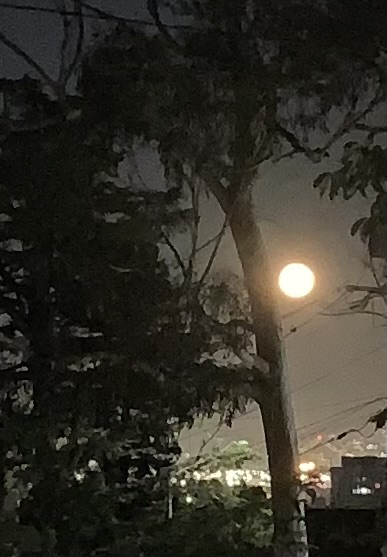
Sturgeon Moon over San Francisco,
August, 2026, photo by Mary Elyn Bahlert