Uncategorized

The day they died

Jeff and I were driving home from Sacramento on Saturday, March 21, 2009. I leaned over to turn on the radio in the car. There was a repeating news story from Oakland – where we were headed, and where I was pastor of a downtown church -being broadcast on the news, details changing and being added as more information came to the broadcasters. Four Oakland police officers had been shot by one young man that afternoon. Two were motorcycle police officers, two were members of the SWAT team that had gone to the home of the suspect and were murdered by the suspect as they climbed the stairs to the apartment he was holed up in. The attacker was shot dead by officers.

When we arrived home, I checked the messages on our answering machine and discovered several calls. John Hege, the son of a family I served in the church in Oakland, was one of the motorcycle officers who had been shot. John would not die for a day or two, after he had been declared brain dead.

Like so many others, I was in shock. I tried to call John’s parents, John and Tam, but they were not home. The police department had brought the affected families together and they were in the care of officers. I tried to get to John Hege, Jr., who lay brain dead at Highland Hospital, but I was not permitted access to the officer.

*

Friday, March 27. Like so many others, I watched the funeral of the four police officers who had lost their lives on television, broadcast from the Oracle Arena. As the service ended, I walked to Mountain View Cemetery from our house, and met the funeral director who was caring for John’s family. I sat in the hearse as we waited for the family to arrive. I looked back at the hearse, realized there was no casket – four caskets had been visible at the community service. In one of those simple moments at such a time, I asked the funeral director where he was. He nodded toward my arm, leaning on the urn that held John’s ashes. We almost laughed as we broke the silence of that moment.

I rode in the hearse to the Hege plot, high in the hills, and waited with the family at John’s graveside. Tam and John and their two daughters and their families stood silently with us. I said a few – unimportant, but necessary, I suppose – words in the presence of this sombre gathering, and the funeral director nodded at John, the officer’s father, giving him the urn with his son’s ashes.

I stood behind John as he kneeled over the grave and leaned over to place all that was left of his son into the grave. As he kneeled, he appeared to fall over, and I leaned over him, reaching for his shoulder, just as he set his son’s ashes in the grave.

Years later, telling the story to someone who has not heard it, I come to tears each time. In my role that day, I did not cry. I witnessed. I was a witness to the grief that hung over us all, to the grief that enveloped John’s family.

*

There are some moments in life that remain, some moments as a Pastor that I remember, vivid moments that come to mind as if I am living them again. That day on the hill, witnessing the grief and the resignation of John’s family, comes often to my mind. When I pass the sign on the freeway that names the four officers killed that day, I nod, as a witness, and to my memory.
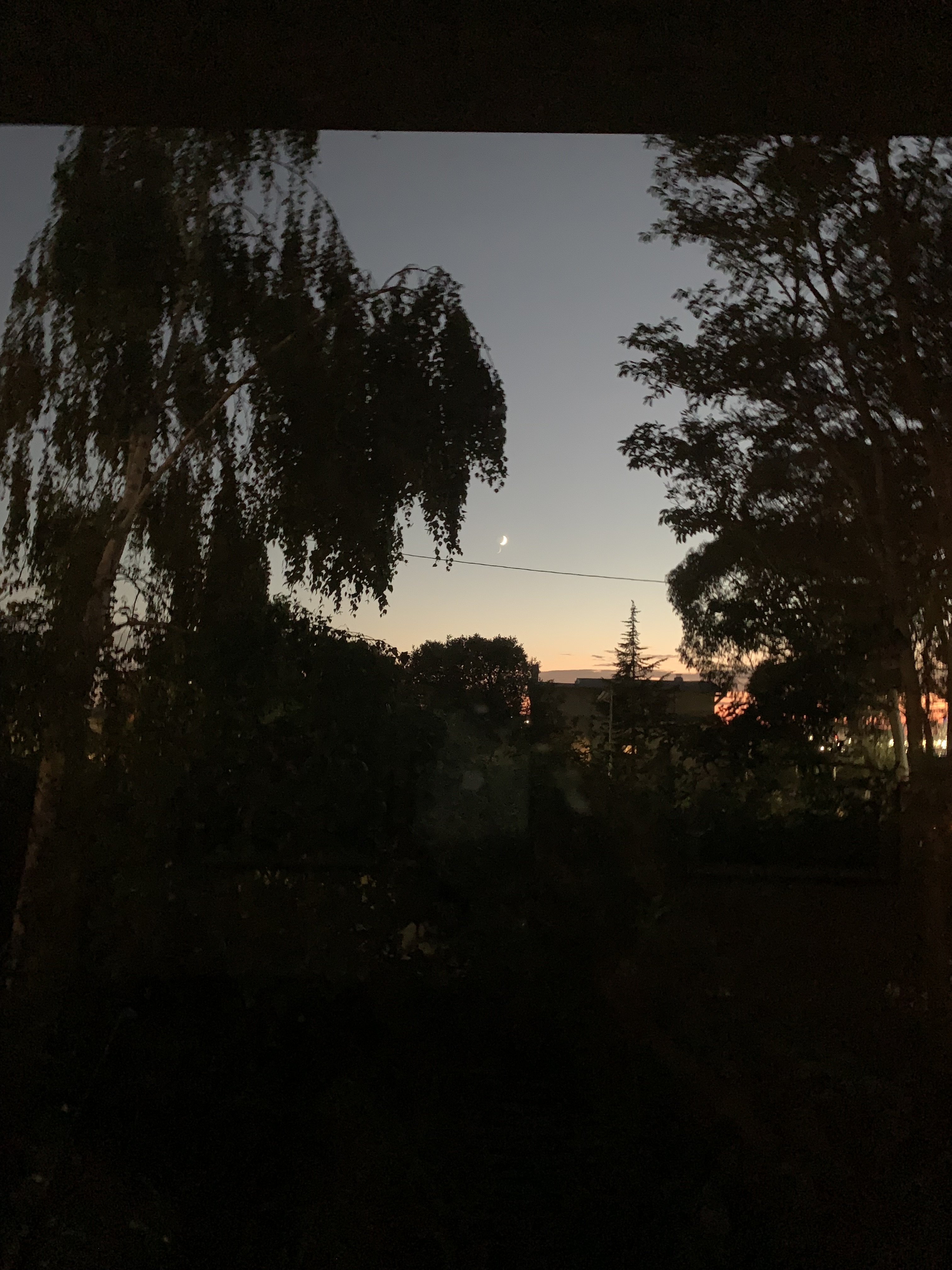
Sometimes it seems strange that beauty remains after such a grave loss.

Photo by Mary Elyn Bahlert

Uncategorized

Friends

Some would call it a blessing. For others, it is something they are not able to attain. Many people need – and want – only one or two. Some think that everyone they meet is a friend.

I call mine a blessing.

This past week, I spent several days with Vicki, a friend I met in high school. I met her brother Bruce before I met Vicki, when I sat behind this tall, painfully shy boy in Art Appreciation Class, my first elective course as a senior at Washington High School in Milwaukee. During our college years, Vicki and I started to hang out together more often. The course of our lives has been very different, but our friendship remains. When we met in Denver – as close to halfway between New Berlin, WI and Oakland as we could figure – we spent the evenings together in our hotel room, talking and talking, until after we’d turned out the lights and lay in our beds.

I remember meeting Joanne for the first time, when she sat down at my desk in Green Bay, Wisconsin, smiled her bright smile, and said, “do you golf?” (My answer: I didn’t, but I could try. I never did). We took road trips together, and we flew together to Montreal and Quebec with another friend, Carla, who is still in Joanne’s life. Joanne commiserated with me as we mourned our lack of dates, until we finally met the men we would marry. Joanne stood up with me in my wedding. Because I was at school in Berkeley, I wrote a prayer for her wedding and posted it in the U.S. mail, instead.

The Bug was my best friend in high school, and we keep in touch via email now. Her sister Bonnie and I stood up in the Bug’s wedding. My heart hurts for the Bug now; her son died unexpectedly – at only 46 – in the past year.

I knew Pat’s family from the time I was little in Milwaukee. Her aunt was one of my mother’s good friends, a friend from her neighborhood in Milwaukee, too. Later, Pat and I, her brother Bobbie and the Bug, and several other teenagers from our neighborhood worked together at the Times Fine Arts Theater on Milwaukee’s North Side. Now, I talk to Pat very few months on the phone, and even now, we’ve got plenty to talk about. And to laugh about.

Later in my life, I’ve continued to make friends. I’m grateful. I met Alexis and Linda, both clergy, through meetings with other United Methodist clergy in Northern California. Staying in touch with them is important to me. A year ago, Judith rode home with me from a retreat where we’d both led small groups of clergy in reflection sessions, and we’ve been friends ever since.

Some of my friends, like Lana, live locally, so I get to have lunch with her, where we discuss books we are both reading, and with Jean, another Oakland person.

I hope their friendships keep me healthy, and I hope I have something to give them, as they do to me. Conversation with each one is different, full of history, often serious, and always interesting.

My life is richer for each one of my friendships. I am grateful.

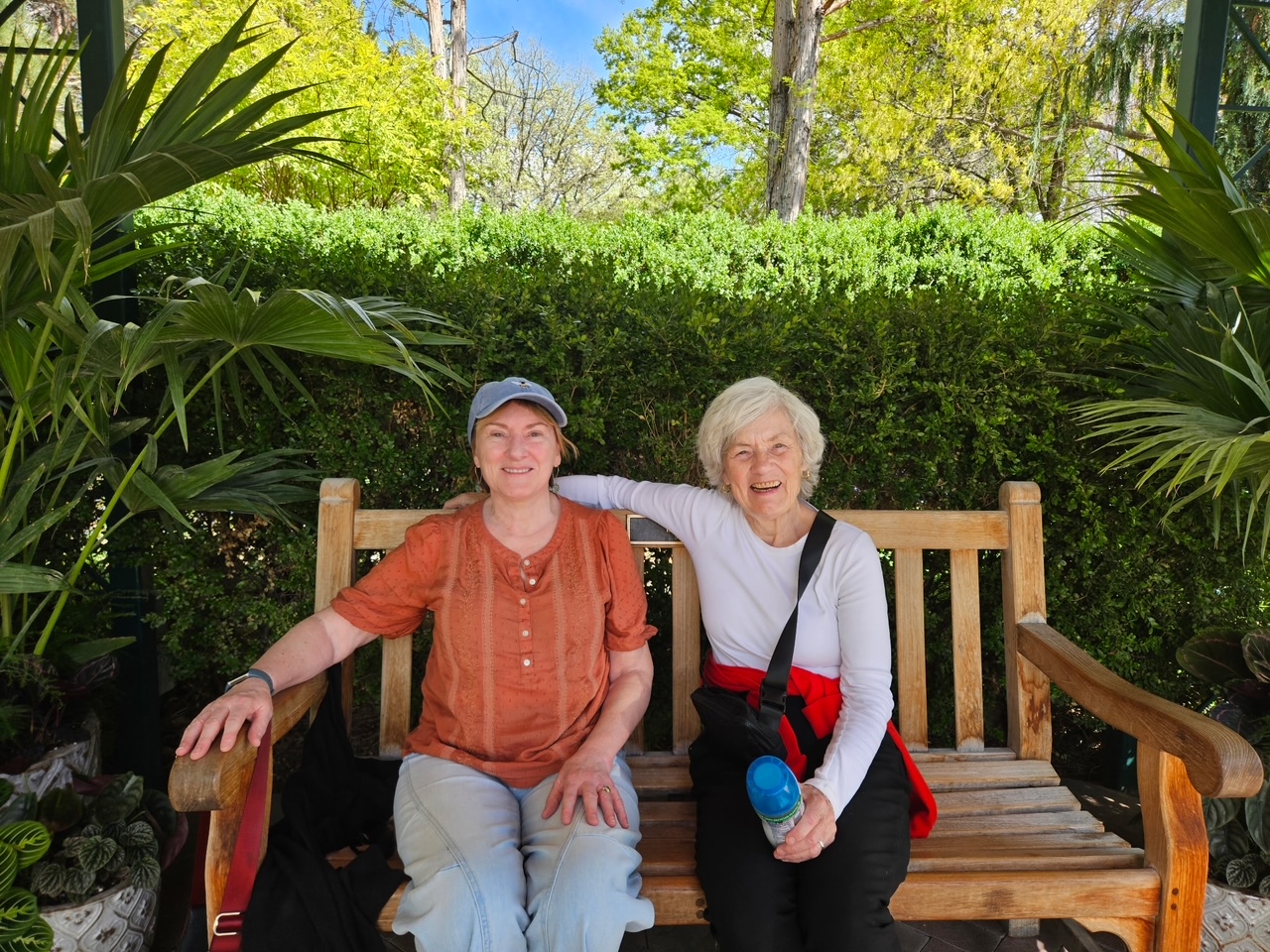
Vicki and me, Botanical Gardens, Denver, 5/2025

Uncategorized

Me and the cat

When I married in 1984, I married a man and a cat. The cat’s name was Schatzi – and Schatzi was the best cat in the world. She was cuddly and friendly to everyone. When company came to visit, Schatzi would join all of us in the living room as we sat and talked. When I lay on the couch to take an afternoon nap, Schatzi would cuddle up next to me, her back against my body. We’d take a nap together.

I think Schatzi stayed alive that winter of 2000-2001, even after she spent most days next to the heat register in the dining room, because that was the winter we learned that my mother had inoperable cancer and was put on hospice, and as Mom spent her last days in her little room at the Mathilda Brown Home in Oakland. When I arrived home after a long day at church and then after a long day with Mom, Schatzi would be cuddled up close to the heat, soaking up the comfort she found there. And the spring after Mom died, Schatzi, too, died, on the kitchen floor where Jeff had spent her last hours beside her. She was a good cat. We buried her in the back yard of the duplex on Sunnyslope Avenue in Oakland.

*

Sometimes now, I lay on the grass in the yard of our house on View Place, near the back door. Before I do this, I open the kitchen door wide. Then I call the cat, LiLi, who spends most of her days sleeping on the yellow quilt on our bed. She never fails to jump down from the bed, down the five stairs from the bedroom into the hall, through the kitchen, to rush out the back door to join me on the lawn. As she comes to sit with me, I watch her from the ground, my view of the earth close to hers.

LiLi is not an affectionate girl, but for a few minutes as we lay on the grass, she rumbles next to me, leaning in just so – just so she is in the shade that my arm forms. It seems to me that we must both enjoy the same things in those moments: the smell of the grass, watered for a few minutes before dawn, the sunshine, and the shade, the good company of another being.

I almost hold my breath when she’s with me; soon her nose is moving, down, down, down to the earth, and her eyes narrow into slits as she surveys her surroundings. She moves slowly, but she crawls away, her body close to the ground, her nose down, to the bushes a few feet from where I lay. Someone interesting must have visited that spot during the night, because she spends a few moments sniffing. Then, she places one foot gingerly in front of her, then another, and she moves into the shadow of the rose bushes or the rosemary bush.

She doesn’t come back to me. I’ll have to wait for her another day.

*

I think about these moments with the cat, in the winter, when it’s raining. When I pass the step into the yard, I turn my head to look at our place. I think about the sun shining, I think about the clear air, the smell of the earth, and I see the two of us – me and the cat – lying there, on the grass.

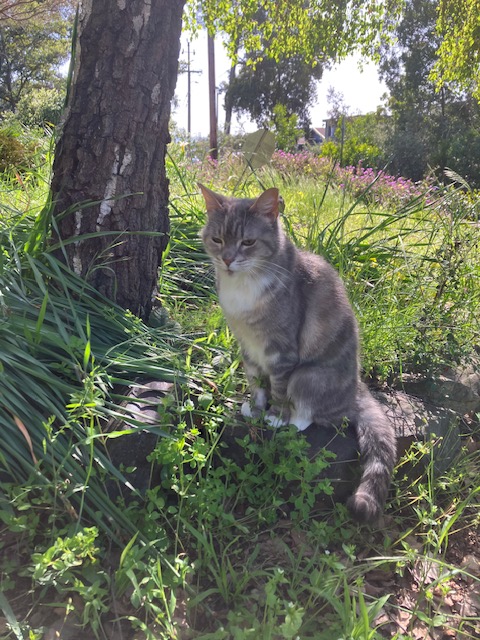
LiLi, who is now in her elder years, on one of her short excursions into the yard. Photo by Mary Elyn Bahlert

Uncategorized

Mr. Fischer

November 22, 1963. I was in my 9th grade German class, Mr. Fischer at the front of the room, when his teaching was interrupted by the distinctive ringing of the public address system, the large speaker in the right hand corner of the room, almost directly across from my desk.

I don’t remember what words came drifting down to us in our desks, bolted to the floor in even rows. What I remember, as the announcement of the assassination of President John F. Kennedy as he rode in the presidential motorcade in Dallas, Texas was reported to us from the intercom, was the face of Mr. Fischer, tears streaming down his cheeks. He made no attempt to cover his face. His eyes were not looking at all of us, the young people whose various motives had brought them to be enrolled in his second-year German class. His eyes were somewhere else in their sorrow.

Now, I remember that moment in detail, the detail of his face, larger than life, in front of the desks filled with young people who would not, could not understand the enormity of what had happened to the President, and to all of us. I had seen my father cry – never my mother – and so it must not have struck me as strange to see the kind man cry.

Now, I also – in my considering that moment in our lives over the years – believe that Mr. Fischer, so many years older than all of us sitting before him – had witnessed in his own life and history such happenings in Europe. And so he was living again in his new country a repeat of history. A sordid history.

And for the first time in my life, I came to know that not everyone saw the state of the country, the state of the world, as we did. I mentioned something about the assassination to my friend Carlene, to be met with her cryptic response: “we didn’t like him.” That was jarring, but I said nothing, taking it in, and maybe seeing for the first time the great difference between Carlene and me, between our families: her father an engineer in an engineering firm, my father a union steel worker with an 8th grade education. I saw something clearly, then, in her response. I saw something clearly about her, something that would never leave me. And I understood that we were different, and that other people saw the world differently. I understood, and for the first time.

And I knew I would stand with my people.

*

Now, as the nation struggles with the sharply drawn political/ideological differences of the people, those lines are drawn more clearly than those first decades following World War II. Vietnam and what it would bring to all of us, in particular to all of us in my generation, did not hold an important place in our minds at that moment. That would come later, and the years of unrest – brought to a head in my generation – were before us.

I remember that moment, Mr. Fischer – as a teacher, always larger than life in my own memory – standing, tears on his cheeks. And always, I’m grateful to him and to the others who influenced me, who formed the shape of my youthful world, whose influence would never leave me.

*

Remembering, from the autumn time of life… photo by Mary Elyn Bahlert, 10/2024, Wales, Wisconsin

memories, reflecting, remembering, Uncategorized

Grandma Bahlert

My most vivid memory of my Grandma Bahlert is seeing her – tall and thin – as she opened the door of the little cabin that Uncle Erdreich had built for her and Grandpa, right behind his and Auntie Irene’s house, on the road in Baileys Harbor that led from Highway 57 to a gravel road deep in the woods, a swamp.

Daddy and I had made the long drive from Milwaukee to Baileys Harbor on a Friday night, and we had left Momma and the baby and Ronnie back at home in Milwaukee. Momma and Daddy must have agreed – and known – that this was to be an important trip, and so Daddy drove the four + hours along Lake Michigan when darkness had already descended, to see his Mother. I didn’t feel well on the way, and so I lay down in the back seat, and when we entered Door County, I watched the shadows of the trees that stood, tall and deep, dark, along the highway. Daddy drove on.

When we arrived at the house, Daddy and I walked up to the door of the cabin, and Grandma Bahlert stood at the door to “greet us,” she would have said.

Auntie Irene’s buoyancy, her love of children, must have greeted us first. Later that evening, I would lay on a couch in the living room of the pieced-together house that Erdreich had built – a house that grew longer and more filled with furniture and knick-knacks as the years passed. And when I couldn’t get to sleep, Auntie Irene went next door to get my Daddy, who lay with me cuddled up against him as he fell asleep on the couch.

In her letters – written in a primitive, elementary school handwriting – to my folks, my Grandma Bahlert had mentioned, again and again, “my little Mary.”

A few months later, she was gone. Auntie Edna – who always took charge of such things – had called us on the telephone, and when Daddy came back to sit in his chair, he cried.

Years later, I would ask to see Grandma in a dream, before I fell asleep. She didn’t come for many nights, but then I had a dream! I was standing at a grave, Grandma Bahlert’s grave, and I was alone. When I awoke, I knew the message of the dream to me: “she’s really dead.”

+

From where I sit at the dining room table where Jeff and I eat dinner together every evening, I look out onto the beautiful trees that fill my sight at the dining room windows. In the center of the windows, on the counter on which I place beautiful things to enjoy, I have placed two black-framed photos, both in black and white. The photos are old, and the manner of dress attests to that. On the right are my Grandpa Markowski, Grandma Markowski, John – Ivan, about 4 years old – standing in front of them in an old-fashioned sailor suit. They are not smiling, as seems to have been the custom when taking pictures at that time.

To the left is another photo, a photo of the Bahlert family. They were good-looking people, all. The year was 1910, judging from the ages of the children. On my grandmother’s lap is a baby with big brown eyes, looking, like the rest, into the camera. The baby is my father, Frank. His twin, Carl, had already died, only a few months old. Grandma has a small smile on her lips as she holds her baby. Maybe it was for the picture, or perhaps she was happy to be surrounded by the little ones she loved so well.

I think of them often, I remember my Grandma Bahlert’s love for me, always. When I return to Door County, filled with tourists now, I go by the quiet, less traveled roads to the graveyard at the Sister Bay Moravian Church, and I always stand at the graves for many minutes, thinking of them having come to this place, at the end.

A few years ago, I messaged my first cousin’s son, Eric, to tell him what I remembered of his Grandpa, my Uncle Johnny – Ivan – my mother’s eldest sibling. I told Eric how his Grandpa had loved him so much. To my message, Eric replied: “I remember the love.”

Grandma: I remember the love.

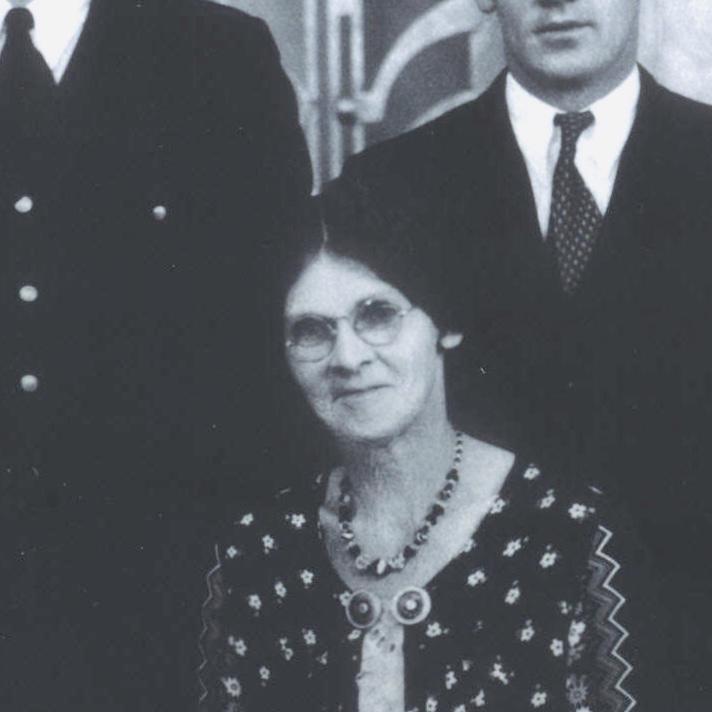
Grandma Bahlert, circa, 1930’s