Uncategorized

Me and the cat

When I married in 1984, I married a man and a cat. The cat’s name was Schatzi – and Schatzi was the best cat in the world. She was cuddly and friendly to everyone. When company came to visit, Schatzi would join all of us in the living room as we sat and talked. When I lay on the couch to take an afternoon nap, Schatzi would cuddle up next to me, her back against my body. We’d take a nap together.

I think Schatzi stayed alive that winter of 2000-2001, even after she spent most days next to the heat register in the dining room, because that was the winter we learned that my mother had inoperable cancer and was put on hospice, and as Mom spent her last days in her little room at the Mathilda Brown Home in Oakland. When I arrived home after a long day at church and then after a long day with Mom, Schatzi would be cuddled up close to the heat, soaking up the comfort she found there. And the spring after Mom died, Schatzi, too, died, on the kitchen floor where Jeff had spent her last hours beside her. She was a good cat. We buried her in the back yard of the duplex on Sunnyslope Avenue in Oakland.

*

Sometimes now, I lay on the grass in the yard of our house on View Place, near the back door. Before I do this, I open the kitchen door wide. Then I call the cat, LiLi, who spends most of her days sleeping on the yellow quilt on our bed. She never fails to jump down from the bed, down the five stairs from the bedroom into the hall, through the kitchen, to rush out the back door to join me on the lawn. As she comes to sit with me, I watch her from the ground, my view of the earth close to hers.

LiLi is not an affectionate girl, but for a few minutes as we lay on the grass, she rumbles next to me, leaning in just so – just so she is in the shade that my arm forms. It seems to me that we must both enjoy the same things in those moments: the smell of the grass, watered for a few minutes before dawn, the sunshine, and the shade, the good company of another being.

I almost hold my breath when she’s with me; soon her nose is moving, down, down, down to the earth, and her eyes narrow into slits as she surveys her surroundings. She moves slowly, but she crawls away, her body close to the ground, her nose down, to the bushes a few feet from where I lay. Someone interesting must have visited that spot during the night, because she spends a few moments sniffing. Then, she places one foot gingerly in front of her, then another, and she moves into the shadow of the rose bushes or the rosemary bush.

She doesn’t come back to me. I’ll have to wait for her another day.

*

I think about these moments with the cat, in the winter, when it’s raining. When I pass the step into the yard, I turn my head to look at our place. I think about the sun shining, I think about the clear air, the smell of the earth, and I see the two of us – me and the cat – lying there, on the grass.

LiLi, who is now in her elder years, on one of her short excursions into the yard. Photo by Mary Elyn Bahlert

Uncategorized

Mr. Fischer

November 22, 1963. I was in my 9th grade German class, Mr. Fischer at the front of the room, when his teaching was interrupted by the distinctive ringing of the public address system, the large speaker in the right hand corner of the room, almost directly across from my desk.

I don’t remember what words came drifting down to us in our desks, bolted to the floor in even rows. What I remember, as the announcement of the assassination of President John F. Kennedy as he rode in the presidential motorcade in Dallas, Texas was reported to us from the intercom, was the face of Mr. Fischer, tears streaming down his cheeks. He made no attempt to cover his face. His eyes were not looking at all of us, the young people whose various motives had brought them to be enrolled in his second-year German class. His eyes were somewhere else in their sorrow.

Now, I remember that moment in detail, the detail of his face, larger than life, in front of the desks filled with young people who would not, could not understand the enormity of what had happened to the President, and to all of us. I had seen my father cry – never my mother – and so it must not have struck me as strange to see the kind man cry.

Now, I also – in my considering that moment in our lives over the years – believe that Mr. Fischer, so many years older than all of us sitting before him – had witnessed in his own life and history such happenings in Europe. And so he was living again in his new country a repeat of history. A sordid history.

And for the first time in my life, I came to know that not everyone saw the state of the country, the state of the world, as we did. I mentioned something about the assassination to my friend Carlene, to be met with her cryptic response: “we didn’t like him.” That was jarring, but I said nothing, taking it in, and maybe seeing for the first time the great difference between Carlene and me, between our families: her father an engineer in an engineering firm, my father a union steel worker with an 8th grade education. I saw something clearly, then, in her response. I saw something clearly about her, something that would never leave me. And I understood that we were different, and that other people saw the world differently. I understood, and for the first time.

And I knew I would stand with my people.

*

Now, as the nation struggles with the sharply drawn political/ideological differences of the people, those lines are drawn more clearly than those first decades following World War II. Vietnam and what it would bring to all of us, in particular to all of us in my generation, did not hold an important place in our minds at that moment. That would come later, and the years of unrest – brought to a head in my generation – were before us.

I remember that moment, Mr. Fischer – as a teacher, always larger than life in my own memory – standing, tears on his cheeks. And always, I’m grateful to him and to the others who influenced me, who formed the shape of my youthful world, whose influence would never leave me.

*

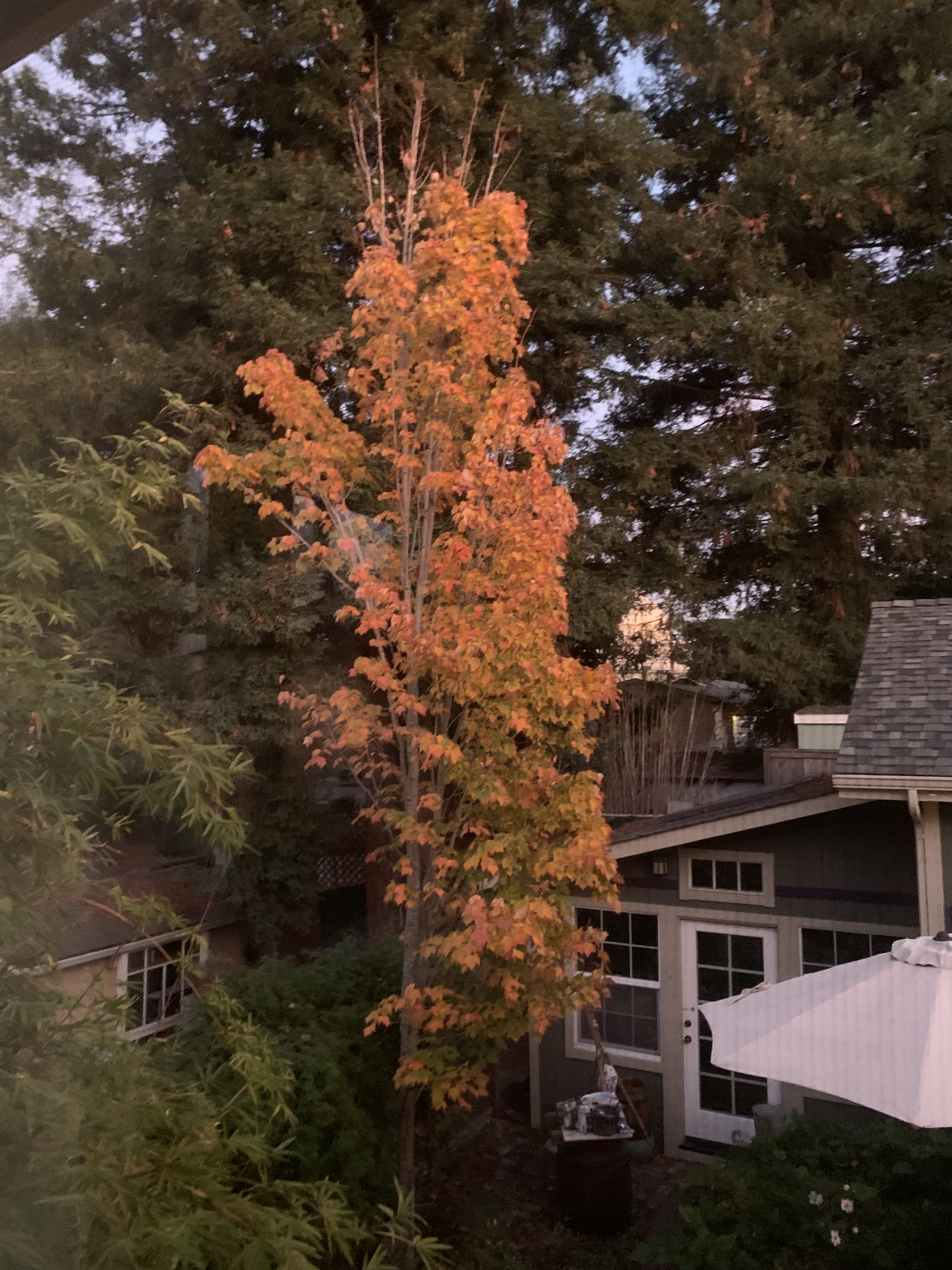
Remembering, from the autumn time of life… photo by Mary Elyn Bahlert, 10/2024, Wales, Wisconsin

memories, reflecting, remembering, Uncategorized

Grandma Bahlert

My most vivid memory of my Grandma Bahlert is seeing her – tall and thin – as she opened the door of the little cabin that Uncle Erdreich had built for her and Grandpa, right behind his and Auntie Irene’s house, on the road in Baileys Harbor that led from Highway 57 to a gravel road deep in the woods, a swamp.

Daddy and I had made the long drive from Milwaukee to Baileys Harbor on a Friday night, and we had left Momma and the baby and Ronnie back at home in Milwaukee. Momma and Daddy must have agreed – and known – that this was to be an important trip, and so Daddy drove the four + hours along Lake Michigan when darkness had already descended, to see his Mother. I didn’t feel well on the way, and so I lay down in the back seat, and when we entered Door County, I watched the shadows of the trees that stood, tall and deep, dark, along the highway. Daddy drove on.

When we arrived at the house, Daddy and I walked up to the door of the cabin, and Grandma Bahlert stood at the door to “greet us,” she would have said.

Auntie Irene’s buoyancy, her love of children, must have greeted us first. Later that evening, I would lay on a couch in the living room of the pieced-together house that Erdreich had built – a house that grew longer and more filled with furniture and knick-knacks as the years passed. And when I couldn’t get to sleep, Auntie Irene went next door to get my Daddy, who lay with me cuddled up against him as he fell asleep on the couch.

In her letters – written in a primitive, elementary school handwriting – to my folks, my Grandma Bahlert had mentioned, again and again, “my little Mary.”

A few months later, she was gone. Auntie Edna – who always took charge of such things – had called us on the telephone, and when Daddy came back to sit in his chair, he cried.

Years later, I would ask to see Grandma in a dream, before I fell asleep. She didn’t come for many nights, but then I had a dream! I was standing at a grave, Grandma Bahlert’s grave, and I was alone. When I awoke, I knew the message of the dream to me: “she’s really dead.”

+

From where I sit at the dining room table where Jeff and I eat dinner together every evening, I look out onto the beautiful trees that fill my sight at the dining room windows. In the center of the windows, on the counter on which I place beautiful things to enjoy, I have placed two black-framed photos, both in black and white. The photos are old, and the manner of dress attests to that. On the right are my Grandpa Markowski, Grandma Markowski, John – Ivan, about 4 years old – standing in front of them in an old-fashioned sailor suit. They are not smiling, as seems to have been the custom when taking pictures at that time.

To the left is another photo, a photo of the Bahlert family. They were good-looking people, all. The year was 1910, judging from the ages of the children. On my grandmother’s lap is a baby with big brown eyes, looking, like the rest, into the camera. The baby is my father, Frank. His twin, Carl, had already died, only a few months old. Grandma has a small smile on her lips as she holds her baby. Maybe it was for the picture, or perhaps she was happy to be surrounded by the little ones she loved so well.

I think of them often, I remember my Grandma Bahlert’s love for me, always. When I return to Door County, filled with tourists now, I go by the quiet, less traveled roads to the graveyard at the Sister Bay Moravian Church, and I always stand at the graves for many minutes, thinking of them having come to this place, at the end.

A few years ago, I messaged my first cousin’s son, Eric, to tell him what I remembered of his Grandpa, my Uncle Johnny – Ivan – my mother’s eldest sibling. I told Eric how his Grandpa had loved him so much. To my message, Eric replied: “I remember the love.”

Grandma: I remember the love.

Grandma Bahlert, circa, 1930’s

Uncategorized

Seeing the Mother-land

1988. The times were very different from these times. The world was changing – quickly, it seemed. I was in my fourth and final year as the Associate Pastor of First United Methodist Church in downtown San Jose. And I had learned about a trip sponsored by the World Council of Churches to travel to the Soviet Union to honor the 1000 anniversary of the introduction of Christianity to Russia.

The congregation I was leaving gifted me – through the donations of several folks – what was needed to travel to the Soviet Union as part of a delegation of Americans sponsored by the World Council of Churches. I was grateful – and very excited – to see what was part of my family’s homeland. My mother’s parents – my maternal grandparents – had immigrated to the United States from Ukraine in 1914. They had held onto the hope for their people, even in the New World, expecting that the formation of the Soviet State would bring freedom. History would prove otherwise, of course (once – having received as a gift, a large volume about Stalin’s time, I’d had to stop reading when Stalin’s slaughter of the Ukrainians numbered well over 10 million people – primarily in the 1930’s). Their hopes did not correspond to the life they had here.

The trip began with several days of study of the Soviet Union and the Orthodox Church tradition in Brooklyn, New York, before the group made the journey to Moscow. Since we were guests in a Communist country, our group had been assigned to travel to events in several cities, and without our consent, the group was divided into smaller groups with different itineraries when we arrived in Moscow. I traveled to Moscow, St. Petersburg, Kiev, and to Odessa, a beautiful city on the Black Sea.

In the Soviet Union, the time had received the name, perestroika – restructuring of the economy. The people of the USSR – and the world – had hopes for the new Soviet Union. It was an exciting time to be in the USSR as a foreign visitor; indeed, the WCC trip coincided with the visit of Ronald Reagan, the U.S. President, to the USSR.

I was as close as I would ever be to “my people,” the people of Eastern Europe. As the years have unfolded, I have learned that my family – who had broken with “Church” by some turn of events in Ukraine, before emigration – must have been Catholic, a common faith and practice in Ukraine. Still, I was grateful for the introduction to the Eastern Church, the Orthodox Church. For me, traveling with the WCC was a doorway into a deeper look at life in the USSR – one doorway among many.

And so I was privileged to see the homeland, over fifty years after my grandparents had left their home. My privilege was reflected in another way; I told my mother about the trip, and invited her to join us, to finally secure her passport, to see the place where her people had lived, and where some still lived. She couldn’t see herself traveling that distance, and out of the country, and so she did not join the trip.

I’ve been inside many churches in my lifetime – to be sure. And there in the Soviet Union, I saw some of the most beautiful churches I have ever seen. The high arched ceilings, the iconography, the beauty of those places touched me. Even more, the babushkas – the poor women who came to the church with their prayers in their hearts, who bowed, again and again, standing before the saint to whom they gave their prayers – touched my heart. I carry their devotion with me, even now.

We learned that the Soviets – atheists – had protected the churches through all the years of the USSR, since 1917. They, too, had been moved by the beauty of those places. When the anniversary of the Orthodox Church was being planned, minutes from the organizing included these words: “Members of the Bishops’ Pre-Council Meeting gratefully consider it necessary to note the positive attitude of the Soviet Government to the questions put forward by the Hierarchy of the Church.” In other words, the government had agreed to allow the celebrations.

When we were not in churches, my roommate and I walked through the streets of the cities we visited. And in Kiev it was that I saw “my people.” The faces, the eyes, the way the people carried themselves – I recognized. They are forever “my people.” The days we were in Kiev were beautiful spring days. The lilacs were in blossom. The people felt the freedom of the spring as well as the changing times – as difficult as the present and the days to come – like all the days in the past – would be.

*

When I read the news these days, the world hears rumblings again coming from that Eastern place, now called Russia, again. I often think that Putin, President Putin, has never lost his history as KGB, and so he rattles the chains to control the people of his country – and the people of Ukraine, a sovereign nation. We may see the lock-down, the disappearing of that place as a free land – again.

On the back of this photo, in my mother’s hand: Vlas Markov Srebny Feodosia Maksuda Srebna, Ivanka (Ivan, little one) Srebny, 4 yrs. old . Photo circa 1914.

memories, remembering

Sheepshead

I loved – still love – the season of holidays. As a child, holiday time meant a time for the cousins and aunts and uncles to gather at our house for the holiday meal – which was followed by the dining room table being cleared as quickly as possible, the tablecloth removed, and the cards ready to be shuffled and played. Of course, the women had already finished the clean up time in the kitchen, the men had had another beer – or two, sitting together in the living room – and it was time to play Sheepshead.

When I explain this ritual now, folks are usually stymied by the name of the game – Sheepshead. It’s a trump game, I tell them, and almost everyone in Wisconsin plays Sheepshead. The original name, schafskopf, is a German name and Sheepshead is a German card game. The full deck is not in use when playing Sheepshead. And the highest card in the deck is the Queen of Clubs. Besides the basics, it’s hard to understand Sheepshead, to get its allure, and to understand why it was a part of every holiday – unless you play.

When I was little, I convinced myself that I’d never play that noisy, rowdy game. The hands were dealt and played quickly, and there were loud voices and complaints that accompanied every hand dealt. Daddy and the uncles pounded on the table, even though money was not involved. When they played Sheepshead, and as the day – and the playing – went on, the loud voices and the pounding on the table seemed to get more fierce. “What could be fun about that”? – I must have thought.

Until I learned to play. Mom taught me, when I was eleven. First, I had to learn what was trump, she said, as she lay all the cards on the table, right side up. Then, I had to learn the rest of the suits, in order. Then, I had to learn how to arrange the cards I was dealt in my hand. Then, I had to learn to count trump as it was played – a necessity for proper strategy. Mom was a good teacher. Soon, I was playing Sheepshead, too.

And soon, I was hooked. Ever after, I could join the shouts and complaints at the table. The shouts and complaints didn’t seem as big as before, and maybe the shouts and complaints seemed necessary, once I’d started to play.

“Sheepshead! I can play!” Here in Oakland, Jeff and I have taught a few people to play Sheepshead. This past year, we taught our friend Jim, who is sure to impress his German relatives when he makes a trip to see them. The rules may be different, we tell him, but you’ve got the basics down.

Our house is a lot quieter on holidays than our house growing up was, and that suits me. Our holiday meals – after we’ve finished and have moved to the living room to sit next to the Christmas tree – are followed by long conversations with good friends, and Sheepshead seems to be something in the past now. We have taught our nephew Rainier and his wife, Lia, to play. I hope they like it, too.

” …after we’ve finished dinner and have moved to the living room to sit next to the Christmas tree…” – photo by Mary Elyn Bahlert, 12/2024