Uncategorized

Walking Through the Pandemic

When the “shelter in place” began in California in 2020, I expect that most of us thought that if we just closed down for a few weeks, we’d be able to get back to our real lives. And so we sheltered. Here in Northern California, the winters are often mild, and many winters, there is not even much rain – until this year, of course, a record-setting year for rain. So in the late winter and the spring of 2020, we stayed close to home, enjoying our yard in the city. In the evenings, before sunset, Jeff and I would often drive through Oakland, seeing neighborhoods we rarely saw, enjoying the one freedom we had. We ordered our groceries delivered to us. We felt privileged – which we are – with a studio in the back of the garage for Jeff, and the room I call “my little study” down a flight of stairs from the kitchen.

Still – how to pass the hours, multiplying into weeks and months? We didn’t take to going to worship online, and so we began to leave our house early on Sunday mornings to find places to walk. Both being retired, a Sunday morning to spend as we wished was a luxury. And we counted: over the course of many months, we walked at least 15 neighborhoods in San Francisco. We walked up hills. We walked down hills. We walked through streets that were mostly empty of other people. We walked and we talked.

We walked, again and again, on the paths that line the Martinez Slough, high tide and low tide. We walked and we talked.

As time went on, we invited friends over to enjoy our yard with us. We brought dinners out to them on paper plates, and we often sat, dressed in sweaters and even coats, until the light of the day was passing away.

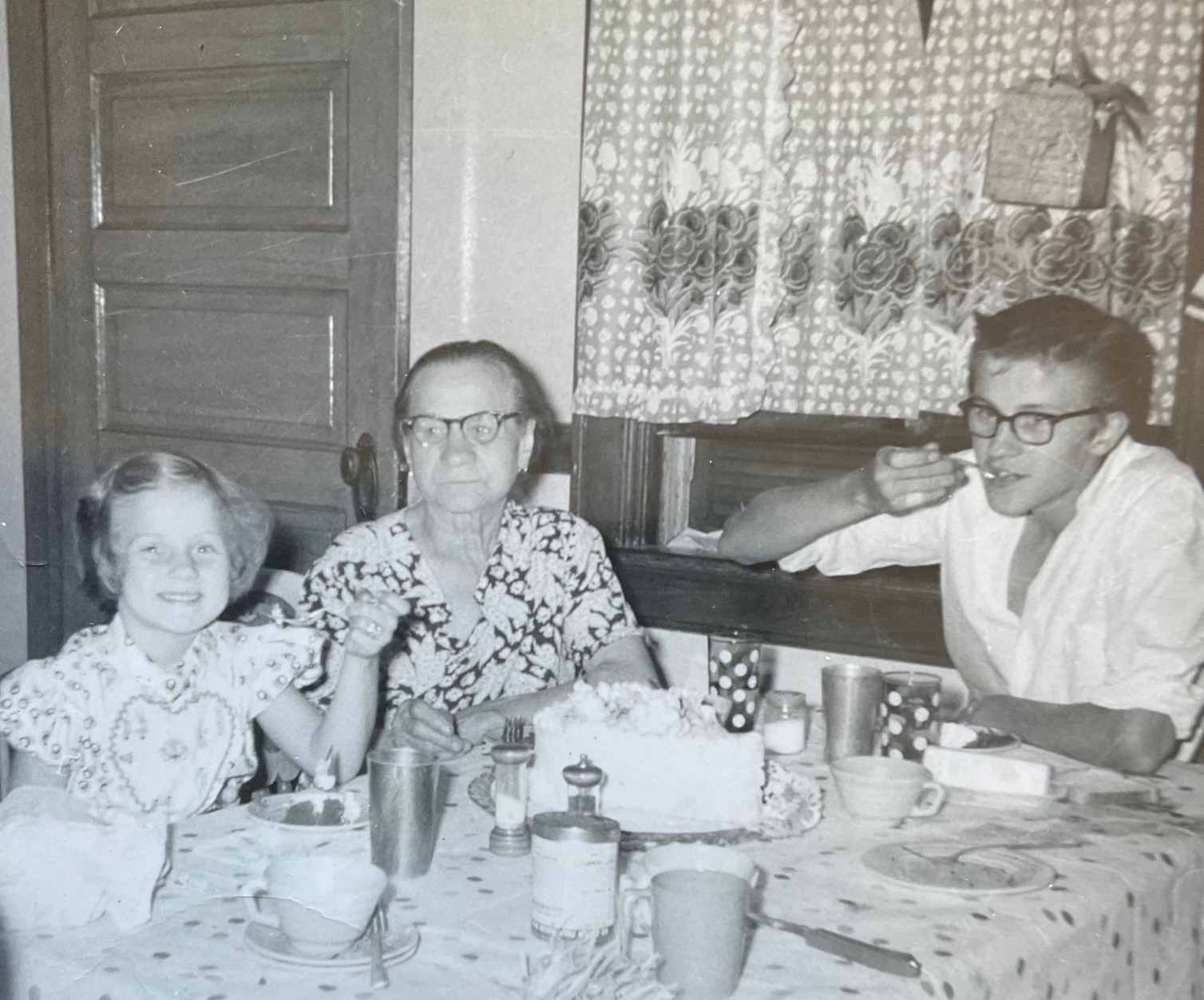
I had a large plastic box of decades of photos from my lifetime – and from the decades before my lifetime – on a high shelf in the garage. Jeff brought the box out to me in the yard, and I sat in the sun and sorted almost a centuries’ worth of photos, some black and white, some formal, some taken on a whim. I looked closely at each one, the time stretching before me into some unknown future, and then, the past stretching behind me. Some of the photos I mailed to my sister in Hawaii, others I sorted again into large folders that now fill a drawer of the wooden file cabinet in my study.

Like so many others, we think back on three years of the world’s living with COVID-19, and it’s hard to believe we did it. We learned to live with the virus, and we are grateful that we didn’t contract the virus until it was less severe than news reports talked about in the beginning, when health care across the world struggled. And our own world grew in a way, as we discovered places in our own community.

It’s a relief that the world has moved on to a different place, with COVID-19 a regular resident of the planet, along with the rest of us.

Walking through the Pandemic: San Francisco 11/2022

photo by Mary Elyn Bahlert

Uncategorized

I wish it would snow once…

Mom was diagnosed with cancer early in December of 2000. We took her home from the doctor’s office, Jeff and Mom and I silent as we made our way from his office to the elevator. We had all agreed to hospice care. When we took her back home to Mathilda Brown Home, the staff went into full gear as we all received an explanation about what hospice would entail. Jeff and I were grateful that Mom could stay in her little room, in the place she loved.

I visited daily then, and most days, I’d find Mom in her room, sitting in her chair, crowded next to her bed, or lying on the bed, resting. One day when I arrived, I found her on a wooden chair in the hallway, her bathrobe over a nightgown. She’d forgotten to change that day, so we went into her room and chose clothes more suitable for the day. “ I must be losing it!” she said.
Another day, Mom was sitting on the edge of her bed, facing the window that overlooked an alley and the playground of Oakland Tech. When I came into the room, Mom said, without turning her head: “ I wish it would snow once, just for me.”

I wished it would snow, then, too. As tough as winter can be in the Midwest, we Midwesterners love its beauty, those days when the snow falls silently and without a wind to rustle it, to the earth. That winter, in the days before Mom died in mid February, weather reports on local radio announced that there had been a sprinkling of snow high on the hills over Oakland. I wished I’d been able to take Mom to see it, but by then, she was confined to bed.

nostalgia, reflectin, reflecting, remembering

Dinners with the Bug

In my late teens, after the Bug and I had graduated from high school and I started college at the University of Wisconsin-Milwaukee, she and I often met to go out on weekend nights. Bug and I had been friends in high school, and we worked together at a movie theater on the north side of Milwaukee, where I was a “vendette” – selling popcorn and sweet treats to the movie patrons – and where the Bug was the cashier who sold tickets at the front window. Several of the kids who worked there were also friends of ours from high school – Pat, who I still talk to on the phone from time to time, now that we’re in our seventies – her brother, Bobby, who died from complications of Crohn’s Disease, a few years ago, and my cousin, Mark. That was my first job, which apparently led to my adult addiction to popcorn (which continues today). Bobby and the Bug dated a few times; he was the one who gave her the name: the Bug.

The Bug and I had many adventures together during my last year of high school and my college years, which ended when she married in her early 20’s. Bug’s wedding and marriage and motherhood were the fulfillment of her dreams, which included her and her husband building a house exactly like her parents’ beautiful home. As far as I know, they still live in that house, outside of Milwaukee. Bug was hysterically funny. I can’t remember anything that she said that was funny, but I do remember one time, when I was driving, with her in the passenger seat, that I had to pull over to the side of the street because she had me laughing so hard.

After we started college – the Bug stayed a year or two, then left school to go to work – she and I had a routine that I remember today as an opening to a way of life that I hadn’t experienced in my working class family. I had my own money then, the money left over after paying tuition and books and transportation to school on a city bus. About once a month, Bug would come over to pick me up at my house. She was always welcome there – all of my friends were welcome there – and my folks loved to see the Bug. When she arrived, we wrote the names of several of Milwaukee’s fine restaurants on slips of paper, and gave them to my Dad, who sat in his chair across from the television, put the slips of paper into his cap, and chose one. Dad would read aloud the name of a restaurant. Then, the Bug and I set out for the evening to the place he’d picked out of the hat.

At first, I felt awkward. My life experience had not included places like these. I had grown up with supper at five in working class flats and small, crowded kitchens, had been raised on home cooked meals, often Ukrainian peasant food. I carefully observed the other patrons on our evenings out, chose something I hadn’t eaten before, and the Bug and I enjoyed the ambiance and our friendship. I know we laughed, and talked about things as only young women do. Over the years, I’ve eaten in many fine restaurants, and I’m comfortable. At first, I wasn’t comfortable, as these evenings out with a dear friend had opened a door in me and outside of me – to another world. The Bug’s father owned a small company of his own where he made toys for carnivals, and her home was very different than mine, which I observed, carefully. Her parents honored the weekend by going out to dinner, the two of them, on Friday nights. My awareness of class, to this day, shapes my world, and it shaped my world then.

Thank you, Bug.

Borscht, photo and soup by Mary Elyn Bahlert, 11/2022

Uncategorized

Dinner with Dad

When I’m talking to friends about our families, how we grew up, where we were from, about our siblings and our education, many of my friends refer to their parents in “formal” ways. I hear them speak about their “Mother,” and their “Father,” as opposed to how I refer to my parents: Mom and Dad.

Dad was an old school guy. Educated to the eighth grade in country schools, he was a worker. He was strong and he loved to work. When I describe him now, I say that he spoke in a dialect that is common to the northeastern part of the State of Wisconsin. When I travel to Door County now – a pilgrimage I like to take every year or so – I hear other folks who speak in the same dialect, even in my generation.

Dad was a Steelworker, a proud union man, proud of his strength and his long seniority at A.O. Smith Corporation in Milwaukee. The site of A.O. Smith remains to this time, but the place has changed names. Last Christmas, I received a large black coffee mug from my sister in Hawaii; across the sides of the mug, in big white letters: “AO Smith.” Most days, I use it now to have my morning coffee.

Dad was an old school guy, and in that era – I grew up in the 50’s and 60’s – that meant that he went to work and Mom stayed home to take care of the house – the flat – to cook, to tend to the children. Dad loved us, and he loved my mother. When I think about that now, those facts form a certain framework around my child, which like most childhood’s, had its share of losses, of sadnesses, of things lacking, even with my parents. In my middle years I had to take those relationships – mother to me, father to me, siblings to me – apart in therapy, but I came away with the love intact. I’m grateful.

When Dad retired at the age of 65, he left behind forty years of hard work as an inspector in a steel factory. He had been grateful to return to work after he suffered a heart attack in his early 60’s, and he credited his doctor with giving him that gift; Dad loved his work, hard as it was. When he’d been retired for several years, he told me that he still dreamt about his work at A.O. Smith from time to time.

Dad was an old school, hard-working laborer, and he loved us. His love and his pride for his family shone in his eyes – one blue, one brown. He loved to laugh, to share something fun with us. For all I lacked in childhood, love was not among the lack. He loved to talk – an extravert in a home of introverts.

A few years after Dad retired, I was living on my own on the other side of Milwaukee. Mom was away for the day and evening, and Dad invited me to dinner. He talked and talked as he and I sat in the kitchen, waiting for the chicken he had baking in the oven. I saw how he’d set the table for the two of us, and for the only time I remember, I sensed a formality about this invitation, about this dinner. For him – as it was for me – this was a special time.

A few weeks ago, I preached at a retirement center just out of the Bay Area. When the worship service was over, a man in a wheelchair came up to me to say a few words, to introduce himself and to thank me for being there that day. He had some thoughtful comments to say about my sermon, and then he surprised me by saying: “You did a lot of research to preach that sermon. You must come from a family of researchers.” Surprised, I simply told him that I was the first in my family to receive an education. I felt proud.

reflecting, remembering

Longing for Cozy

I left Wisconsin to live in California on December 26, 1981. I had moved out of my own apartment to stay with my parents at the beginning of December as I made the transition from full time work to full time student, at Pacific School of Religion in Berkeley. At the time, I didn’t know that I would be moving “forever,” to not return to the place that had been my homeland, the land of my people, for several generations.

For a few years after I made the move to Northern California, I did not return to Wisconsin at holiday time. I stayed in Berkeley and later, in the parsonage at Pleasanton with my new husband, Jeff. I recall vividly the first winter I spent in Pleasanton, as I stood in the driveway in my blazer, preparing to drive to my first parish, in San Jose. I was surprised – here I was a blazer as my top layer in January – no boots, no wool cap and gloves!

My Dad died in April of 1986, and I was able to be with my parents for a few days over the holiday season after Christmas the year before. One day during my visit, Milwaukee had a wonderful snow-fall, a snow-fall without wind, when the large flakes fell straight from the sky to the sidewalks and streets below. I walked over to a coffee shop not far from my parents’ apartment on Appleton Avenue, taking in the white stuff as it landed on me, looking at the falling snow with wonder. That’s the best kind of snow – gentle,calm, falling silently to the streets of the city. And I didn’t have to shovel! I enjoyed the coziness of the coffee shop and set out to walk again to my parents’ place.

For a few years after I moved to Northern California, I tried – without any success – to bring on the feeling of “cozy,” during the holidays. As I write today, Oakland is getting a much needed, and never-enough rain, after many years of draught. This is as close to cozy as I’ll get, I’m sure, the sound of tires driving in the rain, the tree lights lit, heat from the furnace warming the house. One holiday season, a few days before Christmas, after my father had passed and my mother made the trip to spend the holiday season with Jeff and me in the Bay Area, she and I stopped on Christmas Eve to have a lunch together at a cafe. Inside the cafe, Christmas music played on the sound system, and we enjoyed our quiet time together. And that day, as I sat with Mom in a cafe, longing for cozy, I realized that I could never bring on Christmas the way it had been, in my memory. Those days were gone. My life had changed, and with the changes I had lost something I’d never have again, as happy as I was in my new home, in my new life.

I suppose that as I grow older, I will be longing for Christmas every year, longing for a bit of cold, for a snow – silent, lovely – and of course, for the people who lived those Christmases with me, gone now, for a long, long time.

Christmas tree, 2022. Photo by Mary Elyn Bahlert