My dad had worker’s hands. His hands were broad, wide, the nails often broken from his days in the steel factory, the veins pushing blue against his light-colored skin. When I was little, those hands would lift my little sister by her feet straight up into the air on the living room floor after Daddy came home from work. Until the days before his death, I didn’t know how my father identified with his strong, worker’s body. In the hospital, he said with a mournful look in his eyes: “I was always so strong.” Then, he was ravaged with cancer.
Some days, Dad came home from the steel factory with a steel splinter in those strong hands. That hurt. Each time, he would call on Suzie, my sister, to remove the splinter. And she would, working slowly and carefully with a needle, her eyes close to this outstretched hand, intent.
Dad was a gentle man, in spite of his strength, maybe because of his strength. Of the two – my mother and my dad – he was the most able to express his feelings. If Dad’s feelings were hurt, it showed on his face. If he was happy, we saw that, too, his eyes sparkling. When he was angry, his voice rose to a deep shout. I was afraid of his power when he was angry, although he did not take it out on any of us. He was rarely angry. I saw him lift a chair in anger once, and I remember that moment, my fear, I expect, completing the memory. Many times, I saw my father cry. One of my dearest memories is of my Dad sitting in his chair, watching “I Love Lucy,” his favorite. Dad roared with laughter at her silliness, looked over at one of us, and said “fun, isn’t it, honey?” Not once, but every week!
Whenever I smell beer, I think of my Dad, sitting in “Dad’s chair,” drinking four bottles of beer, every night. I never have liked beer; I suppose that’s why. For all that is given, when alcohol is present, much is taken away.
In our house, Dad was the most extroverted of us all. In the days before his death, the minister visited. I don’t remember his question to my father, but I do remember Dad saying: “the girls are quiet, like their mother.” This strong, sensitive, extroverted man who spoke in a rural Wisconsin dialect was surrounded by introverts!
When I was a teenager, I invented the nickname that would be his for the rest of his life. I invented the name that we all called him, the one that stuck: FRB. His initials. We still refer to him as FRB, in my house. I still make up nicknames for my loved ones, too. Always have, always will.
One day many years ago, I had lunch with a male colleague. Sometime during our conversation, he remarked: “you’re comfortable around men.” I don’t know that I had ever thought of it, but I expect it comes from having a strong, gentle hearted man love me from the time I was born. Even more, a strong, gentle hearted man liked me.
In my first apartment, the inside of a hall clothes closet was my place to post inspirational quotes. I cannot remember the source, but one was a quote: “The best thing a man can do for his children is to love their mother.” For all my father lacked – education, refinement, a profession, assertion – he loved my mother. He said so, often and out loud. He told us he loved us, too, with great glee and feeling. My folks did not go out on dates. From time to time, they would be invited to the wedding of a friend, one of his co-worker’s kids, probably. Then, my father, always proud of his good looks, got dressed in his one working-class dress suit, and waited for my mother. When she came into the living room from the bedroom off the dining room, my father would purse his lips: “woo-hoo!” he would say, his eyes alight. Then, my mother’s face shone.
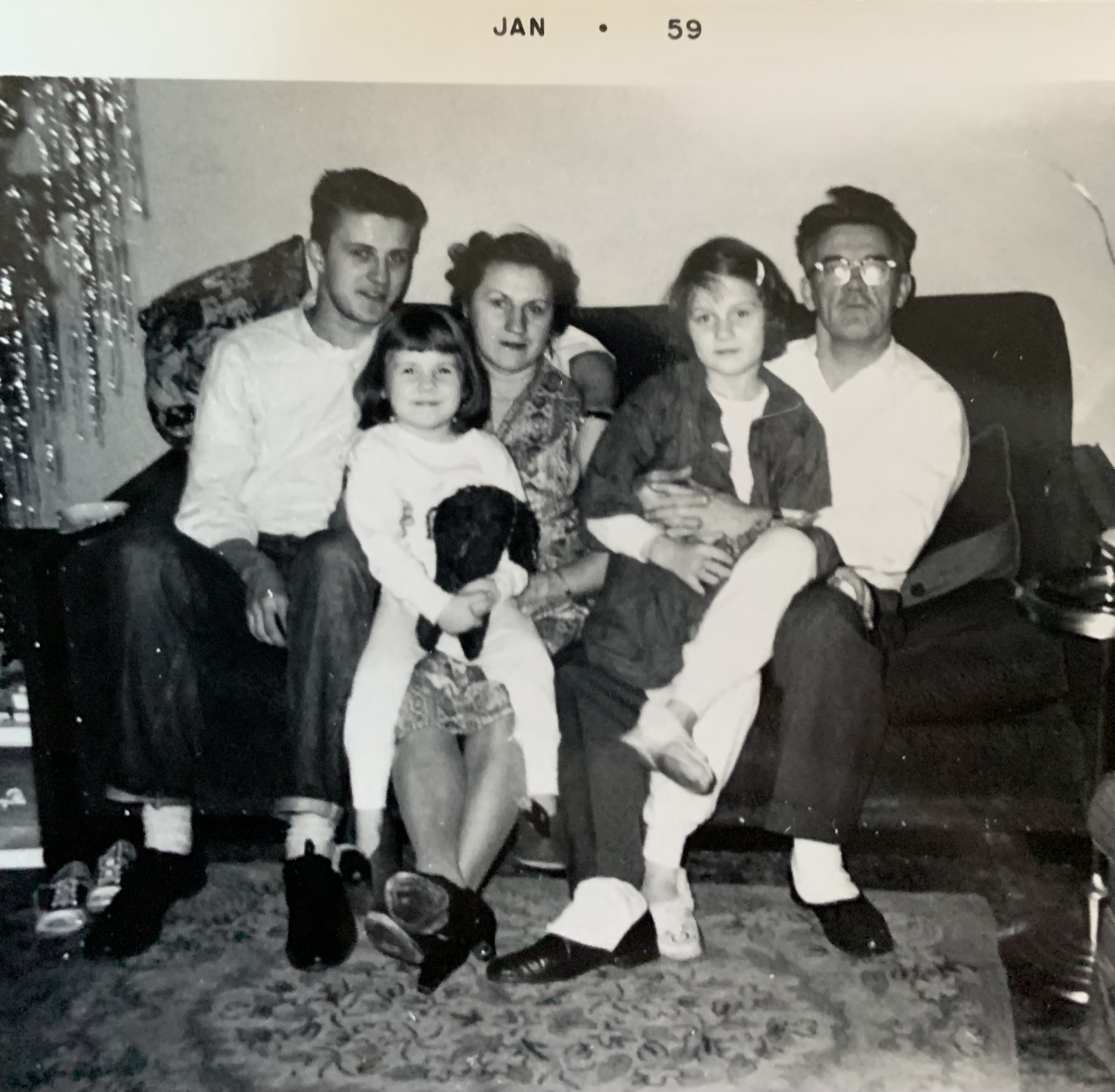
Us: Ronn, Suzie, Mom, me, and Dad.

