Uncategorized

Renny Whiteoak

My mother loved books, and although she had not graduated from high school (she received her GED when I was enrolled in college), she made sure she passed on her love of books and learning to her children. So once every two weeks, she walked my sister and me to the Center Street library, where she checked out several books, and where Suzie and I also found books to take home and to read.

Somewhere over the course of my childhood, my mother received a set of bound, green covered books, fictional accounts of a family from Canada: The Whiteoaks of Jalna (written by Mazo de la Roche, Collier and Son, publishers). I still have the six volumes, a wonderful set of books I set out to display on beautiful fir shelves in our living room. When I was old enough to read these books, Mom and I read the books. And we talked about what we had read, those fictional people, whose lives were much more privileged than ours, that beautiful country land, such a stark contrast to the streets lined with narrow, rented flats in the city.

What I remember most about those books is how they awoke my mother’s fancy, as well as mine. We loved the characters. We talked about the happenings in the books, as if we had witnessed these happenings in our own lives. And we admired – maybe even had a crush – on the eldest son, Renny Whiteoak.

Renny was a red-headed, ruddy young man, strong, good looking. Over the course of the books, he grew from a young person into a young man. And both Mom and I fancied, from time to time, that we had seen Renny. Sometimes, as we rode in the car (Mom learned to drive and got her driver’s license when I was in Junior High), one of us would point out a young man on the street: “look, there’s Renny!” And we’d both agree that we’d seen him, again.

Mom sparked my imagination, and I expect she sparked mine because her own was lit. She would remind me – in later years, when I discovered my anger at what my folks had or had not been able to give me – that she had grown up in a different way than I had. And that included making space for books, for imagination, for a world that would grow to be larger than the world I was coming up in.

Now, I love seeing those green covered books on my shelf. They hold a lot of memories for me. Lately, I’ve been reading again – for the fourth time, I believe – Jane Eyre. As I remember the legacy my mother gifted to me, I expect I’ll be reading about Renny Whiteoak again, too. Maybe I’ll even see him on the street.

Here’s to Renny! – photo by Mary Elyn Bahlert, 6/2023

community, nostalgia, remembering, Uncategorized

Meeting Joanne

2023 marks fifty years since Joanne sat down across from me at my desk in the Social Security office in Green Bay, Wisconsin, smiled warmly at me, and said: “Do you golf?”

I answered: “I haven’t, but I could try.” I have never tried, in 50 years. But Joanne is still a good friend, to me, and to my husband, Jeff.

We were both Claims Representatives at the Social Security office in Green Bay, Wisconsin. I’d arrived at the office in June of 1973, after three months of training in the Minneapolis office. In March, I’d driven my red VW bug to Minneapolis while I received training, and now I was permanently assigned to Green Bay. When I came to the office, I was the first woman to work as a Claims Representative in that District, helping folks who were about to retire to complete their claim for benefits. Joanne would follow, a couple of months later. She’d been promoted from her job as a Service Representative. As a Service Representative, she’d helped folks with issues they had after they had begun to receive benefits: Retirement, Disability, Child’s Benefits. In the time I worked at Social Security, in the Green Bay office, at the office on the South Side of Milwaukee, and later, as a Field Representative out of the Waukesha office, I never ran into a person who performed the job better than Joanne. She read each of the papers that came across our desk each week, filing them in the proper place in her copy of the Social Security Manuel, the working details of implementing the Social Security Law. She was smart and competent, the hardest worker I knew.

We traveled together, driving to the Northeast, to Florida, to Washington, D.C., to Montreal and Quebec on our vacation times. We met one another’s friends. We lamented our lack of dates. We shared recipes. We took rides together on warm summer nights, ending up on the Eastern Shore of Green Bay, watching the sun set over the Bay. When I was able, I moved back to Milwaukee, and Joanne followed, not long after. She bought a little house and she spent her weekends and evenings working hard on that house. Joanne can do anything, in my estimation.

The contractor that helped her with one of her house projects told her that there was a nice, young, divorced man who lived in a house around the corner. He wanted them to meet. Sure enough, Rich and Joanne began to date, and after a couple of years, they married, in the spring of 1983. They moved into his little house in the neighborhood, and later, a larger house. In 2014, they moved into a home they’d built on a small lake in the county to the west of Milwaukee County. Joanne had accomplished her life long dream to live on the water.

I was in seminary when Joanne and Rich were married, and she stood up with me in my wedding to Jeff in Milwaukee in March of 1984. In later years, after I’d moved to California, she and my mother became good friends, baking and cooking together, enjoying one another. When my mother’s memory became bad and she needed help, Joanne visited her and answered her frantic phone calls, until we knew she had to move to be closer to me in California.

A few years ago – 2016 – I answered the phone in the kitchen on Labor Day, in the evening, when Jeff and I were about to go to bed. I heard Joanne’s voice then, and I heard something in it I hadn’t heard before. “Joanne?” I asked. And then again: “Joanne?” She told me that she and Rich had spent the day in Emergency at a local hospital. Rich had been diagnosed with Glioblastoma, an aggressive cancer that originates in the brain. By October 15 of that year, Rich was gone. Jeff and I made sure we cleared our calendars and made the trip to be at his Memorial. There, Joanne was surrounded by so many friends that she and Rich had made over the years, both Rich and Joanne folks who were important to the community in which they lived.

Joanne came to visit us in Oakland this past winter. She’d arrived from Wisconsin, hoping for some nice, sunny weather. Winter can be long and gray in the Midwest, and sadly, winter here was long and gray, also, one rain storm following another for days. But the conversation that started so long ago in Green Bay continued, and since Joanne was visiting, we explored some interesting places in the Bay Area.

Next week, Jeff and I will be flying to O’Hare Field in Chicago, where we’ll rent a car and drive to spend the first night of our trip with Joanne in her house on the water. We won’t run out of things to talk about, the three of us, and together, we’ll make sure we remember Rich, how he made us laugh, how he made Joanne laugh.

Uncategorized

The gladdest thing

I will be the gladdest thing
    Under the sun!
I will touch a hundred flowers
    And not pick one. — “Afternoon on a Hill,” Edna St. Vincent Millay

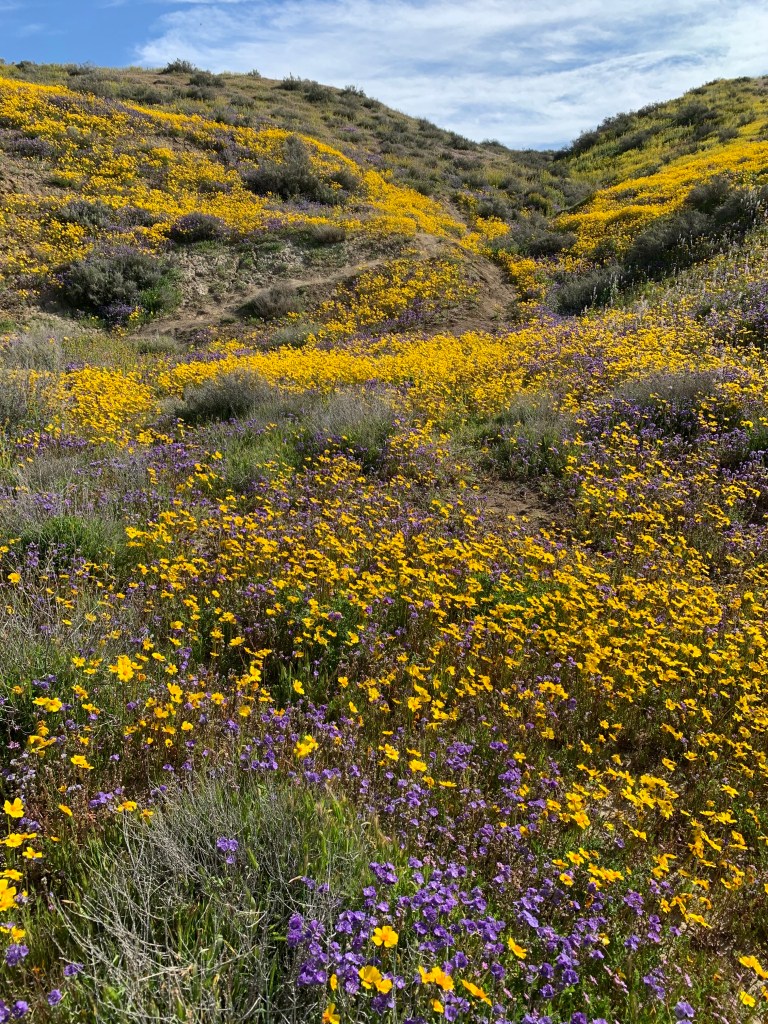
For a couple of days – for a few hours this week – my husband and I and two good friends were, indeed, “the gladdest thing under the sun!” We drove and we hiked up hills and we walked among the hills at Carrizo Plain National Monument in South Central California. The long drive was worth it!

Enjoy this tiny sliver of the beauty that was ours to savor, to enjoy, just for a time:

Carrizo Plain National Monument, photo by Mary Elyn Bahlert, April 11, 2023

Uncategorized

Walking Through the Pandemic

When the “shelter in place” began in California in 2020, I expect that most of us thought that if we just closed down for a few weeks, we’d be able to get back to our real lives. And so we sheltered. Here in Northern California, the winters are often mild, and many winters, there is not even much rain – until this year, of course, a record-setting year for rain. So in the late winter and the spring of 2020, we stayed close to home, enjoying our yard in the city. In the evenings, before sunset, Jeff and I would often drive through Oakland, seeing neighborhoods we rarely saw, enjoying the one freedom we had. We ordered our groceries delivered to us. We felt privileged – which we are – with a studio in the back of the garage for Jeff, and the room I call “my little study” down a flight of stairs from the kitchen.

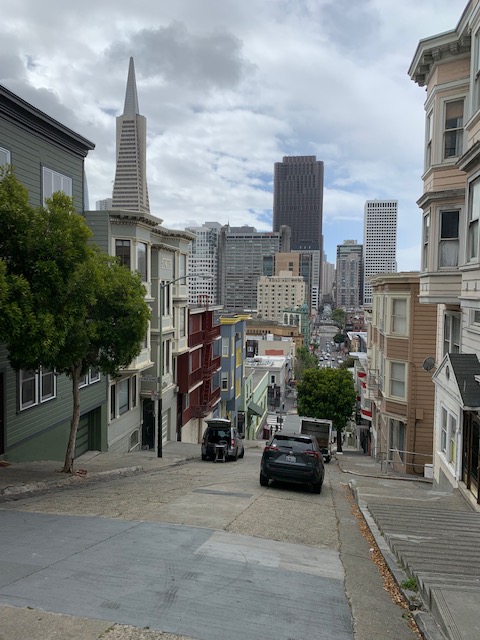
Still – how to pass the hours, multiplying into weeks and months? We didn’t take to going to worship online, and so we began to leave our house early on Sunday mornings to find places to walk. Both being retired, a Sunday morning to spend as we wished was a luxury. And we counted: over the course of many months, we walked at least 15 neighborhoods in San Francisco. We walked up hills. We walked down hills. We walked through streets that were mostly empty of other people. We walked and we talked.

We walked, again and again, on the paths that line the Martinez Slough, high tide and low tide. We walked and we talked.

As time went on, we invited friends over to enjoy our yard with us. We brought dinners out to them on paper plates, and we often sat, dressed in sweaters and even coats, until the light of the day was passing away.

I had a large plastic box of decades of photos from my lifetime – and from the decades before my lifetime – on a high shelf in the garage. Jeff brought the box out to me in the yard, and I sat in the sun and sorted almost a centuries’ worth of photos, some black and white, some formal, some taken on a whim. I looked closely at each one, the time stretching before me into some unknown future, and then, the past stretching behind me. Some of the photos I mailed to my sister in Hawaii, others I sorted again into large folders that now fill a drawer of the wooden file cabinet in my study.

Like so many others, we think back on three years of the world’s living with COVID-19, and it’s hard to believe we did it. We learned to live with the virus, and we are grateful that we didn’t contract the virus until it was less severe than news reports talked about in the beginning, when health care across the world struggled. And our own world grew in a way, as we discovered places in our own community.

It’s a relief that the world has moved on to a different place, with COVID-19 a regular resident of the planet, along with the rest of us.

Walking through the Pandemic: San Francisco 11/2022

photo by Mary Elyn Bahlert

Uncategorized

I wish it would snow once…

Mom was diagnosed with cancer early in December of 2000. We took her home from the doctor’s office, Jeff and Mom and I silent as we made our way from his office to the elevator. We had all agreed to hospice care. When we took her back home to Mathilda Brown Home, the staff went into full gear as we all received an explanation about what hospice would entail. Jeff and I were grateful that Mom could stay in her little room, in the place she loved.

I visited daily then, and most days, I’d find Mom in her room, sitting in her chair, crowded next to her bed, or lying on the bed, resting. One day when I arrived, I found her on a wooden chair in the hallway, her bathrobe over a nightgown. She’d forgotten to change that day, so we went into her room and chose clothes more suitable for the day. “ I must be losing it!” she said.
Another day, Mom was sitting on the edge of her bed, facing the window that overlooked an alley and the playground of Oakland Tech. When I came into the room, Mom said, without turning her head: “ I wish it would snow once, just for me.”

I wished it would snow, then, too. As tough as winter can be in the Midwest, we Midwesterners love its beauty, those days when the snow falls silently and without a wind to rustle it, to the earth. That winter, in the days before Mom died in mid February, weather reports on local radio announced that there had been a sprinkling of snow high on the hills over Oakland. I wished I’d been able to take Mom to see it, but by then, she was confined to bed.