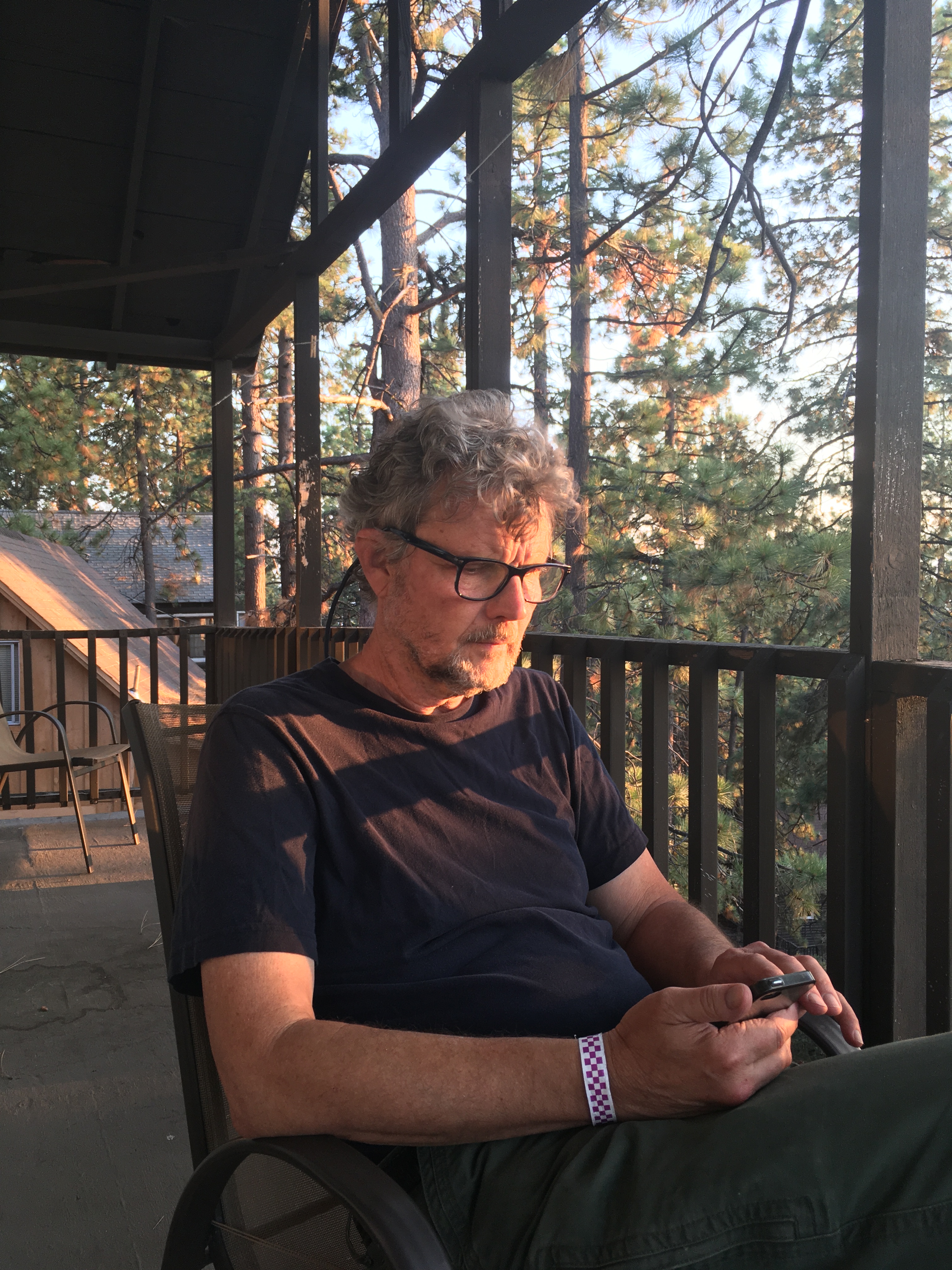
Sometimes in the morning or evening, when Jeff and I sit across the room from each other – he in his beloved leather chair, and me on our sofa, I look up to look at him. He is reading, or watching another series on the web. He doesn’t know I’m looking. I look up and take a few moments to look at his face, to study him, to enjoy him.
Jeff’s face has been in my life for a long time, although sometimes it seems as if all the time has gone by so quickly; it has gone by so quickly. We’ve had good times, sweet times, hard times, laughing times, gentle times, shouting times, quiet times. I am grateful to the Powers for having gifted me with Jeff as my partner in this life.
I love that Jeff is a man who makes sure to make time for relationship, time to nourish and be with one another, offering gratitude, remembering together, enjoying one another.
And so, today, this is an ode to Jeff’s face. “From the beginning of my life I have been looking for your face…” – Rumi
I think his kindness shows in his face, and I’m grateful for his kindness, through all of life’s journey.
Sometimes when I think about my life, I think I came from what we called “The Old Country.” The Old Country was how my mother referred to people who – like her parents from Ukraine – had immigrated to the United States. Many of the customs and much of the way we lived then, in the 1950’s and 1960’s – were ways that had strong connections to the Old Country.
Summers in the Midwest can be brutally hot and humid. By the late afternoon, we tried to find respite from the heat by running an electric fan near the screen door that led to the front porch of the upper flat on Milwaukee’s North Side. Even the whirring fan did not change the oppressive heat in the flat. Several days during the summer, after Daddy came home from his job in the steel mill, Mom and Daddy and Suzie and I set off for a secluded, leafy spot on the Milwaukee River. Daddy had changed into bermuda shorts – he’d been liberated from wearing long pants all summer some time in the 1950’s – and the car was quiet except for his talking, all the way across town to our spot.
We carried wooden poles and Daddy carried a silver bucket with water sloshing against the insides, and a package of raw liver – bait for the cray fish we were about to catch.
I never did like to touch the sharp edge of the hook at the end of the fishing line, so Daddy baited the hook with a bit of slimy liver, and I dropped my line into the river, and waited. Soon enough, the line would be pulled down a bit into the brown water and I’d pull up my end of the pole, a crayfish holding tight to the liver on the hook. I’d swing my pole toward the shore – hoping to not hit Suzie or Mom – and drop the writhing crayfish as close to Daddy as I could. He’d pick the crayfish up by sliding his fingers along the fishing line, pull, and drop the catch into the silver bucket.
Then, he’d bait the hook for me again, and I was back at it.
We still made it home to the flat in time for an early supper, after Daddy had carried the silver bucket, now heavy with crayfish, into the basement. One time, a crayfish found its way out of the bucket – how did that happen? – and he had to chase it around the cool floor of the basement until he picked it up again and dropped it into the bucket with its companions.
The next day, Mom boiled a big pot of water on the stove, and one by one, the cray fish were dropped into the steaming water where they stopped their frantic moving and turned bright red. Mom served the crayfish to Daddy while she made supper for the rest of us.
I never did get to taste a crayfish. I didn’t want to. But I can still find the place where the leafy path led to the river, down a few steps from the sidewalk, where the lush trees muffled the sounds of passing traffic.
Now my summer adventures are to the desert in California. Photo by Mary Elyn Bahlert, 04/2024, at Joshua Tree National Park in Southern California – where two deserts meet.
I sat in the comfortable chair next to my mother’s bed as she lay in a coma, dying, in the room she so loved at the Mathilda Brown Women’s Residence in Oakland. I was sad. I was not thinking about anything in particular. A friend – a woman who had been an intern with me in the congregation in Oakland – had left the room a few minutes earlier, and so I sat in the silence with Mom.
The end of the day had already come; the hall outside Mom’s room was quiet, except for the soft sounds of one of the nurses or care aides as they passed, or a few mumbled words from somewhere else in the building. I would go home soon, to sleep in my own bed; Jeff and I had decided that he would spend the night in the chair next to Mom’s bed, so that I could get a good night’s rest at home.
I looked across Mom at the window of her room that looked out over the playing field at Oakland Tech. Mom’s breathing was even, quiet.
As I sat there, the words to a song from so many I knew from so many years past seemed to drop from nowhere into my head. When I tell the story, I always say: “the words dropped into my head, whole.” I repeated the words, singing to myself:
“How can I hope to make you understand, why I do, what I do? Why I must travel to a distant land, far from the home I love? Who could see that a man would come, who would change the shape of my dreams? Helpless now, I run to him, watching other dreams grow dim… Oh what a melancholy choice this is – wanting home, wanting him – Closing my heart to every hope but his, Leaving the home I love…” —Bock, Harnick – writers
In the morning, several minutes after I arrived in her room and said: “I’m here now,” she passed.
All that’s left… Mom’s pysanki. Photo by Mary Elyn Bahlert, 2024
I leaned over the railing of the front porch of the Upper Flat on Ring Street, and I craned my head to look down the alley to the left. A long way down the alley – almost to Burleigh Street – I saw the little figure, long dark coat almost touching the ground – of Grandma. She walked slowly – my Grandma was old – and she looked down at the pavement. Careful. Old. As she got closer, I saw her head was wrapped in a thick black scarf decorated with the bright colors of flowers. The scarf covered her hair, except for the hairline in the front, and she had tied it in a knot at the back of her neck. She didn’t look up, not even once.
When Grandma came up the narrow stairs and into the flat, I watched her from the other side of the living room. She looked at me once, twice, and a little smile came to her face. And then she talked, but only to Mom. They spoke their own language when she came over, and I didn’t understand. So I played on the floor across from the couch and listened. I listened and listened. What did they say? I listened and listened.
Years later, after she died, Grandma would come to me, as if in a dream. And she stayed with me for a long time. “Why did she come to me?” I asked a friend. “Who else would she go to?” she answered, wisely.
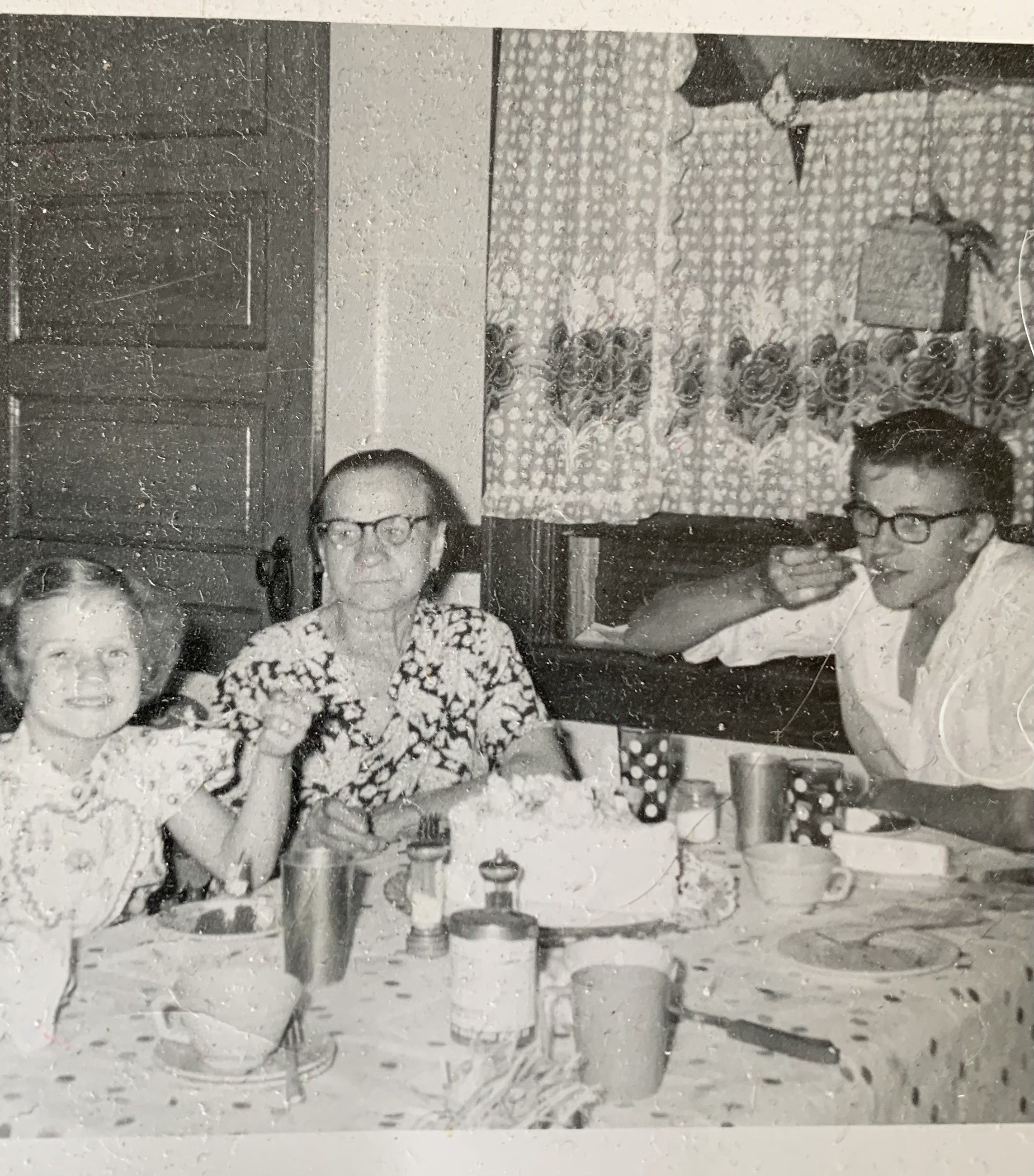
My favorite picture of Grandma – Feodosia Machsuda Srebny – shows her with a little smile on her face, sitting with me and Ronnie at the table. Ronnie wanted to be cool, a teenager. I love the picture because she is smiling, and her eyes are smiling. I don’t think of her as smiling, a little foreign woman – foreign even to me – poor, sad. When she was older she didn’t say any words in English. She forgot. Only Mom could talk to her then.
At Easter, we decorated eggs – some in the old fashioned way, pysanke – and some just dipped into colors: blue, pink, yellow. We blew raw eggs out through holes on the ends and Mom took hours to craft hers. Ronnie was good at it, I think. And Mom. But Grandma didn’t make the eggs. She sat on the couch in her long black dress, her dark hair held back in a loose bun, streaked with gray, her fingers bent as she tried to crack eggs with Suzie.
Daddy and I would go to get her at the nursing home and bring her home for Easter dinner. And soon after dinner, she’d look at my mother again and again, asking to go home. Mom did the same thing when she got old.
I love the holiday season, which begins with Thanksgiving Day. When I was pastor in downtown Oakland, the congregation marked the day of thanks by offering a wonderful, complete Thanksgiving Dinner to anyone in the community who wanted to join. Homeless folks, people who did not speak English, people without family or even friends, joined the day’s gathering to sit at a table and to be served by other grateful folks. For many years, that tradition became part of my personal Thanksgiving, as I looked out at the gathered people and said to myself, again and again: “these are my people!”
And Jeff and I mark the holiday every year now by arriving at Norman and Cheryl’s cottage on a hill in San Francisco, climbing the narrow stairs to the top of a hill, our arms filled with pies – our contribution! – and to sit at the long, narrow table filled with an assortment of Bahlert-related people every year. As the day progresses and the dusk and darkness come, families with little ones begin to gather their belongings and leave, with much ado. The tiny kitchen which produced the feast we’d all enjoyed is full of helpers bumping into each other, cleaning up, continuing the dinner-time conversation. And then – just like that! – we all descend the steps and walk to our cars on the quiet streets and drive home, mentioning to one another moments from the day, who had grown, who talked to who, how much older everyone is (except for us, of course!), and probably feeling a bit of sadness that another holiday has passed.
In the Midwest, the shorter days and long evening of dark and cold have begun by this time of year. There’s a sense of “cocooning” that we don’t know in the same way here in California. And missing now, also, is the childhood sense of a quiet and light filled season, beginning with Thanksgiving, that won’t end until after Epiphany, in January.
My mother honored the season of holidays each year by hosting Thanksgiving Dinner at our upper flat, and by creating for my sister Suzie and me a holiday tradition. In the 50’s and 60’s (of the last century), the holiday season did not officially begin until Thanksgiving. On the day after Thanksgiving, my mother and Suzie and I took the 23 bus from the North Side to downtown Milwaukee, now mysteriously decorated with lights and ribbons along Wisconsin Avenue, still a booming shopping district at the time.
We’d step off the bus at 3rd and Wisconsin to walk through the Boston Store, which anchored the downtown at that time. My mother held tightly to each one of us as we walked through the crowded store, the lights and music having followed us from the street into the store.
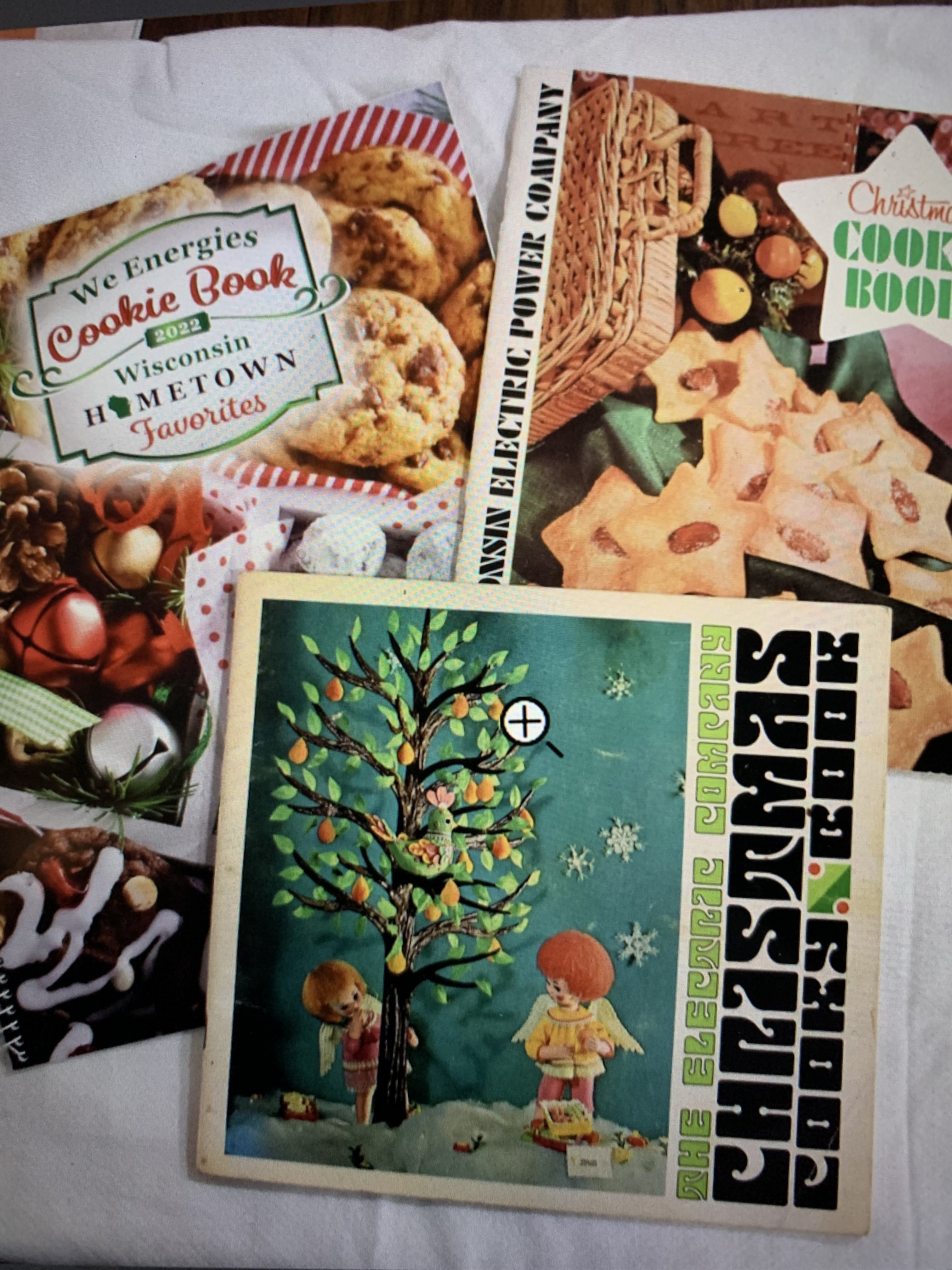
Then, we’d walk, first to the Wisconsin Electric Company, and then to the Gas Company, to take in the cookie displays at each one. My mother made sure that at each place, she was provided with 3 copies of the new cookie book published by each company each year. She loved to try new recipes, and she loved to re-create those that had been her favorites – or dad’s favorite, or mine, or Suzie’s. Unknown to me, she wrote notes as she baked: “a favorite,” “takes a bit less powdered sugar than called for,” “makes a big batch!”
I didn’t discover the notes until years later, when I had my own apartment in Green Bay, and when Mom presented me with the collection of cookbooks she’d saved, just for me.
I’m not a great baker, although the family in San Francisco allows me to bring pies as my contribution to Thanksgiving. My mother loved to bake: “that’s the fun of it,” she’d say. And I expect she envisioned some sort of future for me and for my sister, based on her own life. Neither of us grew to have quite that future, I expect; it was her dream for us, regardless. The year after I retired, I baked a few batches of cookies, looking for a new way to fashion my life after an adulthood of work, often in a “man’s world.” That’s the year I reached high onto the kitchen shelf reserved for our cookbooks, and retrieved the cookbooks Mom had saved so carefully for me. And that’s when I saw her notes, in her particular hand-writing, written with me in mind, written with the relationship between the two of us holding us together.