Uncategorized

Seeing the Mother-land

1988. The times were very different from these times. The world was changing – quickly, it seemed. I was in my fourth and final year as the Associate Pastor of First United Methodist Church in downtown San Jose. And I had learned about a trip sponsored by the World Council of Churches to travel to the Soviet Union to honor the 1000 anniversary of the introduction of Christianity to Russia.

The congregation I was leaving gifted me – through the donations of several folks – what was needed to travel to the Soviet Union as part of a delegation of Americans sponsored by the World Council of Churches. I was grateful – and very excited – to see what was part of my family’s homeland. My mother’s parents – my maternal grandparents – had immigrated to the United States from Ukraine in 1914. They had held onto the hope for their people, even in the New World, expecting that the formation of the Soviet State would bring freedom. History would prove otherwise, of course (once – having received as a gift, a large volume about Stalin’s time, I’d had to stop reading when Stalin’s slaughter of the Ukrainians numbered well over 10 million people – primarily in the 1930’s). Their hopes did not correspond to the life they had here.

The trip began with several days of study of the Soviet Union and the Orthodox Church tradition in Brooklyn, New York, before the group made the journey to Moscow. Since we were guests in a Communist country, our group had been assigned to travel to events in several cities, and without our consent, the group was divided into smaller groups with different itineraries when we arrived in Moscow. I traveled to Moscow, St. Petersburg, Kiev, and to Odessa, a beautiful city on the Black Sea.

In the Soviet Union, the time had received the name, perestroika – restructuring of the economy. The people of the USSR – and the world – had hopes for the new Soviet Union. It was an exciting time to be in the USSR as a foreign visitor; indeed, the WCC trip coincided with the visit of Ronald Reagan, the U.S. President, to the USSR.

I was as close as I would ever be to “my people,” the people of Eastern Europe. As the years have unfolded, I have learned that my family – who had broken with “Church” by some turn of events in Ukraine, before emigration – must have been Catholic, a common faith and practice in Ukraine. Still, I was grateful for the introduction to the Eastern Church, the Orthodox Church. For me, traveling with the WCC was a doorway into a deeper look at life in the USSR – one doorway among many.

And so I was privileged to see the homeland, over fifty years after my grandparents had left their home. My privilege was reflected in another way; I told my mother about the trip, and invited her to join us, to finally secure her passport, to see the place where her people had lived, and where some still lived. She couldn’t see herself traveling that distance, and out of the country, and so she did not join the trip.

I’ve been inside many churches in my lifetime – to be sure. And there in the Soviet Union, I saw some of the most beautiful churches I have ever seen. The high arched ceilings, the iconography, the beauty of those places touched me. Even more, the babushkas – the poor women who came to the church with their prayers in their hearts, who bowed, again and again, standing before the saint to whom they gave their prayers – touched my heart. I carry their devotion with me, even now.

We learned that the Soviets – atheists – had protected the churches through all the years of the USSR, since 1917. They, too, had been moved by the beauty of those places. When the anniversary of the Orthodox Church was being planned, minutes from the organizing included these words: “Members of the Bishops’ Pre-Council Meeting gratefully consider it necessary to note the positive attitude of the Soviet Government to the questions put forward by the Hierarchy of the Church.” In other words, the government had agreed to allow the celebrations.

When we were not in churches, my roommate and I walked through the streets of the cities we visited. And in Kiev it was that I saw “my people.” The faces, the eyes, the way the people carried themselves – I recognized. They are forever “my people.” The days we were in Kiev were beautiful spring days. The lilacs were in blossom. The people felt the freedom of the spring as well as the changing times – as difficult as the present and the days to come – like all the days in the past – would be.

*

When I read the news these days, the world hears rumblings again coming from that Eastern place, now called Russia, again. I often think that Putin, President Putin, has never lost his history as KGB, and so he rattles the chains to control the people of his country – and the people of Ukraine, a sovereign nation. We may see the lock-down, the disappearing of that place as a free land – again.

On the back of this photo, in my mother’s hand: Vlas Markov Srebny Feodosia Maksuda Srebna, Ivanka (Ivan, little one) Srebny, 4 yrs. old . Photo circa 1914.

memories, remembering

Sheepshead

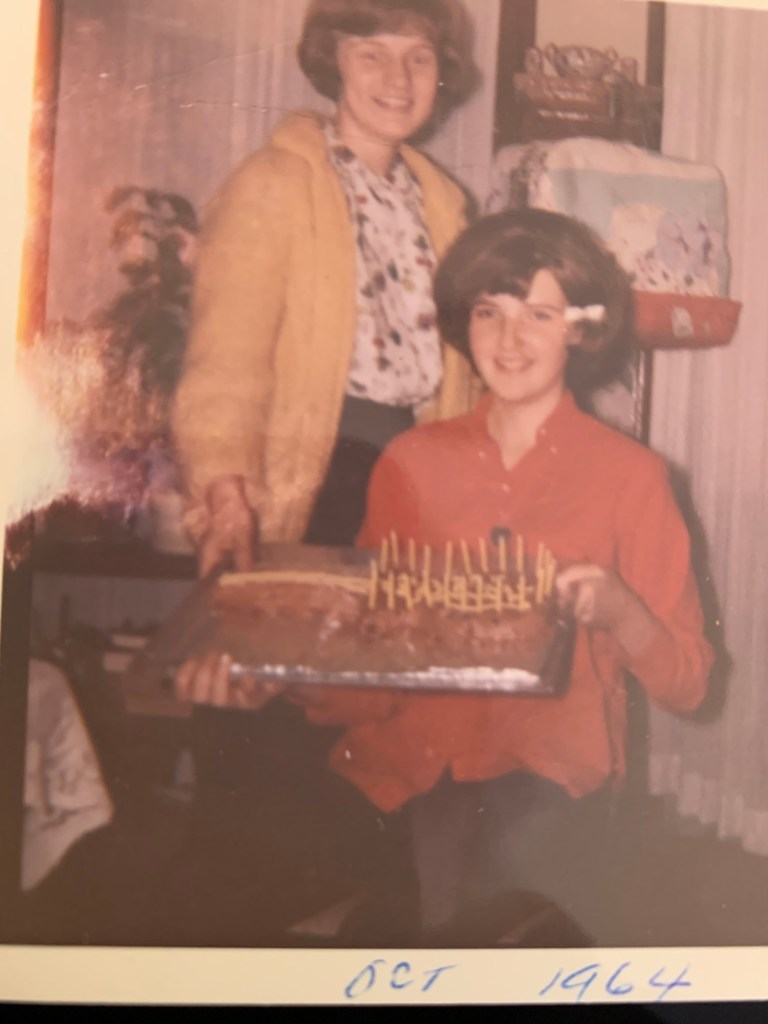
I loved – still love – the season of holidays. As a child, holiday time meant a time for the cousins and aunts and uncles to gather at our house for the holiday meal – which was followed by the dining room table being cleared as quickly as possible, the tablecloth removed, and the cards ready to be shuffled and played. Of course, the women had already finished the clean up time in the kitchen, the men had had another beer – or two, sitting together in the living room – and it was time to play Sheepshead.

When I explain this ritual now, folks are usually stymied by the name of the game – Sheepshead. It’s a trump game, I tell them, and almost everyone in Wisconsin plays Sheepshead. The original name, schafskopf, is a German name and Sheepshead is a German card game. The full deck is not in use when playing Sheepshead. And the highest card in the deck is the Queen of Clubs. Besides the basics, it’s hard to understand Sheepshead, to get its allure, and to understand why it was a part of every holiday – unless you play.

When I was little, I convinced myself that I’d never play that noisy, rowdy game. The hands were dealt and played quickly, and there were loud voices and complaints that accompanied every hand dealt. Daddy and the uncles pounded on the table, even though money was not involved. When they played Sheepshead, and as the day – and the playing – went on, the loud voices and the pounding on the table seemed to get more fierce. “What could be fun about that”? – I must have thought.

Until I learned to play. Mom taught me, when I was eleven. First, I had to learn what was trump, she said, as she lay all the cards on the table, right side up. Then, I had to learn the rest of the suits, in order. Then, I had to learn how to arrange the cards I was dealt in my hand. Then, I had to learn to count trump as it was played – a necessity for proper strategy. Mom was a good teacher. Soon, I was playing Sheepshead, too.

And soon, I was hooked. Ever after, I could join the shouts and complaints at the table. The shouts and complaints didn’t seem as big as before, and maybe the shouts and complaints seemed necessary, once I’d started to play.

“Sheepshead! I can play!” Here in Oakland, Jeff and I have taught a few people to play Sheepshead. This past year, we taught our friend Jim, who is sure to impress his German relatives when he makes a trip to see them. The rules may be different, we tell him, but you’ve got the basics down.

Our house is a lot quieter on holidays than our house growing up was, and that suits me. Our holiday meals – after we’ve finished and have moved to the living room to sit next to the Christmas tree – are followed by long conversations with good friends, and Sheepshead seems to be something in the past now. We have taught our nephew Rainier and his wife, Lia, to play. I hope they like it, too.

” …after we’ve finished dinner and have moved to the living room to sit next to the Christmas tree…” – photo by Mary Elyn Bahlert, 12/2024

memories, nostalgia, remembering, Uncategorized

Facing the dark – entering the deep of the year…

I grew up in the Midwest. There, the darkest times of the year also heralded the beginning of the coldest times of the year.  Now, since I have had the pleasure of living in a Mediterranean climate for many years, I hope for rain to quench the dry land as winter approaches, I watch with interest the days grow shorter, and I watch the final red of sunset linger over the Bay, sink down beyond San Francisco into the Pacific.

*

Here in Germany to visit friends and to visit Christmas Markets – the Germans know very well how to do Christmas! – I am reminded of how the darkness shapes this season, and I remember the Festival of Lights that is Christmas, and the lighting of candles that honor Hanukkah, fall always during these darkest days. Here in Germany, darkness comes on early as the temperature hovers just above freezing.

As I walk through the Christmas Markets of Regensberg this year, I see the same trinkets again and again, and sometimes, a treasure shines out from the rest, and I stop at a tent covered booth to look closely. Will this be a good gift for Joanne, I think? Can I carry this lovely toy in my suitcase without breaking it?

Christmas music playing from speakers hidden somewhere in the eaves of the buildings that circle the Market adds to the festive flavour of the season. Sometimes, the cold air sweeps me away again to those dark December evenings in the Midwest, marching over snow covered ground to select the perfect tree from a well-lit city lot, the perfect tree that Dad carries back to the car and fastens securely with a rope for that purpose, into the trunk. Then, I’m back in Regensberg, as quickly as I left, turning round and round to see where Jeff has wandered, knowing he enjoys the music and cold and darkness and even the crowds, as much as I do.

Yesterday, I learned that Bill, the widower of my good friend Sue who died so young, Bill, who made her so happy, has passed. Melancholy and memory seem to go well with the cold and the Christmas music.

Still, the holidays are here with their mixture of merry and melancholy. When I return home, after Jeff and I select our own tree from a lot in the city, I’ll sit across from the sparkling lights with a cup of egg nog, I’ll remember all those I love who are gone now, who I hold in my heart in the reflection of the lights.

Christmas-time in Wien, Austria. Photo by Mary Elyn Bahlert, 12/2024


Uncategorized

“There are places…”

“There are places I’ll remember, all my life, though some have changed…” – Lennon & McCartney

Today as I walked in Oakland between rain storms – we’ve been promised a winter with lots of rain! – I was remembering places in my life.

I remember the walk from 11 and Ring to 9 and Ring Street as I made my way to kindergarten at LaFollette Primary School – I didn’t know then that I was beginning the walk to a life different from the one I had been born into. I didn’t know then that the teachers who taught me would not only open the doors for me to another world, but that I saw in them – and remember – women unlike my mother. And I saw myself in them.

I remember the evening I sat as the dark came on at the Mathilda Brown Home on 42 Street – behind Oakland Tech – in Oakland, as I sat in the dark beside my mother’s bed, and where she would die the next day. As I sat there, a song filled my mind: “how can I help to make you understand, why I do, what I do? Going away to a distant land, far from the home I love…” (Bock/Harnick, from Fiddler on the Roof).

I remember walking along Piedmont Avenue in Oakland on Halloween Night over a year ago as little Celeste held onto my hand, dressed in her princess costume, and as we passed the other children out to reap the Halloween bounty from the store fronts. She was quiet, careful to stay connected to me in this place, so far from her home.

I remember that I’m an old person now as I passed a man with wrinkles who walked slowly, and as he met my eyes with his own and greeted me, another neighbor from the neighborhood. I’ve changed. He’s changed. But inside of us, we are the same as we’ve always been.

I remember that soon Christmas will be here, and I’ll try to make the house in Oakland cozy, something that’s hard to come by in this temperate climate. And as I sit in the darkened room in front of the Christmas tree with lights shining out from its branches, I’ll remember Christmases past, a long time ago now, a lifetime ago.

I remember as I walk close to home, that I am grateful for this beautiful place, this temperate climate, this lull in the morning’s showers, this air so fresh in my lungs, this place that is home to me, and has been for a long time.

Some of these memories I’ve held onto for many years, as if I can see in my mind’s eye every passing moment. Some of these memories will be gone soon, maybe never to come again. I’m sad. I miss them already.

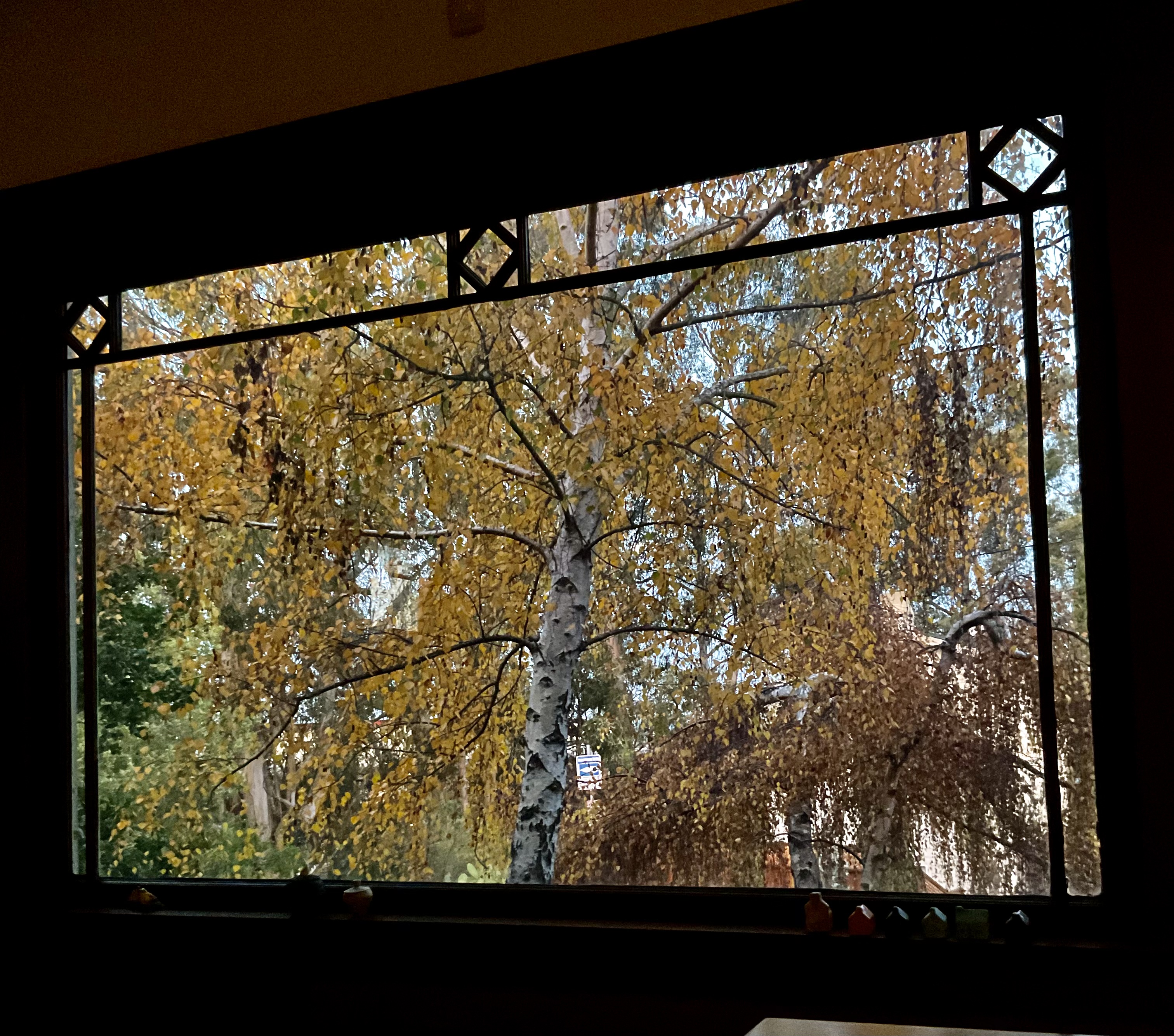
I remember that this beautiful tree has been a faithful, beautiful companion to me for a long time. Photo by Mary Elyn Bahlert, 11/2024