memories, nostalgia, remembering, Uncategorized

John

Judy and I were in love with the same guy. We were fifteen, and we’d been friends since we were in kindergarten together at La Follette Elementary School on the north side of Milwaukee. Judy’s family had moved to West Allis, a suburb of Milwaukee, which put them closer to her dad’s work at Allis-Chalmers Company. We’d come from the same kind of people: hard-working, working-class people.

Judy was sitting across from me the day I returned after getting a vaccine shot by the school nurse, and she saw me throw up what was in my stomach – as it happened. But she was my friend, anyway.

And we were living on the other side of Milwaukee in 1964, when the Beatles “invaded” the United States, and the world. Of course, all the young girls had watched the debut on the Ed Sullivan Show – a favorite of mine for many years – and had decided, at once, who was their favorite Beatle, as we watched the girls our age in the studio shouting, crying, screaming.

My family’s stereo system was on a large cart on wheels, and for some reason, Mom allowed me to have the stereo system in my bedroom, the already-cramped room that I shared with my little sister, Suzie. And so I played the few records – 45’s and albums – that I had, over and over – and over again.

Every few weeks, I’d take the money I’d earned from baby-sitting the three little kids next door, and I’d walk down Medford Avenue to the Sears-Roebuck Store on 24 and Fond du Lac, passing my friend Nancy’s house on the way. As I walked, I had in mind what I intended to buy that day: another single to add to the box I kept on the floor next to the hi-fi setup in my room. All week, I’d listened to WOKY – a Milwaukee radio station that played the kind of music kids like me listened to – so I knew what I wanted to bring home. Sometimes, I had enough money to buy an album, and so I started a small collection, which I propped up against the wall. I listened and I sang along with the records I played (my husband, Jeff, is still surprised when I burst into another song – complete verses – from the 50’s and 60’s – some of which he has never heard before). I can sing through whole albums of the Beatles, The Animals, the Dave Clark Five. Yes, I can!

Later, my taste turned to Motown Records, out of Detroit, and I can sing all the words to those songs, too.

And of course, we knew the birthday of our favorite Beatle. Judy and I talked every few days on the phone, sharing our latest news about John, what we’d read about the Beatles in the paper that week. We knew for sure that John’s birthday was October 9. In those days, this kind of information was common knowledge to Beatle-lovers.

We hatched a plan. Whose idea was it? We hatched a plan: We would bake a cake for John on his birthday. And we’d deliver the cake to the person we knew that was as close to John Lennon as we’d ever get: Bob Barry of WOKY radio in Milwaukee!

And so, on the morning of October 9, 1965, Judy and I met in the kitchen of my family’s flat on Medford Avenue to bake a birthday cake for John Lennon. We were careful as we cut the cake into the shape of a guitar (!) and decorated it with chocolate frosting, and as we added yellow frosting highlights. We were proud of our concoction! My Mom even took a picture of us together, holding the birthday cake for John Lennon!

And we delivered it to WOKY radio on Fond du Lac Avenue in Milwaukee, to be given to Bob Barry.

We had to go to school on Monday, so we didn’t hear whether Bob Barry mentioned our cake or not. And we are fairly sure the cake never made it to our favorite Beatle. But it came as a shock, years later, when John would be killed. The world was changing. And Judy and my worlds were changing, too, as we outgrew our favorite Beatle and each moved into our different lives.

Judy and me, with John’s cake
Uncategorized

Mr. Fischer

November 22, 1963. I was in my 9th grade German class, Mr. Fischer at the front of the room, when his teaching was interrupted by the distinctive ringing of the public address system, the large speaker in the right hand corner of the room, almost directly across from my desk.

I don’t remember what words came drifting down to us in our desks, bolted to the floor in even rows. What I remember, as the announcement of the assassination of President John F. Kennedy as he rode in the presidential motorcade in Dallas, Texas was reported to us from the intercom, was the face of Mr. Fischer, tears streaming down his cheeks. He made no attempt to cover his face. His eyes were not looking at all of us, the young people whose various motives had brought them to be enrolled in his second-year German class. His eyes were somewhere else in their sorrow.

Now, I remember that moment in detail, the detail of his face, larger than life, in front of the desks filled with young people who would not, could not understand the enormity of what had happened to the President, and to all of us. I had seen my father cry – never my mother – and so it must not have struck me as strange to see the kind man cry.

Now, I also – in my considering that moment in our lives over the years – believe that Mr. Fischer, so many years older than all of us sitting before him – had witnessed in his own life and history such happenings in Europe. And so he was living again in his new country a repeat of history. A sordid history.

And for the first time in my life, I came to know that not everyone saw the state of the country, the state of the world, as we did. I mentioned something about the assassination to my friend Carlene, to be met with her cryptic response: “we didn’t like him.” That was jarring, but I said nothing, taking it in, and maybe seeing for the first time the great difference between Carlene and me, between our families: her father an engineer in an engineering firm, my father a union steel worker with an 8th grade education. I saw something clearly, then, in her response. I saw something clearly about her, something that would never leave me. And I understood that we were different, and that other people saw the world differently. I understood, and for the first time.

And I knew I would stand with my people.

*

Now, as the nation struggles with the sharply drawn political/ideological differences of the people, those lines are drawn more clearly than those first decades following World War II. Vietnam and what it would bring to all of us, in particular to all of us in my generation, did not hold an important place in our minds at that moment. That would come later, and the years of unrest – brought to a head in my generation – were before us.

I remember that moment, Mr. Fischer – as a teacher, always larger than life in my own memory – standing, tears on his cheeks. And always, I’m grateful to him and to the others who influenced me, who formed the shape of my youthful world, whose influence would never leave me.

*

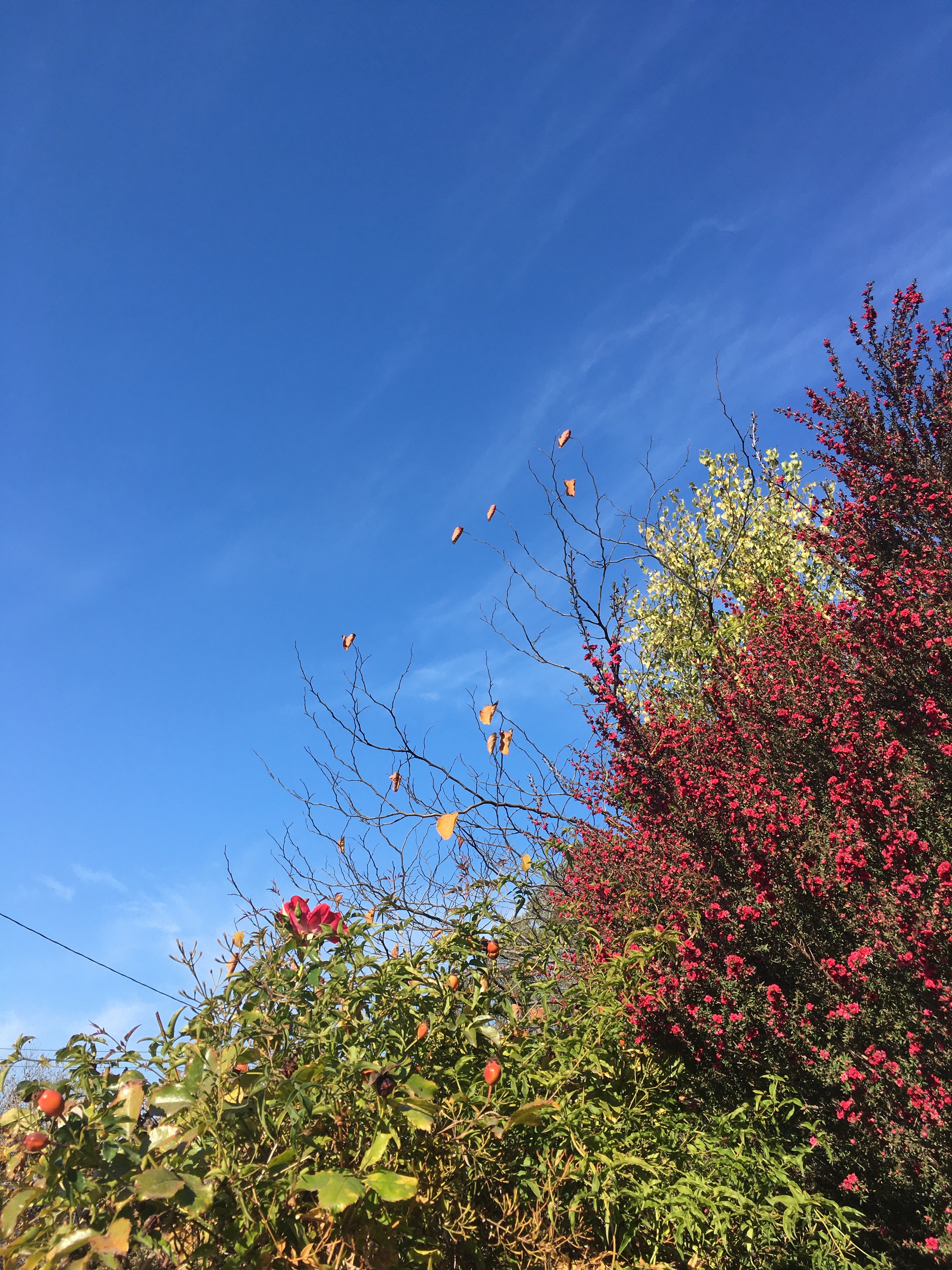
Remembering, from the autumn time of life… photo by Mary Elyn Bahlert, 10/2024, Wales, Wisconsin

Uncategorized

Clouds and Memories

I drop under the azure sky,

fall onto the grass, fresh in spring,

sniff as if for the first time.

The little cat comes to join me,

picking up each paw to navigate the way.

She drops into the shade traced by my arm.

Then, she crawls away

to her better advantage.

Once I sat under this sky

on a green hill

with a boy.

We laughed at the slow parade of cumulus clouds,

watched the white birds drifting:

an angel,

a circus clown —

a theater of our own.

Mary Elyn Bahlert, 04/2020

Uncategorized

Sad, beautiful tree

Is the tree sad in autumn when its leaves fall to earth,

the earth that holds the leaves as gently, as fully as the tree?

Will the tree cry sad and lonely tears – it stands alone, after all –

for the gentle leaves it has cradled until now?

In winter, so it seems as drops of rain fall onto, fall from the branches.

The tree mourns then – another season passes, another year is gone.

Even as the leaves fall,

the rich beauty of falling into another day,

another season gone.

Beauty remains, for those of us who see.

——Mary Elyn Bahlert, 2/2025

memories, nostalgia, remembering, Uncategorized

The outfits

There was always room for a sewing machine in our upper flat. Looking back now, I see how cramped those working class houses were, their windows covered with curtains to keep out the cold of the freezing winters in the Midwest. But there was always room for Mom’s sewing machine.

Well, it was Mom’s sewing machine until Suzie and I learned to sew. Then, if I was working on an outfit with a Simplicity or McCall’s pattern, chances are that either Mom or Suzie was working on something too, and when I stepped away from the machine to get another piece of fabric, carefully looking at the directions – I’d find a spool of thread in a color that didn’t match my material already in the machine. The sewing machine was ours – the three of us.

Like a lot of mothers over time, Mom was happy to have two daughters for her to make homemade clothes from the patterns. She must have worked many hours when we were at school and when Daddy was at work in the steel mill. And because she was happy to have two daughters, she was extra happy (I expect) to be able to make them matching outfits. To make us matching outfits – Suzie and me.

One Easter, Mom made Suzie and me matching dresses, including capes lined in pink fabric. She bought matching Easter hats – “in your Easter bonnet…” and Suzie and I were models, standing together on the front lawn of the flat, looking into the camera.

Mom made us matching outfits, that is, until I told her at some point that I didn’t want to be dressed like my little sister. Thankfully, Mom agreed – or at least understood – because I heard her tell the story to my Auntie Anne not long after. And so the days of matching outfits came to an end.

+

We are well into the 21st century now, and those days in the cramped flats – winter and summer, and fall and spring, when the fragrance of lilacs in the huge bushes in front yards that adorned the streets wafted down to walk with us – are well in the past. It’s interesting that some of the feelings remain, filtered through the grief at remembering all those who are gone now, and how they loved us, each in their own way. How their dreams still live in us.

And I’m grateful for my mother – coming from poverty and abuse – and how she crafted the best life she could for us, for us all. How she protected us, to the best of her ability, how she made a home for us, and how happy she must have been to sew Easter outfits for her two daughters.

Suzie and me, circa 1954