memories, remembering, Uncategorized

“There are places I’ll remember all my life, though some have changed…”

I could say that Sue and Bill have changed. Sue passed in 2003, and Bill passed in 2024. For many years, Sue and I had been the best of friends.

I met Sue in December of 1978. At the time, I was a Claims Representative in the Social Security Office on the South Side of Milwaukee. My supervisor, Larry Alt, had told me that I should meet his wife. He thought we could be friends. When I arrived at the Social Security Office on Fond du Lac Avenue on Milwaukee’s North Side to help adjudicate a back load of SSI claims, I managed to scout out Sue, hard at work at her desk. One day, after the rest of the office had gone home and both Sue and I were working on claims at our desks, I sat down across from Sue. She and I started a conversation that day; in my mind, that conversation was the beginning of one long conversation that ended with Sue’s death in 2004.

When Sue and Larry moved to the Chicago Area a few years later, Sue would come up to spend a weekend with me from time to time. Those weekends had a familiar routine. From the moment she sat down in my living room in the red velvet chair that faced the couch on Friday night until she left early on Sunday afternoon, we talked and talked. At the time, Sue was a smoker, and I’d sit across from her as she lit cigarette after cigarette, the smoke rising in the room along with our laughter. When the evening had come, we’d go to dinner at some good restaurant and sit there, too, talking and talking some more. On Saturday, Sue would sleep in, and I’d rise early to do some weekend cleaning in the apartment until Sue was up. And then – the conversation continued. Sometimes we’d teach one another a new makeup trick, or try on one another’s clothes.

All dolled up again in the evening, we’d find another good restaurant where we’d have dinner and talk – and talk.

I think Sue was surprised when I decided to go to seminary, and left Milwaukee in late December of 1981 to move to Berkeley. But her surprise and my move didn’t matter; the conversation continued. I listened to the details of her life as she divorced Larry and as she moved up in positions in the Federal Government, eventually becoming District Manager of Social Security Office. That position suited her political instincts and her intellect – and her ambition. As I sat down to write about her now, I googled her name and discovered other local community positions she held when she later moved to Milwaukee to be head of staff in a large District Office.

A few years later, after she had dated many men in the years following her divorce from Larry, she met Bill. I knew something was different about Bill from the way Sue talked about him. She had a lift in her soft voice with its Southern nuances. And I was right. A couple of years later, they were married. I flew from the Bay Area of California to Midway Airport in Chicago, where Bill picked me up to drive me to where I’d stay for the weekend. I had the honor of officiating their wedding ceremony. On our ride through the city, I remember Bill saying: “I’m standing on solid ground.”

Indeed. Sue was finally happy. Bill was happy. Together, they formed a large blended family.

On Friday, February 6, 2004, I received a message on my answering machine from Sue’s mother. She happily relayed the news that Sue was in recovery from surgery, and that she had done well. I was surprised. I had not known about a surgery. Later that day, I received news that Sue had died. I don’t remember who relayed the news of this second announcement.

That spring, I returned to Milwaukee to take part in a Memorial Service for Sue. Bill had taken care of the details. I led the service, delivered a eulogy. Her daughter Meredith said a few words. Then, the room opened to the people who were there to remember and honor Sue, her life and achievements. I sat and listened for a long time. When the service had ended, Larry Alt came up to me in the narthex of the church. Larry said, “Sue would have liked this.” I hope he was right.

*

A couple of years after Sue’s death, Jeff and I were staying with Randy and Michael in their home in Pewaukee. Bill took the opportunity to see me again. As he and I sat together at the kitchen table, looking over the beautiful yard, Bill turned to me and said, “I have to get on with my life, Mary Elyn.” I looked into his eyes: “I know you do, Bill,” I answered. Later, a friend suggested that Bill’s announcement to me had been important to him.

From time to time, I saw pictures of Bill in his new life with a new wife – also Sue – in Florida. My warmth for Bill remained. I had hoped to see him again. One day in 2024, he left a message for me on Facebook. “I’d like to see you again, Mary Elyn,” he wrote. “I’d like to see you again, too, Bill,” I answered. My reunion with Bill did not happen; Bill passed in December of 2024. Meredith, Larry and Sue’s older daughter, left a message for me on Facebook.

“There are places I remember
All my life, though some have changed,
Some forever, not for better
Some have gone and some remain.

All these places had their moments
With lovers and friends, I still can recall
Some are dead and some are living
In my life, I’ve loved them all…”
words and music, John Lennon and Paul McCartney
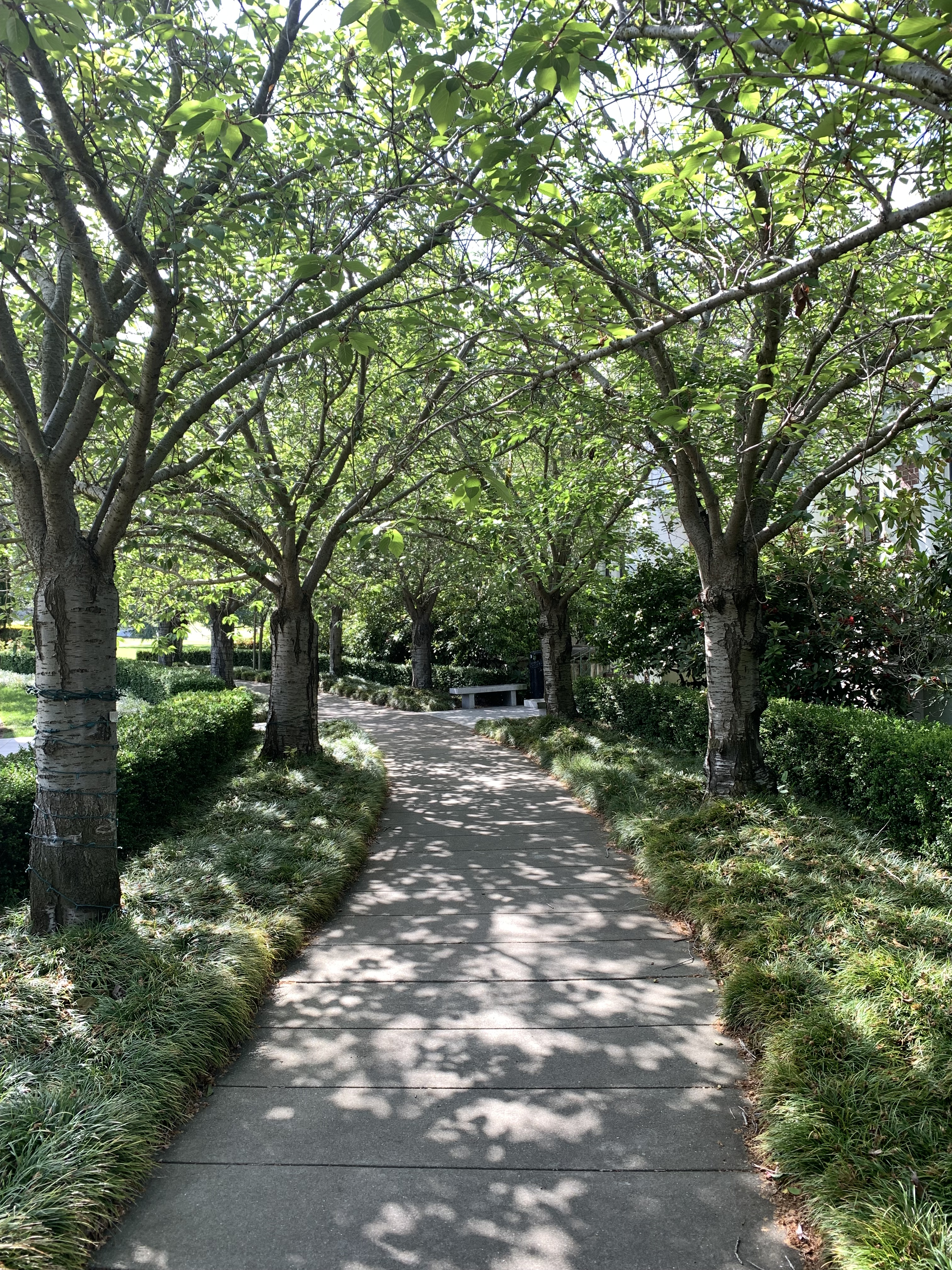
“All these places have their moments, with lovers and friends I still can recall…” photo by Mary Elyn Bahlert, Mountain View Cemetery, Oakland, 2026.
remembering, Uncategorized

More about Dad

My dad had worker’s hands.  His hands were broad, wide, the nails often broken from his days in the steel factory, the veins pushing blue against his light-colored skin.  When I was little, those hands would lift my little sister by her feet straight up into the air on the living room floor after Daddy came home from work.  Until the days before his death, I didn’t know how my father identified with his strong, worker’s body.  In the hospital, he said with a mournful look in his eyes:  “I was always so strong.”  Then, he was ravaged with cancer.

Some days, Dad came home from the steel factory with a steel splinter in those strong hands.  That hurt.  Each time, he would call on Suzie, my sister, to remove the splinter.  And she would, working slowly and carefully with a needle, her eyes close to this outstretched hand, intent.

Dad was a gentle man, in spite of his strength, maybe because of his strength.  Of the two – my mother and my dad – he was the most able to express his feelings.  If Dad’s feelings were hurt, it showed on his face.  If he was happy, we saw that, too, his eyes sparkling.  When he was angry, his voice rose to a deep shout.  I was afraid of his power when he was angry, although he did not take it out on any of us.  He was rarely angry. I saw him lift a chair in anger once, and I remember that moment, my fear, I expect, completing the memory.  Many times, I saw my father cry.  One of my dearest memories is of my Dad sitting in his chair, watching “I Love Lucy,” his favorite.  Dad roared with laughter at her silliness, looked over at one of us, and said  “fun, isn’t it, honey?”  Not once, but every week!

Whenever I smell beer, I think of my Dad, sitting in “Dad’s chair,” drinking four bottles of beer, every night.  I never have liked beer; I suppose that’s why.  For all that is given, when alcohol is present, much is taken away.

In our house, Dad was the most extroverted of us all.  In the days before his death, the minister visited.  I don’t remember his question to my father, but I do remember Dad saying:  “the girls are quiet, like their mother.”  This strong, sensitive, extroverted man who spoke in a rural Wisconsin dialect was surrounded by introverts!

When I was a teenager, I invented the nickname that would be his for the rest of his life.  I invented the name that we all called him, the one that stuck:  FRB.  His initials.  We still refer to him as FRB, in my house.  I still make up nicknames for my loved ones, too.  Always have, always will.

One day many years ago, I had lunch with a male colleague.  Sometime during our conversation, he remarked:  “you’re comfortable around men.”  I don’t know that I had ever thought of it, but I expect it comes from having a strong, gentle hearted man love me from the time I was born.  Even more, a strong, gentle hearted man liked me.

In my first apartment, the inside of a hall clothes closet was my place to post inspirational quotes.  I cannot remember the source, but one was a quote:  “The best thing a man can do for his children is to love their mother.”  For all my father lacked – education, refinement, a profession, assertion – he loved my mother.  He said so, often and out loud.  He told us he loved us, too, with great glee and feeling.  My folks did not go out on dates.  From time to time, they would be invited to the wedding of a friend, one of his co-worker’s kids, probably.  Then, my father, always proud of his good looks, got dressed in his one working-class dress suit, and waited for my mother.  When she came into the living room from the bedroom off the dining room, my father would purse his lips:  “woo-hoo!” he would say, his eyes alight.  Then, my mother’s face shone.

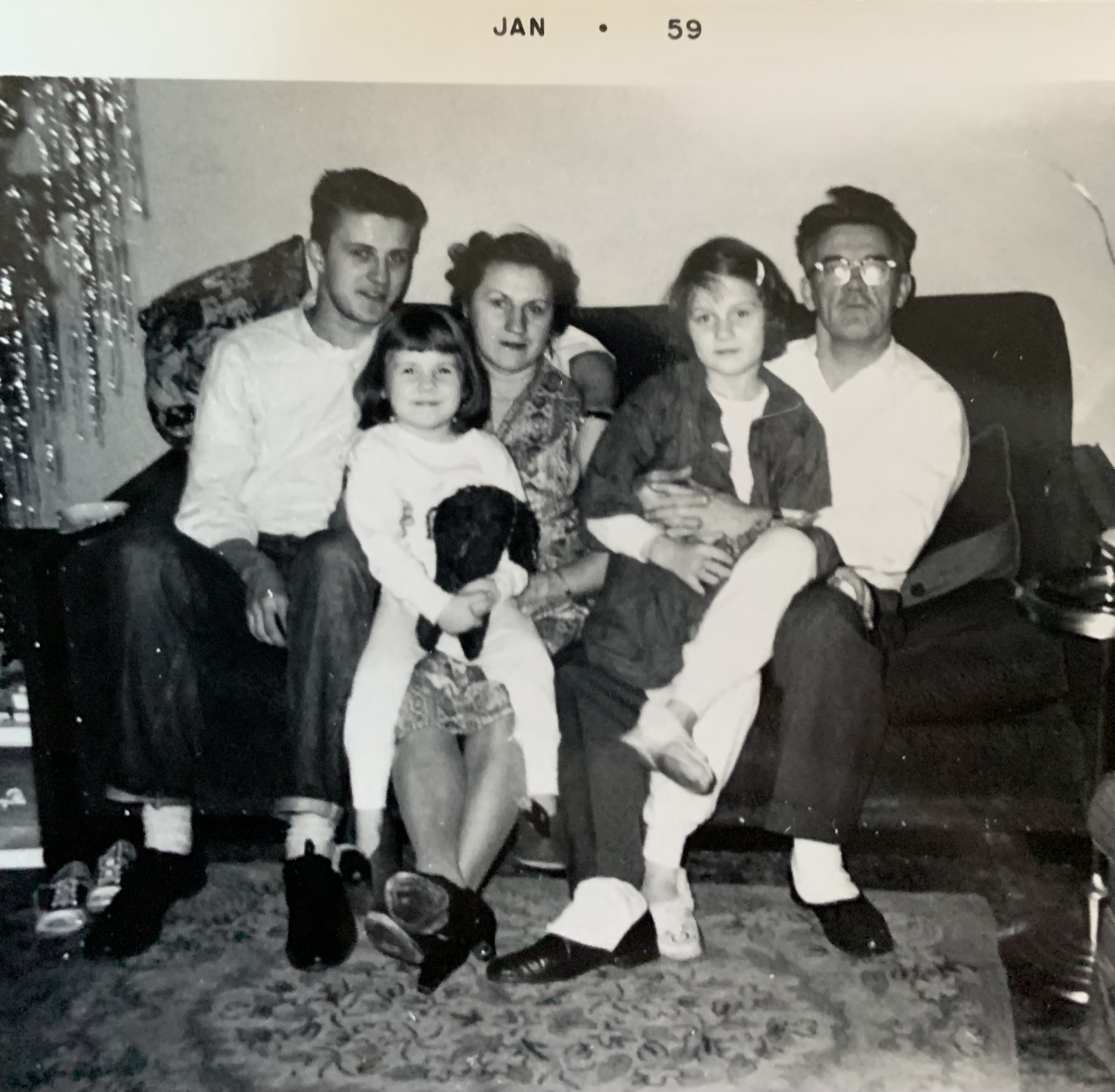
Us: Ronn, Suzie, Mom, me, and Dad.

memories, nostalgia, The Holy, Uncategorized

A dream

My dad loved life. He loved my mother, he loved us, and he loved his life. After having been diagnosed with colon cancer in the year after he retired from his work as a steelworker at age 65, he was always grateful for the life he was able to live during the 10 years after. He came to realize that he could live much as he had before the arrival of the cancer, and so he returned as much as possible to the life he’d had before the cancer diagnosis and the colonoscopy. He rode his bike all around his neighborhood in Milwaukee, and he and Mom drove clear across the country from Wisconsin to visit my mother’s brothers in California. Mom and Dad enjoyed every moment of that trip, my father at the wheel, my mother pointing out sites and reading from the AAA trip-tick that guided their trip. Both my parents – my father had an eighth grade education in a country one-room school house, my mother had received her GED when I was in college – were interested in life. As I remember them, I count the quality of having an interest in life as important, not only to them, but to me, as well. I’m grateful.

My dad loved life. He spent many weeks in a hospital bed at St. Joseph’s Hospital in Milwaukee, knowing he would not leave that room – ever. More than anything, he missed being able to ride his bike, especially now that spring was coming to the Midwest; it was April. He was 75; he would never make it to his 76th birthday. Now that I’m 76, I think of that fact – often.

Before I left his hospital room for the last time, before I traveled back to Pleasanton, California, where Jeff and I lived, I said to Dad: “Let me know you are all right.” I was clear: after he passed, I wanted a sign from him. As I said those words to Dad, he didn’t speak. He nodded. He understood.

The dream came some time later, months after Dad died in April of 1986. It was a simple dream, a clear dream. I saw my Dad, dressed in a suit, standing with a group of people, looking away from me. He had a humble look on his face as he stood with the others, his hands held together in a simple gesture, below his waist.

When I awoke, I knew immediately that Dad had kept his promise. He had come to me. And he had let me know that he was all right.

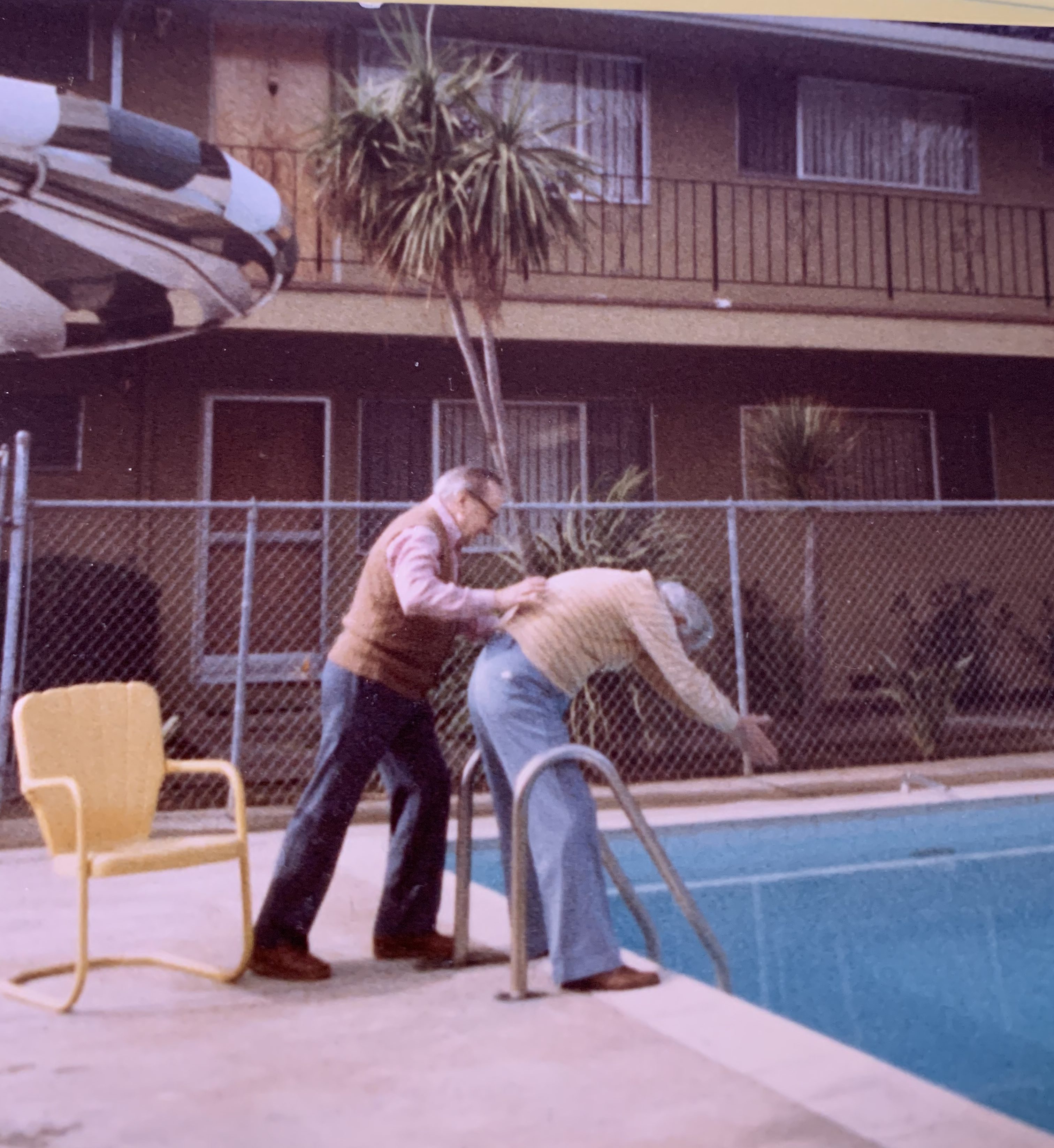
Uncle Johnny must be angry at Dad – he’s about to push him into the pool… They had fun together.
photo, circa 1983, San Jose, CA.

memories, reflecting, remembering, Uncategorized

the day that Grandpa died

I don’t remember my Grandpa Markowski, my mother’s father, but I had heard the story, many times, of how he was with me to witness my first steps. He died a few months after I had turned one – on November 25, 1950.

I don’t know much about his life, either, but I bring to mind my own thoughts about how life was for him after he immigrated to the United States. He worked in a foundry in Milwaukee. He returned to Ukraine – which would soon be swallowed whole into what was the Soviet Union – to bring his wife, my grandmother, Feodosia, to the United States. I know that many immigrants left family in the Old Country, never to see them again, to start a new family. In his new country, Vlas Markov Srebny would lose his name, to take up a name more easily understood: Alex Markowski. When I return now to stand at the grave at the cemetery on the north side of Milwaukee where he and my grandmother – her name in the new country was Frances – are buried, only the name he acquired in his new land remains. I’m always saddened to think of this. It’s a common story, I’m sure.

These past few days, I’ve been sifting through old pictures again. I like to look at them from time to time. During the early days of COVID, I spent several days sitting in our yard, sorting through large boxes of pictures. I got as far as grouping them into decades. I think that’s as far as I’ll go with them. I’d been looking for a particular photo of my mother and my brother Ronnie, but I didn’t find the one I was looking for.

I did find a treasure this time. I’m not sure how I missed it before. My mother had told me that the day my Grandpa Markowski died, he had come to the door of our family’s upper flat, asking for money. She had said no to his request for money – probably knowing he’d spend it on liquor – but he’d declined, and walked away. The treasure I found included more details, details I had not been told.

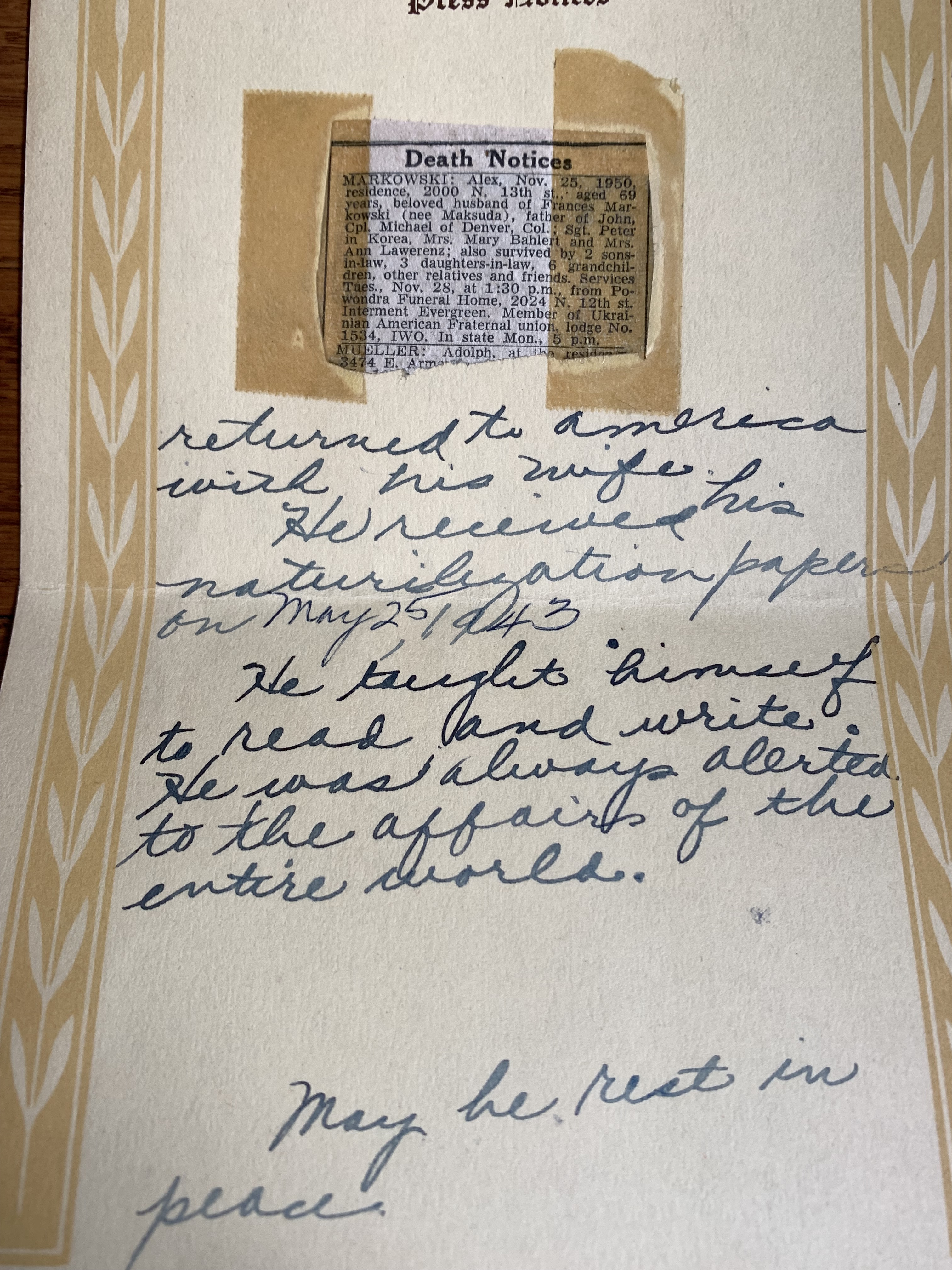
In my mother’s handwriting, two yellowed pieces of paper, apparently torn from a notebook, maybe a notebook intended for family history, recounted:

“Alex Markowski was born Vlas Markov Srebny on February 11, 1881. He was born in Kiev, Ukraine. In 1903, he joined the Army. Also, he married Feodosia Maksuda in 1903. Of this marriage were born Ivan ((John), George, Michael, Mary and Hannah, and Peter. Of these, only John, Michael, Mary, Hannah and Pete remain.
He came to America via Boston, Mass., and the Great Lakes to Milwaukee in June, 1910. He returned to Ukraine in the year and returned to America with his wife.
He received naturalization papers on May 25, 1943.
He taught himself to read and write. He was always alerted to the affairs of the entire world.

May he rest in peace.

On Saturday, November 25, 1950 at 8:30 Dad collapsed on North Eleventh and West Reservoir. It was a very cold day which stimulated his heart. Added to this, he climbed up and down three flights of stairs, and bucked a sharp wind up a steep hill, where he collapsed. He passed away immediately.”

*

memories, nostalgia, Uncategorized

“while we still have our health…”

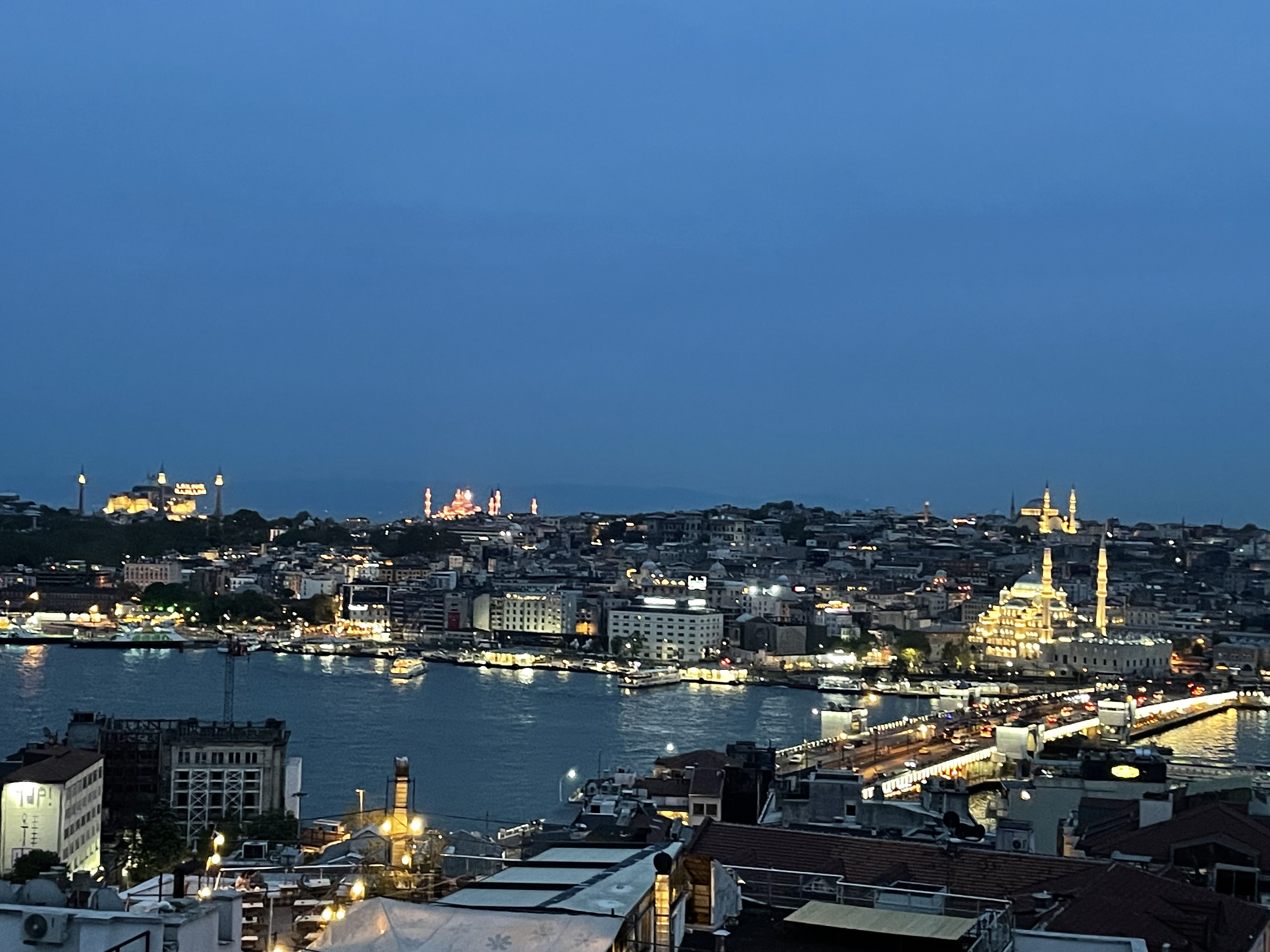
Istanbul at night, looking over the Bosporus, May, 2023
photo by Mary Elyn Bahlert

I first noticed when I was a pastor. From the time I entered the ministry until my retirement, the churches I served were filled with older folks. These “older folks” were people in their 70’s, 80’s, and even 90’s. Being part of a church community had been important to people in the generations before mine, and so, as a young pastor, I was often pastor to folks who were 40, 50, and even 60 years older than I was. Even in the years before I retired at 65, many church-going people were of the generation before my generation, The Baby Boomers. Having always identified with being young, even now I think of myself as young, healthy, full of energy.

A look in the mirror should bring that fallacy into focus, I think.

As the pastor to older folks, I was aware of a phrase used often by the people I came to serve – and to love. Before setting off on a vacation that they had dreamed about for years, someone might say, “I want to do this, while I still have my health, ” or, “I’ve wanted to visit my grandparent’s homeland, to go back before I die.”

Now, although I don’t say it out loud, I’m reminded of that simple wisdom as Jeff and I talk about places we’d like to visit, of places we’d like to see again. I, too, want to crowd as many travel adventures into this time in my life, when I can still travel freely, and when I can enjoy the trips we take completely. As I pack now, I count out the pills of the medications I take carefully, and sometimes I remember a time when I could travel without counting out pills beforehand.

As we plan our adventures together, I think: “will I be able to enjoy this trip, a year from now? I hope so”. The idea of a lifetime of years and adventures ahead of me doesn’t exist anymore. With each year, with each day, that lifetime of years and adventures is moving – quickly, quickly – away from me.

Lately, Jeff and I have been making arrangements for a trip together to North of Boston. Since I was in Miss Ross’s English class at Peckham Junior High School in Milwaukee, I’ve wanted to see the places that I read about as I studied for papers I wrote about the lives of great American poets, as I memorized many of their poems.

And as we plan, I think about the many travels that Jeff and I have enjoyed together. Through the years, Jeff has taken on the duty of planning our trips, down to the details. Now, I take on some of the work load. And we often talk about places we’d like to see, countries we’d like to see again, and new places. Each time we talk, I wonder to myself, “will I be able to travel then? “ That’s a new thought for me, but I expect I’ll not let it go.

I remember a moment when my dad – I called him FRB – looked at me, a look of sadness or grief in his eyes, and said: “It goes so fast.”