memories, reflecting, remembering, Uncategorized

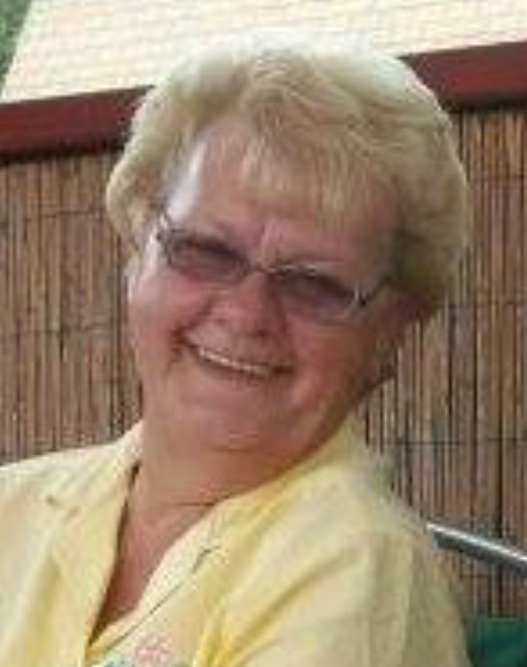
Sue

At home, I was the big sister. And so I was thrilled when my brother Ronn brought home a friendly and fun young woman – Sue – and introduced her to the family as the “girl” he was going to marry (this was the early 60’s, when young women were still referred to as “girls).” And I was thrilled when Sue, who was the middle of three sisters in her own family, took an interest in me.

Sue was the big sister I had never had. She listened to me and she made me laugh. (Sue and me laughing would play a big part in our lives as the years unfolded). I cherish a vivid memory of Sue and me together in the cramped bathroom of my family’s upper flat on the north side of Milwaukee. We sat together as she cried about an argument she was having with Ronn. More often those days, Sue made Ronn laugh, and Ronn made Sue laugh. As I bring Sue to my memory now, I can see her wide smile and the light in her eyes. She liked me, just as I liked her. And – she would never fail to tell me the truth. Never.

*

Early in their marriage, Ronn had had an accident as he drove alone on a Milwaukee street; he ended up in the hospital for several weeks. As the years unfolded, he would need to be hospitalized again and again. And so one summer, as Sue was Mom to three children under five already – David, Alicia, Vicki Sue – she was about to give birth to her fourth child. I stayed with her in their house in the suburbs of Winston-Salem, North Carolina, slept in her bed with her as she tossed and turned, unable to sleep a full night in the last days of this pregnancy. Ronn was hospitalized again.

Most nights, the two of us would sit together on the screened in porch, talking and laughing in the dark. All night long. That year, the cicadas arrived to fill the air with their loud screeching calls, early in the mornings, just before daylight. The children were still asleep, although we didn’t know when that would change, and our world was just the two of us, facing one another in the dark. Sue was a smoker – she smoked until she died in 2015 – and I listened and laughed to her deep voice as I watched the light of her cigarette go up and down in the dark, sitting there together until the morning light broke the silence that surrounded us.

*

The last time I saw Sue was in the spring of 2015. I’d taken a trip to visit the family in Northern Florida on my own that year, and the day before I left, I went to lunch with Sue and Alicia, her older daughter, who was her caregiver. It seems that a medication that Sue was taking was also taking her memory, and from time to time, she’d stare at me quizzically, trying to recall who I was. Then, at one point in the conversation, a moment of clarity, she said to me: “you’re a minister.” Yes! She did know who I was.

After lunch, I drove Sue and Alicia back home. I got out of the car to give them each a hug, and Sue held on to me for a long time. As I drove away a few moments later, I watched in the rear view mirror as Sue stood, waving and waving.

*

“Sue, Sister, Sweet”

I remember when I first knew you were my sister –
you, sitting on the edge of the claw footed bathtub
in the crowded bathroom of an old Milwaukee flat, crying.
I listened to your tears, and then, I knew:
You are my sister, Sue. 

I remember you, 8 months pregnant – again (!)
I remember your voice all night long
in the dark Carolina night,
the light from your cigarette, up and down, up and down,
the two of us, laughing, laughing:
We laughed until dawn.
During the day, you were Mom.

Years later (in my new life)
you brought me a home-baked goodie
while I was still in bed – insisting that I accept this gift of love!
I remember you marching me to the classical music CD’s in the back
of Barnes and Noble:
You bought me Beethoven.
I listened, all spring long, to the minor notes,
mourning another Sue.

Now, these notes, this mourning, is for you.
I mourn for you.

 I remember – I will remember always –
you waving goodbye (I watched you in the rear-view mirror),
as I drove away from you – for the last time.
“I don’t know when I’ll see you again, Sue,” I said into your silence.

You knew, you knew, you knew, my sweet, sweet sister, Sue. (poem by meb, 2015)

community, nostalgia, reflecting

Life in the West – a sense of place

I hadn’t visualized living in the American West for most of my life, but here I am. I’ve lived in Oakland for over 25 years, after I completed my work as a Pastor in Oakland, and I expect I’ll be here for another while – God willing.

When I was young, I imagined that I would leave the Midwest, and I was certain I’d move to the East, to New York City, perhaps, or to Washington, D.C. My imaginings always took me to cities. To big cities. I love the diversity of cities, the abundance of neighborhoods, each one with its own personality, and I love the choices we take for granted in the cities. I love the bustle of things, and I love the way even cities become quiet on holidays, or on early Sunday mornings. I love the diversity of people – diversity of color, of background, of education, of family. I love it all.

And I’ve been privileged to have come West, where I arrived as a student in seminary in Berkeley in the 1980’s. I was fulfilling my dream to go to seminary, to become a pastor.

My husband Jeff is from the Milwaukee area, from Brookfield, a suburb of Milwaukee. Part of him yearns for the quiet country life he came to love and to respect when he spent time with his maternal grandparents on their farm, northwest of Milwaukee, where Jeff’s mother had grown up. His mother, though, waited for the day she graduated from high school to leave that place for another life. Sometimes Jeff reminds me that it’s his turn to choose a place, a country place… I expect he must be dreaming again of finding a place that gives him love and care and a respite from whatever might be bothering him at the moment.

But we are connected here more than by time and a place. We have strong community here; community is important to us as a value, and we know it would take a long time to build that again in a new place.

And – I remind myself – we are not 40 years old anymore!

And so, from year to year, our connection, our deep bond to this place deepens and deepens. And when we travel, living in the West makes it easy to tell people, when they ask where we are from: we’re from California. Everyone knows where California is!

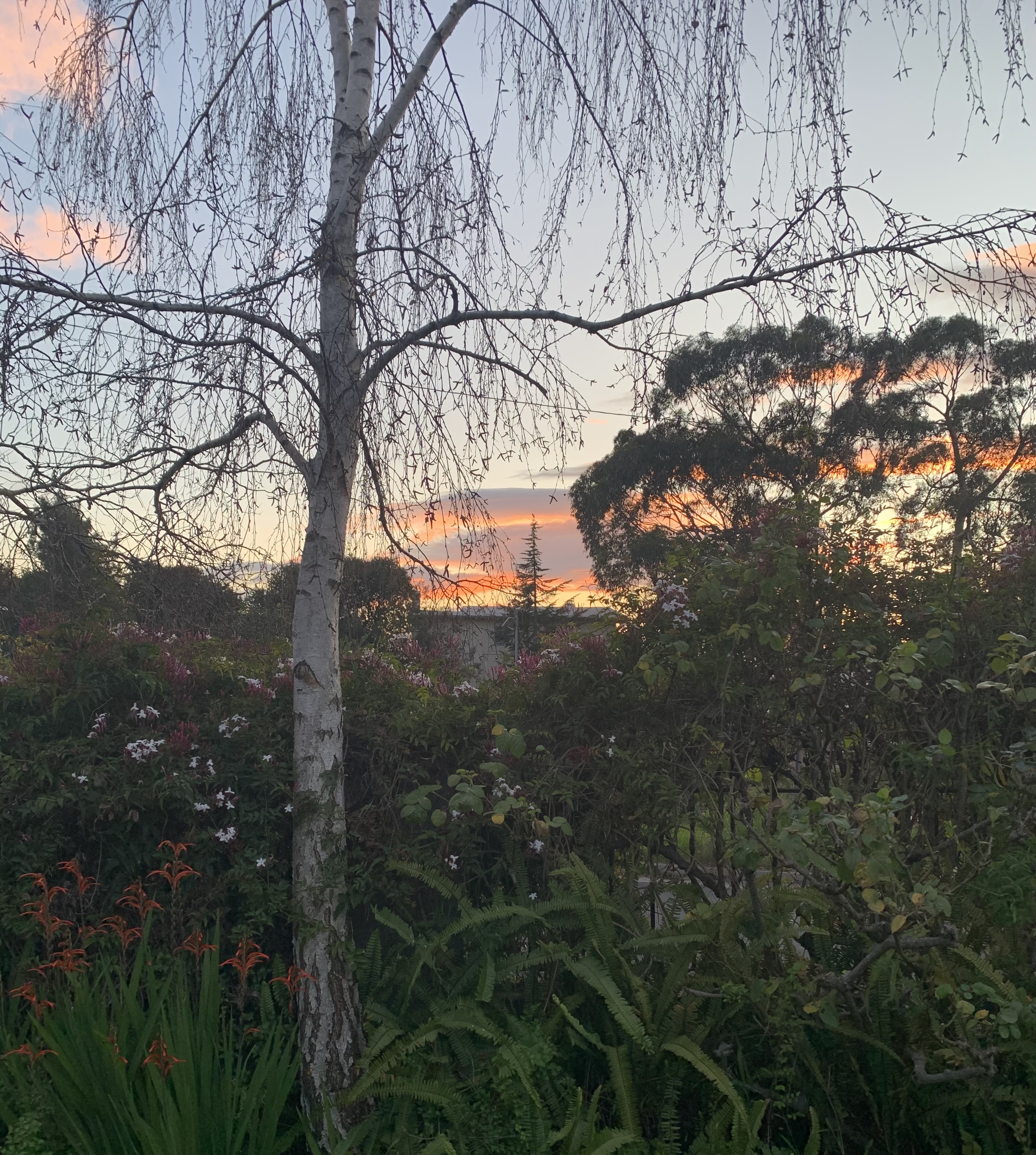
Looking out to the West, over the Pacific, from home. Photo by meb, 3/2025

memories, reflecting, remembering, Uncategorized

Easter

When I was growing up in Milwaukee in the 1950’s and 1960’s, the Christian holidays were honored culturally. We sang Christmas Carols during December at school. We had the week following Easter off – always – as spring break – whether or not the weather honored the season. And although my family were not church-going people, we celebrated the Christian festivals along with everyone else.

For weeks before Holy Week, Mom carefully decorated pysanky, the Ukrainian decorated Easter eggs. I had the job of blowing out the eggs before Mom sat at the kitchen table and carefully applied wax and coloring to the empty shells.

I was still small – maybe 6 or 7 – when Mom told me that a man had been hung on a cross to die. The streets were quiet that Good Friday – stores were closed to honor the somber day – when she let me go out to play on the front steps of the flat on Ring Street, alone. I ran up and down the steps. My instructions were to stay in front of house. And as I played alone on the steps, I wondered about that man who had been left on a cross to die. I thought he was somewhere not far away, but out of my hearing, in the quiet city.

Part of me was taken with the story, which in later years I would tell, again and again, to congregations in California, a long way from those narrow, bleak streets. I imagined the man into existence, in a way: captivated, wondering.

On Easter Day, Grandma Markowski would be making her way up the alley to our house, and we’d try to tap each other’s eggs colorful eggs – not pysanky, but regular decorated, hard-boiled eggs – to see whose egg didn’t break. They were the winner!

Later, Auntie Anne and Uncle Harvey, Mark, Patty, and Johnny would arrive for the dinner, ham and all the trimmings. Later still, the women would go into the kitchen to talk and talk as they washed and dried the dishes, while the men sat together in the living room, drinking beer, and waiting for the holiday table to be cleared so that the Sheepshead playing could begin.

Soon enough, Easter was over, and soon enough, the well decorated, hollow eggs that had been carefully decorated and displayed, were set aside, to come out another year. This year, like all the rest, a dish of the beautifully decorated eggs will grace my table, just as they did Mom’s table.

Pysanki by Mary Bahlert (Mom), Jeff Kunkel, Ronn Lass

memories, reflecting, remembering, Uncategorized

When I was five years old…

When I was five years old – five years and one month old – I started the long walk from 11 and Ring Street in Milwaukee to 9 and Ring Street, where I entered kindergarten at LaFollette Grade School.  Those two blocks were long walks for a little girl.  I expect – although I don’t remember – that my mother must have anxiously walked with me the first day or so, pushing in a stroller my baby sister, Susan, who had been born that March.  After that first day or two or three, I walked those blocks with the other children from my neighborhood.

When I return to drive through those streets now, I see how short the blocks were, moving west to east, toward “the Lake:”  Lake Michigan.  I think of myself as growing up on the shores of Lake Michigan; it’s not too much of a stretch to think that way.  The shore of Lake Michigan formed my compass-point, my sense of direction,  for many, many years.  “The Lake is on the east,” I think, “so I must be facing north, and to get there, I have to turn left, to the west…”  etc.  Years later, when I land in the Bay Area of California, I find that directions are expressed differently.  “Turn right at the second gas station, then get into the left lane.  You’ll turn left at the next stop light.”  When I work at my first job in graduate school, someone hears me giving directions and says:  “You must be from the Midwest.”  Good guess.

That’s how our lives grow, how the edges of our lives expand:  by walking those few blocks to kindergarten, leaving home for the first time.  The edges widen by talking to kids whose lives inside their narrow flats are different.  I hear about dads who are mean, for example, and I hear about mothers who laugh a lot.  Until I leave my house in September of 1954 to walk those few blocks, my imagination does not hold space for those possibilities. 

I am nostalgic for those streets, for those city spaces, for the shadows under the big elms that line the streets, for those narrow stairs with the small window on the right at the top, that lead to the second story flat with its small front room, tall windows, its small bathroom with the clawfoot tub that was used by 5 people without a thought that it could be otherwise.   My nostalgia wants to be satisfied, so I ride my laptop via google earth to the front of that flat; I walk with google the two short blocks to La Follette School.  I still see the beauty that was there, and I see the poverty, the simplicity of those flats, as well.

On the way to school one day, I learn that I am not Catholic.  Michelle, my neighbor across the alley (which runs next to my house), a year older then me, asks me one day, as we walk to school:  “Are you a Catholic?”  I don’t know.  That night, I ask my mother if I am Catholic, and she tells me no.  I do not know the fraught history that lies behind her answer, and I will not know, for many years, the fraught history and longing that goes with not being Catholic, in me. 

At LaFollette School, I am introduced to a kind of diversity, for the first time.  I sit near the front, always, our seats assigned alphabetically by teachers in navy blue polka dotted dresses.  In those narrow rows, in those wooden desks with holes for ink pots still marking the right hand side, I sit beside the children of first and second generation immigrants.  I do not know that many of my classmates speak a different language at home.  In my house, I often hear Ukrainian words, spoken with a kind of mysterious wink; from time to time, when my grandma visits, she and my mother speak their native tongue. 

In the autumn, the elm trees that line Ring Street turn bright colors, and as I walk, I often try to catch a maple seed – a helicopter to enchant children – as it floats to the ground.  Over the street, the trees meet to form a ceiling that arches from one street to the next.  In later years, Dutch Elm disease would take the elms away, and when I see these streets now they are just beginning to be tree-lined again, after many years. 

In winter, snowbanks form a path for children, four foot high, on the strip of land between the road and the sidewalk.  After a winter storm, the tops of the snowbanks form a hardened, frozen, flat sidewalk parallel to the cement sidewalk.   At the corner, I climb that tall bank of snow and stand taller than any adult, until I take the steps – made by other children – down again, at the place the alley meets the street.  After the alley, I climb the snowbank again.

In spring, I walk to school as the glorious, wide, lilac bushes float their purple flowers, their scent into the air.

*

One summer day when I was 13, I walked down the steps in the narrow front hall, from the second floor, to look out the screen door that led to the downstairs porch.  I looked out on that street, with its maples, its curbs with green grass growing beside the asphalt, the tall, spindly houses that held families – broken, near poor – the sound of traffic from the busy street a block over in the air.  I don’t know what happened, then.  Was it hope, speaking to me?  Was it a barely covered wish, from inside of me, speaking to me?  Was it the thought that my mother, my grandmother, held deeply inside, beneath the bright mind, the hand-sewn clothes?  I heard a voice.  The voice was clear, not to be ignored.  “I don’t belong here,” it said.

The streets are not nearly as pretty now as they are in my memory.  Milwaukee can be a bleak place, from December to late May.  Grey clouds hang over the streets, over the city, for way too long each year.  And the houses that line the streets – 50 or so years old when I lived in upper flats – are 100 years old now. 

Those narrow streets formed me.  I left them behind, many years ago.   Still, they are my home.

Me and my baby sister, circa 1955

memories, nostalgia, remembering, Uncategorized

John

Judy and I were in love with the same guy. We were fifteen, and we’d been friends since we were in kindergarten together at La Follette Elementary School on the north side of Milwaukee. Judy’s family had moved to West Allis, a suburb of Milwaukee, which put them closer to her dad’s work at Allis-Chalmers Company. We’d come from the same kind of people: hard-working, working-class people.

Judy was sitting across from me the day I returned after getting a vaccine shot by the school nurse, and she saw me throw up what was in my stomach – as it happened. But she was my friend, anyway.

And we were living on the other side of Milwaukee in 1964, when the Beatles “invaded” the United States, and the world. Of course, all the young girls had watched the debut on the Ed Sullivan Show – a favorite of mine for many years – and had decided, at once, who was their favorite Beatle, as we watched the girls our age in the studio shouting, crying, screaming.

My family’s stereo system was on a large cart on wheels, and for some reason, Mom allowed me to have the stereo system in my bedroom, the already-cramped room that I shared with my little sister, Suzie. And so I played the few records – 45’s and albums – that I had, over and over – and over again.

Every few weeks, I’d take the money I’d earned from baby-sitting the three little kids next door, and I’d walk down Medford Avenue to the Sears-Roebuck Store on 24 and Fond du Lac, passing my friend Nancy’s house on the way. As I walked, I had in mind what I intended to buy that day: another single to add to the box I kept on the floor next to the hi-fi setup in my room. All week, I’d listened to WOKY – a Milwaukee radio station that played the kind of music kids like me listened to – so I knew what I wanted to bring home. Sometimes, I had enough money to buy an album, and so I started a small collection, which I propped up against the wall. I listened and I sang along with the records I played (my husband, Jeff, is still surprised when I burst into another song – complete verses – from the 50’s and 60’s – some of which he has never heard before). I can sing through whole albums of the Beatles, The Animals, the Dave Clark Five. Yes, I can!

Later, my taste turned to Motown Records, out of Detroit, and I can sing all the words to those songs, too.

And of course, we knew the birthday of our favorite Beatle. Judy and I talked every few days on the phone, sharing our latest news about John, what we’d read about the Beatles in the paper that week. We knew for sure that John’s birthday was October 9. In those days, this kind of information was common knowledge to Beatle-lovers.

We hatched a plan. Whose idea was it? We hatched a plan: We would bake a cake for John on his birthday. And we’d deliver the cake to the person we knew that was as close to John Lennon as we’d ever get: Bob Barry of WOKY radio in Milwaukee!

And so, on the morning of October 9, 1965, Judy and I met in the kitchen of my family’s flat on Medford Avenue to bake a birthday cake for John Lennon. We were careful as we cut the cake into the shape of a guitar (!) and decorated it with chocolate frosting, and as we added yellow frosting highlights. We were proud of our concoction! My Mom even took a picture of us together, holding the birthday cake for John Lennon!

And we delivered it to WOKY radio on Fond du Lac Avenue in Milwaukee, to be given to Bob Barry.

We had to go to school on Monday, so we didn’t hear whether Bob Barry mentioned our cake or not. And we are fairly sure the cake never made it to our favorite Beatle. But it came as a shock, years later, when John would be killed. The world was changing. And Judy and my worlds were changing, too, as we outgrew our favorite Beatle and each moved into our different lives.

Judy and me, with John’s cake