Uncategorized

It’s Easter

Very early this Easter morning, a couple of hours before sunrise, Jeff and I were both awake to hear the screeching sounds of a “sideshow” somewhere close to our street in Oakland. Young people connect with one another via text to set a time and place to come together at an intersection in the city, where bystanders watch as the fast moving cars in the intersection screech around and around the circle formed by the intersection itself. One disturbing memory I have of having served as a pastor in Oakland is of the day I received a distraught phone call from the mother of a teenage girl who had been killed the night before while she watched a sideshow from the side of the street, a bystander, an observer. The sanctuary was full the day we held the teenager’s funeral, her casket open as the community gathered to mourn her passing.

When I heard the screeching tires last night, I was reminded of that day.

Last night Jeff and I listened as the screech of tires on pavement made its way into our bedroom through the open windows, open to bring in the beautiful night air of spring. The sound of a sideshow is another thing: the tires of the cars screech as they circle the chosen intersection. Today as we drove home from church, we looked carefully at each intersection until we saw the one with tire marks that marked the activities of the night before Easter. The sideshow last night was only two blocks we from our house.

And we honored Easter today by going to Mass at a parish in North Oakland, where the people sang and shouted: “Christ is Risen!” And Christ, indeed, was risen in that place, a colorful group of worshippers remembering and honoring the High Holiday of the Christian faith. In worship we remembered the people of the world who are struggling to survive in the midst of horrific wars: Ukraine, Palestine. We like this parish for its diversity: class diversity, racial diversity, diversity of acceptance of Catholicism – or not. To us, the people there represent the diversity that is Oakland, which has been an important part of our making our home here for many years.

We chanted together with the other worshippers, laughed and sang with them, and when we left, we felt as if we had, indeed, worshipped on this day, on Easter Day, remembering the old, old story, so badly abused and harmed by well-meaning and damaged human beings. Even so, the story remains. We have known its message to be true in our lives.

It’s Easter.
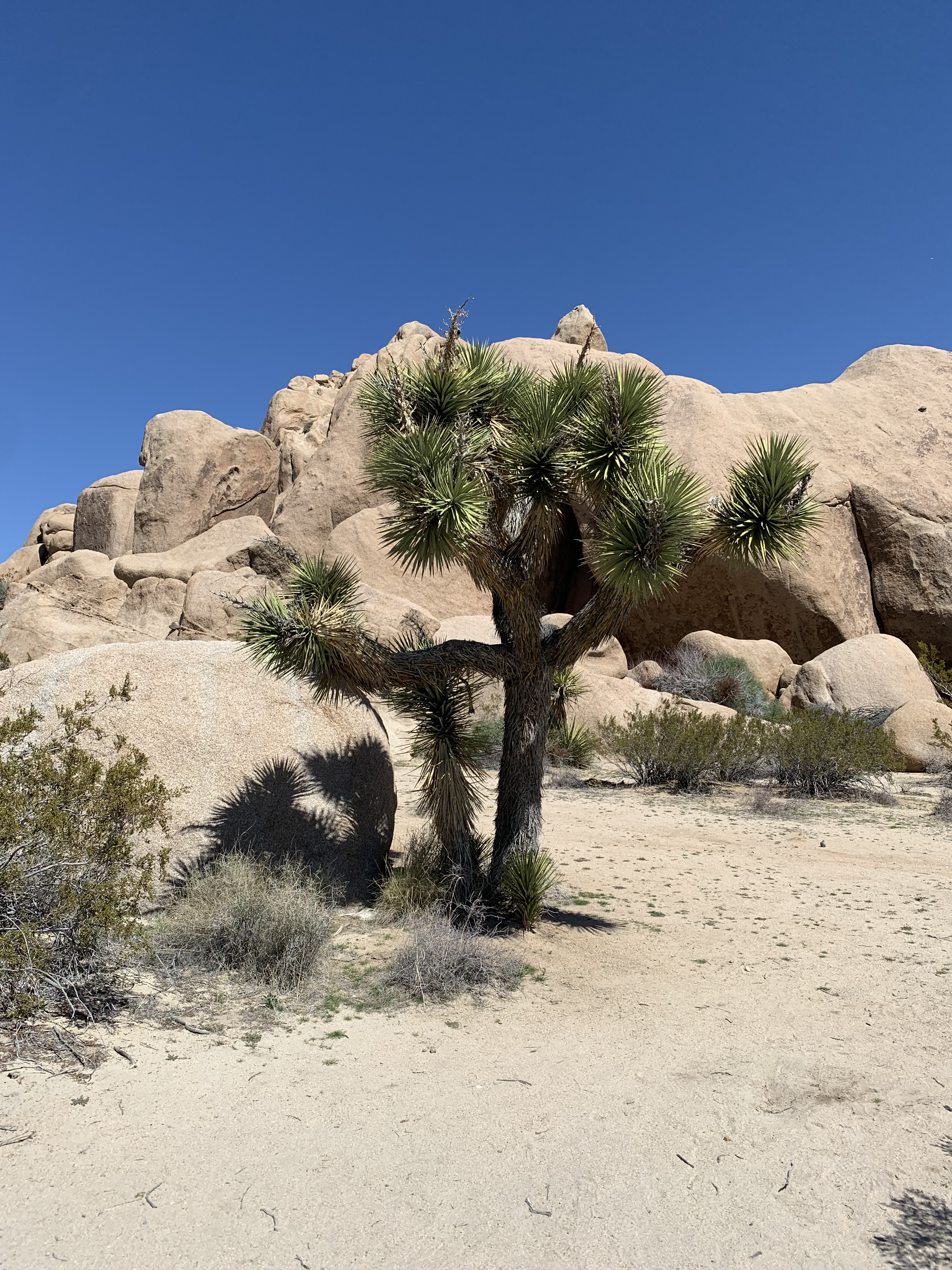
Easter time in the desert, Joshua Tree Park, Mojave Desert. photo by meb: 3/2024

Uncategorized

I love that tree

This is our place. You sit with your back to the tree I love, and I think:

You planted that tree.”

The seasons turn, right outside the window of our place.

Before I loved that tree, I wondered of it: how do you change, so effortlessly, and with grace?

Then, I came to love that tree: I love that tree and that tree loves me.

You gave a gift the day you planted that tree by our place. You didn’t know then, don’t know now:

you planted that tree, and I love that tree and that tree loves me

And right here, right where that tree loves – love simmers here, too.

The tree I love is waiting for spring… photo by Mary Elyn Bahlert, 3/2024

beauty, reflecting, remembering, Uncategorized

Closet Catholic

Sometimes I think I’m a closet Catholic. I didn’t grow up Catholic, like so many of my friends in Milwaukee. I grew up understanding that my family wasn’t Catholic. In the 1950’s and 1960’s, many families still went to church together, although mine did not. I understood that we were not church people, because I had friends who were “church people,” whose families went to church together every week. As I got older, I came to understand and to accept my family’s distrust of “church.” They had their reasons.

Still, when I was in Junior High School, my mother made sure I was enrolled in Confirmation Class at a neighborhood Lutheran Church. Every Saturday morning for two school years, I studied – and memorized – Luther’s Small Catechism with the Deaconess, and then I studied once a week with the Pastor for a year before I was confirmed with a large Confirmation Class, on Palm Sunday, when I was 14. Almost immediately, I stopped going to church.

I was a University student in the late 60’s and early 70’s, that time of anti-war protests and hippies marching in the streets, and so it was a strange quirk inside of me that set my mind on becoming a woman pastor, at a time when there were few women pastors, at a time when I had not heard of such a thing as a woman pastor. At least I had the idea, with no plans in sight, to go to seminary to study.

I still had to find a church, and I found a place for myself in the United Methodist Church, where I met Harvey Stower, a Young Adult Minister, who asked me: “have you ever thought about going to seminary?” My answer: “I think about it all the time, but I don’t tell anyone about it.” Within a year, I was on my way to seminary in Berkeley, on my way to being ordained, on my way to a life in the Church.

And so it must seem odd to think of myself as a Closet Catholic, since the Roman Catholic Church has still not seen its way to ordaining women.

I tell people that “I love the Mass.” I love liturgy. There is something in the rhythm of the Mass, of the reciting of the words that have been recited for centuries, across the world, that touches me. Maybe it’s because my ancestors were Catholic, on another continent, at another time, before they were harmed by the Church. Maybe it’s my love of poetry, of the sounds of things that are beautiful sounds. Maybe it’s my deep connection to the life of faith, that deep connection that had me searching before I knew I was searching.

I do come to Mass with my own judgements: where are the women here? where are the women-priests? What of the damage the Church has done – is doing – in so many people’s lives?

And I set those judgements aside when I go to Mass. I feel a connection there, a connection that is not dependent on the others who are worshipping with me. The connection is deep, deep inside of me, and deep inside the words, the recitations, the incantations. The connection is there, in spite of me. I don’t get it. My understanding does not matter to me.

And so I show up from time to time at Mass, responding when I can, taking in the sanctuary where I sit, the crucifix high in front, the Altar with the elements central to the sanctuary. I listen to the words and I feel myself there – a bit out of place, but still – not out of place at all.

A winter’s day, Martinez – photo by Mary Elyn Bahlert, 1/2023

memories, remembering

Vietnam

While talking to my friend Susan, who lives in another state, she mentioned the years after she had graduated from nursing school and before she was married. Her then-fiance’ discouraged her from going to Vietnam to serve the armed forces. And she was remembering.

I remembered, too, as she mentioned Vietnam; a small lurch in my chest remembered Vietnam, another presence in my life.

In the spring of 1970 at the University of Wisconsin-Milwaukee, I was in sitting in a philosophy class, thinking about what the professor was saying to the small group, seated in a circle. What I thought is that we should all be silent, and sit in the silence. When I left that day, crowds and crowds of students filed out of the student union as protestors with beards and ragged clothes shouted slogans: “end the war! end the war!”

Then, classes were suspended for the rest of the semester.

Vietnam was a presence to my generation, a conflicted, horrible presence. All the young men I knew waited for their number to come up. One was gone, then another. When we tell the stories of those times to one another, Vietnam is mentioned, along with the names of friends, of people we know who are gone now, some too soon, in that war – never declared a war. Some are stories of the young men who were not called to serve as they watched their friends go off.

Protest songs filled the air waves, along with the news of casualties. Photos brought the conflict to our homes. Our minds were never far from the news of casualties. And young men we would know later in our lives told the stories of their time in Vietnam.

Today, Vietnam is a popular vacation spot for Americans. We like to visit that place, exotic and beautiful. From time to time a photo from that era will show up online, the shooting at Kent State, a young Vietnamese girl running for her life. I hope we have not forgotten the people there and those who are still with us, who saw that place in another, war-torn time. Some of the soldiers who served there are still dying from their exposure to chemicals, to Agent Orange. Our friend Richard was buried a few years ago, his cancer related to his time in Vietnam. A childhood friend has his name inscribed on the wall in Washington, D.C.

My hope is that we all have that place inside us that tugs at us when we remember. “Ain’t gonna study war no more,” an anthem of that time repeats. “Ain’t gonna study war no more…”

Uncategorized

borscht

I make the best borscht in the world. Period. And I only make the best borscht in the world once a year. And I only make borscht in the winter.

During the cozy winter months in Milwaukee, my mother would make soup – her soups. There was barley soup and chicken soup and there was borscht. From the time I was little, I loved borscht. I’ve ordered borscht in restaurants in several places in the world, but there is no other borscht than the deep red, tart soup my mother made. My Uncle Johnny, too, would make borscht, and it tasted like Mom’s. That is borscht to me.

Over the years, I’ve come to call my mother’s rendition of borscht, “peasant borscht,” to distinguish it from meatless borscht served in Jewish delis. Mom’s borscht was a deep, deep red, colored by the large beets, sliced just so, and rich with beef and pork and cabbage and onions and potatoes and tomatoes. One bowl is a complete meal. And a good pot of borscht can last through almost a week of suppers at our place.

When I make borscht, I use the recipe my mother penned to me several years before she died, in her hand. I treasure the book with her distinctive handwriting, and her self drawn illustration of how to cut the cabbage. As in: “then add the beets – sliced thusly”, in parentheses. Followed by an illustration of the proper cut.

When I was a child, Mom would call me into the kitchen to suck the marrow out of the spare ribs. Nothing like it in the world – in my world. I loved her borscht then, and I love it now. When Suzie and I remember specific details of the days of our growing up in Milwaukee, we mention the food, of course. Suzie disliked borscht then, and she hasn’t ever made it. She preferred the barley soup.

For me, offering a meal of borscht to a friend is a great gift. One day a few years before she passed, I invited my dear friend Bonnie to join me for lunch at my place, so she could enjoy the pot of borscht I’d made during the days leading up to Christmas. We sat at the table in the dining room, eating the borscht with dark rye bread covered in sour cream, salt sprinkled across the top, and talking.

The next time I saw Bonnie, she shared with me an elaborate account of why she didn’t eat beets, hadn’t her whole life after a bad experience as a child. So she’d dutifully eaten her bowl of borscht because she had seen how excited I was to offer it to her! A true friend must be someone who eats your borscht!

The rains are falling this year, and we are already into March, without a sign of letting up. I haven’t made the huge pot of borscht that we’ll enjoy for several days, sitting in the dining room across from the black and white photo of my grandparents from Ukraine along with my mother’s eldest brother, Johnny, a photo taken over a century ago. So it’s time to enjoy that secret recipe another time.

Maybe it’s time, also, to invite the ancestors to join us at the table as we eat. At the end of her hand-written borscht recipe, dated May 13, 1992, she wrote:

“Enjoy! Any questions – just call! Mom Bahlert”

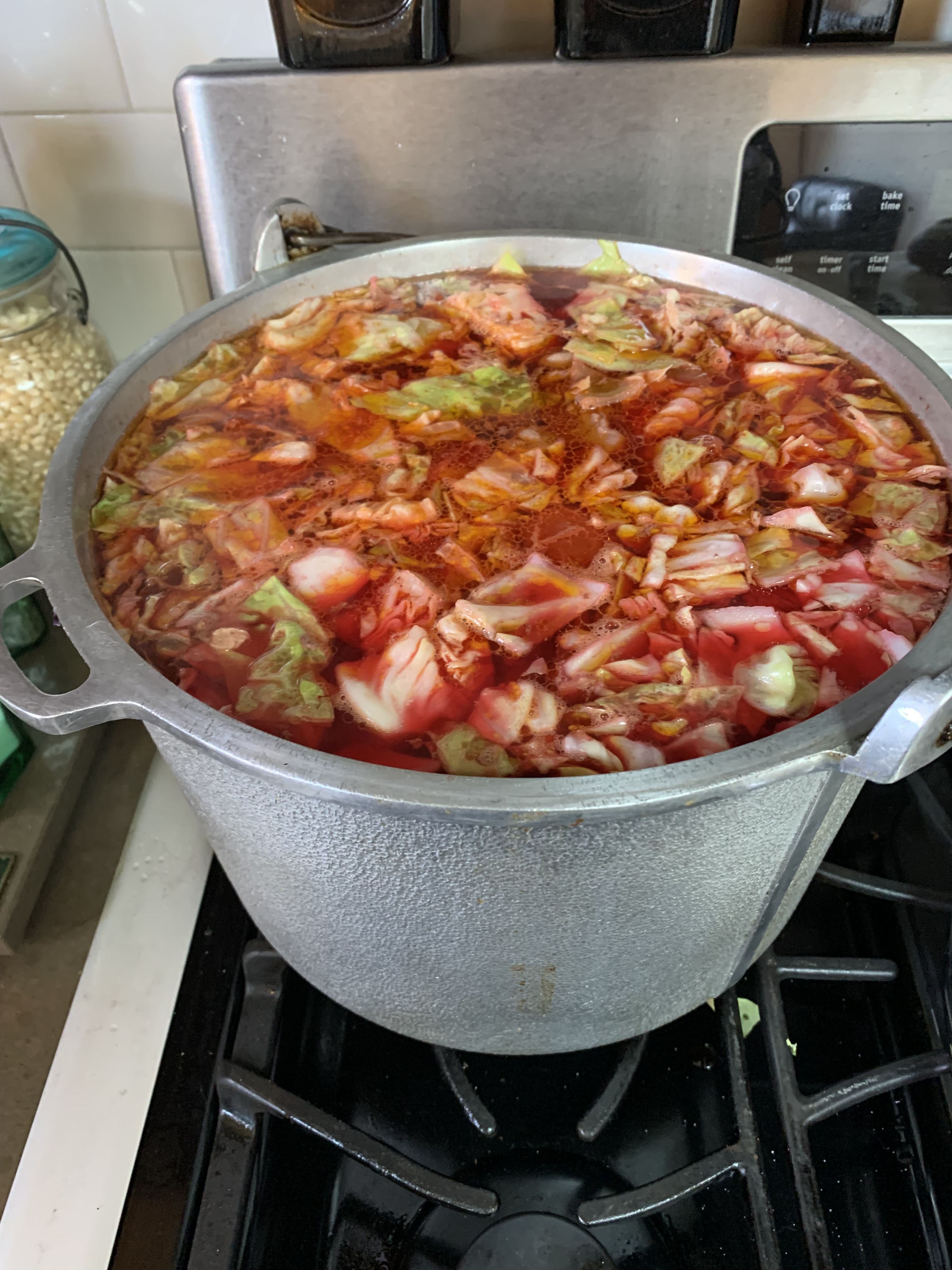
A perfect pot of borscht! photo by Mary Elyn Bahlert, 11/2022