Uncategorized

Woman’s work

My mother was a product of the 30’s – when she came of age.  When she and my father married – her second marriage, my father’s first – she quit her office job at Cutler Hammer to stay at home to work as a housewife. She had been well regarded at her work, crafting a life for herself as she navigated being a single mother to my brother, Ronnie.  

From the beginning, my life had taken a different shape than my mother’s, whose parents kept a sort of “rooming house” for men who arrived in Milwaukee alone, without families, from Ukraine.  Her first language had been Ukrainian, and she made her way through the 9th grade before quitting school to go to work.  Like many of the children of immigrants, she taught her father to read and write English.  She would have been a great teacher, I’m sure.  But that path was not open to her.

My parents – who both valued education, although that path had not been theirs – supported me as I lived at home and commuted to the University of Wisconsin-Milwaukee to get a degree in English.  I graduated in the winter of 1973 and worked for several weeks in the offices at A. O. Smith, the steel mill where my father worked as an inspector on frames.  Then I interviewed with several other young people – also new college graduates – for an entry level position as a Claims Representative for the Social Security Administration.  In 1973, SSA was bracing itself for the coming of the Supplemental Security Income, which offered benefits – not livable benefits, but benefits, just the same – to the disabled and elderly.  And so I was hired, along with other college graduates from all over the country, and left home to train as a CR at the Social Security Administration in Minneapolis.   At the end of training, we all waited anxiously for news of our assignment, and I was relieved when I was sent to Green Bay, Wisconsin – a city, at least – to begin my career with the government.  

When I arrived in the office in Green Bay, I took my place at one of the desks in the long row of desks, separated by a center aisle, in the offices of SSA, on the second floor of a government building in downtown Green Bay.   I was the first woman to work as a Claims Representative in that office, although a woman who had been promoted from her current position – Joanne – was away at training to hold the same position.  Five days a week, we interviewed, completed applications, followed up to back up the applications with photocopies of the necessary documents for each applicant, and adjudicated the claims that came with the people we’d interviewed.  The SSA and SSI laws were constantly changing, and week after week, we received pages and pages of material that needed to be read and filed in the proper place in the copy of the SSA Law that each one of us had at our work stations. 

It would take three years for me to achieve journeyman status as a Claims Representative.  I’m grateful for the additional training I received in public relations and management through the government, traveling from time to time to Chicago to take a class (I’ve written about my trips to the Big City in another post), offering training to the other CR’s, receiving training.  A year or two into my work at the office in Green Bay, the new building in downtown that would house only the Social Security District Office was complete, and we moved – files, machines, desks, and all – to the new office.  I commuted each day three miles to my little one bedroom apartment in Ashwaubenon – home to the Green Bay Packer stadium, Lambeau Field.  

My apartment was simply furnished with a telephone on the wall.  I had a black and white television and a turntable and speakers for my LP’s.  Mostly, I watched PBS shows, one or two nights a week.  A small round table with four chairs filled the small space between the kitchen and the carpeted living area.  Sitting on the second hand couch I’d found – somewhere – I read a new magazine I’d heard about and subscribed to:  Ms. Magazine, Gloria Steinem, publisher.  I was hooked.  I read those monthly issues of Ms. from cover to cover, reading articles that opened my mind to a new way of looking at the world.   

Looking back now, I can say it this way:  my consciousness was raised.  I had a “feminist click,” a way of looking at my life and the lives of other women that shed light on the second class status that women had – have – in our society, and in the world.  

The work world continued in my day job.  Every few months, a paper would appear on my desk, passed from one person to the next, asking the women in the office to sign up for a week to clean the break room at end of the week.  Like the other women in the office, I signed my name dutifully, not thinking more about it.  Until.  Until what?  

One day when that sign-up sheet arrived on my desk, I picked it up, walked to the desk of the Administrative Assistant, outside the office of the District Manager, threw the sign-up sheet that already boasted some signatures onto her desk, and said:  “until the men have to sign up too, I’m not going to clean the break room.  I’m a CR, too.”  Usually easygoing and fun, I could see that the AA was stunned. I walked back to my desk.

I suppose something had to be done: the District Manager consulted, discussions needed to be held, opinions shared (I’m sure) – all behind closed doors.  

A few days later, we learned of a new policy regarding the clean-up of the break room:  the cleaning folks who came after hours to vacuum and get rid of the endless papers would be cleaning the break room from here on out. 

*

To me, it seemed like a half victory – still, I’d stuck my neck out to say “no more.”  To this day, I’m disappointed at the result, because I realize allowance had been made to make sure the men – who held the same position and grade as I did – did not have to clean the break room.  I’m sure they retired without ever having to do the job.

Years later, when I was pastor at Lake Merritt United Methodist Church in downtown Oakland, I told the story as an illustration in a sermon.  I wish I could at least remember the text!  What I do remember is that after I’d told the story, the gathered worshippers had a reaction:  they applauded!  
Uncategorized

Walking Through the Pandemic

When the “shelter in place” began in California in 2020, I expect that most of us thought that if we just closed down for a few weeks, we’d be able to get back to our real lives. And so we sheltered. Here in Northern California, the winters are often mild, and many winters, there is not even much rain – until this year, of course, a record-setting year for rain. So in the late winter and the spring of 2020, we stayed close to home, enjoying our yard in the city. In the evenings, before sunset, Jeff and I would often drive through Oakland, seeing neighborhoods we rarely saw, enjoying the one freedom we had. We ordered our groceries delivered to us. We felt privileged – which we are – with a studio in the back of the garage for Jeff, and the room I call “my little study” down a flight of stairs from the kitchen.

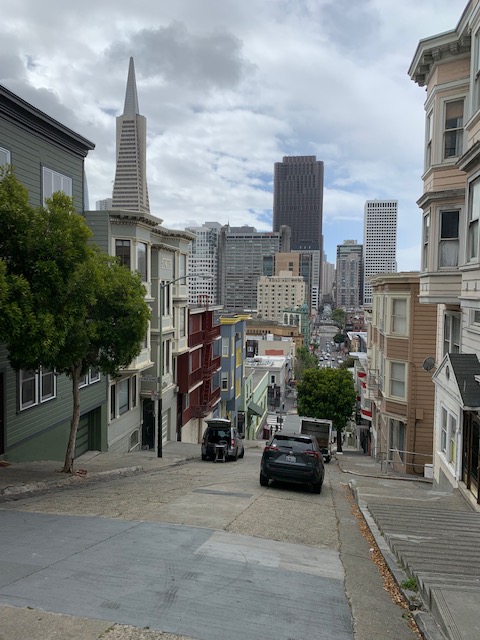
Still – how to pass the hours, multiplying into weeks and months? We didn’t take to going to worship online, and so we began to leave our house early on Sunday mornings to find places to walk. Both being retired, a Sunday morning to spend as we wished was a luxury. And we counted: over the course of many months, we walked at least 15 neighborhoods in San Francisco. We walked up hills. We walked down hills. We walked through streets that were mostly empty of other people. We walked and we talked.

We walked, again and again, on the paths that line the Martinez Slough, high tide and low tide. We walked and we talked.

As time went on, we invited friends over to enjoy our yard with us. We brought dinners out to them on paper plates, and we often sat, dressed in sweaters and even coats, until the light of the day was passing away.

I had a large plastic box of decades of photos from my lifetime – and from the decades before my lifetime – on a high shelf in the garage. Jeff brought the box out to me in the yard, and I sat in the sun and sorted almost a centuries’ worth of photos, some black and white, some formal, some taken on a whim. I looked closely at each one, the time stretching before me into some unknown future, and then, the past stretching behind me. Some of the photos I mailed to my sister in Hawaii, others I sorted again into large folders that now fill a drawer of the wooden file cabinet in my study.

Like so many others, we think back on three years of the world’s living with COVID-19, and it’s hard to believe we did it. We learned to live with the virus, and we are grateful that we didn’t contract the virus until it was less severe than news reports talked about in the beginning, when health care across the world struggled. And our own world grew in a way, as we discovered places in our own community.

It’s a relief that the world has moved on to a different place, with COVID-19 a regular resident of the planet, along with the rest of us.

Walking through the Pandemic: San Francisco 11/2022

photo by Mary Elyn Bahlert

remembering, wisdom

??? Curiosity ???

It was in the beginning of January, 2001. My mother was in the last days of her life, and she lay on her bed, under hospice care, in the Mathilda Brown Home in Oakland, every day, all day.  I sat with her often – as often as possible –  and we chatted idly, our conversation about ordinary things.  From time to time, Mom would close her eyes as she lay on her back, and I sat in the silence – our last times together. 

At the time, I was the proud and enthusiastic owner of the Palm Pilot, powered by batteries, that held my calendar. 

One afternoon, I sat next to Mom’s bed as she rested, and because I had not brought a book or other work from my office, I turned on my little computer-calendar and started to play Solitaire- a bonus feature.  A few moments later, Mom sat up, and threw her legs over the side of the bed, as she looked at the object in my hands.  “What is that?” she asked.

?????????????????

Over the years, I’ve come to value my own curiosity more and more.  Curiosity has been a great gift to me.  As I get older, I know that I prefer to spend my time with curious people – people whose sights are set on the abundance of wonder in the world.  Their curiosity may lead them to interests that aren’t mine, but it’s the quality they possess that makes them interesting – and, well, curious – to me. What they give me from what they’ve received from their own interests continually makes my life richer.

And their curiosity flows over – to people.  Curious people are interested in other people, about the world other people inherit, about how other people got to where they are going now, what decisions they made, who they’ve encountered in their lives. Over the years, my friends loved to visit with my parents. In their small living room, my friends’ lives were of interest to Mom and Dad, whose lives were enriched by the young people in their lives. Mom and Dad were interested in the lives of the young people who visited, and the young people knew that – and liked it.

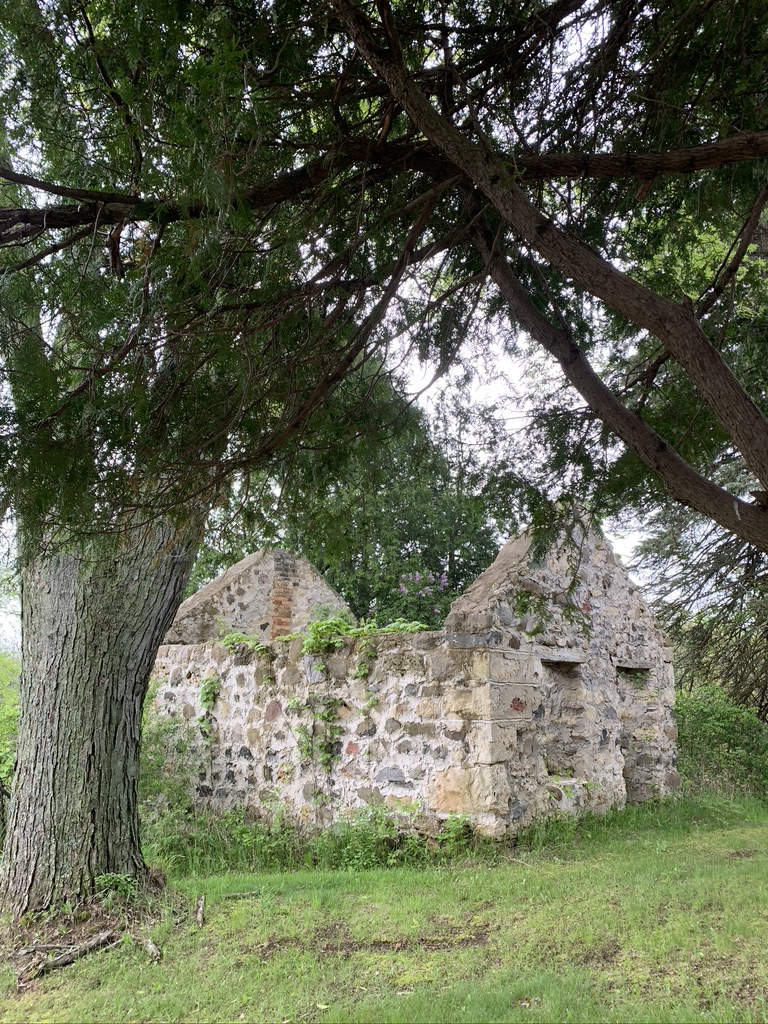
A curious stone building, once home… Saukville, WI, 5/2022 Photo by Mary Elyn Bahlert

My brother Ronn was 9 years older than me; he married when I was 14.  In my eyes, he was all grown up, making his way in the adult world.  One day, after he’d been married a year or so, he said something to me that I’ve never forgotten: “Do you know that some people are not as interested in things as we are in our family?”  “No,” I answered Ronn, in response to his reflective question.  I’ve never forgotten his question, his observation, really, about the world as he saw it – his own world growing larger by his connection to another family.

Curiosity has led me to be curious about myself, to be curious about my inner life, about what has brought me here, about who and what I’ve encountered over the course of the years of my life.  My curiosity extends to other people:  what makes them tick? In my mind, curiosity is not dependent on finding answers; curiosity is interested in questions…

I’ve always loved libraries.  What better place than a building whose purpose is to hold books, computers, magazines – all filled with something to satisfy someone’s curiosity – or to leave someone’s curiosity unsatisfied, so that they have to go back for more?!?

I didn’t come from highly educated people, people with degrees and titles.  But I did come from a curious sort, people whose eyes lit up with the discovery of what was new, new in their lives. I expect that the quality of being curious is not related to education.

And would the world be different, if human beings were less concerned with certainty than with curiosity?