Uncategorized

Woman’s work

My mother was a product of the 30’s – when she came of age.  When she and my father married – her second marriage, my father’s first – she quit her office job at Cutler Hammer to stay at home to work as a housewife. She had been well regarded at her work, crafting a life for herself as she navigated being a single mother to my brother, Ronnie.  

From the beginning, my life had taken a different shape than my mother’s, whose parents kept a sort of “rooming house” for men who arrived in Milwaukee alone, without families, from Ukraine.  Her first language had been Ukrainian, and she made her way through the 9th grade before quitting school to go to work.  Like many of the children of immigrants, she taught her father to read and write English.  She would have been a great teacher, I’m sure.  But that path was not open to her.

My parents – who both valued education, although that path had not been theirs – supported me as I lived at home and commuted to the University of Wisconsin-Milwaukee to get a degree in English.  I graduated in the winter of 1973 and worked for several weeks in the offices at A. O. Smith, the steel mill where my father worked as an inspector on frames.  Then I interviewed with several other young people – also new college graduates – for an entry level position as a Claims Representative for the Social Security Administration.  In 1973, SSA was bracing itself for the coming of the Supplemental Security Income, which offered benefits – not livable benefits, but benefits, just the same – to the disabled and elderly.  And so I was hired, along with other college graduates from all over the country, and left home to train as a CR at the Social Security Administration in Minneapolis.   At the end of training, we all waited anxiously for news of our assignment, and I was relieved when I was sent to Green Bay, Wisconsin – a city, at least – to begin my career with the government.  

When I arrived in the office in Green Bay, I took my place at one of the desks in the long row of desks, separated by a center aisle, in the offices of SSA, on the second floor of a government building in downtown Green Bay.   I was the first woman to work as a Claims Representative in that office, although a woman who had been promoted from her current position – Joanne – was away at training to hold the same position.  Five days a week, we interviewed, completed applications, followed up to back up the applications with photocopies of the necessary documents for each applicant, and adjudicated the claims that came with the people we’d interviewed.  The SSA and SSI laws were constantly changing, and week after week, we received pages and pages of material that needed to be read and filed in the proper place in the copy of the SSA Law that each one of us had at our work stations. 

It would take three years for me to achieve journeyman status as a Claims Representative.  I’m grateful for the additional training I received in public relations and management through the government, traveling from time to time to Chicago to take a class (I’ve written about my trips to the Big City in another post), offering training to the other CR’s, receiving training.  A year or two into my work at the office in Green Bay, the new building in downtown that would house only the Social Security District Office was complete, and we moved – files, machines, desks, and all – to the new office.  I commuted each day three miles to my little one bedroom apartment in Ashwaubenon – home to the Green Bay Packer stadium, Lambeau Field.  

My apartment was simply furnished with a telephone on the wall.  I had a black and white television and a turntable and speakers for my LP’s.  Mostly, I watched PBS shows, one or two nights a week.  A small round table with four chairs filled the small space between the kitchen and the carpeted living area.  Sitting on the second hand couch I’d found – somewhere – I read a new magazine I’d heard about and subscribed to:  Ms. Magazine, Gloria Steinem, publisher.  I was hooked.  I read those monthly issues of Ms. from cover to cover, reading articles that opened my mind to a new way of looking at the world.   

Looking back now, I can say it this way:  my consciousness was raised.  I had a “feminist click,” a way of looking at my life and the lives of other women that shed light on the second class status that women had – have – in our society, and in the world.  

The work world continued in my day job.  Every few months, a paper would appear on my desk, passed from one person to the next, asking the women in the office to sign up for a week to clean the break room at end of the week.  Like the other women in the office, I signed my name dutifully, not thinking more about it.  Until.  Until what?  

One day when that sign-up sheet arrived on my desk, I picked it up, walked to the desk of the Administrative Assistant, outside the office of the District Manager, threw the sign-up sheet that already boasted some signatures onto her desk, and said:  “until the men have to sign up too, I’m not going to clean the break room.  I’m a CR, too.”  Usually easygoing and fun, I could see that the AA was stunned. I walked back to my desk.

I suppose something had to be done: the District Manager consulted, discussions needed to be held, opinions shared (I’m sure) – all behind closed doors.  

A few days later, we learned of a new policy regarding the clean-up of the break room:  the cleaning folks who came after hours to vacuum and get rid of the endless papers would be cleaning the break room from here on out. 

*

To me, it seemed like a half victory – still, I’d stuck my neck out to say “no more.”  To this day, I’m disappointed at the result, because I realize allowance had been made to make sure the men – who held the same position and grade as I did – did not have to clean the break room.  I’m sure they retired without ever having to do the job.

Years later, when I was pastor at Lake Merritt United Methodist Church in downtown Oakland, I told the story as an illustration in a sermon.  I wish I could at least remember the text!  What I do remember is that after I’d told the story, the gathered worshippers had a reaction:  they applauded!  
memories, nostalgia, remembering, Uncategorized

Thanksgiving

I love the holiday season, which begins with Thanksgiving Day. When I was pastor in downtown Oakland, the congregation marked the day of thanks by offering a wonderful, complete Thanksgiving Dinner to anyone in the community who wanted to join. Homeless folks, people who did not speak English, people without family or even friends, joined the day’s gathering to sit at a table and to be served by other grateful folks. For many years, that tradition became part of my personal Thanksgiving, as I looked out at the gathered people and said to myself, again and again: “these are my people!”

And Jeff and I mark the holiday every year now by arriving at Norman and Cheryl’s cottage on a hill in San Francisco, climbing the narrow stairs to the top of a hill, our arms filled with pies – our contribution! – and to sit at the long, narrow table filled with an assortment of Bahlert-related people every year. As the day progresses and the dusk and darkness come, families with little ones begin to gather their belongings and leave, with much ado. The tiny kitchen which produced the feast we’d all enjoyed is full of helpers bumping into each other, cleaning up, continuing the dinner-time conversation. And then – just like that! – we all descend the steps and walk to our cars on the quiet streets and drive home, mentioning to one another moments from the day, who had grown, who talked to who, how much older everyone is (except for us, of course!), and probably feeling a bit of sadness that another holiday has passed.

In the Midwest, the shorter days and long evening of dark and cold have begun by this time of year. There’s a sense of “cocooning” that we don’t know in the same way here in California. And missing now, also, is the childhood sense of a quiet and light filled season, beginning with Thanksgiving, that won’t end until after Epiphany, in January.

My mother honored the season of holidays each year by hosting Thanksgiving Dinner at our upper flat, and by creating for my sister Suzie and me a holiday tradition. In the 50’s and 60’s (of the last century), the holiday season did not officially begin until Thanksgiving. On the day after Thanksgiving, my mother and Suzie and I took the 23 bus from the North Side to downtown Milwaukee, now mysteriously decorated with lights and ribbons along Wisconsin Avenue, still a booming shopping district at the time.

We’d step off the bus at 3rd and Wisconsin to walk through the Boston Store, which anchored the downtown at that time. My mother held tightly to each one of us as we walked through the crowded store, the lights and music having followed us from the street into the store.

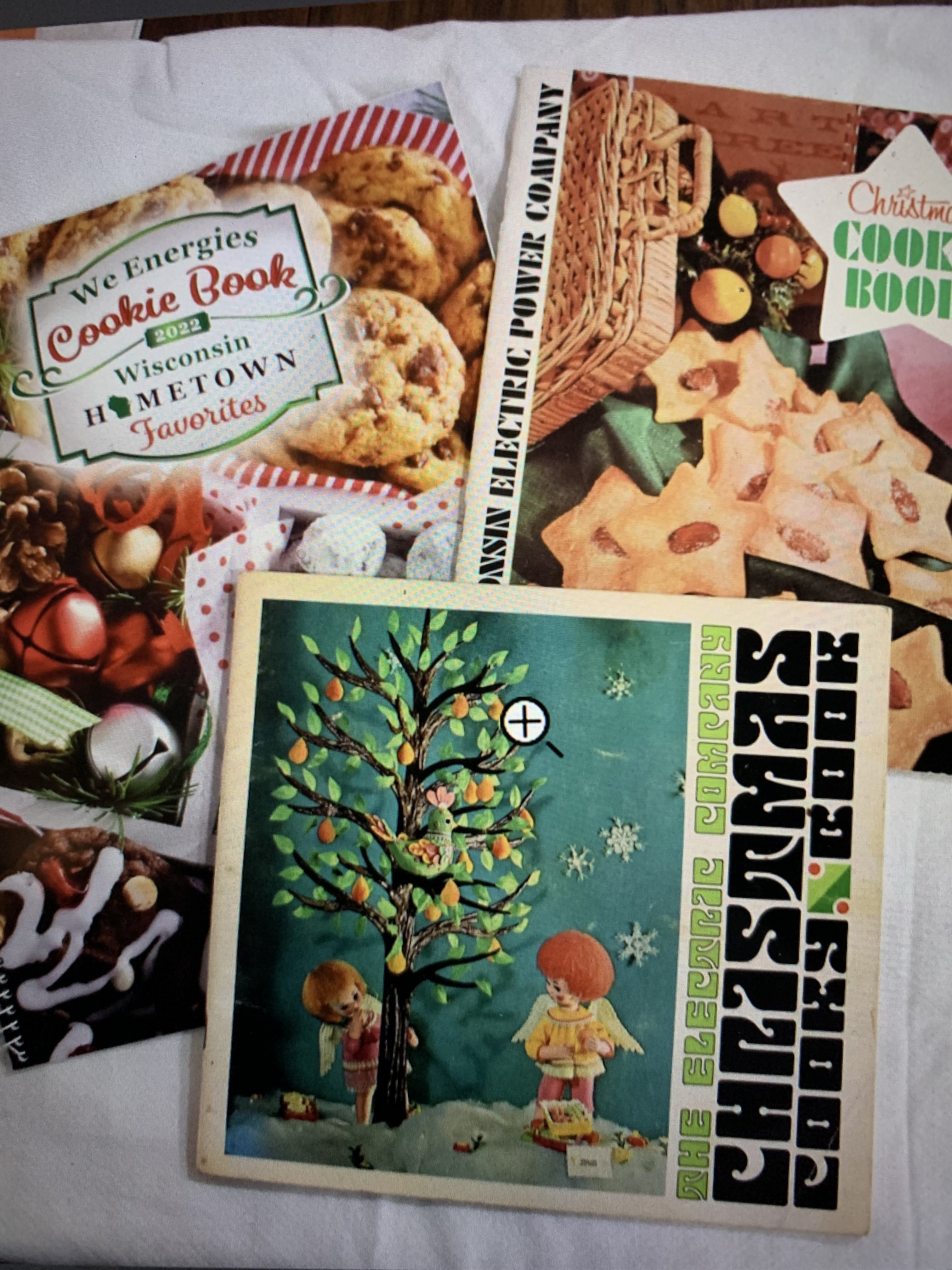
Then, we’d walk, first to the Wisconsin Electric Company, and then to the Gas Company, to take in the cookie displays at each one. My mother made sure that at each place, she was provided with 3 copies of the new cookie book published by each company each year. She loved to try new recipes, and she loved to re-create those that had been her favorites – or dad’s favorite, or mine, or Suzie’s. Unknown to me, she wrote notes as she baked: “a favorite,” “takes a bit less powdered sugar than called for,” “makes a big batch!”

I didn’t discover the notes until years later, when I had my own apartment in Green Bay, and when Mom presented me with the collection of cookbooks she’d saved, just for me.

I’m not a great baker, although the family in San Francisco allows me to bring pies as my contribution to Thanksgiving. My mother loved to bake: “that’s the fun of it,” she’d say. And I expect she envisioned some sort of future for me and for my sister, based on her own life. Neither of us grew to have quite that future, I expect; it was her dream for us, regardless. The year after I retired, I baked a few batches of cookies, looking for a new way to fashion my life after an adulthood of work, often in a “man’s world.” That’s the year I reached high onto the kitchen shelf reserved for our cookbooks, and retrieved the cookbooks Mom had saved so carefully for me. And that’s when I saw her notes, in her particular hand-writing, written with me in mind, written with the relationship between the two of us holding us together.

memories, remembering, Uncategorized

Auntie Edna

“There are places I’ll remember. All my life, though some have changed. Some forever, not for better; Some have gone and some remain…” Lennon and McCartney

Our yearly trips to Door County seemed to have a pattern, and the pattern included visits to various aunts and uncles – my father’s siblings – who lived close to where they had been born. At some point during the week, we would drive for a visit to Auntie Edna’s house, close to the tip of the Door Peninsula, at Gill’s Rock. The road that ran to the north of Auntie Edna and Uncle Werner’s (we said, “Verner”) place led to the dock to the ferry to Washington Island.

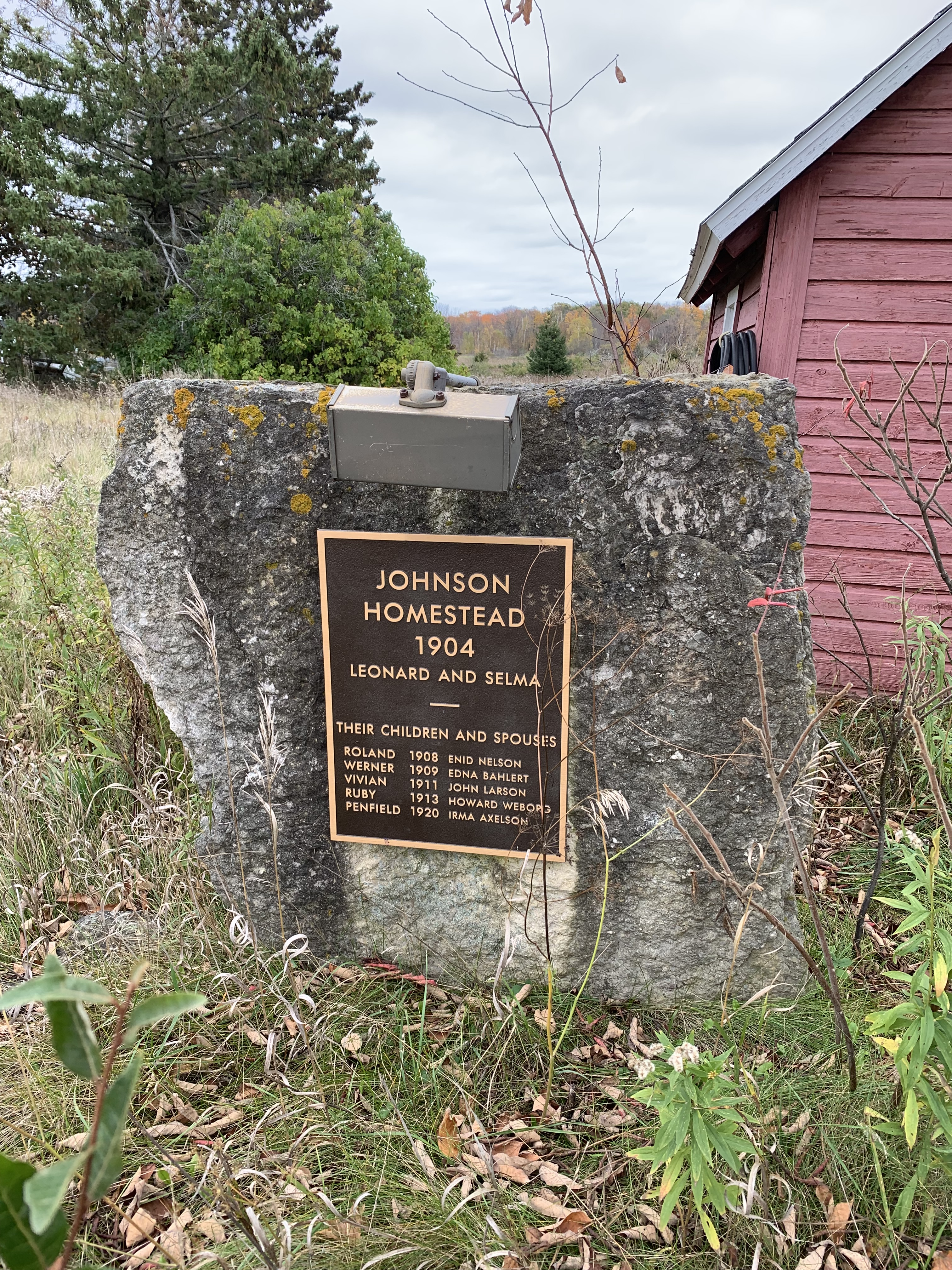
Edna and Werner had lived in that house for many years longer than I had been alive. My cousins Donna and Dean had been born in that place. On my trips to Door County now, I always drive past the brown-shingled house with the cherry orchard to the East. On the edge of the property on which their home stands is a plaque: “Johnson Homestead 1904, Leonard and Selma” the names of their children with years of birth, below. My Uncle Werner, who spoke as if he’d come straight from Sweden, had been born there! Years later, the thought would come to mind that his first language had been Swedish.

For a living, Uncle Werner had fished the tumultuous waters of that part of Wisconsin, Green Bay, Death’s Door to the North ( the native people had named that passage between Green Bay and Lake Michigan). He also raised the sour cherries that grew abundantly in the rocky soil of Door County.

The visit to with Auntie Edna and Uncle Werner began in their living room, with both Edna and Werner seated in their large, comfortable chairs. I sat in the same place each time, also, and I would look to that part of the long, narrow room toward the places we did not sit. Did they ever go into that part of the house, I wondered? Did the Christmas Tree go there?

Dad and Mom, Suzie and I sat formally in that living room, Dad with his cap in his hand, doing most of the talking. Of the lot of us, he was the most extraverted. Uncle Werner seemed to have a twinkle in his eye; I always thought that in his way, he was laughing at us. Auntie Edna was one of the quiet Bahlerts, and so she sat quietly in her chair, asking questions. Gentleness radiated from her presence. After awhile, we’d all get up, and Auntie Edna, Mom, Suzie and I would move to the small, dark dining room, where she served us juice and cookies. I remember her kindness, her ability to listen. When I went to the bathroom before we left the house, I’d glance into their bedroom, and always wondered why they slept in two single beds. At home, Mom and Dad slept together.

Years later, I would come to know my cousin Donna, who worked in Milwaukee and made the trip to the Door Peninsula every week to get her clothes washed, to be home again. Her life was much like my father’s had been, a generation before. While I was in college, I made the trip to Door County with Donna for a weekend, and she took me to her lifelong haunts. After she retired, Donna would marry Jim Thorp, who had lived his entire life on the Door Peninsula. They would live in their double-wide trailer, a short walk away from Donna’s folks.

On the Sunday of our week in Door County, we’d go to church at the Moravian Church just down the road from Werner and Edna’s place, and there she would be, my beloved aunt. In her quiet way, she was a presence.

Once a week, Edna wrote a column for the Door County Advocate about happenings in that place, so beautiful in the summer, with long bleak winters. When we had had our yearly visit, our names were mentioned in her column.

When we are a child, it’s hard to imagine these elders as being young, but sometimes I try to piece together the bits and pieces I heard, often repeatedly, into a pattern. I knew that Edna had graduated from high school, something not all of her siblings had done. She spoke as I spoke, not in the dialect of that place that my father had. Her father, Ginter Bahlert, my grandfather, had wanted her to go to college to be a schoolteacher, but that was not to be. She worked for a time at Bunda’s Store in Sister Bay, an establishment that lasted there until at least the 1970’s, on the West Side of Highway 42, on the South end of town, before she married Werner. I think of her every time I pass the building that once housed Bunda’s Store, the Sister Bay Bowl across the street, still standing.

It is odd, in a way, hard to understand that these places are still there, and the people I loved gone now, so long.

Photo by Mary Elyn Bahlert, October, 2021

Uncategorized

A night visitor

My Grandma, Frances Markowski – Feodosia Machsuda Srebna – had been born in Ukraine and came to the United States in 1914, before the Soviet Revolution that took that land and swallowed it into itself. A picture of her as a young woman with her young son, Ivan/John, and her husband, Vlas/Alex sits on the cabinet under the window in my dining room.

As a little girl, I looked over the railing of the porch on the second floor of the flat on Ring Street to see my grandma walking slowly, head down and covered by a scarf – she was a true “babushka” – her long dark winter coat covering her legs, up the alley to sit with my mother in the kitchen, to have a talk in the language that was native to both. In later years, Mom would often forget much of her Ukrainian first language, only speaking a word or two, sometimes with humor, with her sister, Anne, or one of her brothers.

Grandma died when I was in high school, and her funeral was the last that my parents went to without me and my sister, Suzie. A few months later, my mother’s younger sister died, as if to follow her mother. Years later, her son, my cousin Mark, would tell me that he thought his mother – who was already battling cancer – gave up after her mother died.

After Grandma’s death, my mother went to the cemetery a few times a year to clean up the graves of her father and mother, a sort of homage. When I went with her, she’d send me off with a bucket to the water spout on the road that ran past the graves and I’d come back, the bucket filled with the water, so that she could tend to the dead. A few years ago, Jeff and I returned to the cemetery in Milwaukee, and when we drove into the gates, I provided directions that took us right to the graves. I have not forgotten.

***

I wasn’t thinking of Grandma at all when I entered seminary in 1982 in Berkeley. One early morning, before sunrise, as I lay sleeping in my small room in the dormitory apartment that I shared with two other women, I was awakened by a presence in the room. I knew it was Grandma. I knew. She came into me that early morning. Frightened by this unbidden presence, I called out to Jesus.

Was I haunted? Why did she come to me? I asked the questions, longing to know, in a conversation with a friend. “Who else would she go to?” Her answer.

Jeff speaks of that time as a “haunting,” but I’m not sure. I do know that she lived with me, in me, for a number of years. And over the course of that time I wrote the series of poems I call “The Feodosia Poems.” They are her poems, not mine. She was an illiterate woman from the Old Country, and I am a woman of the New World, privileged, educated.

My mother told me she did not remember her dreams. But she remembered a dream one morning when I was visiting in her apartment. Just before she awoke, she dreamed she was standing looking at the back of a truck. The back of the truck rolled up, and there, looking at my mother, was a Matryoshka doll, a nesting doll. The doll’s face was her mother, my grandmother. She winked at my mother! And Mom woke up. She recounted the dream to me when we talked over coffee that morning.

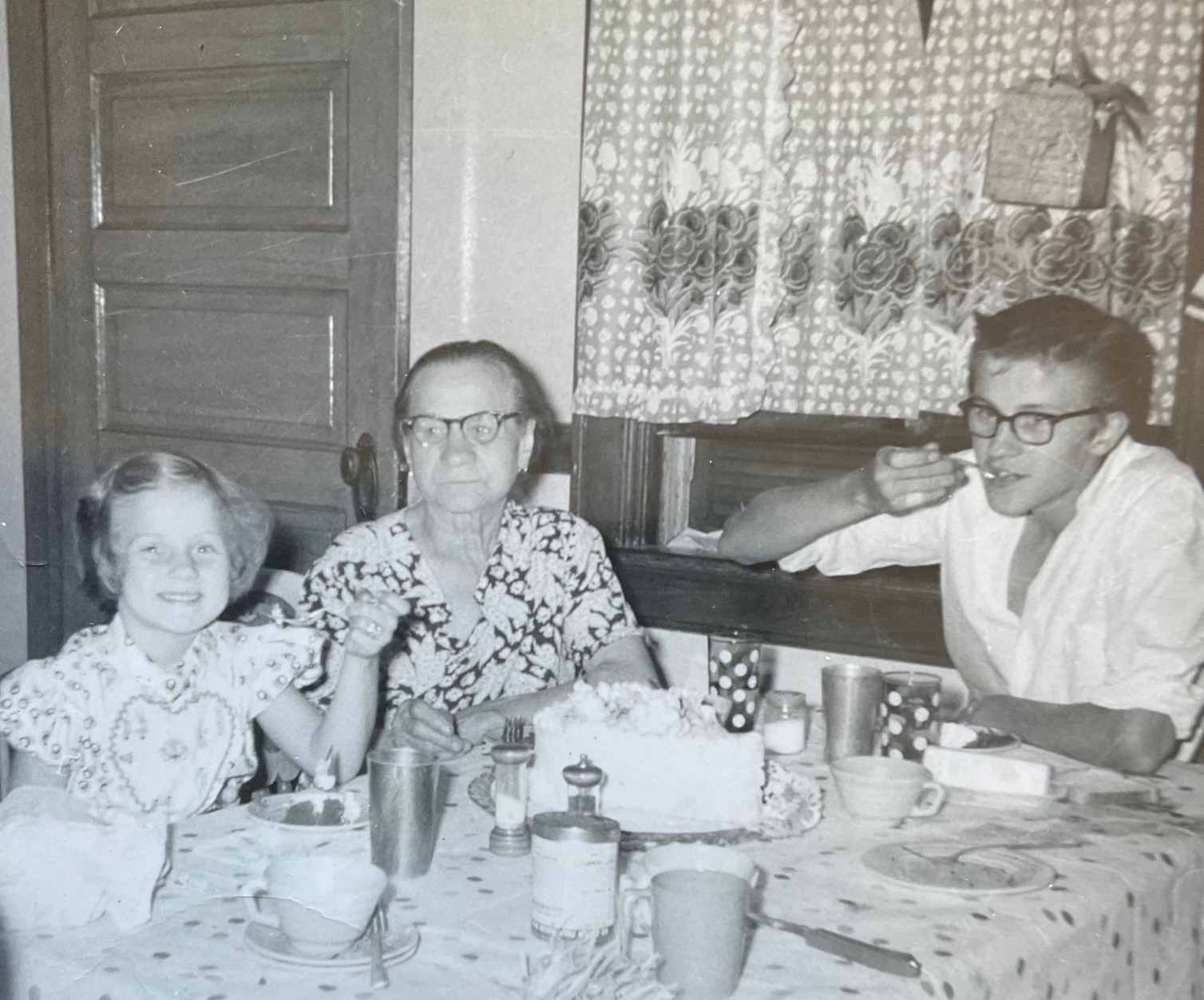
A black and white photo from the 1950’s is the only photo I have of Grandma with a light in her eye. She sits between me and big brother Ronn, already a teenager, trying to look “cool.” Maybe we brought some joy to her.

How I wish I knew her better, my Grandma, my babusya. And maybe, I do.

Me, Grandma, Ronn, circa 1955

beauty, memories, reflecting

the cat

I married a man and a cat. Schatzi had been in Jeff’s life for several years when he and I were married in 1984. Part Maine Coone, she was a beautiful creature with long gray fur. After we were married, she took to sleeping at our feet, making room for me. Schatzi will always be my favorite cat (sorry, LiLi).

Schatzi was my first cat, and she became my introduction to cats. She was a good role model. I’ve discovered since that not all cats have the same people-loving, generous disposition that Schatzi had. If I pushed her too far, she warned me gently, stretching one leg, claws showing, in my direction. I always paid attention! I studied her closely. One day I announced to Jeff: “this cat doesn’t have any eye-lids!” Welcome to cat-hood!

When I took long naps on the green couch in our living room, Schatzi would lie next to me, her back stretched out along my body, an extra layer of warmth. When we had visitors, Schatzi made sure to find her way to the center of the action. While she was a house cat, she was allowed outside if she chose, and being female, she didn’t ever go far from home.

In December of 2000, I recall a Sunday during the liturgical season of Advent when I recounted three things in my sermon that had happened to me during the prior week: I’d received a phone call that my friend and colleague Bruce had died of a heart attack, a doctor’s appointment with my mother had revealed that she had terminal cancer, and the cat had spent the week sick, lying close to the heat register in the dining room of our flat off Grand Avenue in Oakland. As she passed me after church, Phyllis turned to me and said: “I can’t get that cat out of my mind.”

A few months later, Mom passed, in February of 2001, at her beloved home at Mathilda Brown Women’s Residence in Oakland.

Schatzi stayed awhile longer that year. She seemed to know that I was grieving, that I needed her cozy and comforting presence. In the autumn of 2001, Schatzi spent her last night with us on the floor of the kitchen, not able to move, not able to eat. Jeff lay on the floor next to her, all night long.

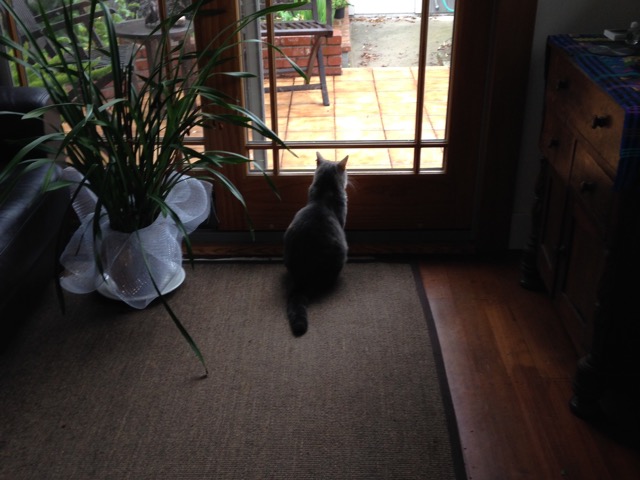
LiLi, our current feline housemate. Photo by Mary Elyn Bahlert.