I see what is beauty to me:
A few warm days in spring,
the smell of lilacs in the house,
the wetness that comes at night,
red sunsets.
Loneliness.
“Beauty to me,” from Moments, Mary Elyn Bahlert, published, 2026
I am not often lonely. But I have known loneliness, hard and deep loneliness. In my twenties, I worked in my first professional position, finally moving into public relations in both the Social Security Administration and the Food and Drug Administration. I had good friends. I lived in Milwaukee, where I’d grown up; I knew Milwaukee well, and I liked the life I had there. But I was lonely.
I was lonely, and it hurt. Some times, I’d come home after a day at work to my one bedroom apartment, furnished with furniture from the 1940’s, books lining the full bookshelves. This was the 1970’s; this was in the time before the Internet. Sometimes, in my loneliness, I’d call a good friend – a friend I’d called more than once that week – and chat for a time, until something else called to her to attend to. Was she lonely, too? I never told her I was lonely, and I never heard her talk about loneliness. But I was lonely.
During those years, I began to learn about the ministry. I’d been drawn to ministry since my late teens, when the thought arrived on its own, one day: I could be a minister. I had not seen or heard of such a thing as a woman minister; in the Lutheran Church in which I’d been confirmed, women were not allowed to speak in church. That – among other things – did not sit well with me. I started to learn about the ministry by reading books I’d borrowed from the library. I read about denominations. Until my mid-twenties, I did not find a church in which to connect. I began my learning in my own particular, introverted way.
And then, I did do some searching. I’d attend a church service at some congregation. More than once, as the unknown person – and as an unmarried, un-partnered woman – I’d be ignored. That was enough for me to not return. In my searching, I was led to visit a United Methodist Church across from the University I’d attended, on the East Side of Milwaukee. There, a kind older woman – Verdell de Yarman – looked right at me, asked if this was my first time at Kenwood United Methodist Church, and, after church, walked with me to the coffee fellowship, where she introduced me to the Rev. Harvey Stower. And it was Harvey who warmly invited me in, the way he warmly invited everyone in, to a circle of young people. And it was Harvey who asked me one day if I ever thought about seminary. And I told Harvey that I did – often – but that I just didn’t talk about it. After all, I had never seen a woman minister (although they did exist!).
I was grateful for Harvey and the community that formed around him. That community became important to my life in the years that followed. I’m always grateful.
The loneliness remained, until the mysterious and wonderful day I met Jeff Kunkel, my husband. In our marriage, I have not been lonely. I’ve heard about people who are lonely in their marriage. How hard that must be. Jeff is my true companion, my life partner.
As I reflect now on those times, many years ago, I look back at the quote of John Steinbeck that serves as the title of this blog post. I expect that Steinbeck knew loneliness, that he knew loneliness well enough to have clearly described it. And although he did not write of loneliness as I have – as a painful companion, a companion that brings tears and a complete emptiness into the mix – I expect he knew that of loneliness, also.
When I was a pastor, I spoke of loneliness in one sermon. And I have not forgotten: after worship, as people greeted me and sometimes commented on what they had heard (which is not always what I thought I had said!), a young woman shyly said to me: “thank you for talking about loneliness.”
“All great and precious things are lonely…”
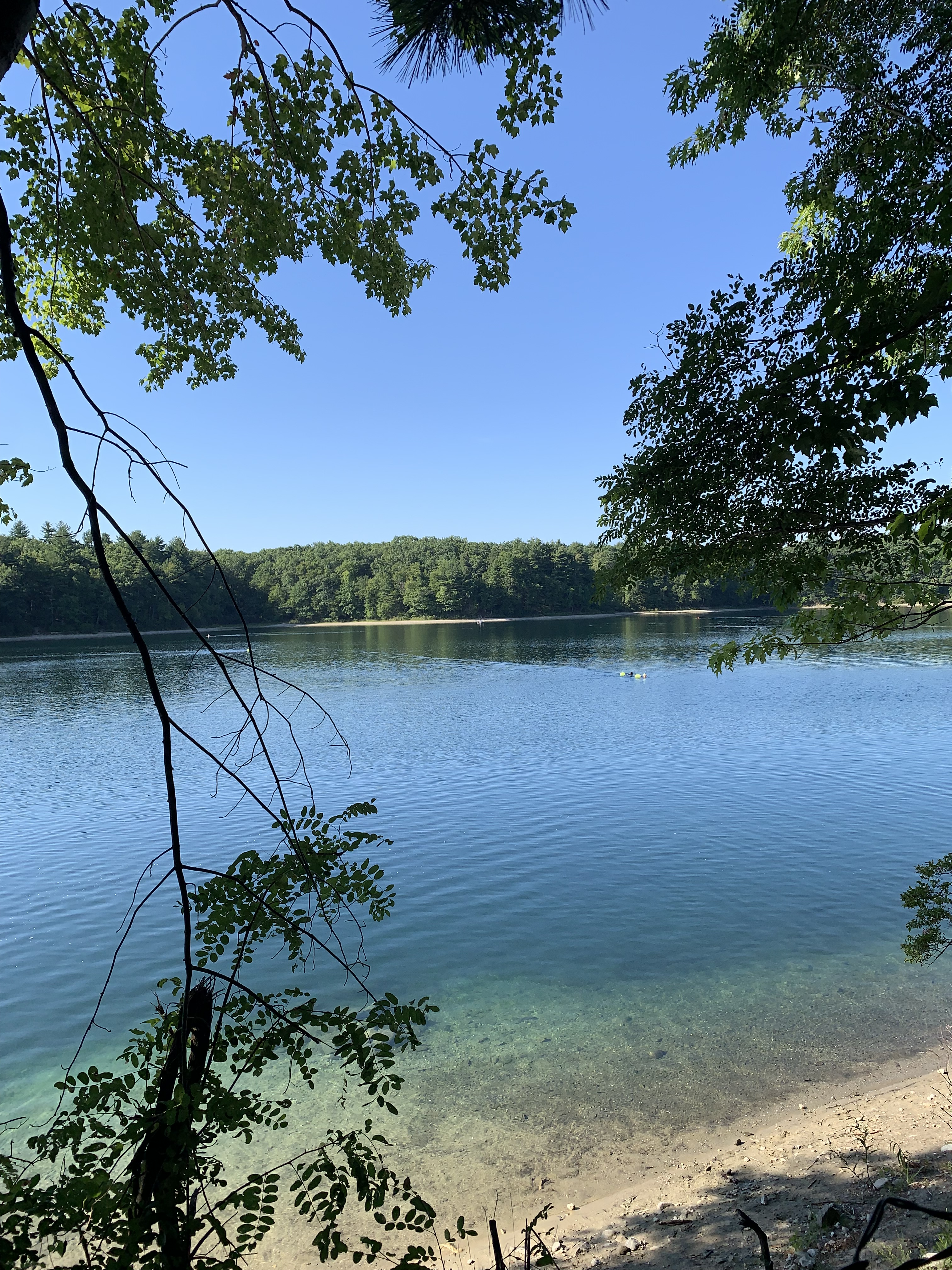
At Walden Pond, Massachusetts, where Henry David Thoreau lived in a small cabin, relishing his alone-ness. Photo by Mary Elyn Bahlert, 8/2026