My father was diagnosed with colon cancer within the year after he retired from 40 years of work in the steel mill at A.O. Smith Corporation in Milwaukee, retiring as an inspector. He and my mother had looked forward to retirement, and now, something intervened to make that retirement less assured than they had expected.
My father was not a man to speak up to someone, to offer his own opinion, if that opinion was different. While he was very extraverted – very extraverted – he kept his feelings to himself, and within his family. Being diagnosed with cancer changed that in some ways.
For one thing, he questioned his doctor more, eventually giving up on his physician when he failed to see the signs that the cancer had returned, in later years. But his voice came to life in another way, and what he said has stayed with me.
He told me that as he was being wheeled into the surgery to have the cancer removed, and to be fitted with a colostomy – which he had to the end of his life, ten years later – the nurse who walked beside him, being kind, said to him: “we’ll be in there with you,” as a word of assurance. “No,” he told her: “I’ll be in there alone.”
How true of what he was facing, what he faced.
I was reminded of that as we sang the words to an old song today in worship:
“Jesus walked this lonesome valley; He had to walk it by himself. Oh, nobody else could walk it for him; He had to walk it by himself.
We must walk this lonesome valley; We have to walk it by ourselves. Oh, nobody else can walk it for us; We have to walk it by ourselves.” – words and music, Eileen M. Johnson, public domain
Finally, we each walk our path alone. Community is a great gift on the journey along that path, but the final leg of the journey, the final act, is ours alone.
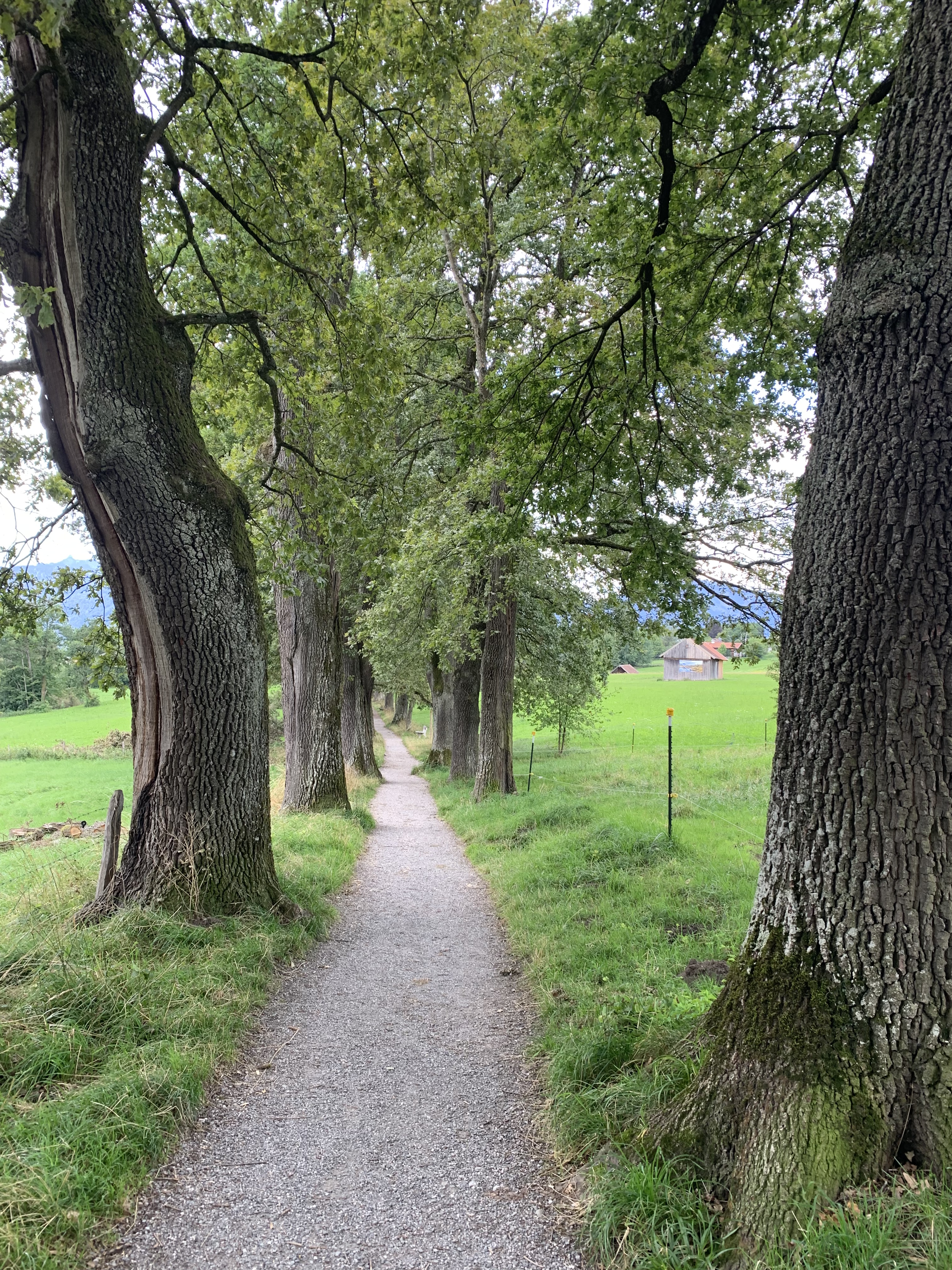
photo, Murnau, Germany, 8/3/20323 photo by Mary Elyn Bahlert
My mother was a product of the 30’s – when she came of age. When she and my father married – her second marriage, my father’s first – she quit her office job at Cutler Hammer to stay at home to work as a housewife. She had been well regarded at her work, crafting a life for herself as she navigated being a single mother to my brother, Ronnie.
From the beginning, my life had taken a different shape than my mother’s, whose parents kept a sort of “rooming house” for men who arrived in Milwaukee alone, without families, from Ukraine. Her first language had been Ukrainian, and she made her way through the 9th grade before quitting school to go to work. Like many of the children of immigrants, she taught her father to read and write English. She would have been a great teacher, I’m sure. But that path was not open to her.
My parents – who both valued education, although that path had not been theirs – supported me as I lived at home and commuted to the University of Wisconsin-Milwaukee to get a degree in English. I graduated in the winter of 1973 and worked for several weeks in the offices at A. O. Smith, the steel mill where my father worked as an inspector on frames. Then I interviewed with several other young people – also new college graduates – for an entry level position as a Claims Representative for the Social Security Administration. In 1973, SSA was bracing itself for the coming of the Supplemental Security Income, which offered benefits – not livable benefits, but benefits, just the same – to the disabled and elderly. And so I was hired, along with other college graduates from all over the country, and left home to train as a CR at the Social Security Administration in Minneapolis. At the end of training, we all waited anxiously for news of our assignment, and I was relieved when I was sent to Green Bay, Wisconsin – a city, at least – to begin my career with the government.
When I arrived in the office in Green Bay, I took my place at one of the desks in the long row of desks, separated by a center aisle, in the offices of SSA, on the second floor of a government building in downtown Green Bay. I was the first woman to work as a Claims Representative in that office, although a woman who had been promoted from her current position – Joanne – was away at training to hold the same position. Five days a week, we interviewed, completed applications, followed up to back up the applications with photocopies of the necessary documents for each applicant, and adjudicated the claims that came with the people we’d interviewed. The SSA and SSI laws were constantly changing, and week after week, we received pages and pages of material that needed to be read and filed in the proper place in the copy of the SSA Law that each one of us had at our work stations.
It would take three years for me to achieve journeyman status as a Claims Representative. I’m grateful for the additional training I received in public relations and management through the government, traveling from time to time to Chicago to take a class (I’ve written about my trips to the Big City in another post), offering training to the other CR’s, receiving training. A year or two into my work at the office in Green Bay, the new building in downtown that would house only the Social Security District Office was complete, and we moved – files, machines, desks, and all – to the new office. I commuted each day three miles to my little one bedroom apartment in Ashwaubenon – home to the Green Bay Packer stadium, Lambeau Field.
My apartment was simply furnished with a telephone on the wall. I had a black and white television and a turntable and speakers for my LP’s. Mostly, I watched PBS shows, one or two nights a week. A small round table with four chairs filled the small space between the kitchen and the carpeted living area. Sitting on the second hand couch I’d found – somewhere – I read a new magazine I’d heard about and subscribed to: Ms. Magazine, Gloria Steinem, publisher. I was hooked. I read those monthly issues of Ms. from cover to cover, reading articles that opened my mind to a new way of looking at the world.
Looking back now, I can say it this way: my consciousness was raised. I had a “feminist click,” a way of looking at my life and the lives of other women that shed light on the second class status that women had – have – in our society, and in the world.
The work world continued in my day job. Every few months, a paper would appear on my desk, passed from one person to the next, asking the women in the office to sign up for a week to clean the break room at end of the week. Like the other women in the office, I signed my name dutifully, not thinking more about it. Until. Until what?
One day when that sign-up sheet arrived on my desk, I picked it up, walked to the desk of the Administrative Assistant, outside the office of the District Manager, threw the sign-up sheet that already boasted some signatures onto her desk, and said: “until the men have to sign up too, I’m not going to clean the break room. I’m a CR, too.” Usually easygoing and fun, I could see that the AA was stunned. I walked back to my desk.
I suppose something had to be done: the District Manager consulted, discussions needed to be held, opinions shared (I’m sure) – all behind closed doors.
A few days later, we learned of a new policy regarding the clean-up of the break room: the cleaning folks who came after hours to vacuum and get rid of the endless papers would be cleaning the break room from here on out.
*
To me, it seemed like a half victory – still, I’d stuck my neck out to say “no more.” To this day, I’m disappointed at the result, because I realize allowance had been made to make sure the men – who held the same position and grade as I did – did not have to clean the break room. I’m sure they retired without ever having to do the job.
Years later, when I was pastor at Lake Merritt United Methodist Church in downtown Oakland, I told the story as an illustration in a sermon. I wish I could at least remember the text! What I do remember is that after I’d told the story, the gathered worshippers had a reaction: they applauded!
Some people have uncles that were awful people, creepy people, uncles that no one liked, uncles that were hard to be around.
Not me. I had wonderful uncles, and I remember them, along with all the rest of the ancestors, often. While they did not say it – ever – I knew that there was love, or at least affection, in them for me.
Uncle Pete, my mother’s youngest brother, was full of himself. Like all the others who are full of themselves, he took up all the space in a room. He had a large presence, a sort of charisma, I suppose. His dark eyes danced as if he had a joke to tell. He could tell stories from three wars – “Pete fought in three wars,” the men in his neigborhood said as they made room for his wandering, his memory loss, in his later years. Pete, my handsome uncle Pete, who walked silently to the car with me on a visit I made to the military hospital in Oakland to see Aunt Athalie, his wife. Then, he seemed shy even, as he carefully saw that I was in my car and had driven safely off.
Sometimes as I got older, he’d ask me a question he should have asked my mother; “ask my Mom,” I’d say, without saying more. He didn’t press me further. Did he ask my Mom? I don’t think so! Like many families, differences were not worked out directly between the siblings. They had to trust in the passage of time to take away old hurts.
Uncle Johnny was the eldest brother, a hero to my mother and her other siblings, Mike, Anne, Pete. He was older than the next one in line – Mike – by 9 years, and it was safe to say that he had been born in the Old Country, Ukraine, although the family lore held that he was “born on the boat.” When he went off to work, he showed up at home to bring Christmas to his siblings, knowing that his folks would not come through for them – ever.
Uncle Johnny was smart, well-read, an atheist: an uneducated intellectual, the condominium he shared with Aunt Dani filled with piles of magazines and books. His brother’s eyes were full of pride when Johnny spoke; my mother’s, too. He was a quiet one – like Mike and my mother, to Anne’s, to Pete’s extraversion. In his later working years as a machinist, he was a union man, his democratic socialist leanings lived out in his own life. He was our hero, too.
Uncle Mike was so quiet, so much part of the background that I have few memories of him. Did he ever speak to me? He married Alice, a British woman he’d met when he was a motorcycle-riding soldier in England during the War. When I was a young woman, Alice would call me from time to time, and she’d take me to dinner, where she talked and talked. After Mike died, Alice finally got a phone for their little home in a town north of Milwaukee. I last talked to Alice when she happened to call my mother in the days before we moved Mom to live out close to us in the Bay Area. My mother’s memory was already poor, so when my Aunt Alice identified herself to Mom, she handed the phone to me, probably thinking the call was for me.
**
Dad was one of nine siblings, one of only two who’d left Door County, Wisconsin, to live in the city; Dad settled in Milwaukee, Uncle Norman, his youngest brother, in Queens, New York, where he worked as a police officer. And so I had a string of aunts and uncles on the Bahlert side.
Clarence and Ray were Dad’s older brothers, Ray, a farmer, Clarence, a retired Coast Guard officer who worked the wild waters of Lake Michigan, all the way north to Washington Island, off the tip of Door County. When we stopped at Clarence’s house in Baileys Harbor – a cottage close to the shore of Lake Michigan – my Dad and Clarence stood outside talking for a long time, two brothers, separated by time and distance, by different lives.
We stood on the grass outside of Ray’s house, too, Ray, a quiet man – “one of the quiet Bahlerts,” with a quiet wife and a quiet daughter, my cousin Terri. By the time I remembered seeing Ray and his place, my cousin Roger, Terri’s elder brother, was married and gone, with a daughter of his own. Not until years later did I come to know Roger, after I’d retired. After a time of talking – my Dad did the talking, Ray the listening (I’m sure) – we’d walk around to the back of the property, to see the raspberry bushes, to taste a few, and to take a quick look at the outhouse, still in use, on the property. My family in northern Wisconsin were rural people, kind, gentle people. I loved them – love them – for that.
My dad told us a story about Ray and him, the two of them riding a Model T down the Sister Bay Hill that wound right down and into the main street of Sister Bay, on the Green Bay side of the peninsula. Young men, they yelled “Betsy Ross!” – a slang of the day, as they started down the hill, and as the driver shouted, he pulled the steering wheel right out of the steering column and held it high in the air until he realized what was happening, then poked that steering wheel right back where it belonged, and continue to navigate down the long Sister Bay Hill! Every time I go down that hill now, I think of them on that day, and I think of my father’s face, his voice rising, as he told the story – as he’d lived to tell the story.
Uncle Fritz was next in line, younger than my father. He was Dad to my cousin Bobbie, like Terri, a bit younger than me. Like the rest of the Bahlerts, Fritz was a worker, coming home from a day in the shipyards in Sturgeon Bay to butcher at the store he and Aunt Goldie operated near the north point of the Door County Peninsula. The only time I went as fast as 100 miles an hour in a car, I sat with Bobbie in the front bench seat of my uncle’s pickup, watching that speedometer go faster and faster! Fritz was quiet, too, and I don’t remember a conversation with him, although he was closest in age to my Dad.
Uncle Norman, the youngest, married a woman from the East Coast and raised his family there. My only memory of Uncle Norman was when he stayed with us overnight on the way to Door County to see his mother, my Grandma Bahlert, in the days before her death. I was a little girl, and I watched with big eyes as my handsome Uncle Norman came into the kitchen. Every year at Thanksgiving now, Jeff and I celebrate the holiday by sitting around the table with Uncle Norman’s eldest son, Norman Bahlert, and his family – children and even grandchildren now, and Cheryl, Norman’s wife. Pictures of the Bahlert’s from generations past look down on us all, seated around the long table, as if guarding their progeny.
So these were the uncles, distinct, kind, a part of the framework of family who peopled my life, then – and even now.
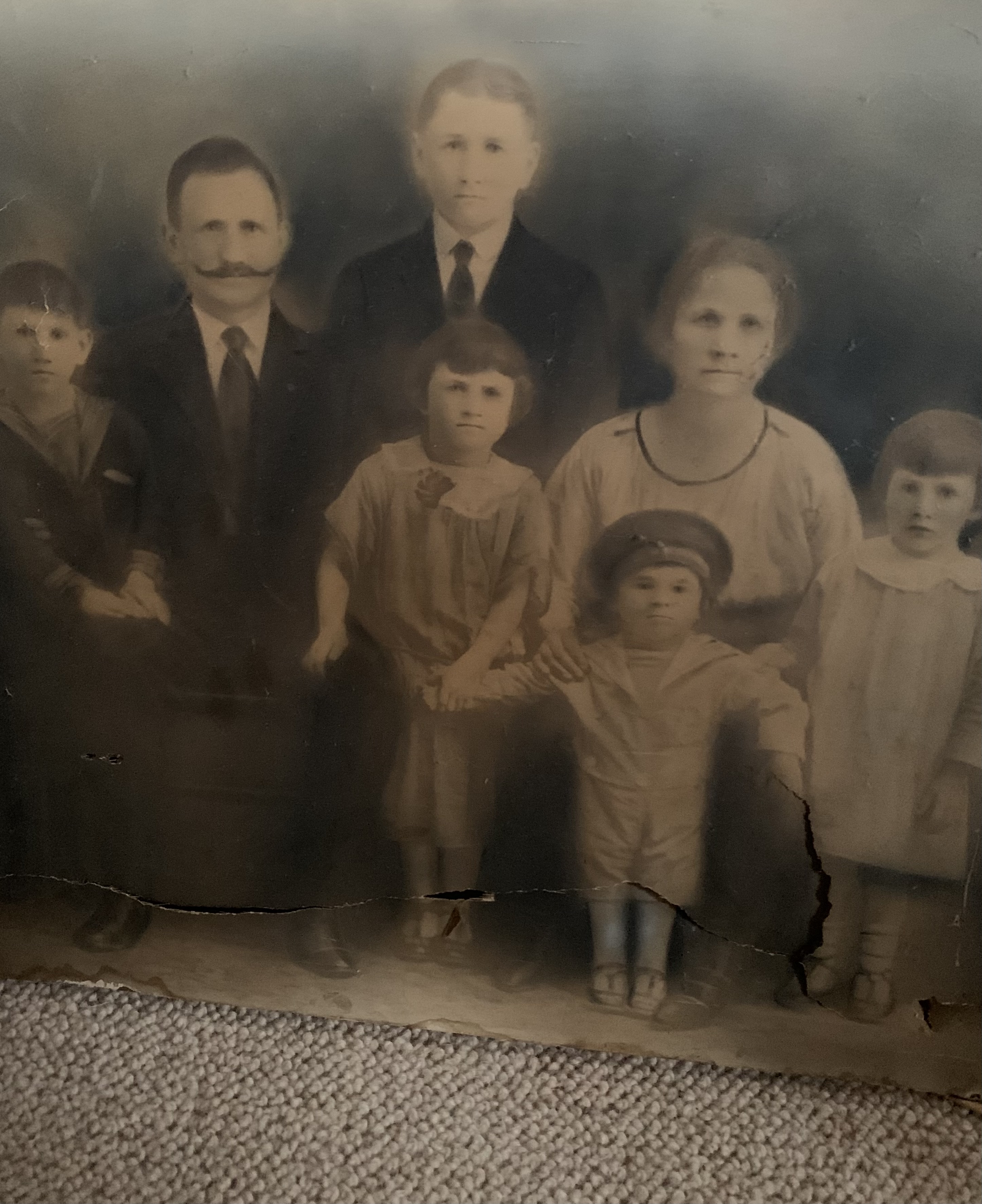
Vlas Markowski (Srebny) with Mike to his right, Johnny standing behind, and Pete, the little boy with the hat, at his mother’s knees. Photo, circa 1921-1922, Milwaukee, WI.
Over the course of my college years, while I lived at home and attended school at the University of Wisconsin-Milwaukee, I worked weekends as a cashier in a car wash, 20 hours per week, Friday, Saturday, and Sunday. There, I was introduced to people and cultures outside my personal experience, people I came to respect for their hard work, their ability to make their way in the complex situations which arise when working with the public.
Many of the young men who worked on the cars, who wiped them down before driving them onto the belt that took the car through the wash were men, African-Americans, who had arrived in Milwaukee from the Jim Crow South, although I didn’t know that at the time. When work in the car wash was slow, I talked to Acey, who spoke in a slow Southern drawl, and who said again and again, as if to himself: ”we just good friends, that’s all.” I knew that he was poor, and now, years later, I think that he was illiterate, as well. He spoke about his wife and children, at home in some neighborhood I did not know, where he took a city bus to home every day.
I met a smart, likable young man with a good manner. After a time, he quit working at the car wash, and one day he arrived with a brand new car, dressed to the nines in a suit and tie. We chatted for a moment as he paid his bill, and I asked him what he was doing now. Looking at me, he said: ”I’m a pimp.”
I’ll never forget the kindness and people-smarts of two of the managers – who managed both the employees who cleaned the cars, and the various problems that came with dealing with the public. One, Jim, was a white man with a quiet manner, kind, and well-spoken. Another, Montell, was a black man who’d survived throat cancer and spoke by putting his fingers over the hole in his throat, the result of a layrngectomy. His dark eyes danced as he teased and talked, sometimes, as if he had a secret that he could not share. Both men were excellent at disarming confrontations with customers, and they stood behind the men who worked for them on the wash line. They were loyal to the man who owned the car wash, and both worked for him for many years.
Marilyn, who was the bookkeeper and secretary who worked full time during the week, came to be a role model to me of a woman who was so different from my mother, Marilyn, who laughed and was cheerful – all the time, it seemed to me. I admired her extraversion, her ability to do more than one thing at a time, and her kindness and acceptance of us all. At the holidays, she was the one who purchased gifts for us all on behalf of the owner.
Summer weekends, I could bring a book or even two with me to sit behind the counter to read where the cash register and I waited for a few customers.
Winter was the busiest time, especially weekends that followed a week of snow storms. The salt on the roads of city streets was damaging to cars, and it was easier to have a car washed in the machine than to do it in the driveway or on the street in front of the house. And so my fingers flew over the rows of the keys of the cash register I operated manually, adding up as many as 100+ customers/hour, most who paid cash, and an occasional credit card payment. One Saturday in a cold January when we’d had a week of snow storms, I stayed standing at the cash register for hours, taking payment; I had to take a “powder room” break, but the owner, who passed through several times an hour, couldn’t spare a moment of my fast and accurate work with the customers, so I waited until the last car went through the wash, the doors to the business locked, before I used the rest room.
“I made it!” I said as I came out, thinking of all the hours of hard work we’d all accomplished. The owner laughed as I said it, clearly thinking I’d made it to the restroom in time. That, too!
I first saw my future husband, Jeff, at the carwash, but I didn’t know it at the time. Like all the other men who worked hard during the week and wanted to prevent damage from salt on their cars, his dad brought Jeff and his brother Randy with him to the wash, stopping at the cash register and walking through the long hallway of windows, watching their car go through the loud machines.
At the end of my shift, I tallied up the profits for the day, totaling the money in the cash register, balancing the books to what the register had recorded, and I left for the day, to take the city bus back home.
Something magic comes to life during the holidays, although not in the old ways. I remember one Christmas Eve, when I was a little girl. Before I went to sleep in my bed pushed up against the cold wall on the window side of the flat, I heard, in the snowy night outside that window, sleigh bells.
Or maybe it was Mom and Dad, preparing the scene for Christmas morning, when my little sister and my big brother Ronn and I would wake to the decorated tree in the front room, the colored bulbs lit, presents scattered underneath the tree. We waited for Dad to sit, cross-legged, in front of the tree, and one by one, he brought out the gifts and called our names. Dad enjoyed Christmas morning as much as we did, relishing his role as gift-giver.
There’d been magic the night before, also, when I recited my verse in the Christmas Eve pageant at the Evangelical Lutheran Church where I attended Sunday School . Magic, as all the little children recited their verses to a darkened sanctuary lit only by candles – real candles! – across the altar and hanging high on the walls at the side aisles. Magic! After Christmas Eve worship, each child received a box of chocolate-covered cherries, and we’d drive home, me sitting smugly in the back seat of my Dad’s ‘54 Chevy.
I wait for the magic now. Each Christmas, the magic seems to grow dimmer, but I still love the lights on the tree, and I listen to classical Christmas music, hearing the same songs again and again, without tiring of them. I have a few solemn rituals I follow; each season I watch “A Child’s Christmas in Wales,” a beautiful depiction of Dylan Thomas’ remembrance of his Christmases past.
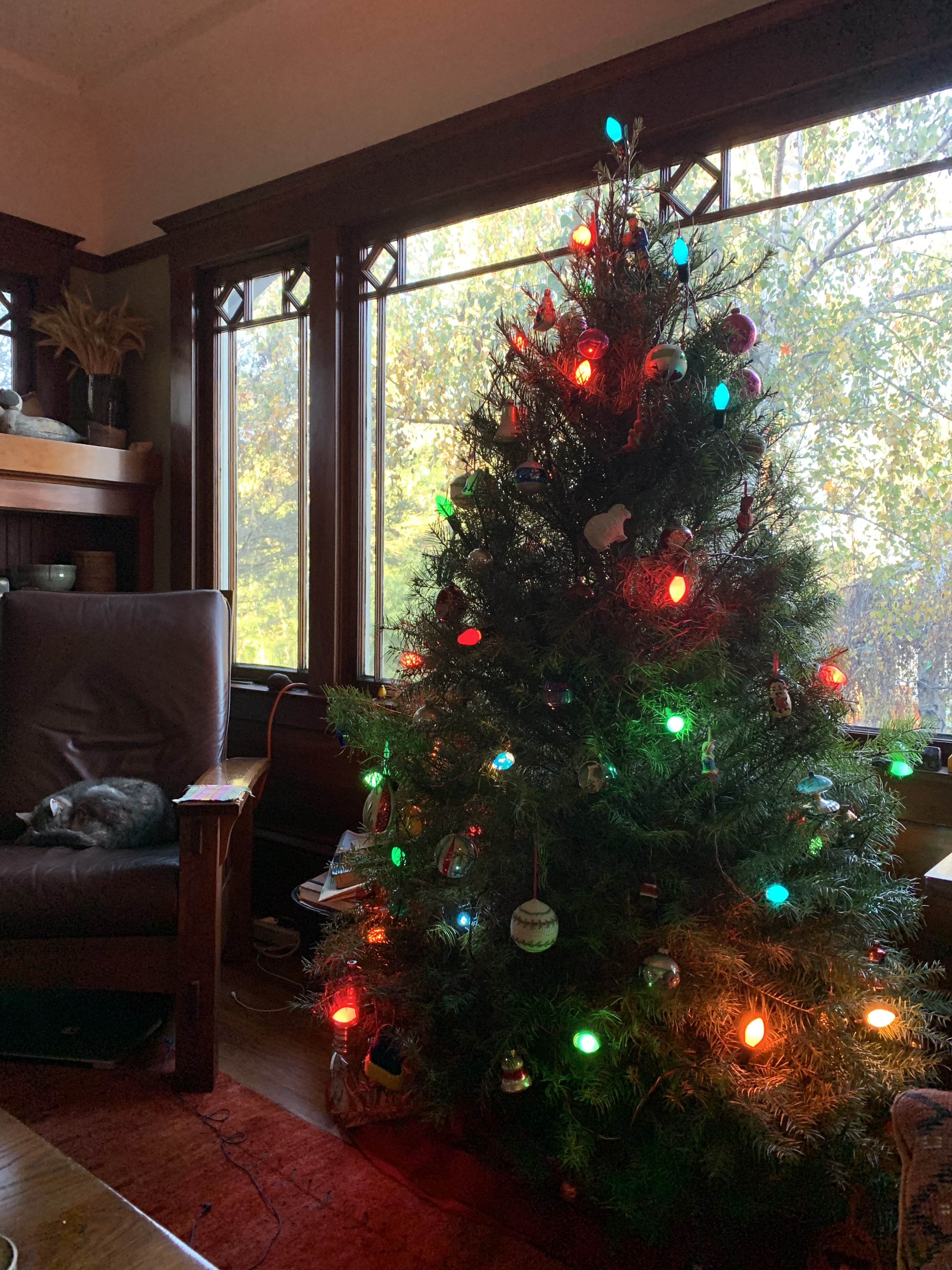
The magic lessens, with each year, it seems. Life in the Bay Area of California does not afford the cozy nights in a warm, warm house, the wind blowing cold off of Lake Michigan against the windows. Still, it is comforting to sit beside the Christmas tree – a presence of its own in the house – in the early dark evenings, the room lit only by the old-fashioned, multi-colored lights.
And the season passes quickly, each day shorter than the next, each year flying by – where did the time go? I ask the question of myself as the generations before me must have asked the question, and those generations all gone now, a long time ago.
The cat and the Christmas tree, 12/2023 Photo by Mary Elyn Bahlert