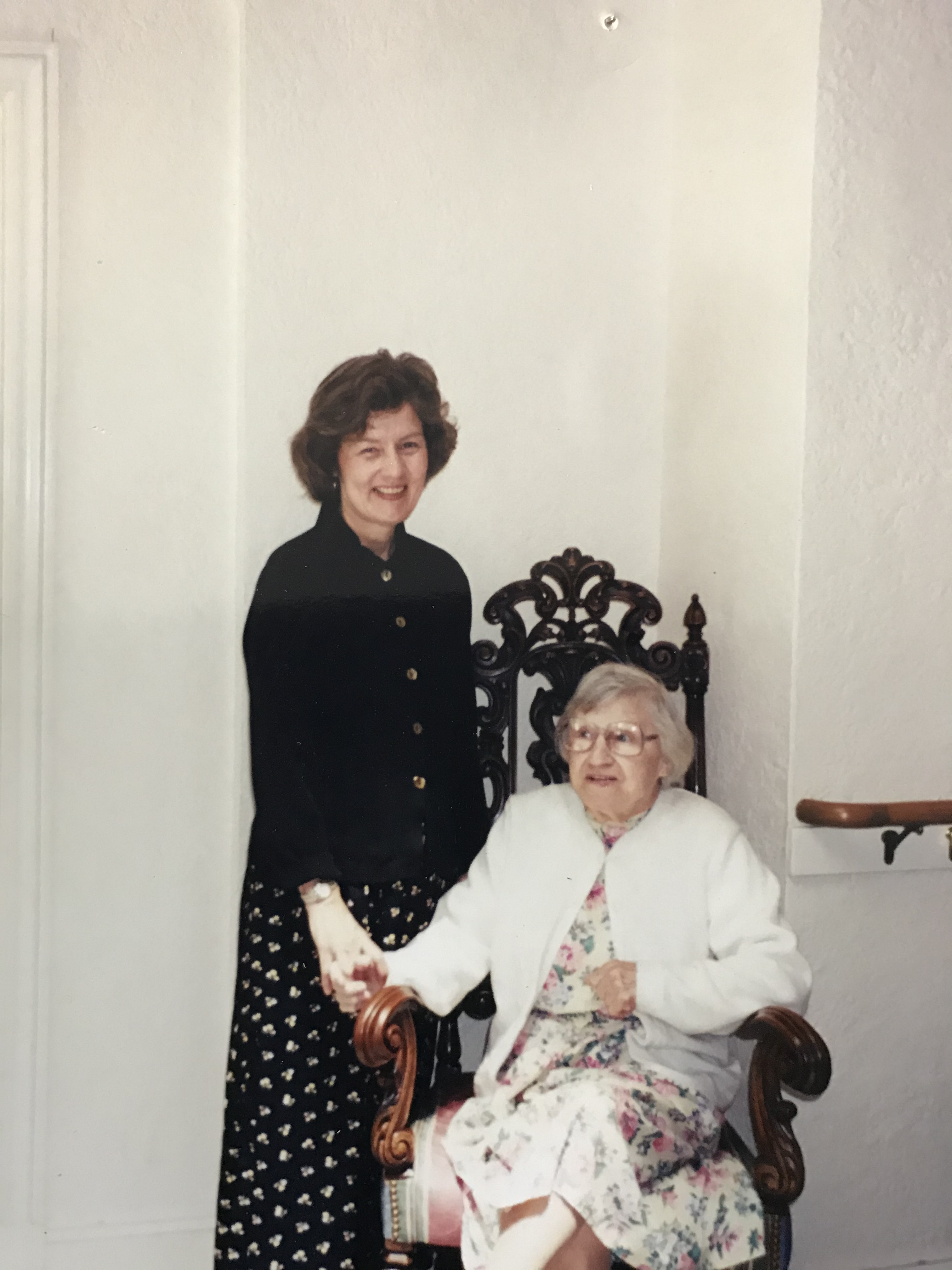
At this time of year I remember – always – the days of the New Year in 2001, after my Mom had been diagnosed with inoperable cancer, and as she spent more and more time in her small, much-loved room at the Mathilda Brown Home in Oakland. She had loved living at Mathilda Brown almost since the day she arrived, in August of 1998. And for that, I was grateful. She needed the assisted living care she received there, and the home was big enough for Mom to find a good friend with whom she could spend time. And small enough for her to feel comfortable, to know everyone. She was safe. She was happy. That was enough.
In December of 2000, she was diagnosed with the cancer, and after a final visit to the physician, Jeff and I had taken her back to her room and alerted the staff that she would now be on hospice. The staff at Mathilda Brown hurried into high gear, understanding that my mother would be receiving the care she needed from hospice, and that they would provide her basic living needs, as always. She grew thinner and thinner as the days went on. But she could still be lively, and fun – forgetting that she was ill.
One day I sat with her as she lay in bed, and we talked. She asked me then: “what is wrong with me?” “You have cancer,” I told her. Even hospice care had noticed how honest we were with one another. And this time, when I answered, she said, immediately: “we’ll fight it!” Slowly, looking into her eyes, I shook my head, “no.” A sadness came across her, then. And in another moment, it was gone, replaced by another thought, another mood.
Now, remembering, it is hard to believe that only a few days before she died, Jeff and I took my mother and Mildred, a woman for whom Jeff was caregiver, to stay overnight in a place overlooking the Pacific, in Half Moon Bay. But we did it. I don’t remember much about that trip – except that we did it. It was a lot, caring for the two elders. But we did it. And we returned them both safely to their homes.
Suzie had been to visit Mom, Ronn had been called and alerted to her coming death, a friend – a colleague – had stopped to visit with her.
The week before Mom died, I had an idea. One morning, I picked her up at her home and we drove to the neighborhood where Jeff and I lived. I took Mom for a manicure and pedicure. She chose the colors – she always liked pastels – and we spent an hour chatting together and with the women who worked in the shop. When their work was done, and as we were getting ready to leave, Mom held a hand to her face, admiring the freshly, carefully painted nails.
“Hmmm,” she said. “A man must be coming!” The shop women giggled along with Mom and me as she glowed with delight.
“A man must be coming!” Indeed.
Mathilda Brown Home closed, several years after Mom passed. We live in the neighborhood, close to the Home, and sometimes, on my way to other errands, I drive past the building, the grounds still beautiful, although its original use as a residence for single women and then as an assisted living facility is now its history. I always remember how happy Mom was to be safe at home there.
I suppose it is a strange phenomenon, having grown up in a family with a particular distaste – and history, according to family lore – for Church, for me to think I might want to go to seminary. We held my atheist Uncle Johnny – whose life was always bent on helping others – in high esteem. And although my mother ascertained that I should attend Confirmation Classes at the closest Evangelical Lutheran Church in the neighborhood, a Missouri Synod Church, and I had there memorized Luther’s Small Catechism (I am forever grateful), yet there I was, thinking about becoming a pastor, with no experience of what a pastor was all about. I was about 19 when the idea entered my mind.
Of course, I had never seen – or even heard – of a woman pastor. Still, I had the thought: “I could be a Pastor.”
And so I set on the journey of finding a Church Community. I had run away from the fundamentalism that was the theology in the Missouri Synod Lutheran denomination, almost as soon as I’d heard it. That didn’t make sense to me. But were there other places, were there other way to look at Church, at the faith, at life? Maybe so.
I started the journey toward finding such a place where I often begin journeys: at the library. I read about denominations, discovering ideas and understandings I had not heard before. Several – almost 10 – years later, I found myself in a United Methodist Church, where I learned that there were folks whose faith was lived out in social justice, not in right doctrine.
Within a few years, I made my way to seminary – at last! – and within three years, I was ordained and sent to my first appointment within the Methodist system. I had a lot to learn, about church itself, how the inner workings of a church happened (!), and I learned what church community was in real life – or was not. I’d married my husband, Jeff Kunkel, during my last year as a seminary student, and our lives were complicated by being part of a clergy couple. Then, and even now, those in authority had an often difficult time finding an appropriate slot for us both.
And so, after several church appointments, and after leaving a conflicted church situation, we found ourselves as a “clergy couple” in Tracy, CA. Even now, I think of the people of that congregation as my first congregation, in the way I connected to them, and in the way they connected to me. Life in Tracy was less urban than I had been accustomed to living, so there was that adjustment. Still, I remember those two years with fondness for the people there.
Jeff and I were part of a group of clergy from the area who met monthly to have lunch together, to simply be together with other clergy. I was the only woman – as I was the first woman pastor at the congregation in Tracy – but I went to the meetings and expected to be treated as an equal among peers. That’s my way. I don’t remember not being treated as an equal.
One of the clergy in the group was the Pastor of a large Lutheran Church – Missouri Synod. One day, as the clergy were gathering, he and I stood together, chatting. We were friendly, and I told him that I’d been confirmed in the Missouri Synod Lutheran Church. With a glint in his eyes, he asked me: “So when did you fall from grace?”
Without skipping a beat, I said: “Called by God.”
At that, he did not lose his kind and open expression, but simply smiled at me. I’ve always thought of that moment as a time when some Spirit – greater than me and yet in and with me – had somehow moved.
We sat down with the other clergy, and the gathering began.
a tree in autumn – also called by God (I would guess) – photo by Mary Elyn Bahlert, 10/2024
Suzie didn’t go to Charm School. I asked her. She said that she could have used Charm School, but I guess Mom only decided to send me. I can guess the reasons for this, but I don’t know for sure.
Once a week, the year I was 13, Mom enrolled me in Charm School, which was held on Saturday mornings on the top floor of the Boston Store in downtown Milwaukee. I rode the 23 bus line to Wisconsin Avenue, where I got off at the stop in front of the Boston Store and took the elevator to the top floor. There, I learned how to be charming.
I learned a lot of things that were important to know in Charm School. For example, I learned how to greet someone, to extend my hand, to look them in the eye as I greeted them. I learned how to hold my legs when I stood, so that I looked proper – lady-like. I learned how to wear white gloves. I learned how to speak properly in public, how to introduce myself, how to be presentable when in public. Maybe Mom wanted me to go so that I would be presentable in public; I’m not sure.
As it was, the charms I learned in Charm School would be called into question within a few years, with the country in turmoil over the Vietnam War, the protests that accompanied that turmoil, and the demonstrations on University campuses all over the country. I wore skirts and garter belts with proper stockings all the way through High School, but the world was about to change.
The world did change, the year I graduated from high school – 1967. We’d seen the assassination of a President and of his brother, and we’d watched, again and again, the assassination of the Rev. Martin Luther King, Jr. We were witnesses to the world changing; the world we lived in changed – quickly and with no turning back – and so we changed, too.
Soon, I’d be wearing blue jeans all the time – even to school – tank tops in the summer time, and I’d give up teasing to get my hair to stay up high in the air. I’d give up rollers at night, too. While I learned about how to wear the proper amount of makeup in Charm School, I gave up makeup, too, in college.
And I read Fear of Flying, by Erica Jong, signaling to my mother – who couldn’t read past the first few pages, though she didn’t say a word to me about reading it – that I was part of a new generation.
Charm School had opened doors for me, even doors that led to places I couldn’t have imagined. And some of those doors that opened for me led me to places my mother could not have imagined, although she had dreamed a different future for me. A future different from hers.
Charm School had its limitations in my life during changing times. However, I do know how to stand correctly, how to introduce myself (who goes first, etc.), and how to show interest in what someone else is saying. Maybe that’s what’s left over in me from Charm School.
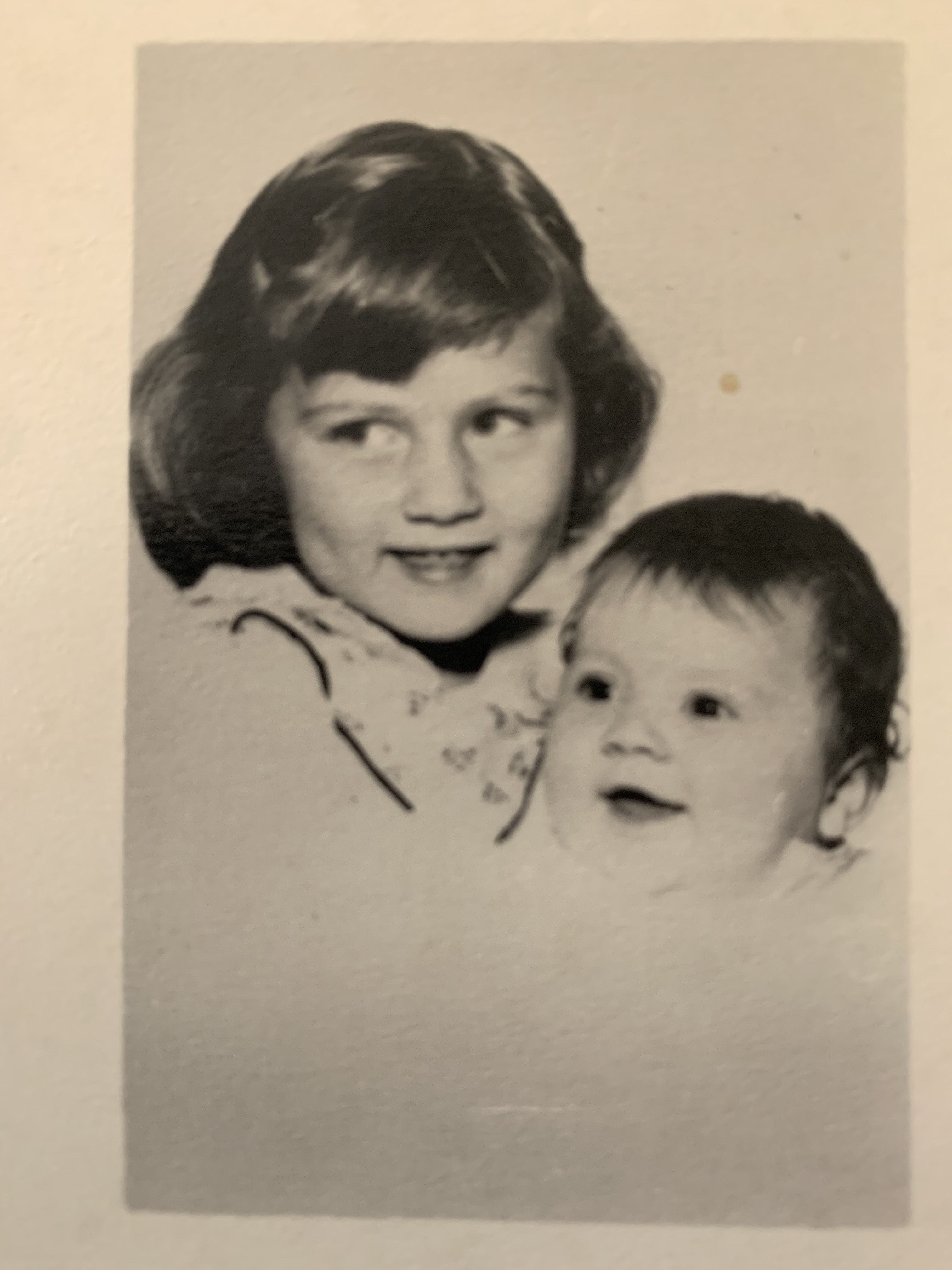
Me and Suzie, in my pre-Charm School days, circa 1954.
I sat in the comfortable chair next to my mother’s bed as she lay in a coma, dying, in the room she so loved at the Mathilda Brown Women’s Residence in Oakland. I was sad. I was not thinking about anything in particular. A friend – a woman who had been an intern with me in the congregation in Oakland – had left the room a few minutes earlier, and so I sat in the silence with Mom.
The end of the day had already come; the hall outside Mom’s room was quiet, except for the soft sounds of one of the nurses or care aides as they passed, or a few mumbled words from somewhere else in the building. I would go home soon, to sleep in my own bed; Jeff and I had decided that he would spend the night in the chair next to Mom’s bed, so that I could get a good night’s rest at home.
I looked across Mom at the window of her room that looked out over the playing field at Oakland Tech. Mom’s breathing was even, quiet.
As I sat there, the words to a song from so many I knew from so many years past seemed to drop from nowhere into my head. When I tell the story, I always say: “the words dropped into my head, whole.” I repeated the words, singing to myself:
“How can I hope to make you understand, why I do, what I do? Why I must travel to a distant land, far from the home I love? Who could see that a man would come, who would change the shape of my dreams? Helpless now, I run to him, watching other dreams grow dim… Oh what a melancholy choice this is – wanting home, wanting him – Closing my heart to every hope but his, Leaving the home I love…” —Bock, Harnick – writers
In the morning, several minutes after I arrived in her room and said: “I’m here now,” she passed.
All that’s left… Mom’s pysanki. Photo by Mary Elyn Bahlert, 2024