Uncategorized

My trusty Royal

When I left Milwaukee to go to seminary at the end of 1981, I took 2 suitcases of clothes and a portable Royal Typewriter.

I had used that typewriter in high school after I learned to type. All the girls took a mandatory course in which we were taught how to use a typewriter in the 1960’s (that along with being required to wear a skirt). Being able to type with some proficiency – and accuracy, which I can prove now, as I write these words – was expected. And so, using index cards with carefully written notes, along with sources, properly described, I wrote my first term papers on that Royal typewriter. I was good at the writing, which came easily to me.

And I used that typewriter in college. I majored in English literature, and my typing skills came in handy. I was quiet in classes, but I made up for being quiet by being able to write sentences and paragraphs. And I made up for being quiet by being interested in literature: my interest showed in the papers I wrote.

It was Mom’s typewriter. Most of the time, the typewriter sat, covered and locked, on the desk Mom used when she wrote checks or did other business – until I took it over. If I needed to use the typewriter, it was mine. Most of the time, the typewriter took up what was left of the space on the desk – the desk which now sits in the small office my nephew Rainier has for himself at his home in Seattle. When his little girl, Celeste, was an infant, the desk served as a changing table in her bedroom. I’ve told Rainier that his Grandma would be happy to know that her desk was still in use – and by her grandson, of whom she would be proud.

When I left to go to seminary, the typewriter became mine. It sat on the desk in my dorm room, and later in my studio apartment, a third floor walk up in North Berkeley, where my kitchen window overlooked the patio of the Franciscan Seminary next door. On Friday nights, the smell of alcohol drifted up to my window, along with the sounds of laughter and muffled conversation of the aspiring monks below. When I used the typewriter in my studio, I moved it to sit at the table in the kitchen.

When I left seminary and started to serve as a pastor in downtown San Jose, the typewriter moved with me and my husband to Pleasanton. There was a typewriter – an electric typewriter! – in my office in downtown San Jose, and I used that when I was in the office. But shortly after our move to Pleasanton – this being the 1980’s – we purchased our first computer – a little box that had a separate keyboard, and a printer that used a roll of paper to churn out our writings.

And that first computer signaled the end of a long and worthy life for the little Royal typewriter that had served me so well.

Now, that little Royal portable typewriter sits on a shelf in the garage. I rarely take it out, and if I did, it would be to take a look at it again. Instead, it gathers dust. I expect that little Royal portable typewriter to outlive me. It’s a relic from another time, for sure.

memories, reflecting, remembering, Uncategorized

Sue

At home, I was the big sister. And so I was thrilled when my brother Ronn brought home a friendly and fun young woman – Sue – and introduced her to the family as the “girl” he was going to marry (this was the early 60’s, when young women were still referred to as “girls).” And I was thrilled when Sue, who was the middle of three sisters in her own family, took an interest in me.

Sue was the big sister I had never had. She listened to me and she made me laugh. (Sue and me laughing would play a big part in our lives as the years unfolded). I cherish a vivid memory of Sue and me together in the cramped bathroom of my family’s upper flat on the north side of Milwaukee. We sat together as she cried about an argument she was having with Ronn. More often those days, Sue made Ronn laugh, and Ronn made Sue laugh. As I bring Sue to my memory now, I can see her wide smile and the light in her eyes. She liked me, just as I liked her. And – she would never fail to tell me the truth. Never.

*

Early in their marriage, Ronn had had an accident as he drove alone on a Milwaukee street; he ended up in the hospital for several weeks. As the years unfolded, he would need to be hospitalized again and again. And so one summer, as Sue was Mom to three children under five already – David, Alicia, Vicki Sue – she was about to give birth to her fourth child. I stayed with her in their house in the suburbs of Winston-Salem, North Carolina, slept in her bed with her as she tossed and turned, unable to sleep a full night in the last days of this pregnancy. Ronn was hospitalized again.

Most nights, the two of us would sit together on the screened in porch, talking and laughing in the dark. All night long. That year, the cicadas arrived to fill the air with their loud screeching calls, early in the mornings, just before daylight. The children were still asleep, although we didn’t know when that would change, and our world was just the two of us, facing one another in the dark. Sue was a smoker – she smoked until she died in 2015 – and I listened and laughed to her deep voice as I watched the light of her cigarette go up and down in the dark, sitting there together until the morning light broke the silence that surrounded us.

*

The last time I saw Sue was in the spring of 2015. I’d taken a trip to visit the family in Northern Florida on my own that year, and the day before I left, I went to lunch with Sue and Alicia, her older daughter, who was her caregiver. It seems that a medication that Sue was taking was also taking her memory, and from time to time, she’d stare at me quizzically, trying to recall who I was. Then, at one point in the conversation, a moment of clarity, she said to me: “you’re a minister.” Yes! She did know who I was.

After lunch, I drove Sue and Alicia back home. I got out of the car to give them each a hug, and Sue held on to me for a long time. As I drove away a few moments later, I watched in the rear view mirror as Sue stood, waving and waving.

*

“Sue, Sister, Sweet”

I remember when I first knew you were my sister –
you, sitting on the edge of the claw footed bathtub
in the crowded bathroom of an old Milwaukee flat, crying.
I listened to your tears, and then, I knew:
You are my sister, Sue. 

I remember you, 8 months pregnant – again (!)
I remember your voice all night long
in the dark Carolina night,
the light from your cigarette, up and down, up and down,
the two of us, laughing, laughing:
We laughed until dawn.
During the day, you were Mom.

Years later (in my new life)
you brought me a home-baked goodie
while I was still in bed – insisting that I accept this gift of love!
I remember you marching me to the classical music CD’s in the back
of Barnes and Noble:
You bought me Beethoven.
I listened, all spring long, to the minor notes,
mourning another Sue.

Now, these notes, this mourning, is for you.
I mourn for you.

 I remember – I will remember always –
you waving goodbye (I watched you in the rear-view mirror),
as I drove away from you – for the last time.
“I don’t know when I’ll see you again, Sue,” I said into your silence.

You knew, you knew, you knew, my sweet, sweet sister, Sue. (poem by meb, 2015)

community, nostalgia, reflecting

Life in the West – a sense of place

I hadn’t visualized living in the American West for most of my life, but here I am. I’ve lived in Oakland for over 25 years, after I completed my work as a Pastor in Oakland, and I expect I’ll be here for another while – God willing.

When I was young, I imagined that I would leave the Midwest, and I was certain I’d move to the East, to New York City, perhaps, or to Washington, D.C. My imaginings always took me to cities. To big cities. I love the diversity of cities, the abundance of neighborhoods, each one with its own personality, and I love the choices we take for granted in the cities. I love the bustle of things, and I love the way even cities become quiet on holidays, or on early Sunday mornings. I love the diversity of people – diversity of color, of background, of education, of family. I love it all.

And I’ve been privileged to have come West, where I arrived as a student in seminary in Berkeley in the 1980’s. I was fulfilling my dream to go to seminary, to become a pastor.

My husband Jeff is from the Milwaukee area, from Brookfield, a suburb of Milwaukee. Part of him yearns for the quiet country life he came to love and to respect when he spent time with his maternal grandparents on their farm, northwest of Milwaukee, where Jeff’s mother had grown up. His mother, though, waited for the day she graduated from high school to leave that place for another life. Sometimes Jeff reminds me that it’s his turn to choose a place, a country place… I expect he must be dreaming again of finding a place that gives him love and care and a respite from whatever might be bothering him at the moment.

But we are connected here more than by time and a place. We have strong community here; community is important to us as a value, and we know it would take a long time to build that again in a new place.

And – I remind myself – we are not 40 years old anymore!

And so, from year to year, our connection, our deep bond to this place deepens and deepens. And when we travel, living in the West makes it easy to tell people, when they ask where we are from: we’re from California. Everyone knows where California is!

Looking out to the West, over the Pacific, from home. Photo by meb, 3/2025

Uncategorized

The day they died

Jeff and I were driving home from Sacramento on Saturday, March 21, 2009. I leaned over to turn on the radio in the car. There was a repeating news story from Oakland – where we were headed, and where I was pastor of a downtown church -being broadcast on the news, details changing and being added as more information came to the broadcasters. Four Oakland police officers had been shot by one young man that afternoon. Two were motorcycle police officers, two were members of the SWAT team that had gone to the home of the suspect and were murdered by the suspect as they climbed the stairs to the apartment he was holed up in. The attacker was shot dead by officers.

When we arrived home, I checked the messages on our answering machine and discovered several calls. John Hege, the son of a family I served in the church in Oakland, was one of the motorcycle officers who had been shot. John would not die for a day or two, after he had been declared brain dead.

Like so many others, I was in shock. I tried to call John’s parents, John and Tam, but they were not home. The police department had brought the affected families together and they were in the care of officers. I tried to get to John Hege, Jr., who lay brain dead at Highland Hospital, but I was not permitted access to the officer.

*

Friday, March 27. Like so many others, I watched the funeral of the four police officers who had lost their lives on television, broadcast from the Oracle Arena. As the service ended, I walked to Mountain View Cemetery from our house, and met the funeral director who was caring for John’s family. I sat in the hearse as we waited for the family to arrive. I looked back at the hearse, realized there was no casket – four caskets had been visible at the community service. In one of those simple moments at such a time, I asked the funeral director where he was. He nodded toward my arm, leaning on the urn that held John’s ashes. We almost laughed as we broke the silence of that moment.

I rode in the hearse to the Hege plot, high in the hills, and waited with the family at John’s graveside. Tam and John and their two daughters and their families stood silently with us. I said a few – unimportant, but necessary, I suppose – words in the presence of this sombre gathering, and the funeral director nodded at John, the officer’s father, giving him the urn with his son’s ashes.

I stood behind John as he kneeled over the grave and leaned over to place all that was left of his son into the grave. As he kneeled, he appeared to fall over, and I leaned over him, reaching for his shoulder, just as he set his son’s ashes in the grave.

Years later, telling the story to someone who has not heard it, I come to tears each time. In my role that day, I did not cry. I witnessed. I was a witness to the grief that hung over us all, to the grief that enveloped John’s family.

*

There are some moments in life that remain, some moments as a Pastor that I remember, vivid moments that come to mind as if I am living them again. That day on the hill, witnessing the grief and the resignation of John’s family, comes often to my mind. When I pass the sign on the freeway that names the four officers killed that day, I nod, as a witness, and to my memory.

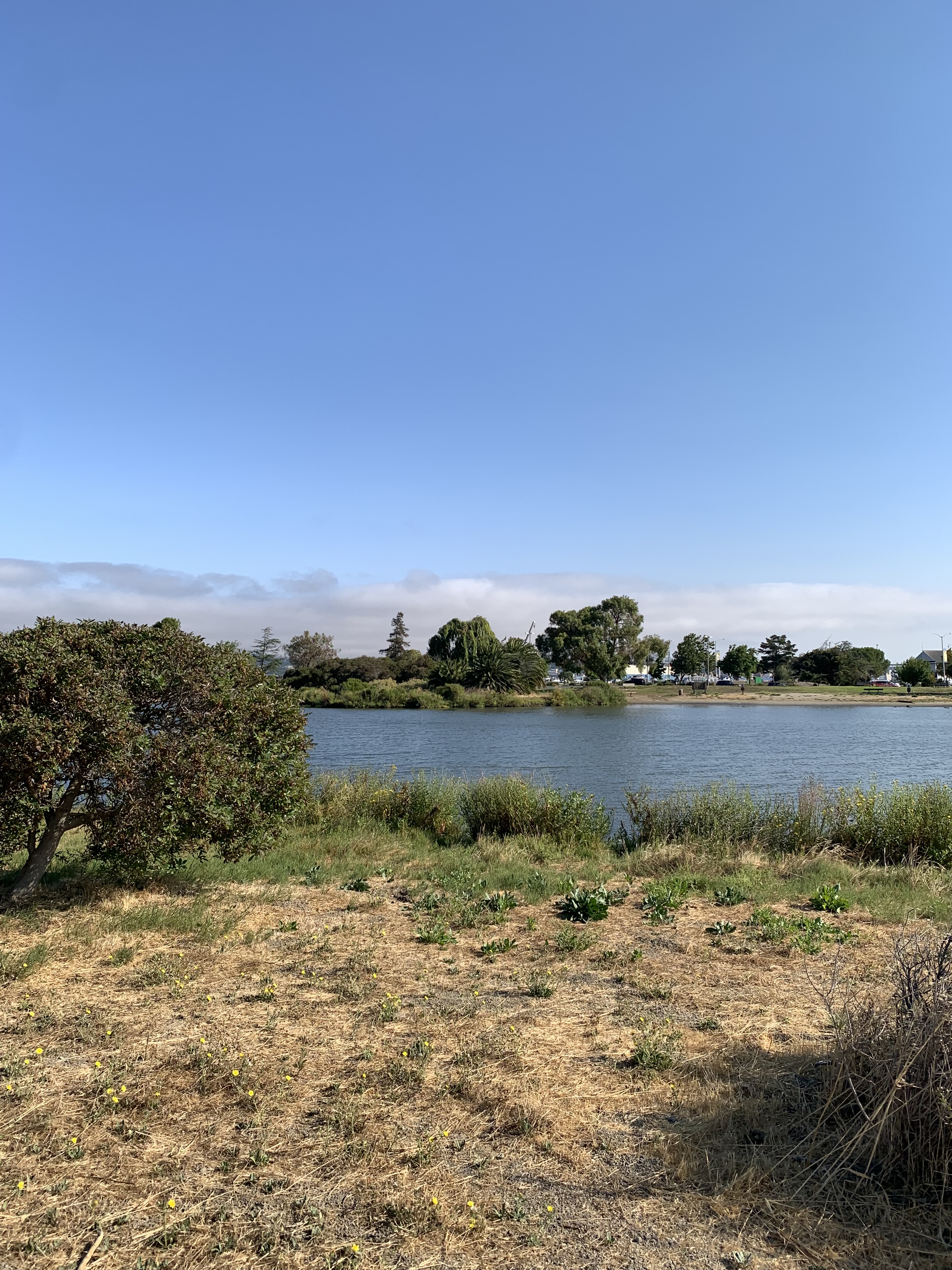
Sometimes it seems strange that beauty remains after such a grave loss.

Photo by Mary Elyn Bahlert

Uncategorized

Friends

Some would call it a blessing. For others, it is something they are not able to attain. Many people need – and want – only one or two. Some think that everyone they meet is a friend.

I call mine a blessing.

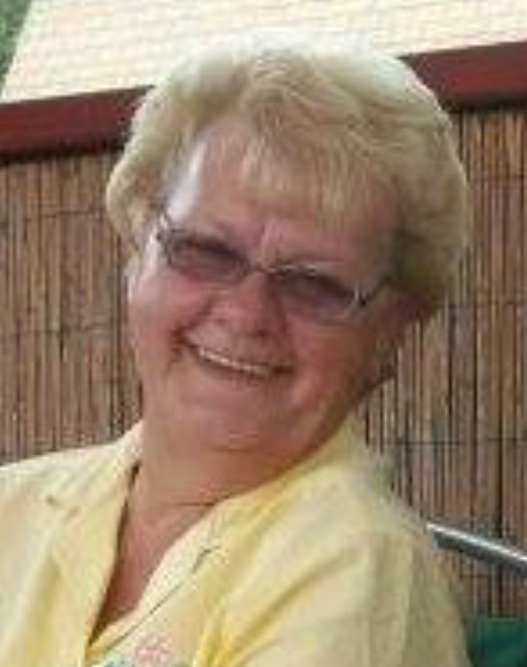
This past week, I spent several days with Vicki, a friend I met in high school. I met her brother Bruce before I met Vicki, when I sat behind this tall, painfully shy boy in Art Appreciation Class, my first elective course as a senior at Washington High School in Milwaukee. During our college years, Vicki and I started to hang out together more often. The course of our lives has been very different, but our friendship remains. When we met in Denver – as close to halfway between New Berlin, WI and Oakland as we could figure – we spent the evenings together in our hotel room, talking and talking, until after we’d turned out the lights and lay in our beds.

I remember meeting Joanne for the first time, when she sat down at my desk in Green Bay, Wisconsin, smiled her bright smile, and said, “do you golf?” (My answer: I didn’t, but I could try. I never did). We took road trips together, and we flew together to Montreal and Quebec with another friend, Carla, who is still in Joanne’s life. Joanne commiserated with me as we mourned our lack of dates, until we finally met the men we would marry. Joanne stood up with me in my wedding. Because I was at school in Berkeley, I wrote a prayer for her wedding and posted it in the U.S. mail, instead.

The Bug was my best friend in high school, and we keep in touch via email now. Her sister Bonnie and I stood up in the Bug’s wedding. My heart hurts for the Bug now; her son died unexpectedly – at only 46 – in the past year.

I knew Pat’s family from the time I was little in Milwaukee. Her aunt was one of my mother’s good friends, a friend from her neighborhood in Milwaukee, too. Later, Pat and I, her brother Bobbie and the Bug, and several other teenagers from our neighborhood worked together at the Times Fine Arts Theater on Milwaukee’s North Side. Now, I talk to Pat very few months on the phone, and even now, we’ve got plenty to talk about. And to laugh about.

Later in my life, I’ve continued to make friends. I’m grateful. I met Alexis and Linda, both clergy, through meetings with other United Methodist clergy in Northern California. Staying in touch with them is important to me. A year ago, Judith rode home with me from a retreat where we’d both led small groups of clergy in reflection sessions, and we’ve been friends ever since.

Some of my friends, like Lana, live locally, so I get to have lunch with her, where we discuss books we are both reading, and with Jean, another Oakland person.

I hope their friendships keep me healthy, and I hope I have something to give them, as they do to me. Conversation with each one is different, full of history, often serious, and always interesting.

My life is richer for each one of my friendships. I am grateful.

Vicki and me, Botanical Gardens, Denver, 5/2025