We trek to a place of solitude, this lonely place, to sit, to listen to the water, to the wind, to the silence: the silence speaks to us as we walk, as we sit.
And in this lonely place the loneliness drains from us – from our arms, our legs, our beating hearts – richness fills us: the voices of the pines, the balsam, and the birch which call out to us in the wind. Gentle, the breeze ruffles the needles, the leaves.
We have searched – endlessly – for this place: for the solitude that is in loneliness, for the depth that is boundless, without form.
Here, the emptiness fills us, completes us.
—Mary Elyn Bahlert, “At Solitude Swale,” Door County, Wisconsin, 5/2025
At Solitude Swale, photo by Mary Elyn Bahlert, May 25, 2025
“So he said to the paralyzed man, “Get up, take your mat and go home.” 7 Then the man got up and went home.” Matthew 9:6b-7
This really happened to me. I swear (if I need to).
In the early 2000’s, I was happily working as a Pastor in downtown Oakland, a perfect place and a perfect, diverse community for me to serve. And then it hit. One day, a pain developed in my lower left jaw. Of course, I went to the dentist to have him take a look, to get the toothache taken care of. I arrived in the doctor’s office early one Saturday morning, and methodically, he numbed one tooth after another in my mouth, and methodically, we both waited for me to announce that the pain was gone. He was looking for the culprit, the one tooth that was causing me pain.
After several hours in the dentist’s chair (and have I mentioned that I cringe even now at the thought of needles?), we both ascertained that the pain in my jaw was not caused by a tooth. There.
And so I was left to go about my life for almost a year and a half, living with the pain that had mysteriously arrived and mysteriously stayed.
I tried massage – neck massage, back massage. The pain persisted. One day, I made an appointment with a Rosen Method therapist, a woman in Berkeley whose work I admired and trusted. Miriam was working on me that day – she had her hands on me -and as she worked, I began silently to pray: “please Jesus, help me!”
Miriam stopped moving her hands and stepped back from the table. “I don’t know why I haven’t thought of this before,” she said. “but have you tried Feldenkreis work?”
Like most of you – I suspect – I had not heard of Feldenkreis work. But I left Miriam’s office that day with the name and phone number of an acquaintance of hers who lived in another city in the Bay Area. And that afternoon, I called and made an appointment with Iren.
I arrived in Iren’s office for my appointment, not knowing what to expect. First she had me walk through the short hall from her reception area to the room where she did her work as she watched. Then she had me – fully clothed – lay on the low massage table in a small room where she worked. She set to work on me as I lay quiet, not hoping, not expecting any particular result.
As she worked, Iren was silent. At one point, though, she stood up straight from her work position, bending over me to methodically move one part of my body, then another. As she stood: “I can help you,” she said.
I made another appointment. I was looking forward to traveling to Paris with Jeff in a couple of weeks, and I made one appointment a week with Iren in the weeks coming up to the day of the trip.
At the last session before my trip, as she worked on me, we were both silent. And when the time for the session was ended, Iren said to me: “Now, go and enjoy Paris!”
I did. Jeff and I did enjoy Paris together. And I was pain free for the first time in many months. And the pain, the mysterious pain, has not returned. Ever.
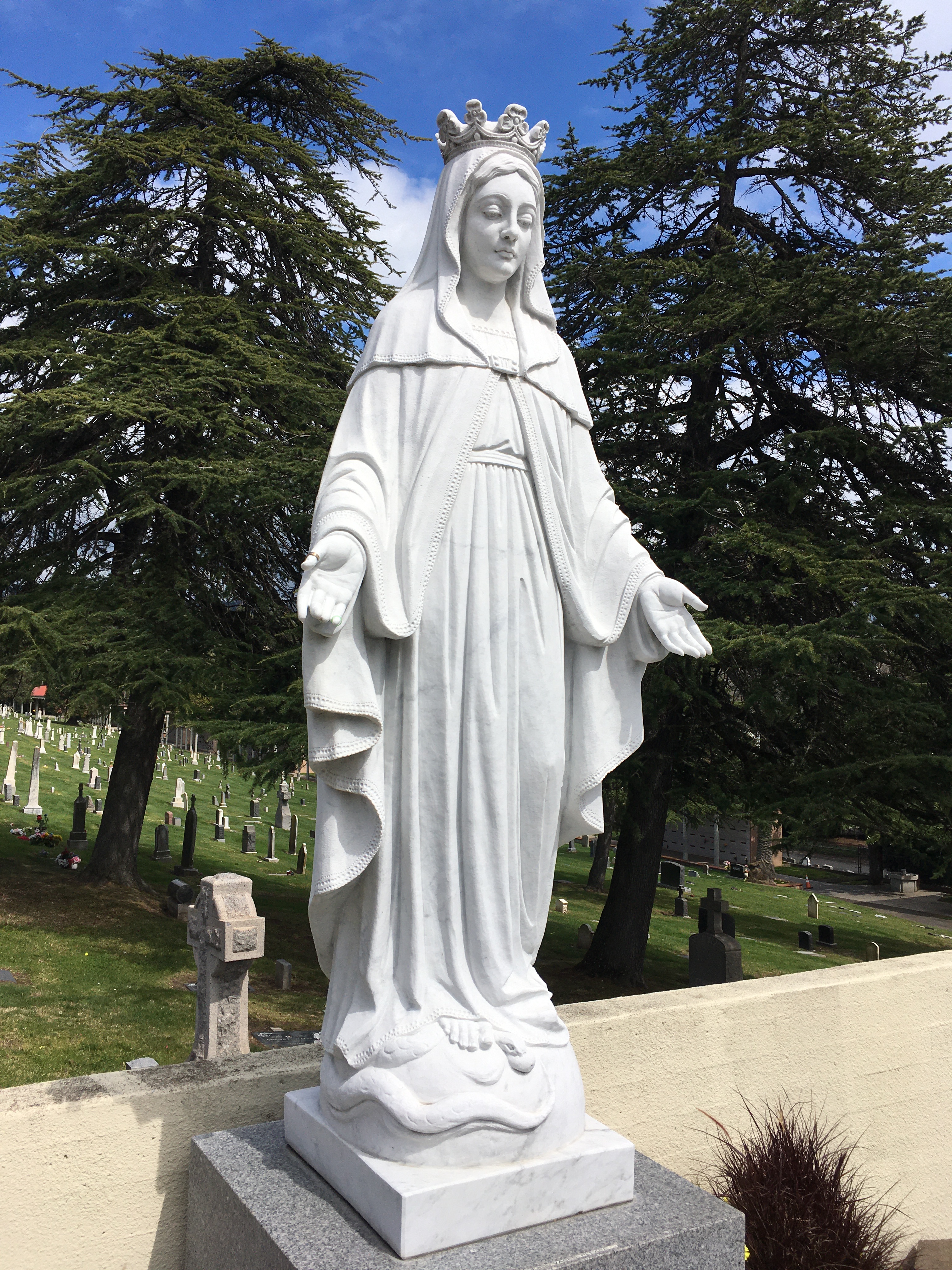
photo by Mary Elyn Bahlert, Art Museum of Estonia, Tallin, Estonia, 2024.
I expect that most of us who have lived through – or are living through – the “Covid Years” since March of 2020 have stories to tell. Some of the stories will be about times of isolation, times when holidays were lived through with phone calls instead of dinner around a table with loved ones, times when groceries were delivered to the door, when the PBS Evening News on Friday afternoon included the number of recorded deaths across the country that week, times when people discovered new ways to work, to connect, to cope.
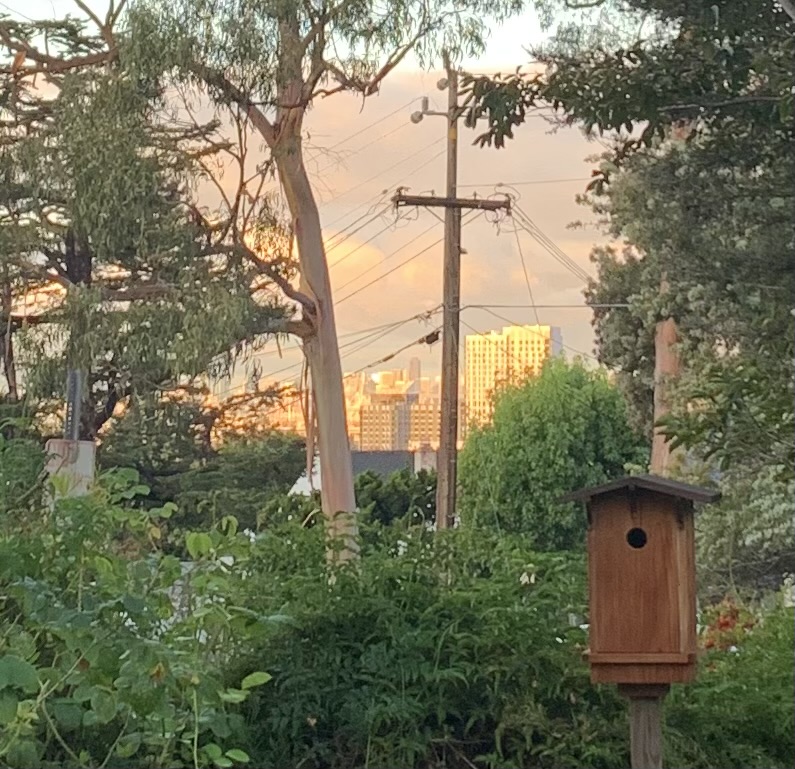
Jeff and I remember fondly those long evenings when we would get into one of our cars and drive somewhere in Oakland we had not seen before, a new neighborhood, a new view, perhaps. And we remember those early days of 2020 when we sat in a circle, scarves thrown over our shoulders, in our yard, with good friends. We had a way to see each other face to face, and we were grateful for those times, for those friends. Each day seemed the same: the alarm beside our bed going off at 5:30 am, coffee together as the sun came up, an early morning walk in St. Mary’s Cemetery, where we came to know some of our neighbors for the first time, the streets – once filled with lines of cars waiting at the stop light – quiet. We discovered for the first time some of the treasures of living here in the Bay Area.
And we discovered a place we love to walk even now, a place we like to take friends, as we introduced our friend Ron to that place today: the Martinez Slough. Martinez is a small city about 20 miles to the North and East of Oakland, through the tunnel and past the satellite city of Walnut Creek, along the highway that runs through the Valley and on to the Sierra, several hours to the east. Martinez is an industrial city, and the hills which surround Martinez often fill with steam from the petroleum refining and chemical manufacturing companies that surround the city proper. Martinez, on the southern shore of the Carquinez Strait, sees the tide come in and go out, marking the days, marking the passage of time.
And along the Strait, we discovered a walking path that is home to the shore birds and other creatures as well as to the humans who walk there along the level path. People are often friendly when we pass them on our walks, and we stop again and again at the site of a ship wreck – more of the ship visible to our eyes as the tide goes out. The paths further from the water are rutted and uneven, but along the water, the path is most often free of debris, easy to walk.
In the spring of the year, the kites of people from the area go up in the Park that lines the shore of the Strait, colorful kites, and the children and daddies holding the strings are colorful, diverse, too.
During the COVID years, we liked to leave our house early on a Sunday morning – free Sunday mornings remain a luxury to us, two retired preachers – to drive to a small parking lot across the railroad tracks from downtown Martinez, to leave our car there, enjoying one another’s company, and to walk the paths, chatting with one another, greeting other human beings, enjoying the air, the green, the blue of the Strait, the ships coming and going, docked for a day or two, the sound of traffic on the Martinez Bridge – we can see from the shore! – just a soft buzz in the air.
There’s a new train station in Martinez, a block away from the parking lot where we leave our car, and sometimes we wait to cross the tracks as a passenger train makes its way to the East, on its way to the Valley, to the Sierra. Every time we pass the train station we remind each other that we’d like to take the train from Oakland to Martinez – some day (we haven’t, at this writing!).
As the COVID years continued, we discovered a Farmers’ Market on Sunday mornings in downtown Martinez. Jeff made sure to take a cloth shopping bag from the car to fill with goodies – fruit, fresh vegetables – at the market. Caramel popcorn, a favorite for me, is fresh-popped and sold by the bag, which I carry with me to the car, and which both Jeff and I devour, all the way home.
*
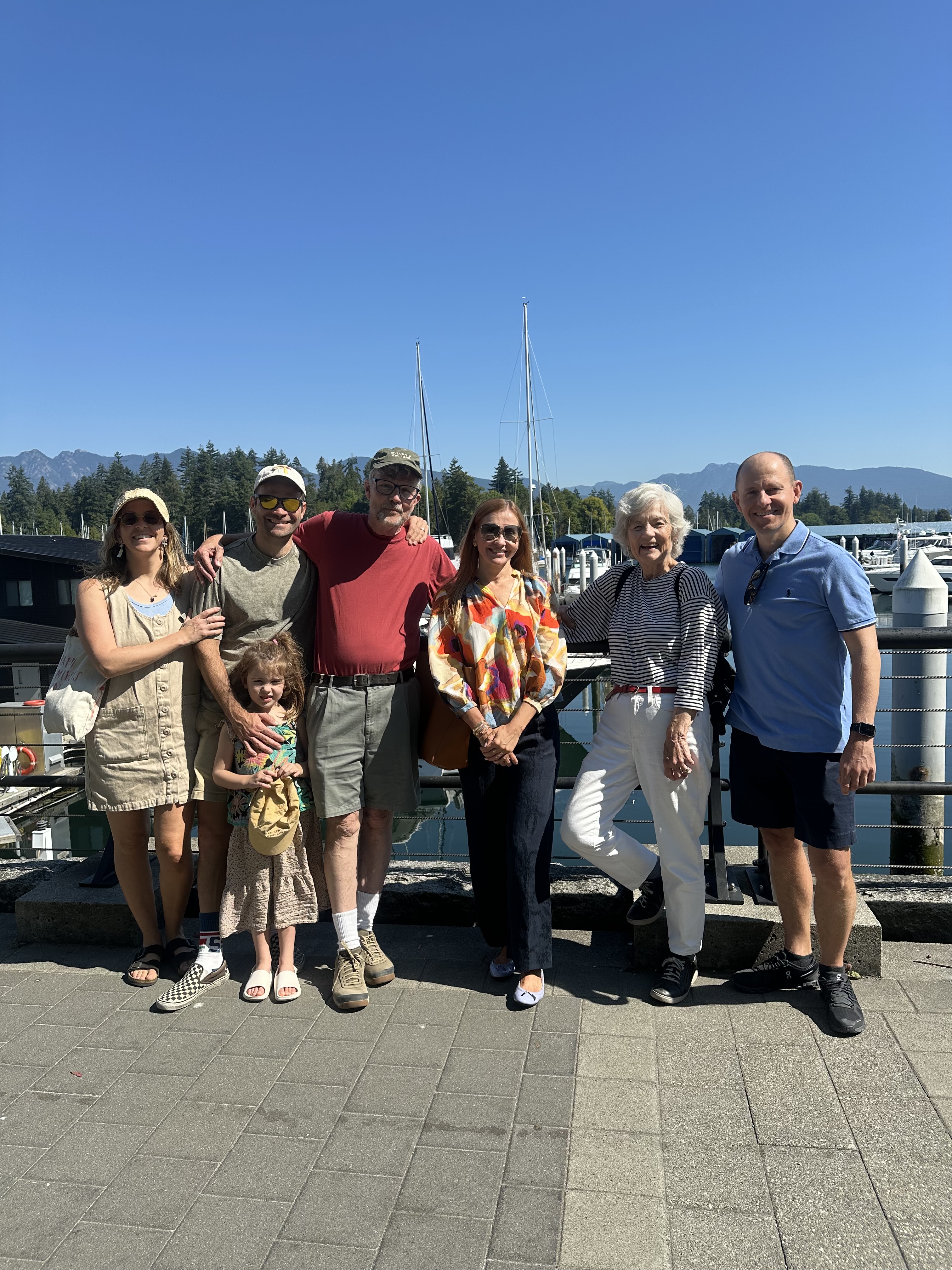
Ron, our companion today, is an experienced hiker, having hiked with his wife on paths around the world, but the Slough was new to him; we like to introduce this gem to friends who visit us from other places. Each person we take finds something in particular to like at the Slough, as we have.
It’s been over 5 years – 5 long years – since the world was introduced to COVID, a staple in our experience now. Our lives have changed, and our lives have remained the same in many ways, over those 5 years. Still, it’s always a new pleasure to walk the trails at Martinez Slough, enjoying the path, enjoying the air, the light, the shore birds that fly away when we come near, enjoying one another.
At Martinez Slough, photo by Mary Elyn Bahlert, 8/11/2025
You were just little when you started to walk away from all you knew, when you left Mama and Daddy in the past and used your bright sight to peer into another way, another path, another road to another life.
You were just little when the spark in your large eyes lit the way, showed the door, looked into the faces of your teachers and knew them as you knew you.
You were just little when you made invisible notes on paper – – not to give away the sacred secret you held in your belly – when you charted the path even you did not know for sure you’d travel.
You were just little when you began to say goodbye to the legacy the ancestors had given, when you knew you’d always love them with their faults and their virtues, when you knew you’d have to take another way that wasn’t easy for you, walking alone without a map, without a hand to hold yours.
You were just little when you smiled your last smile at the doorway to the ancestors, when you told them you’d take their dream to safety, you’d walk in worlds they would not know, could not see.
You were little when that part of you took shelter in your darkness, the glimmer of hope which lit your way watching, watching, watching for the light. The light that lights your way, now, now, now…
When I left Milwaukee to go to seminary at the end of 1981, I took 2 suitcases of clothes and a portable Royal Typewriter.
I had used that typewriter in high school after I learned to type. All the girls took a mandatory course in which we were taught how to use a typewriter in the 1960’s (that along with being required to wear a skirt). Being able to type with some proficiency – and accuracy, which I can prove now, as I write these words – was expected. And so, using index cards with carefully written notes, along with sources, properly described, I wrote my first term papers on that Royal typewriter. I was good at the writing, which came easily to me.
And I used that typewriter in college. I majored in English literature, and my typing skills came in handy. I was quiet in classes, but I made up for being quiet by being able to write sentences and paragraphs. And I made up for being quiet by being interested in literature: my interest showed in the papers I wrote.
It was Mom’s typewriter. Most of the time, the typewriter sat, covered and locked, on the desk Mom used when she wrote checks or did other business – until I took it over. If I needed to use the typewriter, it was mine. Most of the time, the typewriter took up what was left of the space on the desk – the desk which now sits in the small office my nephew Rainier has for himself at his home in Seattle. When his little girl, Celeste, was an infant, the desk served as a changing table in her bedroom. I’ve told Rainier that his Grandma would be happy to know that her desk was still in use – and by her grandson, of whom she would be proud.
When I left to go to seminary, the typewriter became mine. It sat on the desk in my dorm room, and later in my studio apartment, a third floor walk up in North Berkeley, where my kitchen window overlooked the patio of the Franciscan Seminary next door. On Friday nights, the smell of alcohol drifted up to my window, along with the sounds of laughter and muffled conversation of the aspiring monks below. When I used the typewriter in my studio, I moved it to sit at the table in the kitchen.
When I left seminary and started to serve as a pastor in downtown San Jose, the typewriter moved with me and my husband to Pleasanton. There was a typewriter – an electric typewriter! – in my office in downtown San Jose, and I used that when I was in the office. But shortly after our move to Pleasanton – this being the 1980’s – we purchased our first computer – a little box that had a separate keyboard, and a printer that used a roll of paper to churn out our writings.
And that first computer signaled the end of a long and worthy life for the little Royal typewriter that had served me so well.
Now, that little Royal portable typewriter sits on a shelf in the garage. I rarely take it out, and if I did, it would be to take a look at it again. Instead, it gathers dust. I expect that little Royal portable typewriter to outlive me. It’s a relic from another time, for sure.