One day, a teacher and her disciples were walking.This was in the initial days. While they were traveling, they happened to pass a lake. They stopped there and the teacher told one of her disciples, “I am thirsty. Do get me some water from the lake.”
The disciple walked up to the lake. When he reached it, he noticed that some people were washing clothes in the water and, right at that moment, a bullock cart started crossing through the lake. As a result, the water became very muddy, very turbid. The disciple thought, “How can I give this muddy water to my teacher to drink!” So he came back and told the teacher, “The water in there is very muddy. I don’t think it is fit to drink.”
After about half an hour, again the teacher asked the same disciple to go back to the lake to get some water to drink. The disciple obediently went back to the lake. This time he found that the lake had absolutely clear water in it. The mud had settled down and the water above it looked fit to be had. So he collected some water in a pot and brought it to his teacher.
The teacher looked at the water, and then looked at the disciple and said, “See what you did to make the water clean. You let it be … and the mud settled down on its own – and you got clear water… Life is also like that. When it is disturbed, just let it be. Give it a little time. It will settle down on its own. You don’t have to put in any effort to calm it down. It will happen.”
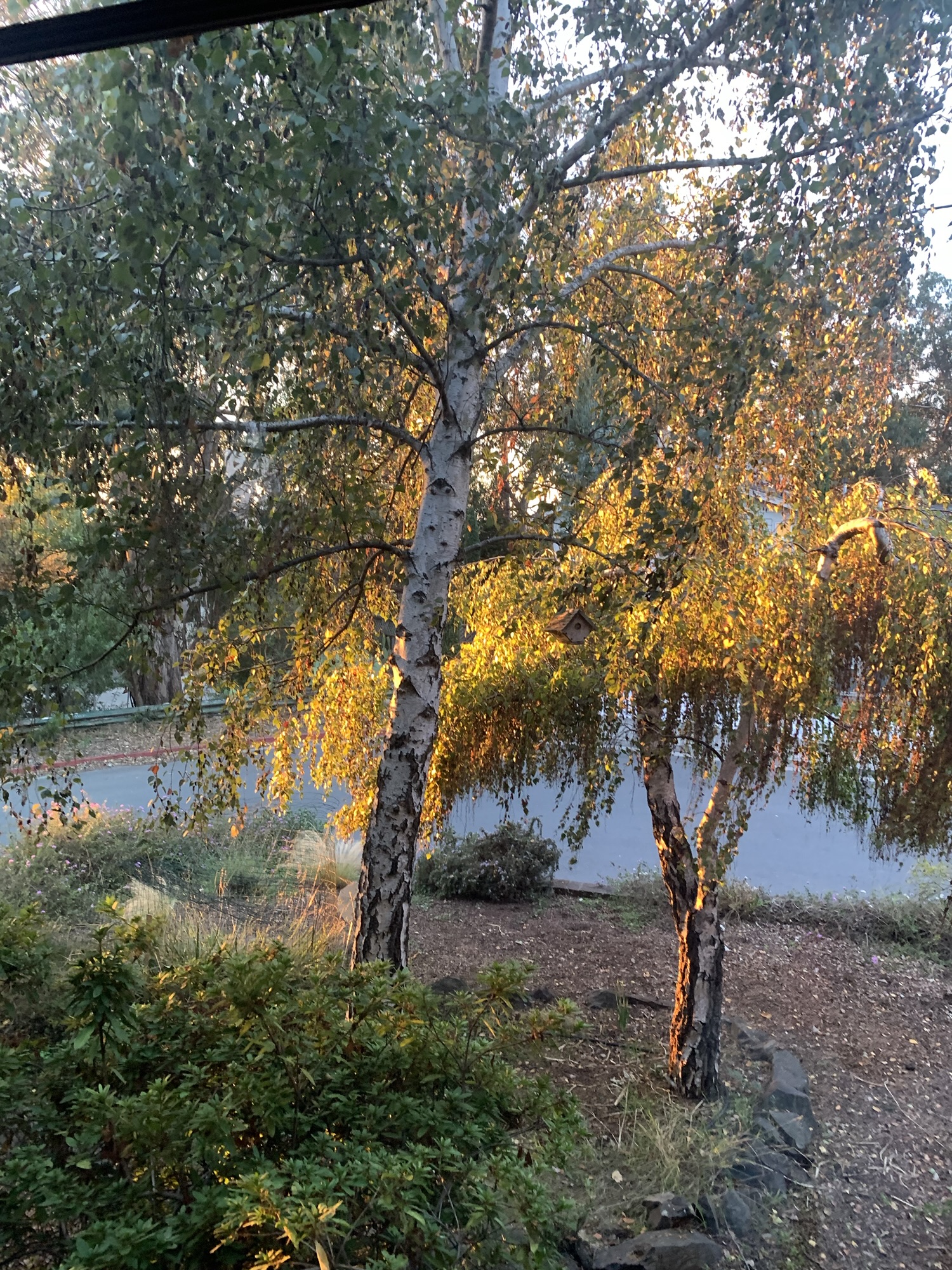
Peace from my window – in Oakland. Photo by Mary Elyn Bahlert, 11/2025
Life is the color of things: of places, of thoughts, of people I have loved, of sky and trees. I know gray well, and I have taken from gray a gift: the gift of gray is to know – for the first time – the color of things.
Life is the color of things and it is good to breathe in the riches of sky, of earth, of shadows across the sky, of green grass that carries the fragrance of earth, of long orange autumns, bright maples, of gray and darkened days of winter, of spring, snow banks melting, of a navy-blue awakening, dawn.
The color of things lives in the eyes of friends, places where sadness lurks, where pain is not covered by dull happiness.
Life is the color of things: this gift, earth, all that is in it, the heart, the heart, full:
And all that is in it.
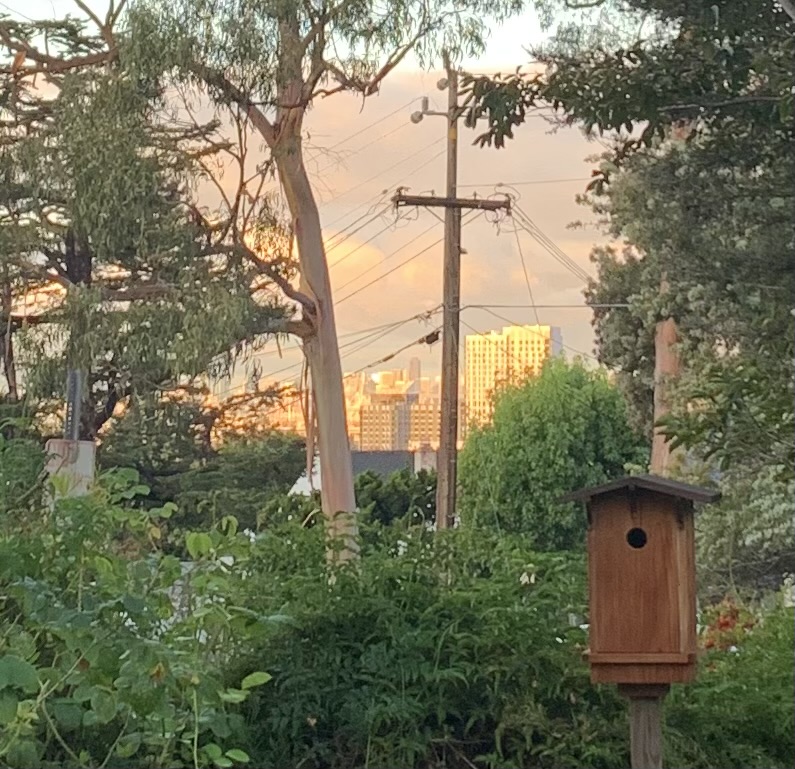
Life is the color of things. Photo by Mary Elyn Bahlert, Oakland, View Place, 2025
One of the pleasures in my life is the pleasure of having lived in one place for many years. In 1995, Jeff and I moved to Oakland and we have stayed in Oakland, and moved into our 1915 Craftsman Home about 2005. Over those years, Jeff has worked hard to steward a beautiful garden – a garden which we enjoy every day. We have hosted many gatherings and dinners with friends here in the house – often in the garden. I expect those times of hosting have attached us even more to this place. And having lived in one place for so many years, and having seen the seasons – slow and sacred in the Bay Area – pass to us and away again all those years since 2005, I have come to know very well the passage of time in one place.
In the yard of our home are several trees that I see from one of the windows: the listing birch outside the living room, the apple tree whose trunk and branches seem to greet us – bowing – when we sit at the dining room table, the maple that shines into our bedroom window in the autumn.
I have a refrain that I say to myself often about the birch: “I love that tree and that tree loves me”. And if saying it often makes it so, then it is true: that tree loves me. Silently and with grace the tree stands and waits for me as I lounge facing the window with my morning coffee. Silently and with grace the tree has sparked my mind as I sit on the couch, writing a sermon, reading a book from the local library, chatting with Jeff. The tree is a steady and beautiful companion to my life. I’m grateful for the tree.
And if gratitude is a poem, then that tree has sparked whatever poems are resting inside me, waiting for the right time to come out.
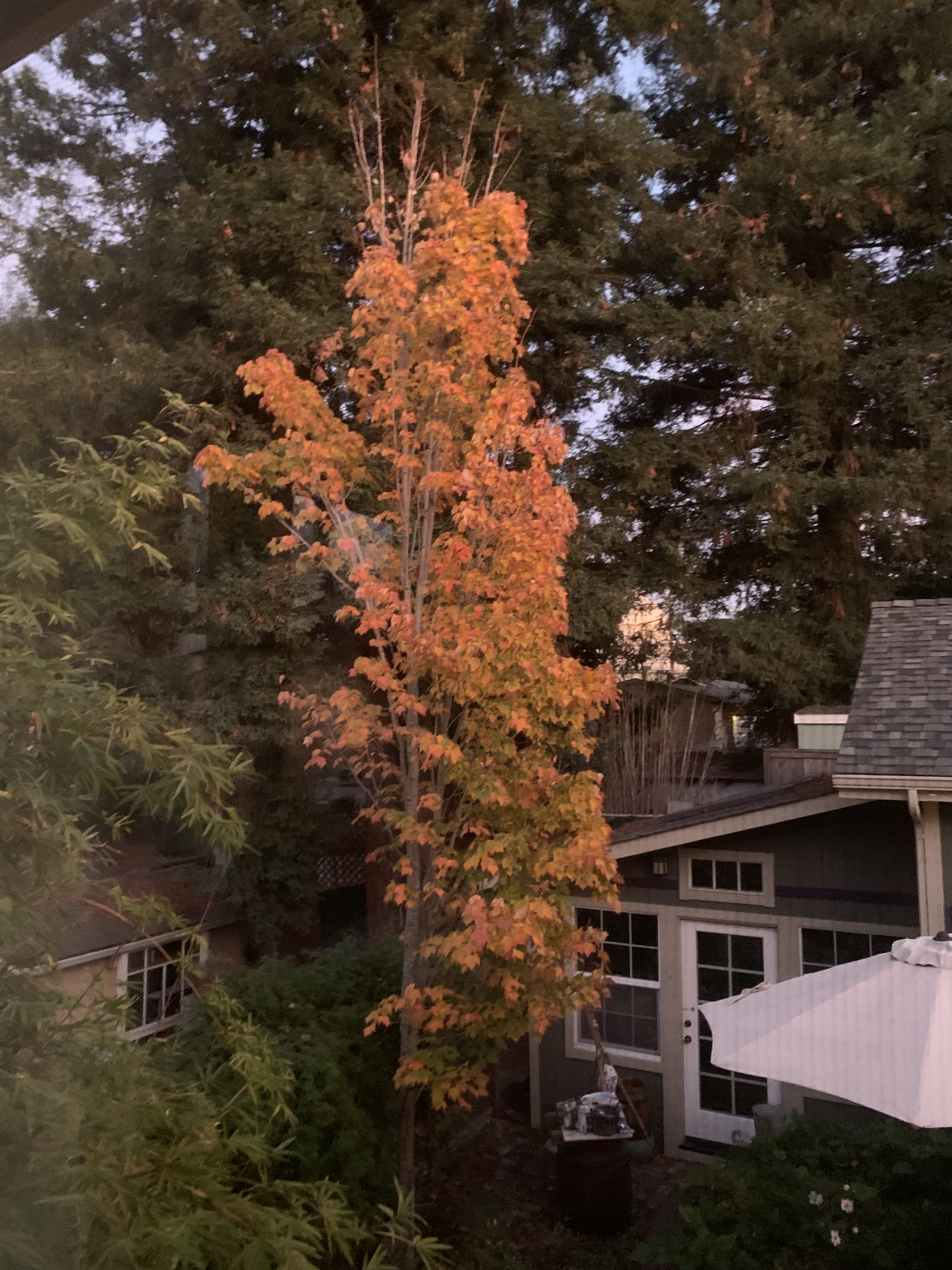
And it’s autumn again. The slender maple outside our bedroom window is shining with the light of autumn. And the slender maple is so beautiful: a beautiful, silent, stalwart companion.
My stalwart companion in autumn. photo by Mary Elyn Bahlert, 2024
In the mid-2000’s I had my dna researched by several services to see if/how they overlapped. It was no surprise to me to learn that my dna was mostly connected to Eastern Europe, with a fair amount in Western Europe. And through dna research, the websites offered the names of others who share some of the same dna. There are ways to walk back through the generations to discover the exact connections, although I have not ever done that.
Many of the folks who have their dna work completed do so and then disappear, their curiousity apparently satisfied. I had thought to possibly connect with others who were interested in meeting others. But for the most part, that thought was not satisfied. One day, however, a message appeared for me – from a distant, distant – distant relative, a cousin. He was from the same place in Ukraine that my grandparents were from (I’ve written about them, both illiterate, in other posts).
And so, through the magic of the Internet, I met Volodymyr. For several years, we stayed connected with numerous messages on Facebook. If I’d text him, he’d respond. In these days of internet connections, I consider that a miracle! We learned about one another’s politics – and agreed to simply disagree with no more conversation!
In August, Jeff and I made a trip we look forward to each year. In the months leading up to our few days away with Rainier, Lia, and Celeste, who live in Seattle, we talk about places we’d like to see. This year, we traveled from our home in Oakland to Seattle by plane, and then we drove two cars from Seattle to Vancouver, B.C. Vancouver, where my cousin Volodymyr lives with his wife, Olesia, who had lately returned from a visit to Ukraine. In some (covoluted) way, Rainier is also related to Volodymyr.
Jeff and I, Rainier and Lia were all happy to meet our cousin and his wife, Olesia. When the seven of us met in at their high rise condo in downtown Vancouver, my cousin and I stood a few feet from one another, uncertain. He looked pleased to finally meet me. I felt happy, too. We stepped forward and gave one another a wam, welcoming hug! For this moment, I am grateful.
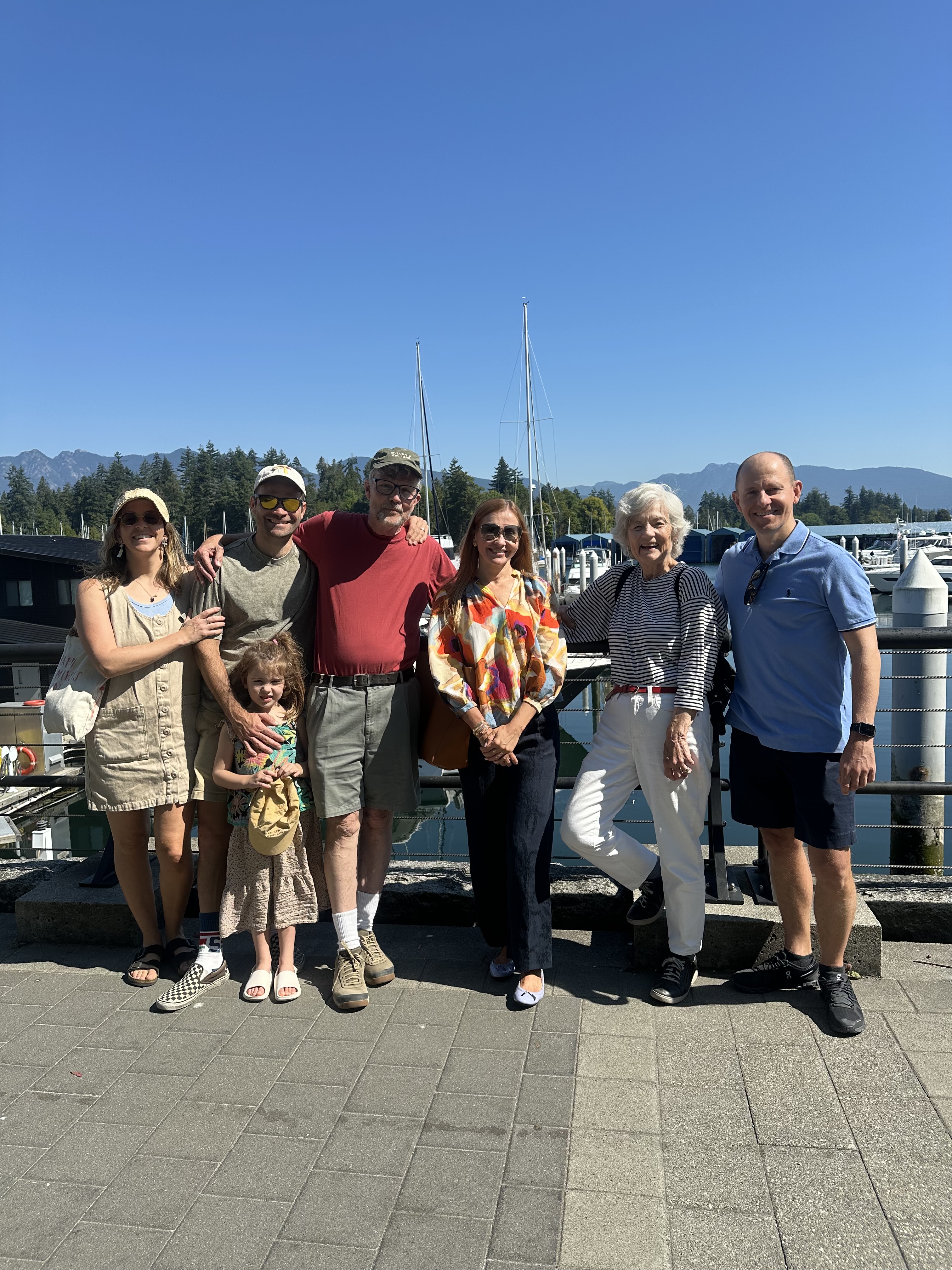
Volodymyr, Olesia, Rainier and Lia and Celeste, and Jeff and I spent several hours together, walking through downtown Vancouver, ending up on the shore of the West End of the city. Sometimes I walked alongside my cousin, and sometimes his wife. We chatted about our lives, about their trips to Ukraine. We shared photos from our phones. My cousin and his partner were generous with their time spent with us. We were happy to meet them and so happy to have those several hours together.
Volodymyr tells me that our common relatives were from (anglicized, of course): Buzifka, or probably Sabadash. He had on his phone a photo of a babushka, like my grandmother, a relative distant to me.
And so, I made a connection to that distant place. I had hoped to travel there again – I’d been in Ukraine in 1988, in the last years of the USSR – but the continuing war and the struggle there now prevent me from traveling, although Olesia had just returned from Ukraine. I am grateful for their generosity, and for their interest. Before we parted, we took a picture of us all along the water. I cherish this memory.