When I was growing up in Milwaukee in the 1950’s and 1960’s, the Christian holidays were honored culturally. We sang Christmas Carols during December at school. We had the week following Easter off – always – as spring break – whether or not the weather honored the season. And although my family were not church-going people, we celebrated the Christian festivals along with everyone else.
For weeks before Holy Week, Mom carefully decorated pysanky, the Ukrainian decorated Easter eggs. I had the job of blowing out the eggs before Mom sat at the kitchen table and carefully applied wax and coloring to the empty shells.
I was still small – maybe 6 or 7 – when Mom told me that a man had been hung on a cross to die. The streets were quiet that Good Friday – stores were closed to honor the somber day – when she let me go out to play on the front steps of the flat on Ring Street, alone. I ran up and down the steps. My instructions were to stay in front of house. And as I played alone on the steps, I wondered about that man who had been left on a cross to die. I thought he was somewhere not far away, but out of my hearing, in the quiet city.
Part of me was taken with the story, which in later years I would tell, again and again, to congregations in California, a long way from those narrow, bleak streets. I imagined the man into existence, in a way: captivated, wondering.
On Easter Day, Grandma Markowski would be making her way up the alley to our house, and we’d try to tap each other’s eggs colorful eggs – not pysanky, but regular decorated, hard-boiled eggs – to see whose egg didn’t break. They were the winner!
Later, Auntie Anne and Uncle Harvey, Mark, Patty, and Johnny would arrive for the dinner, ham and all the trimmings. Later still, the women would go into the kitchen to talk and talk as they washed and dried the dishes, while the men sat together in the living room, drinking beer, and waiting for the holiday table to be cleared so that the Sheepshead playing could begin.
Soon enough, Easter was over, and soon enough, the well decorated, hollow eggs that had been carefully decorated and displayed, were set aside, to come out another year. This year, like all the rest, a dish of the beautifully decorated eggs will grace my table, just as they did Mom’s table.
Pysanki by Mary Bahlert (Mom), Jeff Kunkel, Ronn Lass
When I was five years old – five years and one month old – I started the long walk from 11 and Ring Street in Milwaukee to 9 and Ring Street, where I entered kindergarten at LaFollette Grade School. Those two blocks were long walks for a little girl. I expect – although I don’t remember – that my mother must have anxiously walked with me the first day or so, pushing in a stroller my baby sister, Susan, who had been born that March. After that first day or two or three, I walked those blocks with the other children from my neighborhood.
When I return to drive through those streets now, I see how short the blocks were, moving west to east, toward “the Lake:” Lake Michigan. I think of myself as growing up on the shores of Lake Michigan; it’s not too much of a stretch to think that way. The shore of Lake Michigan formed my compass-point, my sense of direction, for many, many years. “The Lake is on the east,” I think, “so I must be facing north, and to get there, I have to turn left, to the west…” etc. Years later, when I land in the Bay Area of California, I find that directions are expressed differently. “Turn right at the second gas station, then get into the left lane. You’ll turn left at the next stop light.” When I work at my first job in graduate school, someone hears me giving directions and says: “You must be from the Midwest.” Good guess.
That’s how our lives grow, how the edges of our lives expand: by walking those few blocks to kindergarten, leaving home for the first time. The edges widen by talking to kids whose lives inside their narrow flats are different. I hear about dads who are mean, for example, and I hear about mothers who laugh a lot. Until I leave my house in September of 1954 to walk those few blocks, my imagination does not hold space for those possibilities.
I am nostalgic for those streets, for those city spaces, for the shadows under the big elms that line the streets, for those narrow stairs with the small window on the right at the top, that lead to the second story flat with its small front room, tall windows, its small bathroom with the clawfoot tub that was used by 5 people without a thought that it could be otherwise. My nostalgia wants to be satisfied, so I ride my laptop via google earth to the front of that flat; I walk with google the two short blocks to La Follette School. I still see the beauty that was there, and I see the poverty, the simplicity of those flats, as well.
On the way to school one day, I learn that I am not Catholic. Michelle, my neighbor across the alley (which runs next to my house), a year older then me, asks me one day, as we walk to school: “Are you a Catholic?” I don’t know. That night, I ask my mother if I am Catholic, and she tells me no. I do not know the fraught history that lies behind her answer, and I will not know, for many years, the fraught history and longing that goes with not being Catholic, in me.
At LaFollette School, I am introduced to a kind of diversity, for the first time. I sit near the front, always, our seats assigned alphabetically by teachers in navy blue polka dotted dresses. In those narrow rows, in those wooden desks with holes for ink pots still marking the right hand side, I sit beside the children of first and second generation immigrants. I do not know that many of my classmates speak a different language at home. In my house, I often hear Ukrainian words, spoken with a kind of mysterious wink; from time to time, when my grandma visits, she and my mother speak their native tongue.
In the autumn, the elm trees that line Ring Street turn bright colors, and as I walk, I often try to catch a maple seed – a helicopter to enchant children – as it floats to the ground. Over the street, the trees meet to form a ceiling that arches from one street to the next. In later years, Dutch Elm disease would take the elms away, and when I see these streets now they are just beginning to be tree-lined again, after many years.
In winter, snowbanks form a path for children, four foot high, on the strip of land between the road and the sidewalk. After a winter storm, the tops of the snowbanks form a hardened, frozen, flat sidewalk parallel to the cement sidewalk. At the corner, I climb that tall bank of snow and stand taller than any adult, until I take the steps – made by other children – down again, at the place the alley meets the street. After the alley, I climb the snowbank again.
In spring, I walk to school as the glorious, wide, lilac bushes float their purple flowers, their scent into the air.
*
One summer day when I was 13, I walked down the steps in the narrow front hall, from the second floor, to look out the screen door that led to the downstairs porch. I looked out on that street, with its maples, its curbs with green grass growing beside the asphalt, the tall, spindly houses that held families – broken, near poor – the sound of traffic from the busy street a block over in the air. I don’t know what happened, then. Was it hope, speaking to me? Was it a barely covered wish, from inside of me, speaking to me? Was it the thought that my mother, my grandmother, held deeply inside, beneath the bright mind, the hand-sewn clothes? I heard a voice. The voice was clear, not to be ignored. “I don’t belong here,” it said.
The streets are not nearly as pretty now as they are in my memory. Milwaukee can be a bleak place, from December to late May. Grey clouds hang over the streets, over the city, for way too long each year. And the houses that line the streets – 50 or so years old when I lived in upper flats – are 100 years old now.
Those narrow streets formed me. I left them behind, many years ago. Still, they are my home.
The world was always there for me – gurgling with joy, shining like the brightest sun, fragrance-full, slippery and hard-edged, colorful beyond belief – and there I was, walking around with my head in the clouds, my eyes toward the ground.
I have a good mind, but living from that linear place didn’t work for me forever, thank God. My best thinking brought me straight into a long and deep depression almost 20 years ago. Life has not been the same, since. Today, I am grateful to be alive, and every day offers new delicacies for my delight. The gift of being a Monk in the World is that I get to enjoy what has been there all along, and I get to enjoy it as if it is new, as if it has never been witnessed before.
Many years ago, I learned to pray after reading The Christian’s Secret to a Happy Life, by Hannah Whitall Smith (of the American Holiness Movement). That was the beginning of a long, rich, and growing walk as a Monk in the World. I studied theology and became a preacher, a way to offer to others the gift of knowing we are not separate, we are not alone. I found strength and power and growing self acceptance through prayer. After all this time, I still believe we can change the world by praying, by praying for ourselves, which grows us in Love.
I’m as inter-faith as I am Christian, knowing that the Light, the Universe, the Christ, the Mother, the Holy One, El, is in us all. Or maybe we are swimming in this Holy One. I struggle to find words for this life, this living.
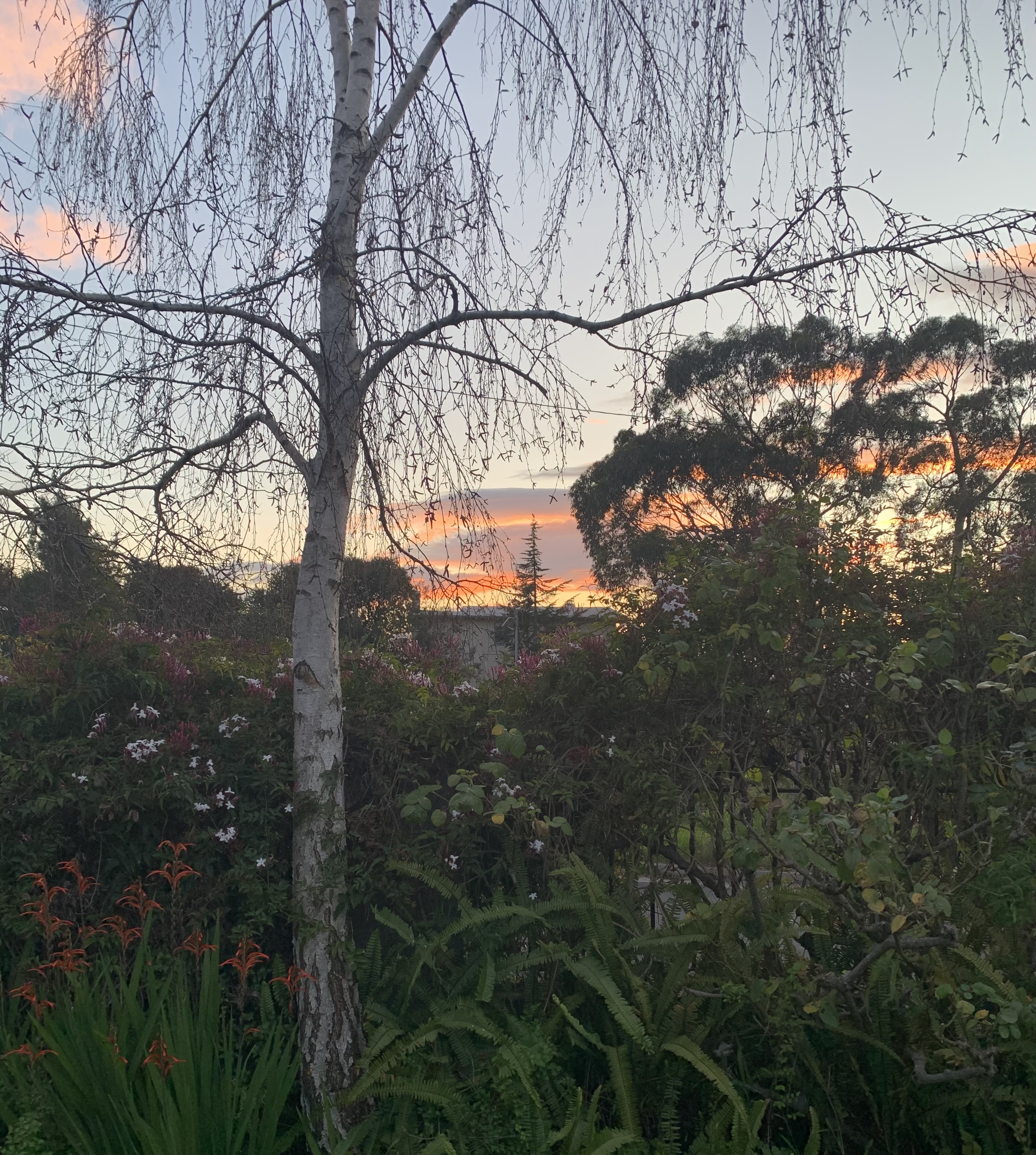
I learned to meditate over 4 years ago, and this practice has deepened me. My greatest joy in meditation is that I find myself more present in the moment, moment by moment, day by day. I see things I did not see before. I delight in the branches of the birch tree outside my city window; I watch the seasons and winds bring change to that tree. I say: “I love that tree, and that tree loves me.” It’s true.
When I meditate, I find the boundaries between myself and the world dissolving. I feel the sound of a neighbor’s voice, the boom of a truck on the street, the harsh call of a jay, the wind in the eucalyptus trees, as much as I hear them. I suppose this is being one with all of creation. For me, it is not as clear as that, but I am beginning to understand, to know.
As a preacher, I also served a community of faith. My work as a Monk in the world was very extraverted for this introvert! I had the privilege of being called to be with others in their times of deepest need – learning a diagnosis that would take a beloved woman’s life, baptizing an infant who would not go home from the hospital, as she lay in the arms of her teenage mother, rushing into a hospital emergency room only minutes before the death of a vibrant woman in her 50’s, as her partner lay sobbing on top of her; I’ve sat in silence and watched the minutes tick away, waiting for surgery to end, with a frightened wife. I’ve answered the door to find a man who has not slept in days, smelling of the street, who tells me his long and convoluted story, only to ask me for a few dollars for food. I’ve heard many of those stories, and even though I do not understand, I have prayed with each one, knowing I have not have ever known that particular desperation. I’ve witnessed the suffering of the mentally ill who come to Church, hoping for something; I am blessed by my own illness to be able to see the suffering person, trapped by their mind, underneath what we call “stigma.”
After 30 years of serving as “Pastor,” I am only grateful. For whatever service I have been able to give, I am grateful. The gift has been mine, truly, truly.
All of this is to say that I am still looking to see the light Thomas Merton, one of my spiritual mentors, must surely have seen. The light is so ordinary, I’m sure. I know with a keen knowing that we are all light, that we are swimming in this light. I’ve felt it for a moment when I meditate, I’ve seen it shimmer – just a glimpse! – in the green, heart-shaped leaves of my beloved birch tree.
I am a mendicant now, begging for alms. I am a mendicant, raising my eyes to look into the eyes of whoever crosses my path. I am a mendicant, wanting to trust each day’s needs and gifts to the Holy One. I am a mendicant, looking for Light.
*
Published as “Monk in the World Guest Post,” on abbeyofthearts.com, 2014
My most vivid memory of my Grandma Bahlert is seeing her – tall and thin – as she opened the door of the little cabin that Uncle Erdreich had built for her and Grandpa, right behind his and Auntie Irene’s house, on the road in Baileys Harbor that led from Highway 57 to a gravel road deep in the woods, a swamp.
Daddy and I had made the long drive from Milwaukee to Baileys Harbor on a Friday night, and we had left Momma and the baby and Ronnie back at home in Milwaukee. Momma and Daddy must have agreed – and known – that this was to be an important trip, and so Daddy drove the four + hours along Lake Michigan when darkness had already descended, to see his Mother. I didn’t feel well on the way, and so I lay down in the back seat, and when we entered Door County, I watched the shadows of the trees that stood, tall and deep, dark, along the highway. Daddy drove on.
When we arrived at the house, Daddy and I walked up to the door of the cabin, and Grandma Bahlert stood at the door to “greet us,” she would have said.
Auntie Irene’s buoyancy, her love of children, must have greeted us first. Later that evening, I would lay on a couch in the living room of the pieced-together house that Erdreich had built – a house that grew longer and more filled with furniture and knick-knacks as the years passed. And when I couldn’t get to sleep, Auntie Irene went next door to get my Daddy, who lay with me cuddled up against him as he fell asleep on the couch.
In her letters – written in a primitive, elementary school handwriting – to my folks, my Grandma Bahlert had mentioned, again and again, “my little Mary.”
A few months later, she was gone. Auntie Edna – who always took charge of such things – had called us on the telephone, and when Daddy came back to sit in his chair, he cried.
Years later, I would ask to see Grandma in a dream, before I fell asleep. She didn’t come for many nights, but then I had a dream! I was standing at a grave, Grandma Bahlert’s grave, and I was alone. When I awoke, I knew the message of the dream to me: “she’s really dead.”
+
From where I sit at the dining room table where Jeff and I eat dinner together every evening, I look out onto the beautiful trees that fill my sight at the dining room windows. In the center of the windows, on the counter on which I place beautiful things to enjoy, I have placed two black-framed photos, both in black and white. The photos are old, and the manner of dress attests to that. On the right are my Grandpa Markowski, Grandma Markowski, John – Ivan, about 4 years old – standing in front of them in an old-fashioned sailor suit. They are not smiling, as seems to have been the custom when taking pictures at that time.
To the left is another photo, a photo of the Bahlert family. They were good-looking people, all. The year was 1910, judging from the ages of the children. On my grandmother’s lap is a baby with big brown eyes, looking, like the rest, into the camera. The baby is my father, Frank. His twin, Carl, had already died, only a few months old. Grandma has a small smile on her lips as she holds her baby. Maybe it was for the picture, or perhaps she was happy to be surrounded by the little ones she loved so well.
I think of them often, I remember my Grandma Bahlert’s love for me, always. When I return to Door County, filled with tourists now, I go by the quiet, less traveled roads to the graveyard at the Sister Bay Moravian Church, and I always stand at the graves for many minutes, thinking of them having come to this place, at the end.
A few years ago, I messaged my first cousin’s son, Eric, to tell him what I remembered of his Grandpa, my Uncle Johnny – Ivan – my mother’s eldest sibling. I told Eric how his Grandpa had loved him so much. To my message, Eric replied: “I remember the love.”
In sadness the lively tree is shed of color, gleaming ornaments carefully, safely wrapped in soft paper, paper that wrapped them safely when I was young. With each one wrapped, a memory: a smile, a tick of sadness arrives as I lay them to rest for another year.
These days, I lay them in their boxes with a wave of grief at how many Christmases have passed, how few festivals of Light there are to come.
Mary Elyn Bahlert, 1/2025
Beautiful Christmas companion, photo by Mary Elyn Bahlert, 12/2024