We’re coming up on the Fourth of July. The Fourth comes as just another day here in Northern California, so the Fourth has come as just another day for me for many years now, many more years than when the Fourth was a day of spectacles.
Milwaukee had an old-fashioned Fourth of July parade, downtown. Even when I had graduated college and was living on my own, I made sure to make it the parade along Wisconsin Avenue, the parade route lined with mostly families, little children holding flags, their eyes wide as they saw another float following the one they’d just seen, filled with loud music, animals, and waving strangers. I loved the Fourth of July parade, in particular the “20 horse hitch,” a team of horses whose driver held all twenty leather reins in his massive hands, his eyes on the team, who had arrived in the city for the day from the Circus World Museum in Baraboo.
One year, I was sick on the Fourth of July, and I watched the parade from my old black and white television set. I didn’t want to miss it.
A favorite memory is a relic of the Fourth of July: laying on a blanket in the grass on a in hill Washington Park, also home to the Milwaukee County Zoo – which has since moved, many years past. I was little. I lay with my Dad to my right, and as the night came on, and deep dusk surrounded us, we watched the fireworks flashing overhead. Dad “oooohed” and ahhhhed” at the sight, and from time to time, I looked over at him as he enjoyed the fireworks – apparently as much as I did. I had a safe feeling, then.
The Fourth of July passes like just another day here in the Bay Area. A few times, when we heard the booming begin in the distance, Jeff and I climbed to the top of a small hill on the strip of land we call The Panhandle, leading from our fence to the next street, and we looked at the fireworks flying across the San Francisco Bay, from cities up and down the Peninsula. I can’t replay the Fourth as I remember it from the Midwest, though, where summer is so precious, and when the Fourth means that in a month or so, it will be time to think about getting back to school.
San Francisco Bay from Floor 9 of Kaiser Hospital, Oakland, 6/24, photo by Mary Elyn Bahlert
Sometimes I think I’m a closet Catholic. I didn’t grow up Catholic, like so many of my friends in Milwaukee. I grew up understanding that my family wasn’t Catholic. In the 1950’s and 1960’s, many families still went to church together, although mine did not. I understood that we were not church people, because I had friends who were “church people,” whose families went to church together every week. As I got older, I came to understand and to accept my family’s distrust of “church.” They had their reasons.
Still, when I was in Junior High School, my mother made sure I was enrolled in Confirmation Class at a neighborhood Lutheran Church. Every Saturday morning for two school years, I studied – and memorized – Luther’s Small Catechism with the Deaconess, and then I studied once a week with the Pastor for a year before I was confirmed with a large Confirmation Class, on Palm Sunday, when I was 14. Almost immediately, I stopped going to church.
I was a University student in the late 60’s and early 70’s, that time of anti-war protests and hippies marching in the streets, and so it was a strange quirk inside of me that set my mind on becoming a woman pastor, at a time when there were few women pastors, at a time when I had not heard of such a thing as a woman pastor. At least I had the idea, with no plans in sight, to go to seminary to study.
I still had to find a church, and I found a place for myself in the United Methodist Church, where I met Harvey Stower, a Young Adult Minister, who asked me: “have you ever thought about going to seminary?” My answer: “I think about it all the time, but I don’t tell anyone about it.” Within a year, I was on my way to seminary in Berkeley, on my way to being ordained, on my way to a life in the Church.
And so it must seem odd to think of myself as a Closet Catholic, since the Roman Catholic Church has still not seen its way to ordaining women.
I tell people that “I love the Mass.” I love liturgy. There is something in the rhythm of the Mass, of the reciting of the words that have been recited for centuries, across the world, that touches me. Maybe it’s because my ancestors were Catholic, on another continent, at another time, before they were harmed by the Church. Maybe it’s my love of poetry, of the sounds of things that are beautiful sounds. Maybe it’s my deep connection to the life of faith, that deep connection that had me searching before I knew I was searching.
I do come to Mass with my own judgements: where are the women here? where are the women-priests? What of the damage the Church has done – is doing – in so many people’s lives?
And I set those judgements aside when I go to Mass. I feel a connection there, a connection that is not dependent on the others who are worshipping with me. The connection is deep, deep inside of me, and deep inside the words, the recitations, the incantations. The connection is there, in spite of me. I don’t get it. My understanding does not matter to me.
And so I show up from time to time at Mass, responding when I can, taking in the sanctuary where I sit, the crucifix high in front, the Altar with the elements central to the sanctuary. I listen to the words and I feel myself there – a bit out of place, but still – not out of place at all.
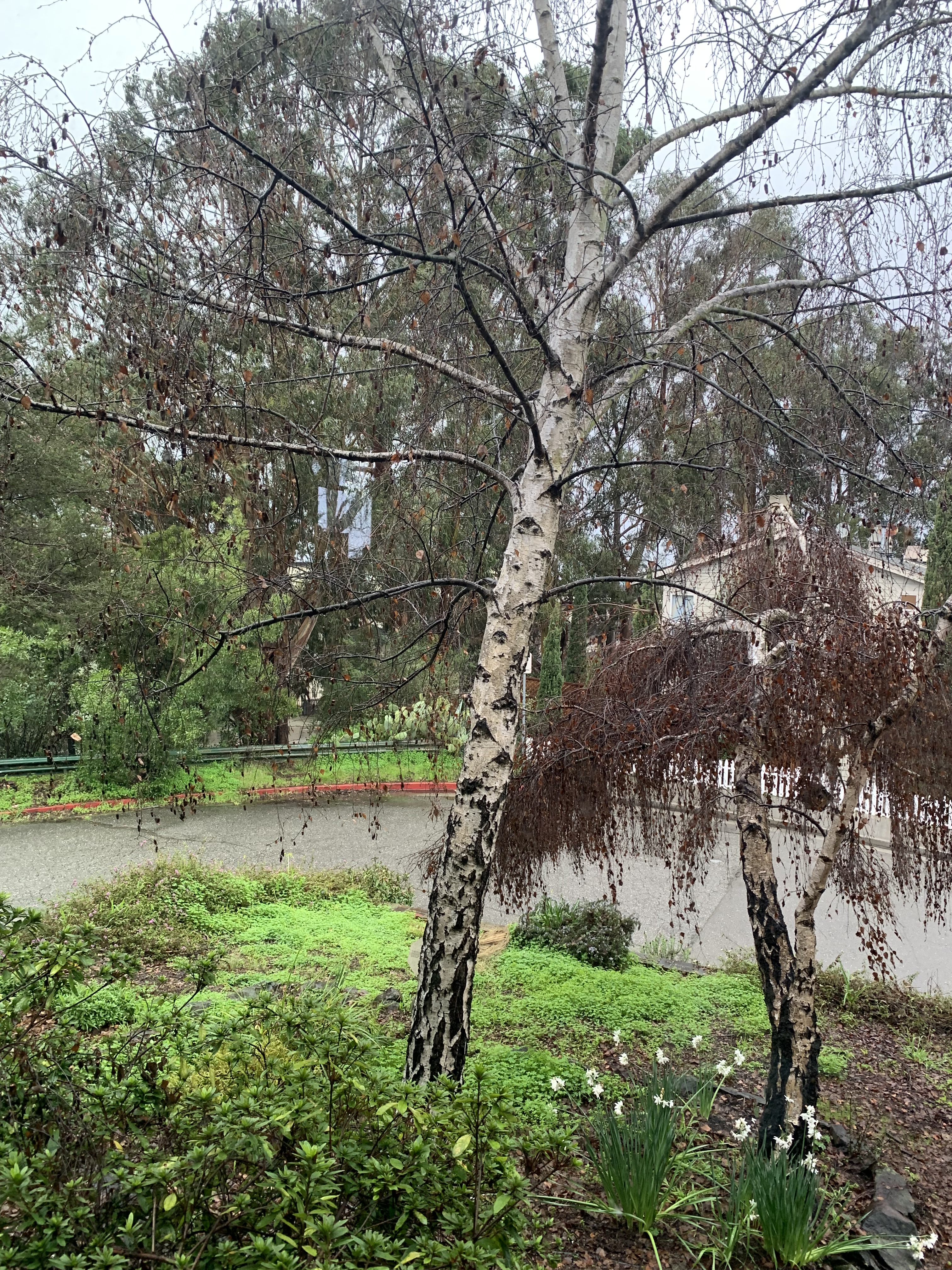
A winter’s day, Martinez – photo by Mary Elyn Bahlert, 1/2023
While talking to my friend Susan, who lives in another state, she mentioned the years after she had graduated from nursing school and before she was married. Her then-fiance’ discouraged her from going to Vietnam to serve the armed forces. And she was remembering.
I remembered, too, as she mentioned Vietnam; a small lurch in my chest remembered Vietnam, another presence in my life.
In the spring of 1970 at the University of Wisconsin-Milwaukee, I was in sitting in a philosophy class, thinking about what the professor was saying to the small group, seated in a circle. What I thought is that we should all be silent, and sit in the silence. When I left that day, crowds and crowds of students filed out of the student union as protestors with beards and ragged clothes shouted slogans: “end the war! end the war!”
Then, classes were suspended for the rest of the semester.
Vietnam was a presence to my generation, a conflicted, horrible presence. All the young men I knew waited for their number to come up. One was gone, then another. When we tell the stories of those times to one another, Vietnam is mentioned, along with the names of friends, of people we know who are gone now, some too soon, in that war – never declared a war. Some are stories of the young men who were not called to serve as they watched their friends go off.
Protest songs filled the air waves, along with the news of casualties. Photos brought the conflict to our homes. Our minds were never far from the news of casualties. And young men we would know later in our lives told the stories of their time in Vietnam.
Today, Vietnam is a popular vacation spot for Americans. We like to visit that place, exotic and beautiful. From time to time a photo from that era will show up online, the shooting at Kent State, a young Vietnamese girl running for her life. I hope we have not forgotten the people there and those who are still with us, who saw that place in another, war-torn time. Some of the soldiers who served there are still dying from their exposure to chemicals, to Agent Orange. Our friend Richard was buried a few years ago, his cancer related to his time in Vietnam. A childhood friend has his name inscribed on the wall in Washington, D.C.
My hope is that we all have that place inside us that tugs at us when we remember. “Ain’t gonna study war no more,” an anthem of that time repeats. “Ain’t gonna study war no more…”
Nancy and Norm (names changed) were so excited when they were able to announce to the congregation that they were expecting a baby. I always remembered the first Sunday Nancy had brought Norm to her church community for worship, her eyes lit up as he had followed her into the sanctuary. From that day on, and after they were married, they were faithful worshippers – and choir members – at the diverse congregation in downtown Oakland.
And – from the time they knew they were pregnant, they invited the congregation into their joy. The day after their baby girl was born, I met Norm outside the church as we both arrived. ”The baby is here!” he said, jubilant. He showed me a picture on his phone of the newborn, beautiful baby girl. We were all excited for the little family that day.
When baby girl was a few months old, a friend of the couple’s expressed concern for the baby to them. She didn’t seem to be developing the way other babies grew. Respecting their friend’s observation – she had two young ones – Nancy and Norm took their little girl to the doctor, and not long after, she was diagnosed with mitochondrial disease. Nancy and Norm brought the news to their church community, and their news was the beginning of a journey for both the couple and their baby girl and for the congregation.
Baby girl was hospitalized many times over the course of her short life. Her mother, who had been a school teacher, quit her job to spend her days and nights at the hospital with the little one. One or two faithful friends from the church visited them in the hospital, offering what kindness and comfort they could offer. Each week, we offered prayers for the little one and her parents.
Finally, the baby was hospitalized for several weeks. We all knew, without saying , that she would not leave the hospital, and that her short life was going to end, very soon. I visited baby girl and her mother the day before I was set to leave for a trip to Wisconsin with Jeff. Before I left that day, I said to Nancy, at the same time as I looked at the baby: ”wait for me.” The baby and I locked eyes as I said those words, and I left the hospital, knowing that Nancy and her little girl would have other caring visitors during my absence.
Two weeks later, my plane touched down at the airport in San Francisco, and I arrived back in Oakland to the message that the baby girl had passed, at her home, in her crib, her Mommy and Daddy with her, a few moments before. When I walked into the house, I was met by Joan, a tall, striking white woman from the church congregation who had been a caring and helpful presence to the family during their ordeal. Joan told me that when 911 was called to take the baby away, she had met the police at the door to their home, telling them: ”this baby has been ill, hospitalized many times in her short life.” She knew that she was protecting the family from unwanted accusations about her having died at home.
When I saw Nancy, when we hugged, she looked into my eyes and said: ”She waited.” Indeed, it seemed as if baby girl had waited for me to arrive back in Oakland before she passed. Her parents were surrounded by a loving community of people who would be with them as they grieved.
Then, there was the matter of announcing the news to the congregation. I was nervous as I stood before them the next morning, before worship began. I told them that baby girl had died. The community was silent, stunned – I suppose – although we had all known that this word would come to us, someday, sometime soon.
After I preached – what did I say to them all that day? – Dan, a gospel singer from the congregation spontaneously stood and sang acappella, a gospel song. As he sang, I heard a loud sob from someone in the congregation.
*
One of the moments as I pastor that I hold dear, that I can see clearly in my mind, is the day we all gathered to mark baby girl’s life, to remember her. I saw her parents, sitting in the front row of chairs, their eyes looking up toward the pulpit. What did I say? I don’t remember. Baby girl, cherished baby girl, was gone. What hope could touch them?
I’ve only returned to visit the congregation a couple of times since I retired, but I see photos of Norm on Facebook sometimes, holding a little one who is in the church congregation now. The little ones come to him, and they are his favorites, as the other folks know. And when I returned for a memorial service a few months ago, Nancy and Norm came up to me, hugging me with warmth, remembering, always.
“Blessed are those whose strength is in you”. - Psalm 84:5 (photo by Mary Elyn Bahlert, 1/2024)
Some people have uncles that were awful people, creepy people, uncles that no one liked, uncles that were hard to be around.
Not me. I had wonderful uncles, and I remember them, along with all the rest of the ancestors, often. While they did not say it – ever – I knew that there was love, or at least affection, in them for me.
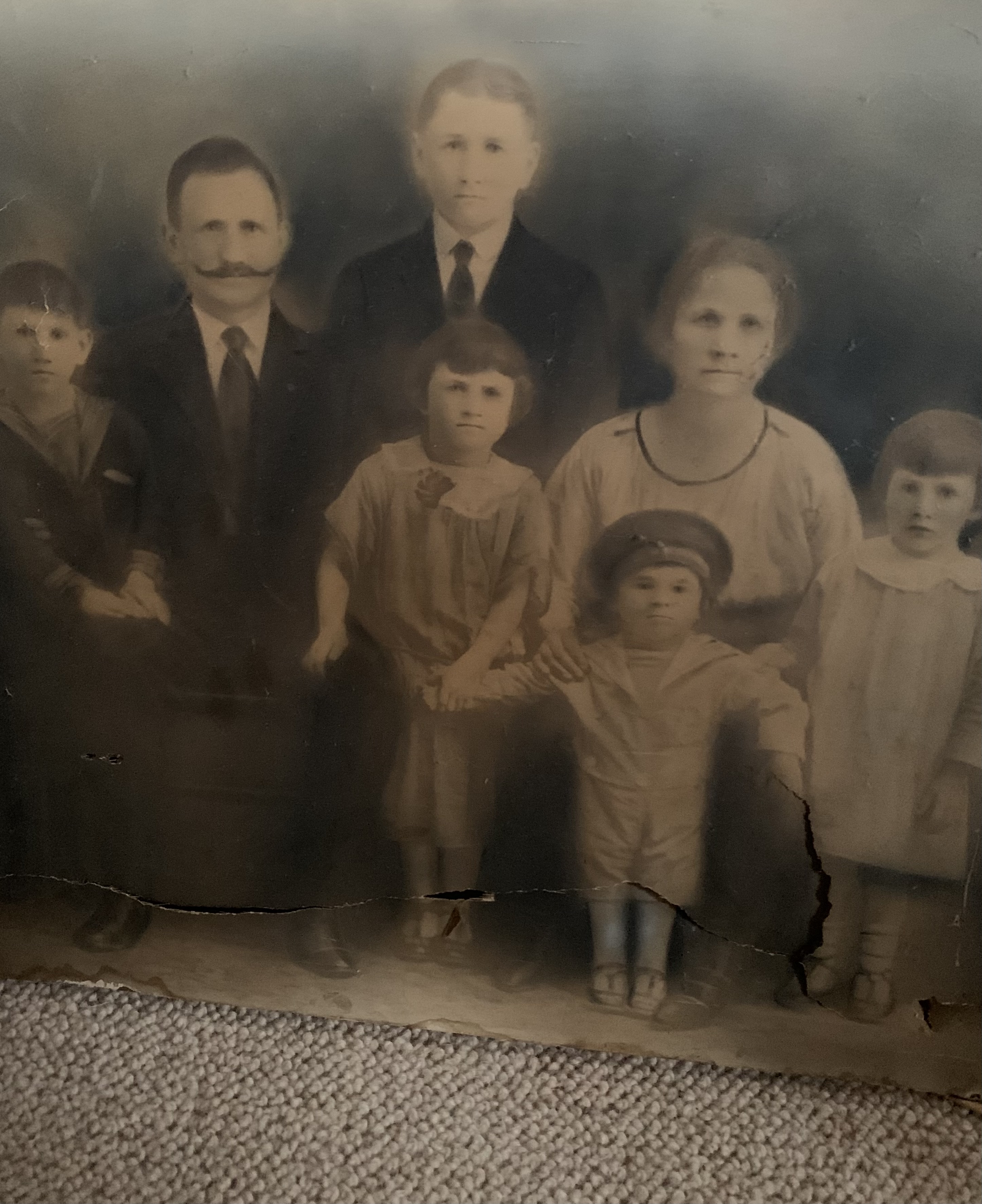
Uncle Pete, my mother’s youngest brother, was full of himself. Like all the others who are full of themselves, he took up all the space in a room. He had a large presence, a sort of charisma, I suppose. His dark eyes danced as if he had a joke to tell. He could tell stories from three wars – “Pete fought in three wars,” the men in his neigborhood said as they made room for his wandering, his memory loss, in his later years. Pete, my handsome uncle Pete, who walked silently to the car with me on a visit I made to the military hospital in Oakland to see Aunt Athalie, his wife. Then, he seemed shy even, as he carefully saw that I was in my car and had driven safely off.
Sometimes as I got older, he’d ask me a question he should have asked my mother; “ask my Mom,” I’d say, without saying more. He didn’t press me further. Did he ask my Mom? I don’t think so! Like many families, differences were not worked out directly between the siblings. They had to trust in the passage of time to take away old hurts.
Uncle Johnny was the eldest brother, a hero to my mother and her other siblings, Mike, Anne, Pete. He was older than the next one in line – Mike – by 9 years, and it was safe to say that he had been born in the Old Country, Ukraine, although the family lore held that he was “born on the boat.” When he went off to work, he showed up at home to bring Christmas to his siblings, knowing that his folks would not come through for them – ever.
Uncle Johnny was smart, well-read, an atheist: an uneducated intellectual, the condominium he shared with Aunt Dani filled with piles of magazines and books. His brother’s eyes were full of pride when Johnny spoke; my mother’s, too. He was a quiet one – like Mike and my mother, to Anne’s, to Pete’s extraversion. In his later working years as a machinist, he was a union man, his democratic socialist leanings lived out in his own life. He was our hero, too.
Uncle Mike was so quiet, so much part of the background that I have few memories of him. Did he ever speak to me? He married Alice, a British woman he’d met when he was a motorcycle-riding soldier in England during the War. When I was a young woman, Alice would call me from time to time, and she’d take me to dinner, where she talked and talked. After Mike died, Alice finally got a phone for their little home in a town north of Milwaukee. I last talked to Alice when she happened to call my mother in the days before we moved Mom to live out close to us in the Bay Area. My mother’s memory was already poor, so when my Aunt Alice identified herself to Mom, she handed the phone to me, probably thinking the call was for me.
**
Dad was one of nine siblings, one of only two who’d left Door County, Wisconsin, to live in the city; Dad settled in Milwaukee, Uncle Norman, his youngest brother, in Queens, New York, where he worked as a police officer. And so I had a string of aunts and uncles on the Bahlert side.
Clarence and Ray were Dad’s older brothers, Ray, a farmer, Clarence, a retired Coast Guard officer who worked the wild waters of Lake Michigan, all the way north to Washington Island, off the tip of Door County. When we stopped at Clarence’s house in Baileys Harbor – a cottage close to the shore of Lake Michigan – my Dad and Clarence stood outside talking for a long time, two brothers, separated by time and distance, by different lives.
We stood on the grass outside of Ray’s house, too, Ray, a quiet man – “one of the quiet Bahlerts,” with a quiet wife and a quiet daughter, my cousin Terri. By the time I remembered seeing Ray and his place, my cousin Roger, Terri’s elder brother, was married and gone, with a daughter of his own. Not until years later did I come to know Roger, after I’d retired. After a time of talking – my Dad did the talking, Ray the listening (I’m sure) – we’d walk around to the back of the property, to see the raspberry bushes, to taste a few, and to take a quick look at the outhouse, still in use, on the property. My family in northern Wisconsin were rural people, kind, gentle people. I loved them – love them – for that.
My dad told us a story about Ray and him, the two of them riding a Model T down the Sister Bay Hill that wound right down and into the main street of Sister Bay, on the Green Bay side of the peninsula. Young men, they yelled “Betsy Ross!” – a slang of the day, as they started down the hill, and as the driver shouted, he pulled the steering wheel right out of the steering column and held it high in the air until he realized what was happening, then poked that steering wheel right back where it belonged, and continue to navigate down the long Sister Bay Hill! Every time I go down that hill now, I think of them on that day, and I think of my father’s face, his voice rising, as he told the story – as he’d lived to tell the story.
Uncle Fritz was next in line, younger than my father. He was Dad to my cousin Bobbie, like Terri, a bit younger than me. Like the rest of the Bahlerts, Fritz was a worker, coming home from a day in the shipyards in Sturgeon Bay to butcher at the store he and Aunt Goldie operated near the north point of the Door County Peninsula. The only time I went as fast as 100 miles an hour in a car, I sat with Bobbie in the front bench seat of my uncle’s pickup, watching that speedometer go faster and faster! Fritz was quiet, too, and I don’t remember a conversation with him, although he was closest in age to my Dad.
Uncle Norman, the youngest, married a woman from the East Coast and raised his family there. My only memory of Uncle Norman was when he stayed with us overnight on the way to Door County to see his mother, my Grandma Bahlert, in the days before her death. I was a little girl, and I watched with big eyes as my handsome Uncle Norman came into the kitchen. Every year at Thanksgiving now, Jeff and I celebrate the holiday by sitting around the table with Uncle Norman’s eldest son, Norman Bahlert, and his family – children and even grandchildren now, and Cheryl, Norman’s wife. Pictures of the Bahlert’s from generations past look down on us all, seated around the long table, as if guarding their progeny.
So these were the uncles, distinct, kind, a part of the framework of family who peopled my life, then – and even now.
Vlas Markowski (Srebny) with Mike to his right, Johnny standing behind, and Pete, the little boy with the hat, at his mother’s knees. Photo, circa 1921-1922, Milwaukee, WI.