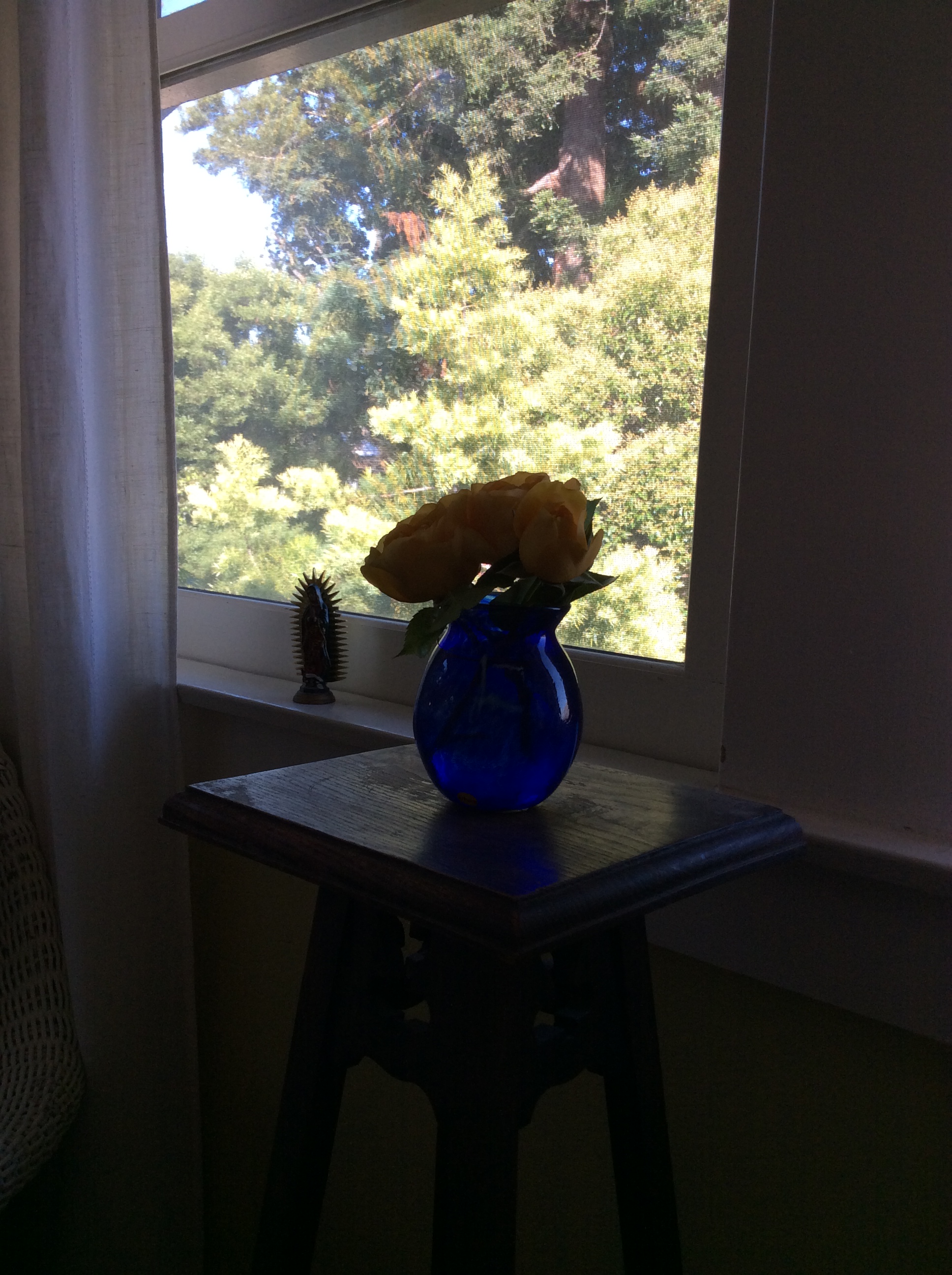
I am surrounded by holy places: shelves that hold cards, small enough to carry in my wallet, a picture of a saint on one side, the prayer of the saint on the other. On the window sill next to my bed is a rosary, gifted to me by a friend, a found rosary she discovered in a second hand store. On the walls of my little study are holy pictures: Mother Mary, holding a child, a copy of a painting created by a dear friend. A favorite: Mary, the Untier of Knots. I keep several of her in my kitchen drawer these days, to send them as gifts: to a friend who is undergoing treatment for cancer, to my cousin Rudy and his wife, Mary, who say the rosary together every day. On a ledge close to the ceiling of my living room, Guadalupe looks down on me and Jeff as we sit together in the morning, sipping our first cups of coffee. Sometimes as I empty out my desk, I find other saints; I find a stone given to me by a friend, I find a few words on a worn, ragged piece of paper – words of a poem: “I love Jesus, who said…” On my shelf above the bathroom sink lies a small cross, decorated with red glass, a gift from a friend who I see so seldom now. Like my rows of books of poetry, each of these items, some I have carried with me for many, many years, is a prayer said for me, spoken silently or not at all, a prayer on my behalf.
I love the diversity of the Bay Area, where I’ve lived for over half my life. As I walk on the busy shopping street in my neighborhood, I’m happy when I hear languages spoken by the people who pass me on the street. As I walk past the store fronts that line the street, most of the languages I hear I can’t identify. All the better!
For many years, I said, from time to time, that in the Midwest, the weather was more interesting – and more rugged, of course! – than the Bay Area of California. But the people were more interesting in the Bay Area. They still are, to me.
As a pastor in downtown Oakland, I was enlivened by the diversity of folks who arrived to worship with us – folks who brought their diverse backgrounds, languages, music, dress, and all the gifts of another culture – to the mostly white congregation that had chosen to stay in Oakland when there were other choices they could have made. I loved the heart of that place, where in years past the people had decided to cast their lot in the city, a city with its share of problems, of poverty, of violence. I loved them for choosing to stay in Oakland.
Today was Pentecost Sunday, and I had the honor of preaching for an anniversary celebration at Oakland Chinese Community United Methodist Church in Chinatown, Oakland. I read my sermon in English, paragraph by paragraph, and the Pastor of the congregation followed each paragraph with a Cantonese translation. The two of us, each speaking our own language, brought to mind the myriad of languages that were spoken when the disciples left the Upper Room and became apostles who went out to tell others about what they knew of God, and of Jesus. “Now there were staying in Jerusalem God-fearing Jews from every nation under heaven. 6 When they heard this sound, a crowd came together in bewilderment, because each one heard their own language being spoken. 7 Utterly amazed, they asked: “Aren’t all these who are speaking Galileans? 8 Then how is it that each of us hears them in our native language?” (Acts 2:1-8).
Jeff accompanied me to the celebration, and we were the only white people in worship. Many times here in the Bay Area, we are minorities – seldom in other places, or in Wisconsin, our birthplace. As we said the Lord’s Prayer in English, I listened for the voices of most of the others, praying in Cantonese, at the same time. A young man who had been raised in China read his statement of faith to the congregation, recounting how he had found his way to the Church, followed by the Pastor translating into English; then, he was baptized. A holy moment.
Diversity has its problems, to be sure. But it’s good to be in a place where people who are different are not afraid, where folks can speak in their own language as they shop or as they walk down the street, and be safe. That’s not true in many places in the United States now, or in so many other places.
As we walked to our car after worship and after receiving the generous meal we all shared together in the fellowship hall, Jeff and I stopped to wait at a corner for the light to change, across from a Buddhist Temple that brings the Holy to those others who do not worship as we do. I’m grateful that they are here.
We crossed the street and drove home to our little house on a quiet street in another part of the city.
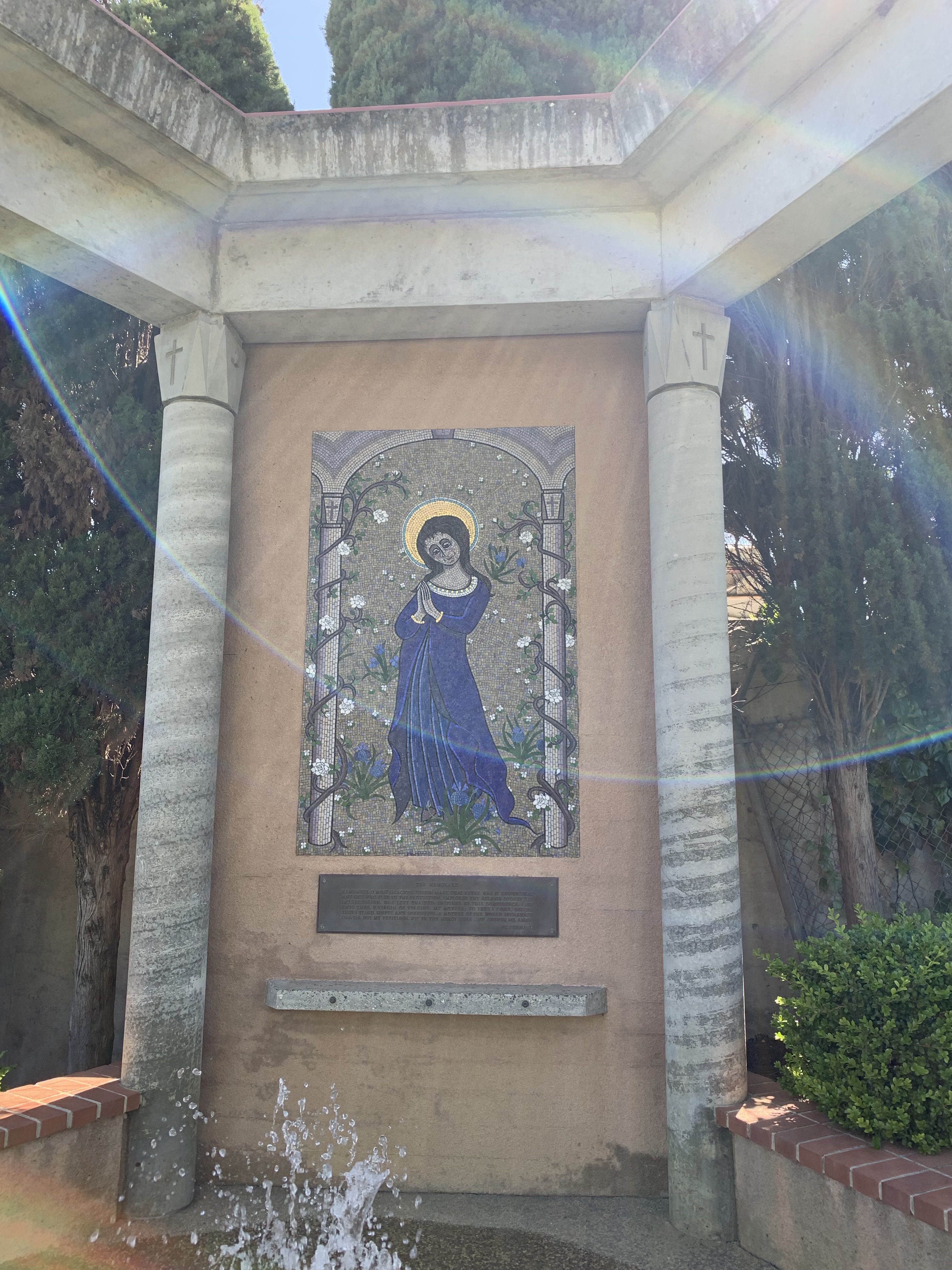
In St. Mary’s Cemetery, Oakland. Photo by Mary Elyn Bahlert, 4/2024
Sometimes I think I’m a closet Catholic. I didn’t grow up Catholic, like so many of my friends in Milwaukee. I grew up understanding that my family wasn’t Catholic. In the 1950’s and 1960’s, many families still went to church together, although mine did not. I understood that we were not church people, because I had friends who were “church people,” whose families went to church together every week. As I got older, I came to understand and to accept my family’s distrust of “church.” They had their reasons.
Still, when I was in Junior High School, my mother made sure I was enrolled in Confirmation Class at a neighborhood Lutheran Church. Every Saturday morning for two school years, I studied – and memorized – Luther’s Small Catechism with the Deaconess, and then I studied once a week with the Pastor for a year before I was confirmed with a large Confirmation Class, on Palm Sunday, when I was 14. Almost immediately, I stopped going to church.
I was a University student in the late 60’s and early 70’s, that time of anti-war protests and hippies marching in the streets, and so it was a strange quirk inside of me that set my mind on becoming a woman pastor, at a time when there were few women pastors, at a time when I had not heard of such a thing as a woman pastor. At least I had the idea, with no plans in sight, to go to seminary to study.
I still had to find a church, and I found a place for myself in the United Methodist Church, where I met Harvey Stower, a Young Adult Minister, who asked me: “have you ever thought about going to seminary?” My answer: “I think about it all the time, but I don’t tell anyone about it.” Within a year, I was on my way to seminary in Berkeley, on my way to being ordained, on my way to a life in the Church.
And so it must seem odd to think of myself as a Closet Catholic, since the Roman Catholic Church has still not seen its way to ordaining women.
I tell people that “I love the Mass.” I love liturgy. There is something in the rhythm of the Mass, of the reciting of the words that have been recited for centuries, across the world, that touches me. Maybe it’s because my ancestors were Catholic, on another continent, at another time, before they were harmed by the Church. Maybe it’s my love of poetry, of the sounds of things that are beautiful sounds. Maybe it’s my deep connection to the life of faith, that deep connection that had me searching before I knew I was searching.
I do come to Mass with my own judgements: where are the women here? where are the women-priests? What of the damage the Church has done – is doing – in so many people’s lives?
And I set those judgements aside when I go to Mass. I feel a connection there, a connection that is not dependent on the others who are worshipping with me. The connection is deep, deep inside of me, and deep inside the words, the recitations, the incantations. The connection is there, in spite of me. I don’t get it. My understanding does not matter to me.
And so I show up from time to time at Mass, responding when I can, taking in the sanctuary where I sit, the crucifix high in front, the Altar with the elements central to the sanctuary. I listen to the words and I feel myself there – a bit out of place, but still – not out of place at all.
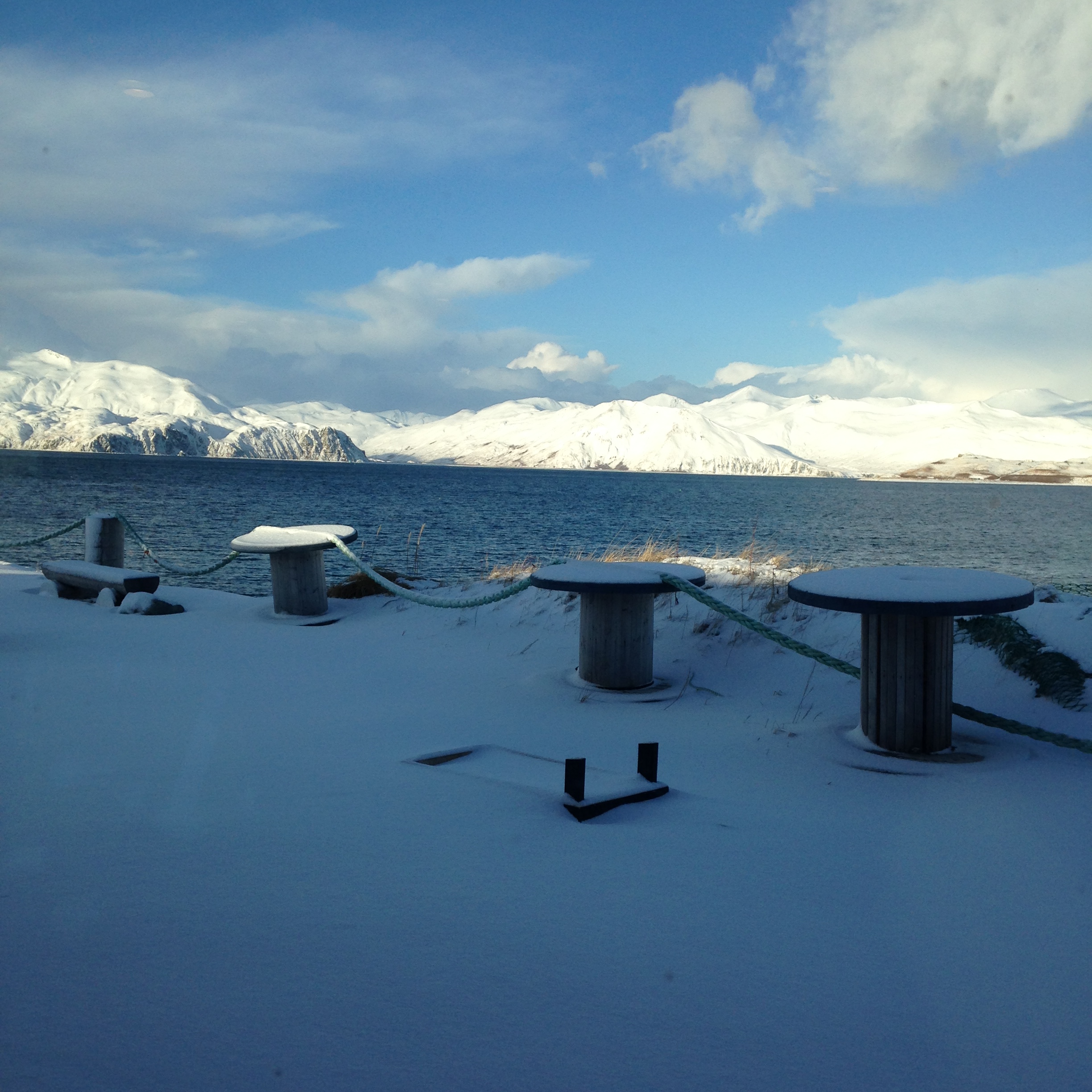
A winter’s day, Martinez – photo by Mary Elyn Bahlert, 1/2023
In the fall of 2015, Jeff received a note from a District Superintendent he had met while working on his books in Alaska. The message was that a little church in Unalaska, on the Bering Sea, was without a Pastor and wanted someone to be with them to celebrate Christmas. I think of myself as a “city person,” one who feels comfortable in cities, wherever they are, but I had traveled to Alaska on several occasions with Jeff, most notably to Nome, where we had had an intimate gathering with the Elders. And so, as soon as I heard the word that a church on the Bering Sea wanted a Pastor, I said: “Yes! Here I am! – Send me!”
And in the middle of December I traveled from San Francisco International Airport to Seattle, on to Anchorage, where I spent the night in a hotel before boarding a small plane with a direct flight to Unalaska. The flight that day was uneventful. I heard stories of flights that needed to be cancelled because of the winds that rise in that place. “Unalaska” is the Inuit word for “birthplace of the winds.” I listened with some anxiety to a story of a flight that had to emergency land along the slopes to the south of the flight’s path until the wind passed and the fog and snow allowed safe passage. And I watched with anxiety and awe as we landed, the cliffs close to the left side of the plane that gave way to the landing strip at Unalaska, with a cliff overshadowing the runway to the right of the plane. I disembarked and was met by the Chair of the Pastor Parish Relations Committee, who took me on a short tour of the Island, introducing me to the one large supermarket, one or two restaurants – always full – and to the church, and the parsonage, a large house whose front windows looked out over the Bering Sea.
As we drove up to the house, several eagles fluttered down from the roof as if to greet us. The church folks had set up a small, artificial tree, complete with lights, in the living room. I kept those lights on 24 hours a day during my stay. The kitchen was well equipped, the bed made, and we turned the heat up when we entered the house. All was well.
The Birthplace of the Winds, indeed. One night I was awakened by a wind, wind so wild that it sounded as if it would pick up the big, cozy house in which I slept and carry it out over the water. The wind surrounded the house, wailing and whipping, louder and louder, until at last – it passed. I was a witness to the winds, then.
I preached for two Sundays before Christmas and met with the musician – a professional piano teacher who had married a native man and lived on the Island, where she raised her family – a worship leader, and one or two other folks who were active in the church community, to plan Christmas Eve worship. We filled our plans with music, the Christmas Story, and lights. Each Sunday of my time with the people in worship, I celebrated Holy Communion, because they did not have a regular pastor to be with them.
During the week, I spent part of my days in the library on the Island, where I became friends with the native man who worked behind the desk. I checked out books and movies to watch in the evenings in the big house, alone. I woke each morning to darkness, and at ten AM, as if by some magic, the sky was light, daylight again. When I could, I called Jeff; we never allow a day to pass without our speaking, even when we are separated.
On Christmas Eve, the sanctuary was full of lights – and people, who arrived from all over the Island to hear the Christmas music, to hear the Christmas story, once again. The music was wonderful – a concert of beautiful Christmas music, led by an artist. At the close of worship, we lit one another’s candles, and sang “Silent Night” to the darkened sanctuary, reverent before we went out again into the cold and the wind.
Jeff arrived on New Year’s Eve, and we watched the fireworks fly across the sky on the Bering Sea from the front window, at midnight. On New Year’s Day, I worshipped with the small band of people in the little church, and after lunch, Jeff and I drove the car I’d been loaned – Alaskans share cars freely with one another – to the little airport, where we were able to make the flight back to Anchorage that day. Jeff’s flight to San Francisco left earlier than mine, and I had a few more hours there, taking time to let go of my sacred days in the Birthplace of the Winds.
Over the Bering Sea, December, 2015, photo by Mary Elyn Bahlert
I married a man and a cat. Schatzi had been in Jeff’s life for several years when he and I were married in 1984. Part Maine Coone, she was a beautiful creature with long gray fur. After we were married, she took to sleeping at our feet, making room for me. Schatzi will always be my favorite cat (sorry, LiLi).
Schatzi was my first cat, and she became my introduction to cats. She was a good role model. I’ve discovered since that not all cats have the same people-loving, generous disposition that Schatzi had. If I pushed her too far, she warned me gently, stretching one leg, claws showing, in my direction. I always paid attention! I studied her closely. One day I announced to Jeff: “this cat doesn’t have any eye-lids!” Welcome to cat-hood!
When I took long naps on the green couch in our living room, Schatzi would lie next to me, her back stretched out along my body, an extra layer of warmth. When we had visitors, Schatzi made sure to find her way to the center of the action. While she was a house cat, she was allowed outside if she chose, and being female, she didn’t ever go far from home.
In December of 2000, I recall a Sunday during the liturgical season of Advent when I recounted three things in my sermon that had happened to me during the prior week: I’d received a phone call that my friend and colleague Bruce had died of a heart attack, a doctor’s appointment with my mother had revealed that she had terminal cancer, and the cat had spent the week sick, lying close to the heat register in the dining room of our flat off Grand Avenue in Oakland. As she passed me after church, Phyllis turned to me and said: “I can’t get that cat out of my mind.”
A few months later, Mom passed, in February of 2001, at her beloved home at Mathilda Brown Women’s Residence in Oakland.
Schatzi stayed awhile longer that year. She seemed to know that I was grieving, that I needed her cozy and comforting presence. In the autumn of 2001, Schatzi spent her last night with us on the floor of the kitchen, not able to move, not able to eat. Jeff lay on the floor next to her, all night long.
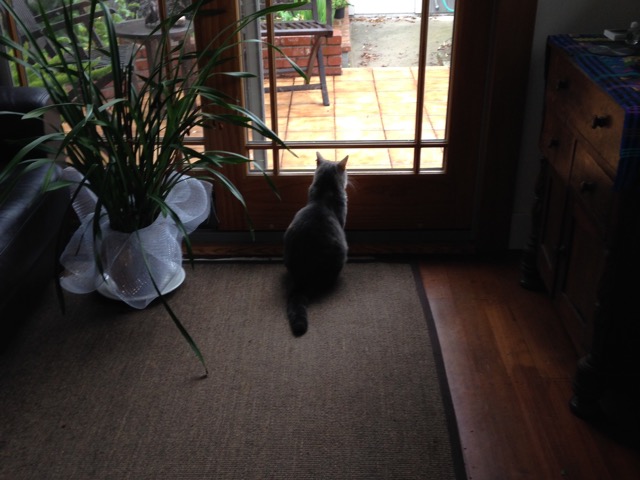
LiLi, our current feline housemate. Photo by Mary Elyn Bahlert.