Uncategorized

who’s a big boy/big girl? Are you?

brave-person-walking-out-on-the-glacier-point-ledge

We ask little children this:  “who’s a big boy?”  The reality is that we are all big, our energy is big, we are larger than our bodies – and much, much – much! – larger than our minds!

Eastern medicine follows the precept that energy follows attention.  Can we apply that to our ordinary, everyday lives?  I think we can!

Most of the time, our energy is scattered.  When we follow the wanderings of our minds, that is completely true.  Our minds wander from one thought to the next, one judgement to the next, one “brilliant” idea to the next.  One day, for practice, intend to watch/observe the wanderings of your mind.  You will have to do this when you are silent and when someone else is not speaking to you.  Pay attention to your thoughts.  This practice alone may surprise you – you will find yourself making judgements, mental comments, about everything you see.  If you really pay attention, you will notice that it is easy for your mind to wander off, to not stay in one place, with one thought, one judgement.  The mind is busy.  The mind keeps moving along.  That’s what it does.

It is also easy, if you are only interested in what you think, to not be completely whole.  This idea in itself is counter-cultural.  We are a culture consumed with words, our own words, the words of others, important words, more and more important words.

(You may want to return to my post:  ‘don’t believe everything you think.’)…

But we are more than the wanderings of our minds.  We are so much greater than the wanderings of our minds.  We are energy, completely energy.  We are made of the stuff of the universe, the stuff of stars, the stuff of time and space and earth and light.  We are so much more than the wanderings of our minds.

Pay attention, today, to the movement of your body through time and space.  Notice.  Notice when your breathing deepens.  Notice the moments when you hold your breath.  Notice the feelings in your body.  When you walk, do you feel as if you are walking solidly on the earth?  Smell your surroundings.  You are a sentient being, a being of feelings, of sense, of physical sensation.  When you pay attention, you begin to experience yourself as a being of sensation.

Many years ago, I was privileged to be friends with a Zen Master, a man then in his 70’s, who was the teacher for a small group of pilgrims in a small city outside the bounds of the Bay Area in California.  In conversations with my friend, I always learned something new, something that opened my world.  One day as we sat together at lunch, we were talking about our minds (go figure how the conversation came to that!).  He asked me a simple question:  can you think outside of your mind?

I tried!  For a moment, I went into that image and word-filled space that I inhabited.  Could I think outside of my mind (whatever “my mind” is!)?  I came back to the present moment shortly:  “well, I tried,” I said to him.  Our minds, no matter how brilliant we are, how well educated we are, how well trained we are, are limited.  Are our minds limited by the constraints of our thinking?  I’m not sure – are you?  Do our minds expand?  I’m not sure – are you?  Is there always room for more in our minds?  I’m not sure -are you?

All I know now, is that we are so much more than our minds.  We are limitless, sentient, boundless, energetic beings.  Some say we are beings of light.  However you say it, however you choose to frame it, you are so much more than your thinking thinks you are.

Just how big are you?

 

Uncategorized

Take a look out the window – !

A few weeks ago I watched an online video about a woman who, from her front window, waved to the high school students who walked past her house day after day, morning and afternoon. Because they were accustomed to her being at the window, the young people waved back. After years of this interchange, the students invited their friend – a woman in her 90’s! – to their school to honor her.

Take a look out the window!

In some neighborhoods in most cities, people are afraid to look out their windows. That’s hard for me to imagine, and maybe it is for you, too. But it’s true. Folks are afraid to look out their windows because they might be seen by the crack dealer who walks the street, the crack dealer who carries a gun. Folks are afraid to look out their windows because they are afraid to be called as witnesses to the crime that is living in the streets.

That can happen to any of us. Unless we take a few moments today to look out our windows, to see what is happening on the street, to witness who is passing by, or to see who is missing today, we’ll lose control of our communities.

Over the past several months, students from a nearby high school have taken to climbing up the hill from the main drag that runs through this part of the city, to walking across the quiet street that leads to a cul de sac, and to sitting on the wall that marks the edge of my yard. I took a look at the kids as I parked my car, making sure they noticed me, as I had noticed them. When I came into the house, I went over to the window that looks out onto the wall. There they have gathered, talking, laughing, playing music. They look like young kids to me, and they look like kids just young enough to pay attention to adults.

That day, I opened the window and told them that this is private property. They looked up at me – ! – and answered politely that they weren’t harming anything. But I wanted them to know I’d noticed. A few minutes later, I heard a loud “pop!”, and laughter. Again I opened the window, but this time, in a firmer voice, I told them they’d have to go. When they didn’t leave, I opened the window a third time and told them I’d call the police if they didn’t leave.

Wow! young people can certainly run fast! I saw about 7 or 8 kids go running back across the street and down the hill onto the sidewalk of the main drag! Whew! That didn’t take much!

I know I’m just another old person to those kids. Anyone over 30 is old to them, after all! But I also know that I’m doing my best to keep my own community safe. I can’t do that alone. I need other well-meaning folks to keep an eye on the street, like I do. I need other kind people to point out clear boundaries to young people who are simply doing what young people do – hanging out together, maybe skipping afternoon classes.

When I was in junior high at Peckham (now Jackie Robinson) Junior High School in Milwaukee, I lived in an upper flat on Medford Avenue. I walked the mile to school, morning and afternoon. My parents rented that flat from Mrs. Schmidt, a widow who seemed very old to me at the time. Every day when I walked up the driveway next to the house to the back door and into the narrow hallway to take the steps to the second floor, I saw Mrs. Schmidt sitting in her chair by the front room window. Recognizing me, she waved – every single day.

I think adults weren’t as leery of young people those days as we are now. But Mrs. Schmidt was keeping watch, in her own way, of who walked up the driveway. One time she knocked menacingly on the window when my friend Sharon came to see me; later, my mother told Mrs. Schmidt that Sharon was the daughter of the Baptist minister, and Mrs. Schmidt didn’t try to motion her away again!

Sometimes we do what’s right, and sometimes we don’t do what’s right. How do we ever know for sure? At the very least, take a look out the window – today!

Uncategorized

seeing through to what is true…

DSC_0581“On a beautiful sunny day, you look up into the sky and see a nice, puffy cloud floating through. You admire its shape, the way the light falls upon its many folds and the shadow it casts on the green field. You fall in love with this cloud. You want it to stay with you and keep you happy. But then the shape and color change. More clouds join with it, the sky becomes dark, and it begins to rain. The cloud is no longer apparent to you. It has become rain. You begin to cry for the return of your beloved cloud.
You would not cry if you knew that by looking deeply into the rain you would still see the cloud.”

Excerpt From: Thich Nhat Hanh. “No Death, No Fear.” Penguin, 2002.

I have these moments, too, do you?  These moments when you see through what you ordinarily see into some space or time or place that is there all along, and mostly unseen.   “You fall in love with this cloud.”

Yesterday evening, I fell in love with the little bit of western sky I can see through the late spring leaves on the tree I love, and live with, on my front lawn.  For a few moments, I was completely grateful for  the bright red streak of sky that lingered behind the branches of the tree, across the street, across the Bay… I didn’t want to take my eyes off the scene, because I knew it would be gone in a breath.  My husband had his back to the splendor, and so I had him sit on the couch next to the window, to see what I was seeing.  Ahhh…

These moments, these precious, precious moments of life as a sentient being are so fleeting, each moment here and gone, here and gone.  And it is possible – although I forget about it, although I am so often preoccupied with the thoughts going around inside of my head, although I am often bothered by a feeling that seems to linger – to be here, now, to witness each moment, each fleeting moment of a cloud that has formed and is forming and will be, forever forming, and to fall in love.

Thich Nhat Hanh goes further in his thoughts, though.  He invites us to know, to honor, to remember those moments when we establish a relationship with another part of this vast and wonderful creation, and we honor its life, its life force, its reality, its ever-ness.  What we know in our hearts will never be taken from us.  What we love is and will always be part of us, with us, in us.  The cloud is us, I am sure Thich Nhat Hanh would say.  What is beloved is never lost.  In our human-ness, we love when and how we can, but the connection continues, forever.

The “cloud-ness” of the cloud will never end, even as what we see evaporates before our eyes.

And isn’t that true of each moment?  Isn’t each moment, that brief moment in time, holy and whole, and isn’t it with us, even as it passes?  Isn’t it true that some moments you will see and feel and hear and know forever, although they have passed?  And they are in you, with you, they are you, and you are those moments…

How completely alive we would be if we were awake enough to fall completely, hopelessly, effortlessly in love with each moment!

As for the tears when the moment passes, when our beloved passes from our lives, when the little ones grow too soon, when a friend leaves or goes away, they are part of us, too.  Tears in a way, honor the one we love.  And then, the tears pass, too.

***

Uncategorized

Some thoughts about death.


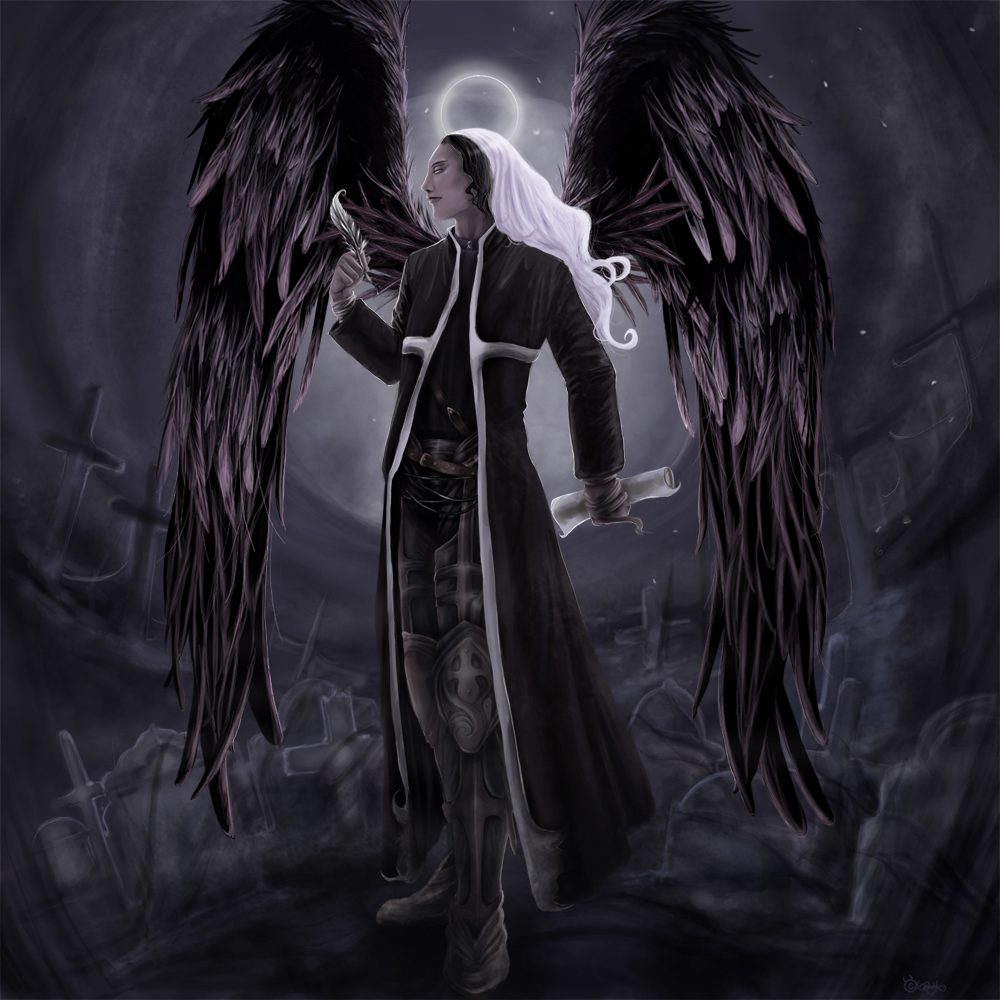
Azrael__Angel_of_Death_by_gaux_gauxAzrael, Angel of death in Jewish mysticism.

“Death is something we shouldn’t fear because, while we are, death isn’t, and when death is, we aren’t.”
― Antonio Machado

Oh, but yes, Antonio, we do fear death. We live our lives in fear of death, that great unknown. And each day is a death, the death of one moment to the next moment, this moment is dead, now, and this next, and now, and this, too…

Think about it:  our culture does everything in its power to avoid death.

Celebrities are forever young.  “50 is the new 40.”  We say someone has “passed away,” instead of saying:  “he has died.”  Our voices lower to a murmur when death is mentioned, as if it is something shameful.  Doctors rail us with promises that we need never age.  If only we eat right, if only we exercise enough, if only we learn how to handle our emotions enough, as long as we are happy enough… we will not – die?

But the wrinkles come, and with the wrinkles, wisdom.

As far as I know, there is no fear of death in faith.  And as far as I know, that there is no fear of death has nothing to do with what happens after we die.  As far as I can understand, there is no fear of death in faith because faith brings us into this present moment, this one moment given to live, to breath, to serve, to give thanks.  This is all there is.

And yet we are simply human, are we not?  We are simply human, given to fear and anxiety and anger and rage.  We are simply human, and so we do fear death.  The fear of death seems to be a part of life.

Still, some cultures seem more able to allow death to have a seat at the table.  In Mexico, The Day of the Dead brings all ages to graveyards, to eat and to dance and to walk and to be together, among the dead, for remembering, for honoring, as part of life.

No one wants a young person to die, and so we all grieve with the grieving mother.  It is true, a child should not die before the parent, this does seem unnatural to us, and it is a wound that no human being should be made to suffer.  And yet it is a wound that many suffer.  Death claims the young.

We have no freedom from death, as much as we want to run from it, to avoid it, to challenge it, to shake our fists at death.  We have no freedom from death.  Death is always with us, in this perfect, fleeting, precious moment.  Death is always with us.

Death is like the partner who walks with us, wherever we go.  “There she is, always following me around,” we might say.  And if we turn to look, to nod, to speak to her, she may have something for us, some wisdom, some honesty, some truth to add to our life. Can we embrace her?  Can we learn about her, walk with her a bit, learn from her, learn what it is that a final ending to what we know can mean for us now, those of us who walk among the living?

“Do not go gentle into that good night,
Old age should burn and rave at close of day;
Rage, rage against the dying of the light.” – Dylan Thomas

Do not go gentle, Dylan, but take a look, get to know that good night.

I think that part of wisdom is to begin to acknowledge death, that one who walks with us, wherever we go.  I see my friends growing older, some refusing to acknowledge that yes, “50 is not the new 40,”  that, “50 is 50,” and that is good.  And I see some of my friends growing older, knowing that as their health changes and as families grow older and move away, there is yet a beauty, a richness, an honor in accepting that “50 is 50,” and it is good.

You are going to die.  Now – how will you live?  – meb, 4/2015/Good Friday


Uncategorized

You know how it is.

index


“You know how it is. Sometimes
we plan a trip to one place,
but something takes us to another…
God fixes a passionate desire in you,
and then disappoints you.
God does that a hundred times!” – Rumi

“You know how it is.” You want something. I want something. We are fixated on it, we want it so badly.

“We plan a trip to one place,
but something takes us to another…”

I see so many examples of easy spirituality on the web. I don’t think Rumi considered the spiritual path easy. It’s not as easy as deciding what we want, then deciding that God placed that desire in us, and then, when we are disappointed, deciding that God is testing us, and that if only we pass this test, our desire will be achieved. Oh – if only it were that simple, if only we could manipulate God that way, if only we held the Universe in the palm of our hand, to shape to our fancy.

***

I know what it’s like to want something badly, don’t you?

For a long time, I wanted a life partner.  That’s what I thought would make me happy.  I fashioned the person in my mind:  someone who would understand me, who would enjoy doing the things I enjoy, someone who could explore intellectually with me, and someone to whom I was wildly attracted, of course!  The list was all about what I wanted, and didn’t include – as I consider it now – anything about who I would be as a partner.  But, there it was, the List, the list of the perfect partner.  I wanted that; I wanted him.

I wanted him to relieve my loneliness, to always be present to me.  So many long evenings, I sat on my red velvet couch in my lonely apartment, going through my phone book, looking for someone to call, someone to relieve the loneliness.

For a long time, that is how I lived.  Caught in the cycle of my unconscious desires, I thought that was how I had to live.  That’s all life was for me.  Is that all there is?

And then, for some reason, I surrendered to it.  I surrendered to the loneliness, to the ever-present solitude of my life, to the life of complete alone-ness I seemed to have.  I don’t know why I surrendered, but I do remember the very place I was when I raised my hands into the air and said:  “ok, God, if this is what you want, this is what it is.”  I can picture myself at that moment, driving into the alley behind the apartment building that held my one lonely, solitude-infested apartment.  I expect I will always remember that moment of surrender.

The loneliness did not end.  I made a sort of peace with the loneliness, though, at that point.  Or maybe I made a sort of peace with God (for the moment!  that dance never ends!).  I knew that the loneliness would raise its head from the pillow from time to time, and so I accepted that I would embrace it, whenever it arose, whenever it was awakened.  That, too, was an acceptance.

***

I can say, now, many years later, that I am grateful.  I am grateful for the one life I have been given, for the one life I am privileged to have lived, to be living.  I can also say that the moments of pain and sadness and sorrow and anger and grief and, yes, loneliness, have continued.  I know now that they are part of life.  The moments of pain and sadness and sorrow and anger and grief and loneliness do not tell me that God has abandoned me, or that I have abandoned my path.  No, those moments are part of the path.  They are part of me, part of this one life I have been given.

Even so, I am grateful.

This ever-disappointing God:

“God fixes a passionate desire in you,                                                                                                        and then disappoints you…”

***

We are people who like to control outcomes, although, truth is, the outcome of any given action or intention or desire cannot be controlled.  God cannot be controlled.  We want to shape God into a shape that fits into our little box – we are ever-inclined to want to understand the workings of this Universe – and we learn, once again, that this God, this Universe is far beyond our understanding, and even farther beyond our ability to control.

And all we can do – if we can stretch that far, sometimes, not always – is to be grateful, to lift our feeble arms into the air to say:  “yes!”  Come what may.

index