Uncategorized

I’m a Monk in the World

This article appeared in “Monk in the World”, Abbey of the Arts (online community), Guest Post, July, 2014

‘As if the sorrows of this world could overwhelm me

now that I realize what we are. 

I wish everyone could realize this. 

But there is no way of telling people 

they are all actually walking around shining

like the brightest sun.’

Thomas Merton

The world was always there for me – gurgling with joy, shining like the brightest sun, fragrant-full, slippery and hard-edged, colorful beyond belief, and filled with grief, loss, loneliness – and there I was, walking around with my head in the clouds, my eyes toward the ground. 

I have a good mind, but living from that linear place didn’t work for me forever. My best thinking brought me straight into a long and deep depression almost 20 years ago.  Life has not been the same, since.  Today, I am grateful to be alive, and every day offers new delicacies for my delight.  The gift of being a Monk in the World is that I get to enjoy what has been there all along, and I get to enjoy it as if it is new, as if I have been witness to this beauty before.

I’m as inter-faith as I am Christian, knowing that the Light, the Universe, the Christ, the Mother, the Holy One, El, is in us all.  Or maybe we are swimming in this Holy One.  I struggle to find words.

I learned to meditate several years ago, and this practice has deepened me.  My greatest joy is that I find myself more present in the moment, moment by moment.  I see things I did not see before.  I delight in the branches of the birch tree outside my city window; I watch the seasons and winds bring change to that tree. I say:  “I love that tree, and that tree loves me.”  It’s true. When I meditate, I find the boundaries between myself and the world dissolving.  I feel the sound of a neighbor’s voice, the boom of a truck on the street, the harsh call of a jay, the wind against the window – as much as I hear them.

Many years ago, I learned to pray after reading The Christian’s Secret to a Happy Life, by Hannah Whitall Smith (of the American Holiness Movement).  That was the beginning of a long, rich, and growing walk as a Monk in the World.  I studied theology and became a preacher, a way to offer to others the gift of knowing we are not separate, we are not alone.  I found growing self acceptance through prayer.  After all this time, I still believe we can change the world by praying, by praying for ourselves, which grows us in Love. And that Love, which is us, changes the world.

 As a preacher, I served a community of faith.  My work as a Monk in the world was very extroverted for this introvert!  I had the privilege of being with others in their times of deepest need – learning a diagnosis that would take a beloved woman’s life, baptizing an infant who would not go home from the hospital, as she lay in the arms of her teenage mother, rushing into a hospital emergency room only minutes before the death of a vibrant woman in her 50’s, as her partner lay sobbing on top of her; I’ve sat in silence and watched the minutes tick away, waiting for surgery to end, with a frightened wife.  I’ve answered the door to find a man who has not slept in days, smelling of the street, who tells me his long and convoluted story, only to ask me for a few dollars for food.  I’ve heard many of those stories, and even though I do not understand, I have prayed with each one; I have not have ever known that particular desperation.  I’ve witnessed the suffering of the mentally ill who come to Church, hoping for something; I am blessed by my own illness to be able to see the suffering person, trapped by their mind, underneath what we call “stigma.”

For whatever service I have been able to give, I am grateful.  The gift has been mine.

All of this is to say that I am still looking to see the light Thomas Merton, one of my spiritual mentors, saw.  The light is so ordinary, I’m sure.  I know with a keen knowing that we are all light, that we are swimming in this light.  I’ve felt it for a moment when I meditate, I’ve seen it shimmer – just a glimpse! – in the green, heart-shaped leaves of my beloved birch tree. 

I am a mendicant now, begging for alms.  I am a mendicant, raising my eyes to look into the eyes of whoever crosses my path.  I am a mendicant, wanting to trust each day’s needs and gifts to the Holy One.  I am a mendicant, looking for Light.

photos taken by Mary Elyn Bahlert, October, 2021
nostalgia

“Your dad died.”

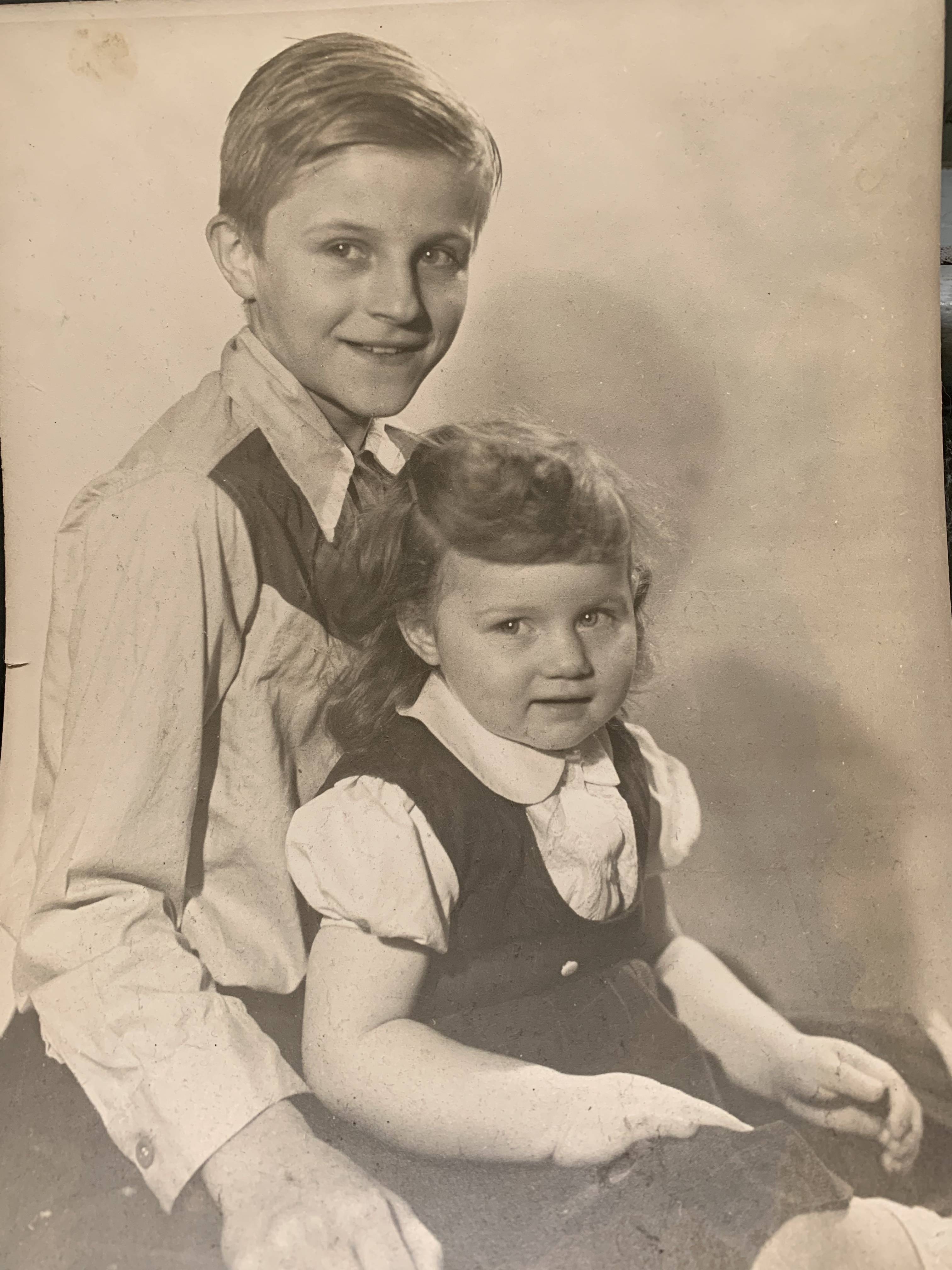
Dad was diagnosed with colon cancer in 1975, the year after he retired as an inspector at the A.O. Smith Company in Milwaukee. At that time, the treatment he received for the cancer was treated by outfitting him with a colostomy. For a time, he felt restricted in his life, but Dad loved life, loved having fun, and in a couple of years he was able to travel with Mom, to California, to see Mom’s brothers, Johnny and Pete, and to Hawaii, to see their grandson, Colin (and his parents, of course!). When I look through the pictures of that time, I see what fun they had, visiting the sites in Northern California, and playing with their grandson in Pearl City. He and Mom had fun together – maybe the time in their lives when they were most free to enjoy retirement.

That time of enjoyment ended in 1985, when the cancer returned. He suffered with chemotherapy for a few months, but by the beginning of 1986, he let go of trying to fix the disease. He spent the last two months of his life in St. Joseph’s Hospital in Milwaukee, holding on. His grandson (and his Mom) visited him. I made a trip from Northern CA, at least once. Pete and Johnny came, and some friends from the steel mill. A couple of folks from church came to see him, to visit and to pray. During that time, my dear friend Joanne visited Dad often in the hospital, and gave support to Mom in the rest of her life.

At the end of my last visit, I stood with the doctor at the end of Dad’s bed, and the doctor said: “I don’t know about your father.” I wish he’d been more honest – I always like to hear the truth, even if it’s hard. We both knew that Dad wouldn’t last much longer.

As with Mom, the end of Dad’s life was held in the hands of some greater Spirit, which became apparent on the night he died. About 11:30 pm on that night, my husband and I were already in bed at our home in Northern California. When the phone rang, I answered right away. Joanne was on the line. She said: “Your Dad died.” Then, she said, “the hospital has tried to call your Mom several times, but she doesn’t answer.” That seemed strange; never a good sleeper, Mom would jump up from anywhere in the apartment to get the phone on the wall in the kitchen. I tried to call her; she answered after the first ring. I said: “Mom, Dad died.” A moan came from her, then she said: “What should I do?” I told her to call Joanne, who would come to take her to the hospital.

My sister Suzie was the last of us to be with Dad the evening before he died. She stood by his bed, adjusting the intravenous tube that brought liquid to his failing body. He’d lamented to me on a visit that he had once been so strong, worked so hard, and now…” As Suzie stood next to his bed, she said a prayer: “God, please don’t let him suffer any more.” Suzie had not prayed the prayer of letting go before that night. Then she went to stay the night at her in-laws.

Several hours later, after I had called Mom, I called Suzie, sound asleep. She told me she’d been dreaming, a dream of her looking down into the casket in which Dad lay. Then she told me, “maybe this could wait until morning.”

As I’ve reflected before, life can be a mystery, more often than we know, I’d guess. At the time of Dad’s death, and at the time of Mom’s death, many years later, some greater Spirit paved the way for us, and walked us through the passage of time, those holy moments of letting go, of surrendering even one we love so dearly to death. We all stood in our places, unknowing, as the Spirit moved.

Dad in better times, in San Franciso.

Remembering now, sadness comes, of course. But I breath deeply in remembering how we were all held by an invisible grace. Sometimes, we forget. I know I do.

Uncategorized

Destroying the sacred

This past week, I read a distressing article on my news app. The article recounted that a right-wing pastor in Tennessee declared to his congregation that God had told him to burn “evil books,” after which the pastor led his congregants outside, where they burned books together, in a huge bonfire. In his mind, these books are a threat to his religious rights, freedoms, and belief system. Apparently this is not the first time the young man has caused a stir, as over the past 2 years – when the country and the world have been dealing with the COVID pandemic, and over 900,000 Americans have died of the disease – he has denied the pandemic.

I’m reminded of Bob Dylan’s words: “You’re gonna have to serve somebody
Well, it may be the devil or it may be the Lord… But you’re gonna have to serve somebody
…” And John Lennon, reacting to those words, wrote: You gotta serve yourself… Ain’t nobody gonna do it for you

Book burning refers to the ritual destruction by fire of books or other written materials. Usually carried out in a public context, the burning of books represents an element of censorship and usually proceeds from a cultural, religious, or political opposition to the materials in question. The burning of books under the Nazi regime on May 10, 1933, is perhaps the most famous book burning in history.” (credit to: encyclopedia.ushmm.org; Holocaust Encyclopedia).

Every day, the great divide in the United States grows, right and left separated from one another, malice for the other accelerating on both sides. Many people in this country are armed, some with assault weapons, a testament to their “Second Amendment Rights.” In their ignorance, they will not travel to other places – where they could see the vast diversity of how human beings live.

I won’t say that this is dangerous; that is obvious. What I want to say is that I grieve for this country. We have gutted our educational system, and in its place are dangerous ideologies that rely on the ignorance of those who hold them. I grieve for the children of this country, in particular the children who will be educated in public schools, children who are not privileged, children whose lives could be opened and enlightened by an education that teaches them to think for themselves, to hold the common good, to be kind to one another, even those who are different. I am fearful for them, and I am fearful for the future that this lack of education will mean to this country, and to the world.

Apparently, the United States, this “great” country, will be empowered by refusing to educate its young, by refusing to to send them into the world as world citizens, as people with respect – for themselves, and for other human beings, whoever they are, however different they may be.

I like to say: “your God is too small.” A small God is a dangerous God, undoubtedly a God who takes orders from the ego, that small part, that fearful part, that wounded part of each one of us, the part we grew from our wounds. This small God is the God of ideologies.

And those who choose this God will be those who hurt other human beings, other living things. Wounded people – hurt people – hurt other people.

You can’t argue with someone whose “God is too small.” There is no room for compassion, for growth, for understanding. There is no room for difference, diversity.

As I get older, I am more and more aware that my life has been shaped, has been formed, has been gifted by, and has been empowered by the education I received in the 50’s and 60’s in the public schools. I am ever grateful for the teachers I had: several were Jews, professional teachers who loved their subject, who loved their work, who wanted to give to the children who were entrusted to them. Several had fled Europe during the Holocaust – and spent their lives giving to the next generation. I am grateful for teachers who taught us to think, to consider, to open our minds, our thinking by reading, learning, and discerning. They taught us by who they were, by their example, by their choice to take on an important profession. They taught us by by their willingness to teach us how to think – to think for ourselves. And in their teaching, they gifted us their longing for a just, kind, and peaceful world. By example, they taught us that there was a way to live with one another.

Through their teaching, and through the example of our elders – even those who were not educated, as in my family – they taught us that we could be citizens who could think, who had historical memory that would continue to teach us, that even those of us who came from poor, working class families could be educated. The public schools taught us this.

And now, every year, the schools in this country are at the bottom of what is deemed important. Instead of being highly regarded for teaching students how to think, they are required to teach students what to think. The best people will not want to be part of that legacy. We will assure that by our actions as a country.

We are all suffering from this world view. We will continue to suffer. We will continue to raise up children – young people – who cannot think for themselves, and because they cannot think for themselves, can be led by damaged, dangerous people – even people who claim to speak for “God.” And we, then, will be responsible for the injustices, for the damage done to other human beings, whoever they are. We will be responsible.

When I was young, my having teachers who opened my mind and experience, gave me the gift of thinking that I could serve, too, that maybe I could leave something of value for the world when it came time for me to leave. Now, in the Wisdom Years, I am less certain.

“The Path,” photo by Mary Elyn Bahlert, 10/2021

beauty, nostalgia

Mid-winter

Were I still living in the Upper Midwest, I’d be in the thick of winter: navigating weather from snow storm to snow storm, carefully descending steps in case a bit of ice clings to the edge of a step, dressing in layers – lots of layers – before going out for the day, idling the car in a store parking lot to get it warmed up for a short drive, driving carefully on city streets to avoid patches of ice, sometimes swerving, having not avoided unseen ice,and sitting in a cozy house, watching flakes fall, early in a storm.

While winter is long, dark, cold, cold, cold, and wet (or icy) -there’s nothing like it.

But I’m not in the Upper Midwest. I live in Northern California, the Bay Area, where I get to enjoy a mild winter, and where I long for a storm in these days – years – of drought all over the West, where I both cherish the mild climate and long for snow and the coziness that arrives along with the winter storms. Although I expected “sunny California” when I moved here, it didn’t take me long to learn that we have a Mediterranean climate in the Bay Area, with lots of fog, fog which often burns off by late afternoon (because of climate change, we do get a lot more sunshine these past few years, and earlier in the day).

In a way, I’ll always be a Midwesterner, although I’ve lived in the Bay Area over half of my life. Every couple of years, I have a longing in me that will not be satisfied until I make it “home” again, to the place that marked my early years, to the places that gave me a start in life. For many years after I moved to Northern California, I would catch a feeling of nostalgia when I went outdoors. I’d be homesick, not knowing why. It came on suddenly, had me remembering places, people, often thinking about the people I loved, many now gone a long time. Later that day, I’d discover that there was a bit of humidity in the air. The humidity had brought on the nostalgia.

My brother-in-law, Randy Kunkel, wrote a Haiku for me, many years ago. I discovered it in some old files the other day:

She draws a deep breath

Unexpected humid air

Nostalgia aroused.

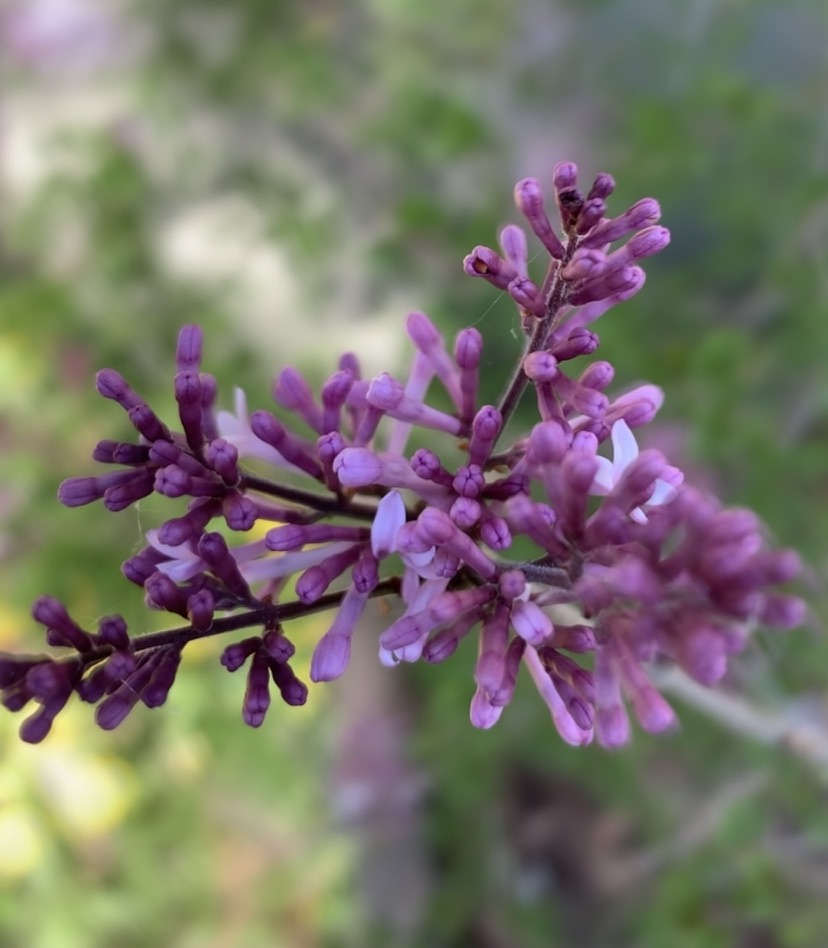
We’ve still got weeks of winter here, longing for rain, hoping, watching the skies: “Is rain coming, or will the gray skies give way to another beautiful day?” At the same time, some trees have already begun to blossom. Today, I took a look at my Korean Lilac – planted by my husband Jeff for me – to see that it is beginning to bud, and February not even here!

In the Midwest, I loved, loved the lilac trees full of fragrant blossoms which graced front lawns in May for several weeks. When I had a tree in my own front yard, I’d cut an armful of blossoms and put them in water to grace my kitchen table before the blossoms went a way. If I didn’t have a tree, I’d have to beg from the neighbors. Nothing like a blossoming lilac tree, gracing lawns in the city or bestowing its fragrance in the house in early spring, coming through open windows, a luxury.

My Korean lilac will blossom this spring, too. It’s getting ready to blossom. This lilac does not need the freeze like the variety in the Midwest, and its blossoms are not as abundant, but the blossoms give the same fragrance as the lilacs I knew as a child and young adult.

I’m grateful.

Uncategorized

Where I came from

When I was five years old – five years and one month old – I started the long walk from 11 and Ring Street in Milwaukee to 9 and Ring Street, where I entered kindergarten at LaFollette Grade School.  Those two blocks were long walks for a little girl.  I expect – although I don’t remember – that my mother must have anxiously walked with me the first day or so, pushing in a stroller my baby sister, Susan, who had been born that March.  After that first day or two or three, I walked those blocks with the other children from my neighborhood.

When I return to drive through those streets now, I see how short the blocks were, moving west to east, toward “the Lake:”  Lake Michigan.  I think of myself as growing up on the shores of Lake Michigan; it’s not too much of a stretch to think that way.  The shore of Lake Michigan formed my compass-point, my sense of direction,  for many, many years.  “The Lake is on the east,” I think, “so I must be facing north, and to get there, I have to turn left, to the west…”  etc.  Years later, when I land in the Bay Area of California, I find that directions are figured differently.  “Turn right at the second gas station, then get into the left lane.  You’ll turn left at the next stop light.”  When I work at my first job in graduate school, someone hears me giving directions and says:  “You must be from the Midwest.”  Good guess.

That’s how our lives grow, how the edges of our lives expand:  by walking those few blocks to kindergarten, leaving home for the first time.  The edges widen by talking to kids whose lives inside their narrow flats are different.  I hear about dads who are mean, for example, and I hear about mothers who laugh a lot.  Until I leave my house in September of 1954 to walk those few blocks, my imagination does not hold space for those possibilities. 

I am nostalgic for those streets, for those city spaces, for the shadows under the big elms that parade along the streets, for those narrow stairs with the small window on the right at the top, that lead to the second story flat with its small front room, tall windows, its small bathroom with the clawfoot tub that was used by 5 people without a thought that it could be otherwise.   My nostalgia wants to be satisfied, so I ride my laptop via google earth to the front of that flat; I walk with google the two short blocks to La Follette School.  I still see the beauty that was there, and I see the poverty, the simplicity of those flats, as well.

On the way to school one day, I learn that I am not Catholic.  Michelle, my neighbor across the alley (which runs next to my house), a year older then me, asks me one day, as we walk to school:  “Are you Catholic?”  I don’t know.  That night, I ask my mother if I am Catholic, and she tells me no.  I do not know the fraught history that lies behind her answer, and I will not know, for many years, the fraught history and the longing that goes with not being Catholic, in me. 

At LaFollette School, I am introduced to a kind of diversity, for the first time.  I sit near the front, always, our seats assigned alphabetically by teachers in navy blue polka dotted dresses.  In those narrow rows, in those wooden desks with holes for ink pots still marking the right hand side, I sit beside the children of first and second generation immigrants.  I do not know that many of my classmates speak a different language at home.  In my house, I often hear Ukrainian words, spoken with a kind of mysterious wink; from time to time, when my grandma visits, she and my mother speak their native tongue. 

In autumn, the elm trees that line Ring Street turned bright colors.  As  I walk, I often catch a maple seed – a helicopter to enchant children – as it floats to the ground.  Over the street, the trees meet to form a ceiling that arches from one street to the next.  In later years, Dutch Elm disease would take the elms away, and when I see these streets now they are just beginning to be tree-lined again, after many years. 

In winter, snowbanks form a path for children, four foot high, on the strip of land between the road and the sidewalk.  After a winter storm, the tops of the snowbanks form a hardened, frozen, flat sidewalk parallel to the cement sidewalk.   At the corner, I climb that tall bank of snow and stand taller than any adult, until I take the steps – made by other children – down again, at the place the alley meets the street.  After I’ve crossed the alley, I climb the snowbank again.

In spring, I walk to school as the glorious, wide, lilac bushes on front lawns float their purple flowers, their scent into the air.

meb/2021