I guess some people would call Uncle Pete a “blowhard”. He did have a tendency to talk loudly in a room filled with people, and to lend his certain extraverted charm to that room.
Even so, Uncle Pete was a favorite of mine.
I watched him as my Uncle Johnny – the smart one, the sibling with the “interesting” past – spoke. Then, Uncle Pete was quiet and listened, with a certain reverence, to every word. I’m not sure how I learned the secret, but word was that Uncle Pete only rose to the rank of Sergeant First Class in the Army because of Uncle Johnny. As I write now, I can see the look in Uncle Pete’s eyes as he listened. He held Uncle Johnny, his eldest sibling, in the highest regard.
Uncle Pete was handsome. In my eyes, anyway, Uncle Pete was handsome. And Uncle Pete knew how to be an Uncle. That’s a difficult quality to explain. But Uncle Pete had it. When I was dating Jeff – who would go on to be my life partner, my husband, Uncle Pete quietly spoke to me one day: “I can see he’s showing more affection to you now.”
After I had moved to the Bay Area from Milwaukee, and after Jeff and I had moved around a fair amount, we lived in San Leandro. At the time, The Oak Knoll Navy Hospital operated in Oakland. My Aunt Athalie – Uncle Pete’s wife, the mother of their daughter, Michelle – was being operated on for the serious arthritis she suffered. I went to visit her, and when I arrived, Uncle Pete was there with her in the private room. He was quiet as she and I talked. After I’d been to seminary, I think some members of the family held me in some suspicion, and I count Uncle Pete among them. And so Uncle Pete – usually a boisterous presence in any room – stayed silent.
Still, after I’d visited with Aunt Athalie, as I left the room, Uncle Pete walked beside me to the elevator, then walked with me from the hospital to my car. He was quiet the whole way. He made sure I drove out of the parking lot safely before he returned to the hospital.
*
In 1995, I was sent by the Bishop to serve a small, half-time Church appointment in South San Francisco. I’ve always considered it a quirk of fate that the church to which I was sent was in a development of single family homes built in the hills of South San Francisco after World War 2. I say “quirk of fate” because the church had been built in the development where Uncle Pete and Aunt Athalie’s modest home stood. I can recite the address today. I’d known the address since I was a child, and had arrived at exactly the place where I’d arrived in my early teens; in a hot, humid Wisconsin summer, I’d taken an imagined trip from my family’s upper flat clear across the country to — Alta Mesa Drive, South San Francisco. The people of Aldersgate United Methodist Church (the church has since built a new building and changed its name), who made sure I had a nice lunch waiting for me every Sunday, would sometimes give me a meal to take over to Uncle Pete and Aunt Athalie.
My mother had never liked Aunt Athalie. I knew that, although I expect no words to that effect were ever spoken. And I think – again, these thoughts are my own – that my mother was jealous of Uncle Pete. Pete had been my grandmother’s youngest child and her favorite. My mother had grown up in a home filled with drinking and parties, their own kind of chaos. And while she loved her father, her relationship with her mother was more complicated. Maybe Mom had expected her mother to protect her from the abuse she suffered in her mother’s house. Still, the way these things happen, Mom was the one who carefully cared for my grandmother in her final years. But in my years getting to know Aunt Athalie, I came to love her. I miss her now.
When Uncle Pete developed Alzheimer’s, he would wander around the housing development. He might have been a nuisance, or worse, to other people. Instead, the men of the neighborhood, who knew Pete was a veteran, accepted and explained his wandering: “Pete fought in three wars,” they’d say. He was safe.
Aunt Athalie called me the day Uncle Pete turned violent – a symptom of Alzheimer’s – and asked for reassurance that if I called the police to help her, they would not take Uncle Pete to jail. I called the police local to the neighborhood and had their assurance. And so they came to take Uncle Pete to the hospital, and later a facility, where he would die.
And I have a fond memory of a visit Jeff, my mother, and I made to see Uncle Pete in the facility. He was safe there. His caregivers brought him into a small room where my mother, my cousin Michelle, her husband, Jeff, and I sat around a table. I don’t think Uncle Pete knew us at all, although he was loud and boisterous. When the visit was over, we walked outside together into the beautiful Bay Area day. As we walked away, my mother turned back. The rest of us waited as she stood again in front of her little brother, Pete, and as she gently reached up to touch his face.
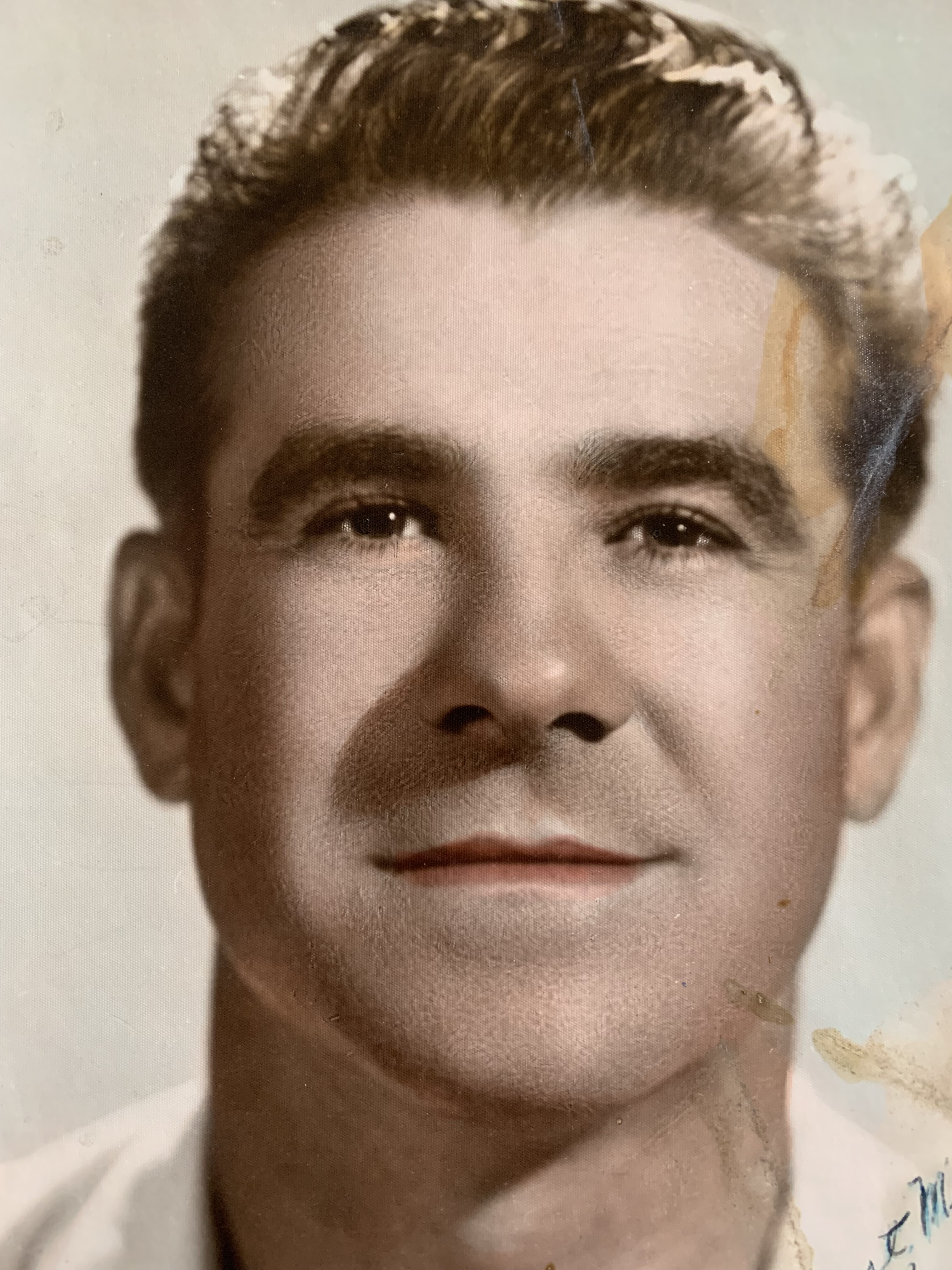
“I can think of younger days, when living for my life was everything a man could want to do. I could never see tomorrow, for I was never told about the sorrow…” words and music by Barry and Robin Gibb, 1971

