memories, nostalgia, remembering, Uncategorized

The outfits

There was always room for a sewing machine in our upper flat. Looking back now, I see how cramped those working class houses were, their windows covered with curtains to keep out the cold of the freezing winters in the Midwest. But there was always room for Mom’s sewing machine.

Well, it was Mom’s sewing machine until Suzie and I learned to sew. Then, if I was working on an outfit with a Simplicity or McCall’s pattern, chances are that either Mom or Suzie was working on something too, and when I stepped away from the machine to get another piece of fabric, carefully looking at the directions – I’d find a spool of thread in a color that didn’t match my material already in the machine. The sewing machine was ours – the three of us.

Like a lot of mothers over time, Mom was happy to have two daughters for her to make homemade clothes from the patterns. She must have worked many hours when we were at school and when Daddy was at work in the steel mill. And because she was happy to have two daughters, she was extra happy (I expect) to be able to make them matching outfits. To make us matching outfits – Suzie and me.

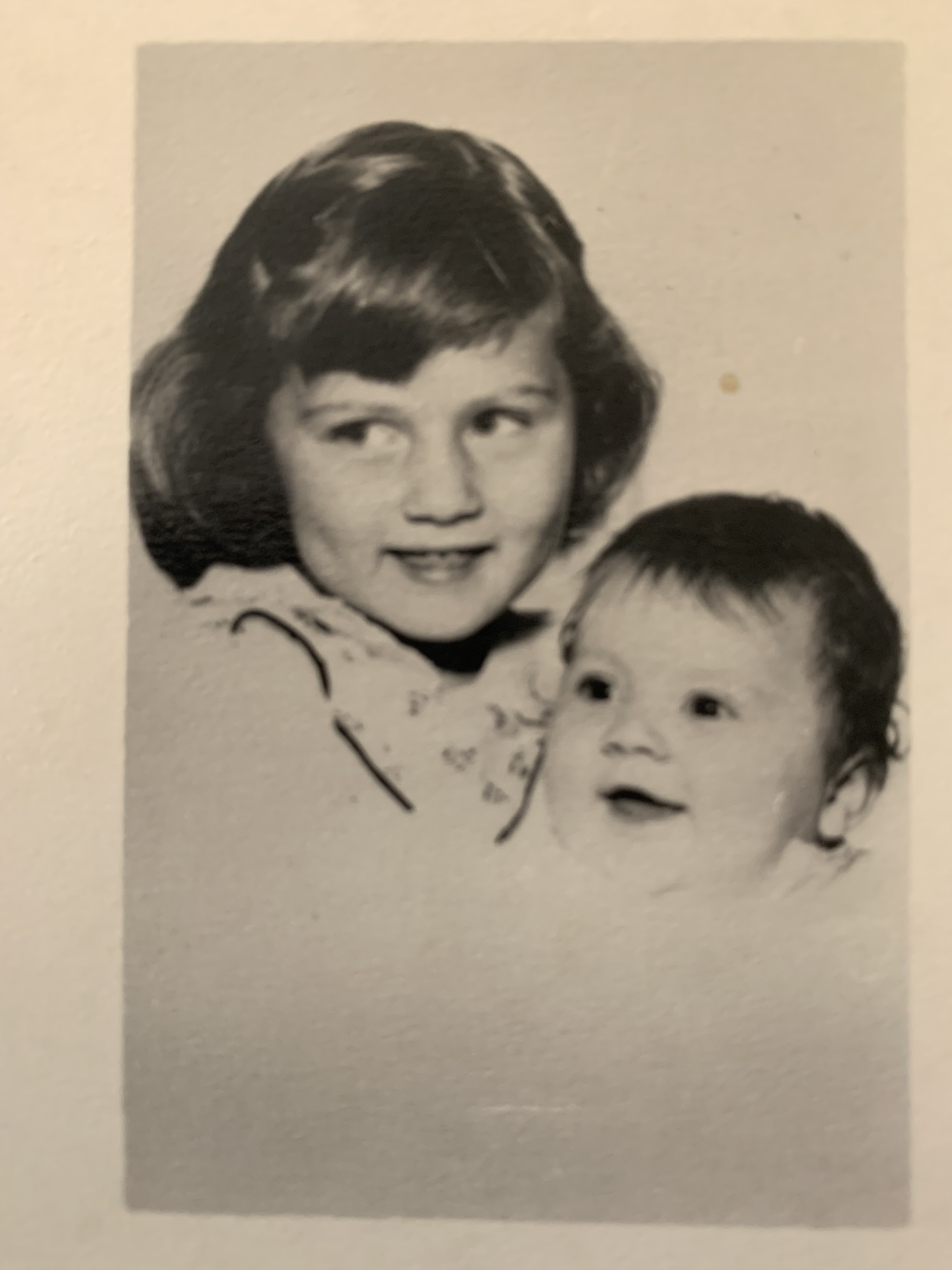
One Easter, Mom made Suzie and me matching dresses, including capes lined in pink fabric. She bought matching Easter hats – “in your Easter bonnet…” and Suzie and I were models, standing together on the front lawn of the flat, looking into the camera.

Mom made us matching outfits, that is, until I told her at some point that I didn’t want to be dressed like my little sister. Thankfully, Mom agreed – or at least understood – because I heard her tell the story to my Auntie Anne not long after. And so the days of matching outfits came to an end.

+

We are well into the 21st century now, and those days in the cramped flats – winter and summer, and fall and spring, when the fragrance of lilacs in the huge bushes in front yards that adorned the streets wafted down to walk with us – are well in the past. It’s interesting that some of the feelings remain, filtered through the grief at remembering all those who are gone now, and how they loved us, each in their own way. How their dreams still live in us.

And I’m grateful for my mother – coming from poverty and abuse – and how she crafted the best life she could for us, for us all. How she protected us, to the best of her ability, how she made a home for us, and how happy she must have been to sew Easter outfits for her two daughters.

Suzie and me, circa 1954

reflecting, remembering

New York City

My husband likes to call me a “City Girl,” and when we travel, I like to add another city to my mental list of cities where I have walked, where I’ve stopped at a cafe for a cup of coffee, where I’ve seen the places that others recollect about having traveled to a particular place. Over the years, I’ve been happiest as a traveler when I’ve had time to simply walk a city; when Jeff and I stayed for several weeks in London as part of a “house exchange,” my happiest moments were the times we took the Tube into the city and walked slowly from one street to the next, noting the differences of that place, comparing what we were seeing to other places we’d been.

In my Junior Year of college, the University offered a trip to New York City to students during spring break. I wanted to go, that’s for sure. But how was I going to swing it? The $ 250.00 was more than I could see myself saving from my part time work at the carwash on weekends. One day, as the weeks to spring break quickly passed, my mother walked up to me in the kitchen of our flat, and from her hand, she handed me $250.00.

Where did she get the money to gift me the trip she knew I wanted? My parents’ habits around money were simple, working class habits. Dad brought his paycheck home every week, and Mom cashed the check at the grocery store, waiting in the line to the office booth at the front of the store, the booth where Green Stamps were redeemed, the booth where she paid the utility bills once a month. Later, at home, she carefully budgeted the cash in a folding paper folder made for that purpose; she and dad got an allowance, there was the money allowed for food, for utilities, and there was the money saved for Dad’s vacation in the summer, when we’d go to Door County for a week. She kept the budgeted cash in the bottom drawer of their dresser.

I’ll never know where Mom got the $250.00 she handed me that day, or whether it put her back a bit in the family’s budget. I don’t think so. I think she had carefully considered giving me the money, that she knew where it would come from, and I doubt it affected their budget.

I can see Mom’s face as she handed me the gift. I can see that she was opening a door for me, a door to a life she hadn’t had for herself, a door to some vision or dream she had for me, her only child to go to college. In her world, that $250.00 was an extravagant gift, certainly more than I had seen before. I’m still grateful for that extravagance, that gift with dreams and hopes – not spoken, but conscious dreams and hopes – attached.

I traveled to New York that spring on a bus with my friend, Vickie. There, we took in the Broadway show, “Hair,” we ate our meals in restaurants, at a New York deli, we walked and walked, and we lifted our hands into the street to get a taxi from here to there.

Later in her life, after my father passed and she had built a new life for herself, volunteering at St. Joseph’s Hospital, making new friends, my mother and her friend Mary took the bus trip offered by a local Senior Center to Washington, D.C. Later in her life, her world opened for her, and I’m grateful. After Mom passed, her friend Mary told me about the fun they’d had, traveling together, two elders, free women. Just like I had traveled to the big City with a good friend, many years before.

I’m grateful not only for the extravagant gift, but for the dream, the hope that was in and with that gift. Just as she’d passed the bills to me that day, she’d passed on that hope and that dream. In many, many ways, I’ve lived a life that my mother could not hope or imagine for herself. She dreamed it – for me.

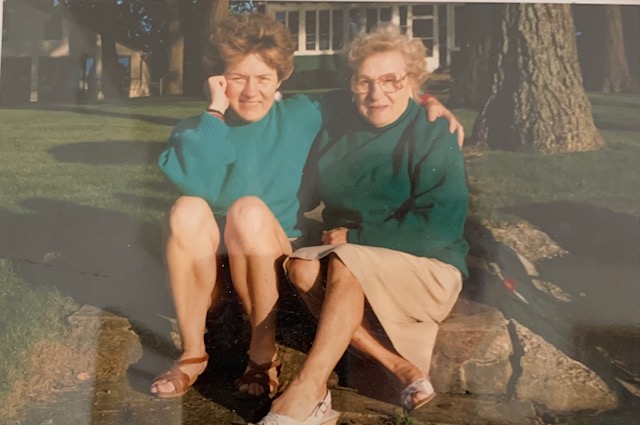
Mom and Dad, October, 2022, New Berlin, Wisconsin

nostalgia, remembering, Uncategorized, wisdom

Remembering Mom, her later years

When I was a girl, my father would say from time to time: “my life has gone by so quickly.” I would look at him, just little, and wonder what he meant, and how that could be. I could not relate. Some people say that time goes more slowly for the young, when all the years stretch out beyond, when growing up is something to be yearned for and in the yearning, of course, time passes slowly. But my memory is of that question or wondering that was in me when I heard my father reflect. Later, he would quote again and again, this Bible verse: “A thousand years is but a day in the eyes of the Lord.” Apparently, my dad did not stop thinking about the passage of time.

Often, I think of my most cherished memories, as “life has gone by so quickly.”   My memories include those days on my visits to Milwaukee to see my mother, after I had moved to the Bay Area of California, after my father had died.  My mother lived in a small upper floor apartment on a busy street close to the center of Milwaukee, and I would stay in the cramped second bedroom, the noise of the busy thoroughfare keeping me awake nights.

Both mom and I were “Milwaukee girls.”  We had grown up in the flats that line the streets of poor and working class neighborhoods of the North Side.  Those flats are still there.

We knew the streets, the bus lines, the parks, and we knew the sense of “small town-ness” that Milwaukee cherished for a long time.  We knew the particular kind of diversity of that place – the streets where Eastern European communities lived, the place where the Italians built their church, now a Cathedral to welcome the Bishop from Rome, the places where African Americans came to live, to build community, during the Great Migration.  We knew the part of town where people from Mexico came to live among others who spoke their native language.  We knew how to navigate to new places, too, in that city laid out in a grid.  I have never understood how to find places in cities that are new to me.  How can addresses not make sense, like they do in Chicago and Milwaukee, a small Chicago?

On my visits to see Mom, before the dementia took her away,, we set aside a day to “do Milwaukee.”  After coffee and breakfast, we backed her car out of the garage and onto the busy street.   We had no particular plan, except to explore old places that held meaning for us, to make our way to the Milwaukee Art Center at some point, to have lunch out, and maybe to do a bit of shopping along the way.  I loved those small adventures.  I loved the fun we had together:  “that’s the fun of it!” was one of my mother’s expressions.

On one of our adventures, we discovered again a small section of town filled with Ukrainian immigrants.  My mother’s first language was Ukrainian, and so we ventured into a small bakery, a storefront, and she stumbled to say a few words to the man behind the counter.  He understood, all right, and soon we found ourselves in another cramped space, the family’s living room, complete with an altar adorning a corner.  They were Ukrainian Catholics, and a candle burned in that corner, lighting up the features of the Virgin Mary, her eyes cast down, her blue gown ending at her bare feet, on a sphere covered with stars.

On another adventure, I gazed at my mother as she gazed at one of her favorite paintings in the Milwaukee Art Museum, The Wood Gatherer, by Jules Bastien-Lepage.  Later, Mom told me her wonderings about the scene that painting depicted, her own story fleshing out the art.   I still own a print of that painting.

One day at lunch we found ourselves in an old Italian neighborhood for an Italian lunch, another at a Jewish deli across from a synagogue.

As the years passed, it was harder and harder for mom to enjoy those days, until the last time we set out.  We did not know it was the last time, but something had changed.  We returned home to her apartment right after lunch.  Soon enough, I’d have to move Mom out of her apartment and into assisted living in the Bay Area, a move which she made bravely and with great trust.

I suppose some part of me thought those adventures would go on forever, that those times when we laughed and remembered and saw old things new again, would not end. All times end.  Now, those days are distant memories, and I continue to cherish them as some of my favorite times.

Here, I find myself years later, remembering those small adventures, remembering the tilt of Mom’s head as she laughed, remembering the narrow streets we knew so well, remembering driving her blue Tercel all over the city we loved.  I’m in the memory time for so many people I have loved, so many experiences, so many grievances that had filled my life over the years.    All of those beloved people, all of those rich days are a memory, now.