Uncategorized

“Houseplants,” a poem by Mary Elyn Bahlert

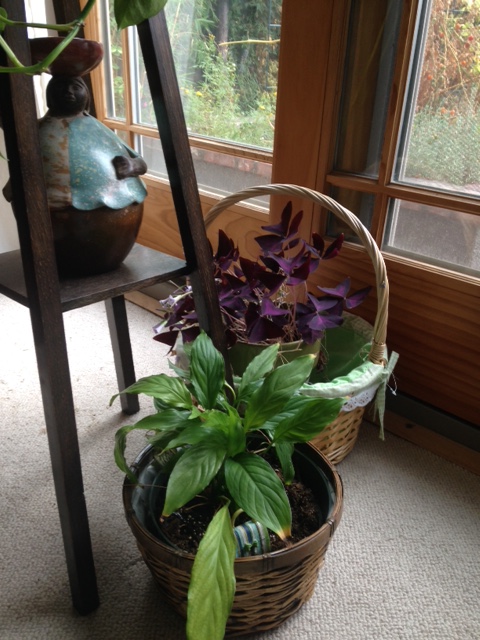
IMG_0525My little friends,
yellow and brown and purple and green,
I treasure you,
my hands among your leaves,
my fingers at your roots.

My little friends,
there is so little I am good at in this world:
my children want for what they cannot have –
I have only these hands among your leaves
and a few places of sunlight in the house.

My little friends,
my eyes drop tear-less on your stalks;
I protect you from the cold in this place.
I touch you with these worthless hands
and you flourish.

+++

I wrote “Houseplants”  as part of a series of poems that belong to my grandmother, Feodosia.  For these poems are the story of her life, told through me over the course of a year or two in the late 1980’s.  Surely our connection to the ancestors goes deeper than we know – or than we are taught to cherish, in our culture.  The magic my Grandma – a bent-over babushka in a long black coat walking through the slush of Milwaukee’s narrow alleys – must surely have come through me, the magic of our connection told through the words I recorded.

Enjoy.

Uncategorized

Who we are is there, all along.

IMG_0512


As I enter the journey to the elder years, I seem to be myself more than ever.
In the shedding of what was not me – what was given to me by others, to shape me into who they would have me be – I become, every day, more myself.  And even though, in the living of life, I wondered if I was being true to myself, I see now that I have only come back – through the shedding of others’ image of me – to me.  To me!  To me!

I have vivid memories of being a young girl – 8 or 9 – playing alone in my first bedroom of my own.  The small bedroom was at the back of the flat, a narrow window overlooking the city backyard and the alley.  To the right of the window, adjacent, was the dark wooden door of the small closet – my own!  The narrow Jenny Lind bed – second-hand, my mother had refinished the wood to a deep cherry – was to the right of the closet, its foot at the door when I entered from the kitchen of that narrow flat.  I had room for a desk – plain wood stained to match the bed, directly ahead of the room’s entry, to the left.

I still like to play alone!  An introvert, I have often had extroverted work in my life, and I’ve had a need to rest – alone.  In my memory, I play at being a teacher, in that small, dark room. .  First of all, I make up files for each of the students in my class.  I use the names of real classmates, to be sure, and I file them in the deep filing drawer of the desk on the left.  I alphabetize the files, too.

I still do that first, in any job, in any endeavor.  I get organized, my pencils in order in the zipper case, books lined up and even.  I like to have my files in order.

Then, I stand to face the class – the full-length mirror – a luxury! – that graces the back of the door.  I teach.

I suppose I have always been a teacher.  Always.  I emulated the teachers I knew from school, imagining them, how they dressed, how they walked back and forth, how they projected their voices, to teach.  They were my models to another life, another path, a reality I did not know in that flat, but that beckoned to me, by purpose, by expectation, by education, which I would have to learn how to traverse, step by step.  Sometimes, I had role models – like those teachers in their navy and white polka-dotted dresses – and sometimes, I did not.  Sometimes, I made the path up on my own.

Though shy as a young person, it has never been difficult for me to speak to a group.  I discovered that in high school, when we were privileged to have forensic societies in my large urban school.  For me, those privileges of public education in the 1950’s and 1960’s began to shape my life.  What teacher could have imagined that shy girl, big green eyes taking in every movement, every word, challenged by new ideas, would make her life as a speaker, a preacher, a teacher of the inner life?

What did those teachers see in each one of us, some of us hungry to learn, some of us not able to speak a word out loud in class, some of us abused at home, some of us hungry – for food, and for knowing?  What did they see – and not see?

Now I see that the gifts that are mine have been mine all along.  I only had to discover them, to have the privilege – a privilege, surely – to live the gifts out in my life.  I suppose we all do.

The little girl who dreamed – and didn’t even know she was dreaming – in that little room at the back of a Milwaukee flat – is a teacher, still.  She always was…


Uncategorized

Always learning


IMG_0685Mom used to say: “You learn something new every day.”

Like a mantra, I have lived those words.

My mother did not graduate from high school, although she received her GED while I was in university.  I know for certain she did that so that I would graduate with a degree, since I was wavering, and had taken a semester off during my senior year at the University of Wisconsin, Milwaukee.  She didn’t tell me her purposes, but I knew.  When she received her certificate, I sent her a spring bouquet.

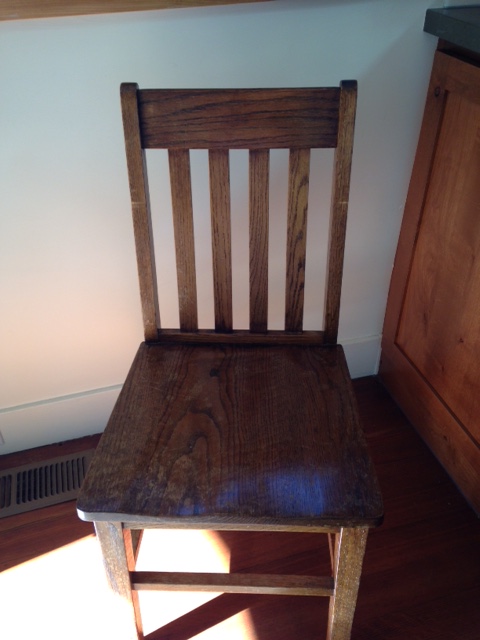
Mom quit school early to work.  She married young, also, and had a son within a year – Ronn, my brother.  Mom was bright.  Now, when Mom comes up in conversation, I tell folks that she should have been a teacher – a kindergarten or first-grade teacher.  The daughter of Ukrainian immigrants who lived in flats in neighborhoods of poor folks, it was enough that she learned to read and write.  She taught her father to read English when she was a girl.  In my mind’s eye, I can see her, bright and determined, her feet wrapped around the rungs of a wooden chair in a cramped Milwaukee flat, as her father, Vlas, concentrated and paced, determined, also.  He was smart, although uneducated in his native language.  He made that long trip across the ocean, left the familiar village of his homeland so that his children could learn to read and to write.

So Mom knew the value of education, although she could not see to get a degree herself.  Life, the life of a working class woman, intervened.  She was married and divorced by the age of 22.  She worked hard at Cutler-Hammer in Milwaukee, where her employers noticed the bright, hard-working young woman.  She quit her job when she married my father.  That’s what working class women did in the 1940’s.  The truth is, she had greater earning potential than my father.  But that’s how things were done.  A woman married, a woman quit working in the outside world, a woman kept house and raised the children.

When I was girl, I walked 3 blocks to the Center Street Library – on 27th and Center – with Mom, every week.  She must have read all of the books  in the “mystery” section of that library.  It was in those days that I learned to love the smell of libraries.  In a library, it seems we can smell the riches of what is carried in the aisles.  Twice in my life I have worked in a library – in high school, and again in seminary.  For awhile as an undergraduate, I even flirted with the idea of becoming a librarian. Books would save me, many times, during my life.

When Mom and I left the Center Street Library  to walk home, we each carried two or three books to read for the week ahead.  I see now that Mom was living her mantra:  “you learn something new every day.”  She modeled that for me in concrete ways.  I was not able to see that for many years, but now, in my own learning, I understand.

Mom taught me how a woman washes clothes, too.  During the summers when I was a young girl, my babushka-d Mom would take me down three flights of stairs to the shared basement of our flat to show me how to wash clothes.  I remember the smell there, too, the damp and soapy smell of the basement, the hot, steaming water of the wringer washer.  Into the first load went whites – sheets, pillow cases, underwear.  Into the second load of the same water went towels and colored clothing.  Into the last load went Dad’s work clothes.  See, Mom?  – I have not forgotten!  I know the smell,  I can see the beautiful wooden stick Mom used to lift the clothes from the washer into the first rinse water, and then into the final rinse before the clothes were taken in the large wooden basket into the yard to dry in the humid air.  As I write, I can smell the air, too.

If I could have one item of Mom’s, it would be that wooden stick, smooth, smelling of soapy water, imprinted with Mom’s hands, her weeping and her worries.  Where did that stick go?

I see Mom’s broad, strong peasant hands, hands that in later years would be crooked with arthritis.  She was a worker, teaching a little girl whose work is ideas and books and the fabric of words.   “You learn something new every day.”  I took those words into myself, and I made them my own.

The path I have taken through life has been the path of learning, too, not always from books.  But I am keeping your mantra, Mom:  I keep it, still.


Uncategorized

A Friend Returns – and Memories

life-and-friends

About 40 years ago, “Mike” was my supervisor at my first professional job. We were both in our 20’s, and although Mike was just a couple of years older than me, he always seemed so much older. Maybe it was his role; maybe it was my being so young, even too young for my age.  Mike was smart, and he was funny.  He was 40 years ago, and he is now.

I was involved in the evolving feminist movement of the time, and I brought my growing consciousness to my job.  I read every month’s issue of “Ms. Magazine” from cover to cover.  Now, young women do not realize what women of the last generation confronted; sometimes, when I remember or tell the stories of those times, it seems as if it cannot be true, as if those were ancient times instead of the 1970’s.  When I think about the treatment of women the world over, the wage inequalities in this country, the limited rights of women as human beings in other countries, I realize these are still ancient times.  We have a long way to go.  And that’s an understatement.

Because of my feminist consciousness, Mike said to me one day:  “You have to meet my wife.”  She worked in the same job as I did, in another office.  Many months later I was sent to that office to work for several days, and I met “Jane” for the first time.  I remember sitting across from her at her desk for a moment, the conversation beginning.  The conversation we began that day would continue until her death, in her early 50’s, over 10 years ago now.  I miss her every day.  Mike was right.  I did need to meet his wife.

Over the years, our lives evolved and changed, as lives do.  Mike and Jane moved away, to another state.  They had two children, two beautiful daughters.  I remained single until my 30’s.  Every few months, Jane would visit me for a weekend. She’d drive  to my apartment late Friday afternoon, arriving in the evening.  We’d sit in my living room, talk for hours, Jane smoking one cigarette after another.  At some point, we decided we were hungry, so we’d dress up, put on evening-out makeup, tell each other how wonderful we looked! – and go out to dinner, talking all the time.

What did we talk about?  What didn’t we talk about?  What do we talk about with those particular people who meet us on so many levels?  Still, when I think about Jane now, I realize our conversations were mainly about our thoughts, our thinking, our opinions, our politics, our ideas, our hopes.  We didn’t talk about feelings, or motives, or foibles.  We didn’t go to those darker, those deeper places in ourselves.  Now, I wish we had.  Now, I’m not sure Jane could go there at all, although she was one of the smartest people I’ve ever known.

Our lives unfolded in different ways.  We took different paths.  I moved across the country, went to seminary, married my beloved at 34, and stayed.  Jane and Mike divorced, although I remained friends with both through the years.  When Jane met her second husband, I liked him, too, and I was proud to be asked to officiate at their wedding.  Ten years later, Jane died of complications from surgery, after she developed lung cancer.  I saw Mike next at her memorial service.  He came up to me after to say:  “Jane would have liked it.”  I had my own grief, and I was grateful for his thoughtful comment, but we didn’t connect that day.

***

By that time, Mike had developed Parkinson’s disease, and it was hard to see him.  In my mind, we will always be young.  That’s something young people don’t know about – how “old folks” are never old, in their minds.  We seem to stay stuck at some age, some age we have always, will always be.  Some time, I’ll write about my “stuck” age.

Through the years, I heard about Mike from time to time. I heard about his new marriage through Jane.  I haven’t met his second wife, although they’ve been married for many years.  I expect that if I did know her, I’d like her, too.  I’m  connected with Mike and Jane’s daughters on social media, and I can see their mother in them, often.  I see her eyes, her expression, her look in the pictures of her grandchildren.  I look for her in them, in her daughters.  I can hear her in the musings her daughter posts.

***

Sometimes, social media can actually help people connect.  Not just through “selfies” or meaningless comments; in real ways.  But the real connection is still real because we are human beings, with feelings, and memories, and relationships, and lives. This past weekend, I saw a picture of Mike on social media, posted by one of his daughters.  I “liked” the photo.  Later that day, when I checked in again, I had a private message.  It was from Mike, and it had been typed by his daughter, who is his caregiver every other weekend.

We “old folks” know how to connect.  We know that connecting isn’t simply having hundreds of friends.  We know that connecting is something else, and we know when it’s there, and when it’s not.  And in that message, Mike connected.  He told me some things about his life now, with Parkinson’s.  He told me that there had been many changes in his life.  He told me a few things about what life is like for him, now. That message has stayed with me.  That message has reminded me of so many happenings, so many events, so many images that are a part of the fabric of my life, and have been for a long time.  That message brought me gratitude, a gift.   That message opened a door in my heart, one of many doors, an important, feeling-filled door.  Images arise, moments with Mike and with Jane, other moments with other friends, other connections, other times.

Sometimes, it’s just good to remember, and to be grateful.


Uncategorized

How Time Passes


time-passing

“Time passes much too quickly,
when we’re together laughing…” Robert Lamm, “Beginnings,” recorded by Chicago

In December of 2000 my mother was diagnosed with an inoperable tumor. Together, she, my husband and I made the decision to place her under hospice care. At the time, I was already tired  from being her caregiver and caring for a parish full-time. I was grateful for the hospice staff and how they worked with the staff at Mom’s assisted living home to make her last days comfortable – for her, and for me. I was grateful that Mom could stay in the home she loved so well, safe in her room, big enough for a single bed, a television set, and a desk in the nook by the window that looked over a parking lot and the school yard of Tech High School.

A few days before she died, Mom sat on the edge of her bed facing the window with its city scene: “I wish it would snow once, just for me,” she said simply, the Milwaukee Girl who had been transplanted just two years before to this strange climate. Had I known that it was snowing in the hills that surround the Bay Area of California for the first time in many years, I’d have packed her into my car and driven to see the snow, only a few miles away.

Instead, I was focused on her, my Mom,  the last precious days and hours and moments that we would be together. Moments flash through my mind, many times since those precious days and now, in these precious days and hours and moments.

In the years since her death the following February, 2001, I have often returned in memory to singular, stark, and lovely exchanges in that little room. I see her growing smaller and smaller, her eyes becoming larger and larger, until I looked deeply into reflections of my own eyes in hers. I rub her back as she talks to me of ordinary things, as if we were in another time in our lives together. On Valentine’s Day, I bring her a large chocolate heart from See’s Candy; chocolate was forbidden her because of type 2 diabetes, but as the days of her life grew shorter, I set those rules aside to bring her what she loved. She didn’t eat the chocolate heart, but I think she understood the gift: “Thank you,” she said, looking into my eyes.

Three days later she would die in that little room, with me as her companion on this side of that journey, whatever it may be.

***
Time stretches out – forever – to the young. That’s how it was for me. For every dream, there was a possibility. For every hope, a stab of feeling that announced it had not yet been fulfilled, but could be fulfilled. For every ambition, there was a way, although not yet discovered.

In my fifties I would sometimes awake early in the morning and see in my inward eye my life floating away behind me, like calendar pages drifting off into the wind. The
feeling: panic. Was there enough time? Enough time, for what?

As I grow older, life becomes more and more a parade of moments. Some of the moments I have captured in memory, like those precious last days with my mother. Some of the moments have been lost, never quite noticed at the time, never quite snapped in the conscious mind’s Polaroid lens.

I understand that the very old retrieve memories they had not known they had, memories that float into awareness as if they’d been behind the curtain on some stage. I’m not in that place. I hope to be, some day.

Now, I am grateful and often saddened by the moments that do come to mind. So many of the characters in memory are no longer here; so many I have loved I will not see again. Some of the places are places to which I will not return. Some moments were painful then, and are painful now,  in the remembering. Some moments are  funny… I laugh again, just as I did the first time.

This moment is already this moment, now. Yesterday’s moment is already past.

Tick-tock. Tick-tock.

The passage of moments cannot be marked by the ticking of some inner clock. They pass by too quickly to be marked at all.

Happy New Year, dear friends!