nostalgia, reflectin, reflecting, remembering

Dinners with the Bug

In my late teens, after the Bug and I had graduated from high school and I started college at the University of Wisconsin-Milwaukee, she and I often met to go out on weekend nights. Bug and I had been friends in high school, and we worked together at a movie theater on the north side of Milwaukee, where I was a “vendette” – selling popcorn and sweet treats to the movie patrons – and where the Bug was the cashier who sold tickets at the front window. Several of the kids who worked there were also friends of ours from high school – Pat, who I still talk to on the phone from time to time, now that we’re in our seventies – her brother, Bobby, who died from complications of Crohn’s Disease, a few years ago, and my cousin, Mark. That was my first job, which apparently led to my adult addiction to popcorn (which continues today). Bobby and the Bug dated a few times; he was the one who gave her the name: the Bug.

The Bug and I had many adventures together during my last year of high school and my college years, which ended when she married in her early 20’s. Bug’s wedding and marriage and motherhood were the fulfillment of her dreams, which included her and her husband building a house exactly like her parents’ beautiful home. As far as I know, they still live in that house, outside of Milwaukee. Bug was hysterically funny. I can’t remember anything that she said that was funny, but I do remember one time, when I was driving, with her in the passenger seat, that I had to pull over to the side of the street because she had me laughing so hard.

After we started college – the Bug stayed a year or two, then left school to go to work – she and I had a routine that I remember today as an opening to a way of life that I hadn’t experienced in my working class family. I had my own money then, the money left over after paying tuition and books and transportation to school on a city bus. About once a month, Bug would come over to pick me up at my house. She was always welcome there – all of my friends were welcome there – and my folks loved to see the Bug. When she arrived, we wrote the names of several of Milwaukee’s fine restaurants on slips of paper, and gave them to my Dad, who sat in his chair across from the television, put the slips of paper into his cap, and chose one. Dad would read aloud the name of a restaurant. Then, the Bug and I set out for the evening to the place he’d picked out of the hat.

At first, I felt awkward. My life experience had not included places like these. I had grown up with supper at five in working class flats and small, crowded kitchens, had been raised on home cooked meals, often Ukrainian peasant food. I carefully observed the other patrons on our evenings out, chose something I hadn’t eaten before, and the Bug and I enjoyed the ambiance and our friendship. I know we laughed, and talked about things as only young women do. Over the years, I’ve eaten in many fine restaurants, and I’m comfortable. At first, I wasn’t comfortable, as these evenings out with a dear friend had opened a door in me and outside of me – to another world. The Bug’s father owned a small company of his own where he made toys for carnivals, and her home was very different than mine, which I observed, carefully. Her parents honored the weekend by going out to dinner, the two of them, on Friday nights. My awareness of class, to this day, shapes my world, and it shaped my world then.

Thank you, Bug.
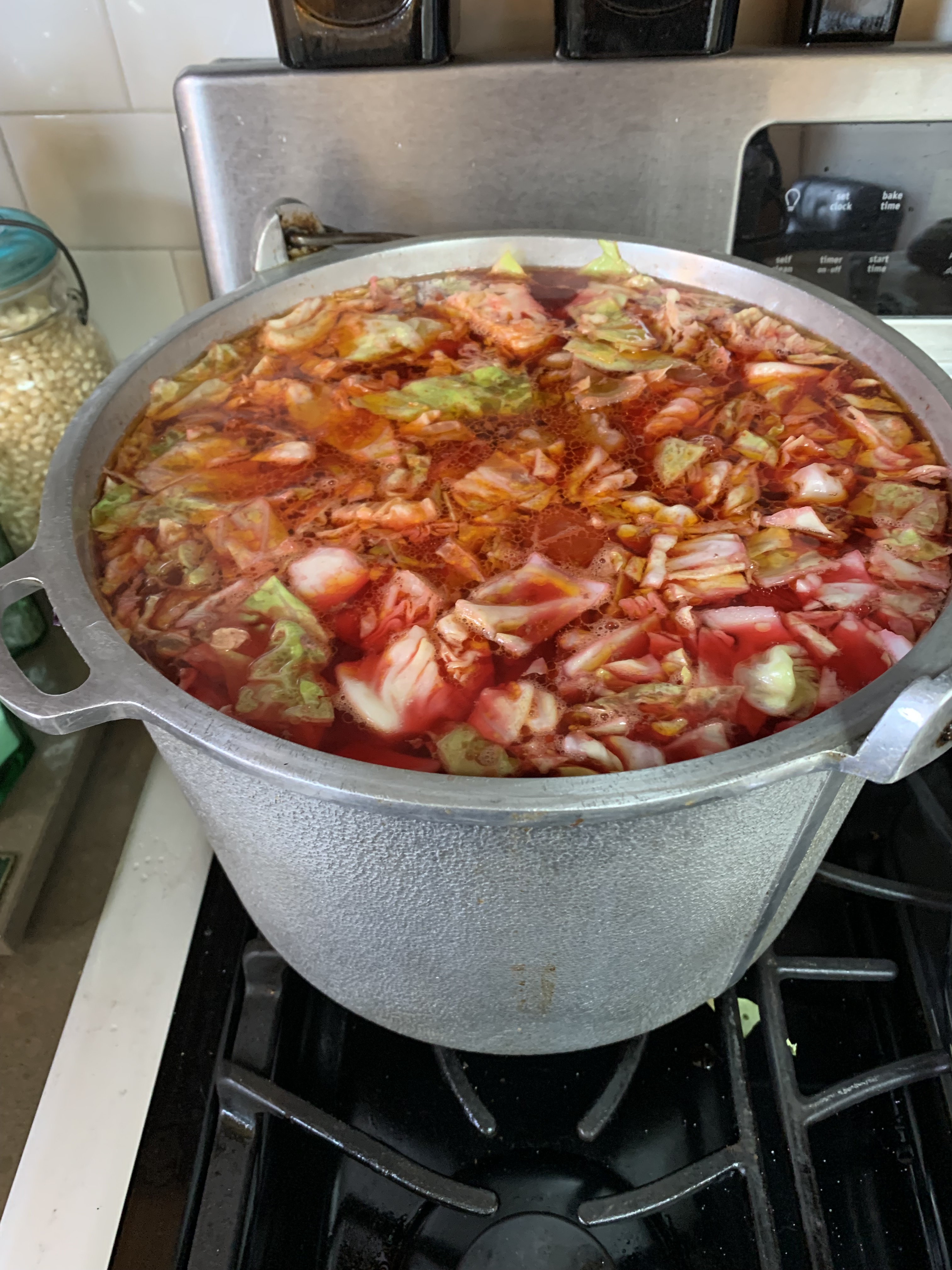
Borscht, photo and soup by Mary Elyn Bahlert, 11/2022

Uncategorized

Dinner with Dad

When I’m talking to friends about our families, how we grew up, where we were from, about our siblings and our education, many of my friends refer to their parents in “formal” ways. I hear them speak about their “Mother,” and their “Father,” as opposed to how I refer to my parents: Mom and Dad.

Dad was an old school guy. Educated to the eighth grade in country schools, he was a worker. He was strong and he loved to work. When I describe him now, I say that he spoke in a dialect that is common to the northeastern part of the State of Wisconsin. When I travel to Door County now – a pilgrimage I like to take every year or so – I hear other folks who speak in the same dialect, even in my generation.

Dad was a Steelworker, a proud union man, proud of his strength and his long seniority at A.O. Smith Corporation in Milwaukee. The site of A.O. Smith remains to this time, but the place has changed names. Last Christmas, I received a large black coffee mug from my sister in Hawaii; across the sides of the mug, in big white letters: “AO Smith.” Most days, I use it now to have my morning coffee.

Dad was an old school guy, and in that era – I grew up in the 50’s and 60’s – that meant that he went to work and Mom stayed home to take care of the house – the flat – to cook, to tend to the children. Dad loved us, and he loved my mother. When I think about that now, those facts form a certain framework around my child, which like most childhood’s, had its share of losses, of sadnesses, of things lacking, even with my parents. In my middle years I had to take those relationships – mother to me, father to me, siblings to me – apart in therapy, but I came away with the love intact. I’m grateful.

When Dad retired at the age of 65, he left behind forty years of hard work as an inspector in a steel factory. He had been grateful to return to work after he suffered a heart attack in his early 60’s, and he credited his doctor with giving him that gift; Dad loved his work, hard as it was. When he’d been retired for several years, he told me that he still dreamt about his work at A.O. Smith from time to time.

Dad was an old school, hard-working laborer, and he loved us. His love and his pride for his family shone in his eyes – one blue, one brown. He loved to laugh, to share something fun with us. For all I lacked in childhood, love was not among the lack. He loved to talk – an extravert in a home of introverts.

A few years after Dad retired, I was living on my own on the other side of Milwaukee. Mom was away for the day and evening, and Dad invited me to dinner. He talked and talked as he and I sat in the kitchen, waiting for the chicken he had baking in the oven. I saw how he’d set the table for the two of us, and for the only time I remember, I sensed a formality about this invitation, about this dinner. For him – as it was for me – this was a special time.

A few weeks ago, I preached at a retirement center just out of the Bay Area. When the worship service was over, a man in a wheelchair came up to me to say a few words, to introduce himself and to thank me for being there that day. He had some thoughtful comments to say about my sermon, and then he surprised me by saying: “You did a lot of research to preach that sermon. You must come from a family of researchers.” Surprised, I simply told him that I was the first in my family to receive an education. I felt proud.

reflecting, remembering

Longing for Cozy

I left Wisconsin to live in California on December 26, 1981. I had moved out of my own apartment to stay with my parents at the beginning of December as I made the transition from full time work to full time student, at Pacific School of Religion in Berkeley. At the time, I didn’t know that I would be moving “forever,” to not return to the place that had been my homeland, the land of my people, for several generations.

For a few years after I made the move to Northern California, I did not return to Wisconsin at holiday time. I stayed in Berkeley and later, in the parsonage at Pleasanton with my new husband, Jeff. I recall vividly the first winter I spent in Pleasanton, as I stood in the driveway in my blazer, preparing to drive to my first parish, in San Jose. I was surprised – here I was a blazer as my top layer in January – no boots, no wool cap and gloves!

My Dad died in April of 1986, and I was able to be with my parents for a few days over the holiday season after Christmas the year before. One day during my visit, Milwaukee had a wonderful snow-fall, a snow-fall without wind, when the large flakes fell straight from the sky to the sidewalks and streets below. I walked over to a coffee shop not far from my parents’ apartment on Appleton Avenue, taking in the white stuff as it landed on me, looking at the falling snow with wonder. That’s the best kind of snow – gentle,calm, falling silently to the streets of the city. And I didn’t have to shovel! I enjoyed the coziness of the coffee shop and set out to walk again to my parents’ place.

For a few years after I moved to Northern California, I tried – without any success – to bring on the feeling of “cozy,” during the holidays. As I write today, Oakland is getting a much needed, and never-enough rain, after many years of draught. This is as close to cozy as I’ll get, I’m sure, the sound of tires driving in the rain, the tree lights lit, heat from the furnace warming the house. One holiday season, a few days before Christmas, after my father had passed and my mother made the trip to spend the holiday season with Jeff and me in the Bay Area, she and I stopped on Christmas Eve to have a lunch together at a cafe. Inside the cafe, Christmas music played on the sound system, and we enjoyed our quiet time together. And that day, as I sat with Mom in a cafe, longing for cozy, I realized that I could never bring on Christmas the way it had been, in my memory. Those days were gone. My life had changed, and with the changes I had lost something I’d never have again, as happy as I was in my new home, in my new life.

I suppose that as I grow older, I will be longing for Christmas every year, longing for a bit of cold, for a snow – silent, lovely – and of course, for the people who lived those Christmases with me, gone now, for a long, long time.

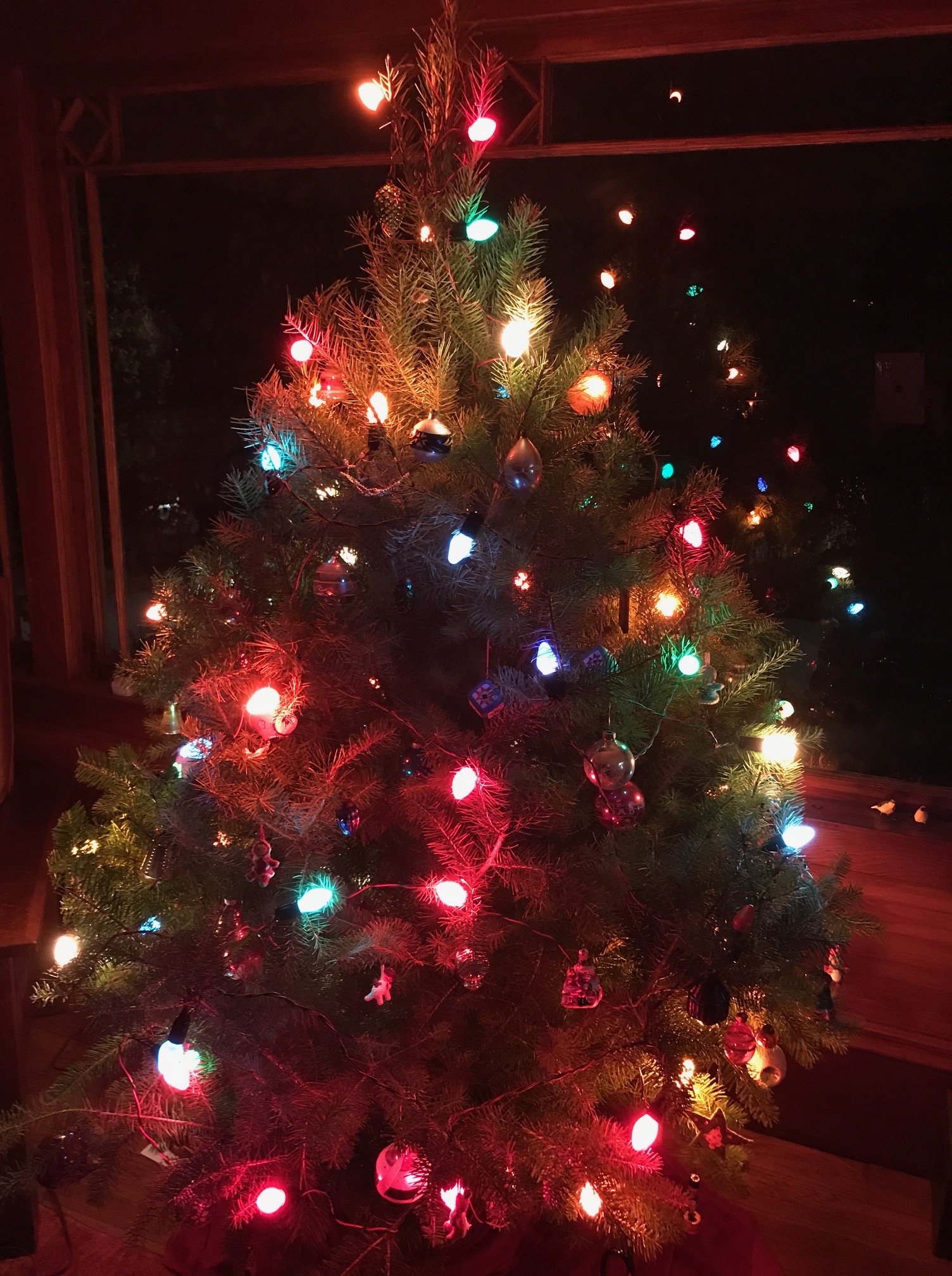
Christmas tree, 2022. Photo by Mary Elyn Bahlert

Uncategorized

Bishop Earl

One Sunday morning in 2002, as I was in the sanctuary at Lake Merritt United Methodist Church in Oakland, preparing for worship, I saw an elderly African American couple I had not seen before. It was my practice to arrive early, while the choir rehearsed, to greet folks I knew, and to personally welcome people I did not know. When I walked up to Joanne and Earl that morning, they stood, and Joanne spoke first, introducing herself, and then her husband: “this is Earl,” she said. “He’s a Bishop,” she added. I saw the look of pride that moved across his face at that moment.

An African Methodist Episcopal Bishop, Earl had chosen to have a community outside of his denomination to make his home in retirement.

I came to know that every emotion showed in Earl’s face: tears shed, eyes shut tight in laughter, a wandering look when he was wondering. Every emotion showed and was quickly replaced by the next emotion. Sometimes anger and frustration, the next moment, joy, laughter. After a time, Bishop Earl volunteered in the church office, and often as I worked in my study there, I would hear his booming voice as he answered the phone, and laughter – also booming – from the office staff, and from Bishop Earl himself.

My husband has an expression that he saves to describe certain people, and I think it applied to Bishop Earl: “he was helplessly himself.” And for those of us who knew him, his being himself filled our lives with kindness, with sincerity, with happiness.

Over the years I pastored at Lake Merritt Church, Earl and I spent lots of time together. One day, we visited the Mountain View Cemetery in Oakland, where Earl parked his car and walked to the stone crypt that held his oldest daughter. He cried, and his little dog, who stayed in the car with me, whimpered as she watched him in that sad and lonely place. When he returned to the car, Earl was all words again, and soon we were laughing, enjoying the day. Sometimes, Earl would take me to another of his favorite eating places, and we’d talk and laugh over lunch together. When my mother died, he was one of the first to talk to me, to offer his condolences, and he preached for me that day after she died, on short notice.

I can remember the exact place in Oakland where, stopped at a stoplight, Earl and I were talking about our favorite kinds of music. I told him that I loved the blues. He burst into song, singing the blues – in his deep, resonant voice. We laughed, and laughed again!

My mother-in-law, Betty, was a reserved woman from a small community in Wisconsin. On one of our visits to see her, she answered the phone to hear Bishop Earl asking to speak to “his children.” She handed the phone over to me quickly, not sure what to make of this!

Joanne’s health failed before Bishop Earl’s, and they moved away. On one of his return trips to Oakland, where their daughters still lived, Earl invited me to hear him preach at a small church near my home. That’s the last time I saw Earl; as I walked away, I watched him court the women, speak with respect to the men. Many years have passed, but I still think of him when I pass that little church.

There was no one like Bishop Earl. I miss him.

Uncategorized

Sue, Sister, Sweet

I remember when I first named you:  “sister,”
your sisterhood, a gift to me:
you, sitting on the edge of the claw footed bathtub
in the crowded bathroom of an old Milwaukee flat, crying.
Smaller, I sat without a word, until we laughed - again.
Then, I knew:
You are my sweet, sweet sister, Sue.

I remember you, 8 months pregnant – 
	another baby!
- your deep voice, your laughter until dawn
in the Carolina night,
the light from your cigarette, bright in the darkness.
During the day, you were Mom.

I remember you, marching with me to find the classical CD’s in the back 
	of Barnes and Noble.
You bought me Beethovan.
I listened, all spring long, to the minor notes,
mourning another Sue.
Now, these notes are for you.
	I mourn for you.

Sweet, sweet Sue:
Your love was there:
a simple melody in the background of my life.
Your love, that spanned the miles, the years.
I remember, Sue, sweet, sweet Sue.

I remember you.

“I don’t know when I’ll see you again, Sue,” I said into your silence,
your deep hug.
I remember your silent wave:  "goodbye."
(I watched you in the rear-view mirror).
You knew, you knew, you knew, my sweet, sweet sister, Sue.
You knew.

Sue Lass, 1943-2015