I hadn’t visualized living in the American West for most of my life, but here I am. I’ve lived in Oakland for over 25 years, after I completed my work as a Pastor in Oakland, and I expect I’ll be here for another while – God willing.
When I was young, I imagined that I would leave the Midwest, and I was certain I’d move to the East, to New York City, perhaps, or to Washington, D.C. My imaginings always took me to cities. To big cities. I love the diversity of cities, the abundance of neighborhoods, each one with its own personality, and I love the choices we take for granted in the cities. I love the bustle of things, and I love the way even cities become quiet on holidays, or on early Sunday mornings. I love the diversity of people – diversity of color, of background, of education, of family. I love it all.
And I’ve been privileged to have come West, where I arrived as a student in seminary in Berkeley in the 1980’s. I was fulfilling my dream to go to seminary, to become a pastor.
My husband Jeff is from the Milwaukee area, from Brookfield, a suburb of Milwaukee. Part of him yearns for the quiet country life he came to love and to respect when he spent time with his maternal grandparents on their farm, northwest of Milwaukee, where Jeff’s mother had grown up. His mother, though, waited for the day she graduated from high school to leave that place for another life. Sometimes Jeff reminds me that it’s his turn to choose a place, a country place… I expect he must be dreaming again of finding a place that gives him love and care and a respite from whatever might be bothering him at the moment.
But we are connected here more than by time and a place. We have strong community here; community is important to us as a value, and we know it would take a long time to build that again in a new place.
And – I remind myself – we are not 40 years old anymore!
And so, from year to year, our connection, our deep bond to this place deepens and deepens. And when we travel, living in the West makes it easy to tell people, when they ask where we are from: we’re from California. Everyone knows where California is!
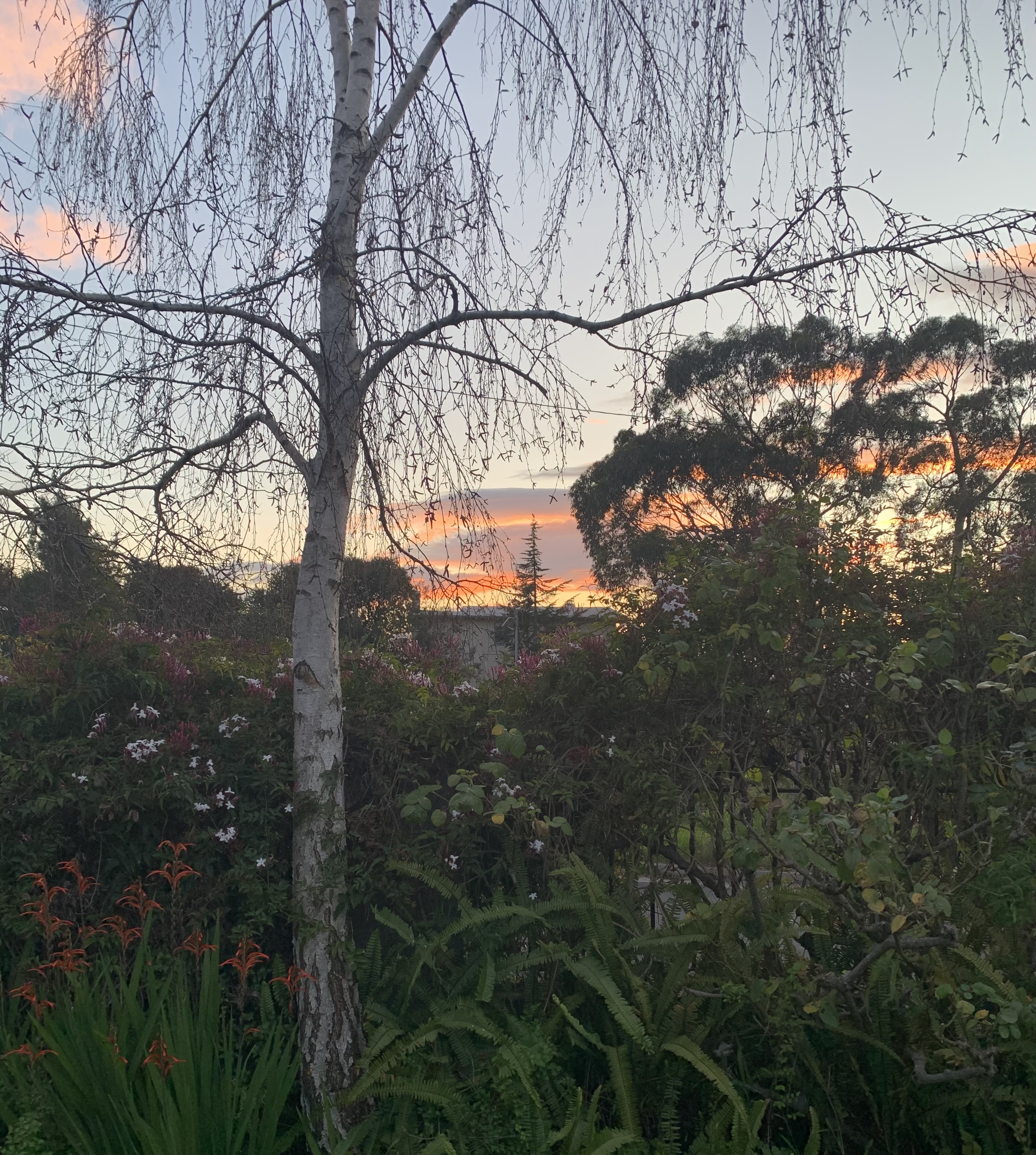
Looking out to the West, over the Pacific, from home. Photo by meb, 3/2025
When I married in 1984, I married a man and a cat. The cat’s name was Schatzi – and Schatzi was the best cat in the world. She was cuddly and friendly to everyone. When company came to visit, Schatzi would join all of us in the living room as we sat and talked. When I lay on the couch to take an afternoon nap, Schatzi would cuddle up next to me, her back against my body. We’d take a nap together.
I think Schatzi stayed alive that winter of 2000-2001, even after she spent most days next to the heat register in the dining room, because that was the winter we learned that my mother had inoperable cancer and was put on hospice, and as Mom spent her last days in her little room at the Mathilda Brown Home in Oakland. When I arrived home after a long day at church and then after a long day with Mom, Schatzi would be cuddled up close to the heat, soaking up the comfort she found there. And the spring after Mom died, Schatzi, too, died, on the kitchen floor where Jeff had spent her last hours beside her. She was a good cat. We buried her in the back yard of the duplex on Sunnyslope Avenue in Oakland.
*
Sometimes now, I lay on the grass in the yard of our house on View Place, near the back door. Before I do this, I open the kitchen door wide. Then I call the cat, LiLi, who spends most of her days sleeping on the yellow quilt on our bed. She never fails to jump down from the bed, down the five stairs from the bedroom into the hall, through the kitchen, to rush out the back door to join me on the lawn. As she comes to sit with me, I watch her from the ground, my view of the earth close to hers.
LiLi is not an affectionate girl, but for a few minutes as we lay on the grass, she rumbles next to me, leaning in just so – just so she is in the shade that my arm forms. It seems to me that we must both enjoy the same things in those moments: the smell of the grass, watered for a few minutes before dawn, the sunshine, and the shade, the good company of another being.
I almost hold my breath when she’s with me; soon her nose is moving, down, down, down to the earth, and her eyes narrow into slits as she surveys her surroundings. She moves slowly, but she crawls away, her body close to the ground, her nose down, to the bushes a few feet from where I lay. Someone interesting must have visited that spot during the night, because she spends a few moments sniffing. Then, she places one foot gingerly in front of her, then another, and she moves into the shadow of the rose bushes or the rosemary bush.
She doesn’t come back to me. I’ll have to wait for her another day.
*
I think about these moments with the cat, in the winter, when it’s raining. When I pass the step into the yard, I turn my head to look at our place. I think about the sun shining, I think about the clear air, the smell of the earth, and I see the two of us – me and the cat – lying there, on the grass.
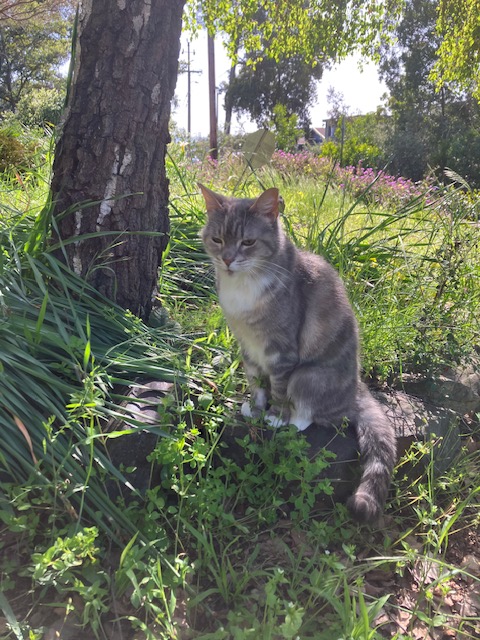
LiLi, who is now in her elder years, on one of her short excursions into the yard. Photo by Mary Elyn Bahlert
So much poetry, so many beautiful views, graves of the beloveds at which to stand, roads that are familiar and dear: this is my place.
When I was in my twenties and I lived for a couple of years in Green Bay, Wisconsin, I often drove 100 or so miles north along the shore of Green Bay to Sturgeon Bay, and further, into the part of Door County I knew so well from the time I was a child. I can remember the drive north from Milwaukee as a child with my dad driving, as I lay in the back seat of the ’49 Chevy, sick with the beginning of the measles. I remember the stand of trees north of Jacksonport, on our way to Baileys Harbor, on our way to Sister Bay, on our way to Ellison Bay and Gills Rock.
I remember the faces and even the voices of the beloved family I would see in Door County. I remember Irene, with her giant hugs and never-ending chatter. I remember standing in a cherry orchard, carefully picking the sour cherries, while Daddy – standing by – filled a bucket in a few minutes. I remember exactly where the gas station is in Sister Bay – on the Green Bay side – and where Bunda’s Store – now another department store fills its space – stood across the street from the Sister Bay Bowl.
I know the names of taverns along the peninsula, too, along with memories of stories I’d been told as a child.
Although Door County has now become an “it” place, its two lane roads often lined bumper to bumper with folks from Chicago who’ve “discovered” the Door, I say I know the “old” places, the quiet places to go. And when I’m in Door County, I take the quiet roads to the quiet places.
Folks talk about a sense of place. Door County satisfies that sense of place for me. In my life, I’ve been privileged to travel to foreign places and I’ve been privileged to take many roads across the United States, beautiful places, all. But in my heart, in my memory, in my blood – it seems – I return always to Door County. At some moment in time, I promised myself that no matter how far away I might go in life, I would return to my place. I’ve kept that promise.
Each place I see again holds a memory for me, and as I stand at the graves of my beloved family – the Bahlerts were warm, gentle people – I see the faces of those who have passed. I can hear their voices. I can stand at exactly the places we stood.
When my beloved Auntie Irene was dying, I sent her a card, and included the words: “wait for me.” I wanted to see her again before she passed. And she did wait. I’d arrived in Door County later than expected after a hospitalization in Milwaukee, and I arrived, along with Jeff and my mother, in time to be at Auntie Irene’s funeral in the old, frame sanctuary of the Lutheran Church north of Baileys Harbor, to stand outside the church with many of my Bahlert cousins, to see them once again.
Several times in my life I have returned to Door County as a place to mark a change. I wrote my application to seminary in the autumn of 1981 in a rustic cabin along the shore of Lake Michigan. When I was heartbroken in earlier times, I went to Door County to heal, and in a cottage I pass along the highway to the north of Baileys Harbor – I remember as I drive past – I heard a voice call me by name.
And I am blessed, blessed by that voice, blessed by a sense of place.
I’ve lived many years in the West. I’ve lived a life I could not bring into my imagination when I was a child and a young person, trying to find my own way in life. And through all those years, I have kept my promise to myself: to return to this beloved place, as often as I am able.
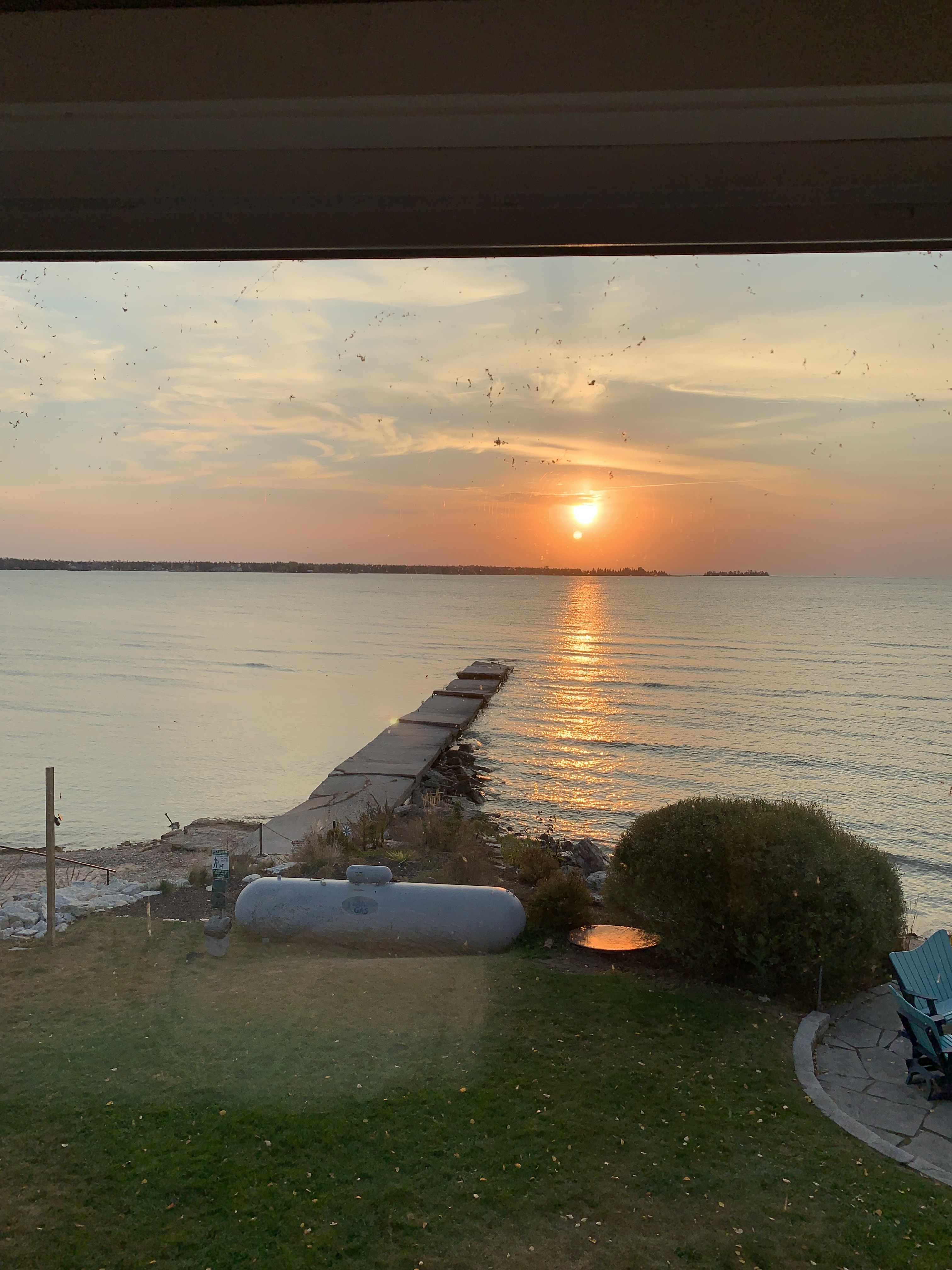
Photo of sunrise over Lake Michigan, photo taken by Mary Elyn Bahlert, 10/24. From a window in Baileys Harbor, WI.
My first job was at the Times Fine Arts Theater on Vliet Street and Hawley Road in Milwaukee. Word must have passed from one young person to another, because most of the other young people who worked at the theater were friends of mine from high school, and even earlier in my life. There was Pat R., her younger brother, Bobbie, my best friend, The Bug (who had received her name from Bobbie at some point), my cousin Mark, and a couple of other kids from the neighborhood.
I could take the 23 bus right to the front door of the theater to start my shift. I was the vendette, my friends Pat and Bug – who worked at different times – were the ticket sellers. We worked for minimum wage – I started at $ .90 – yes, that’s right – 90 cents! – and stayed at that rate for the year I worked there. And I worked no more than 15 hours each week.
My shift started with my walking down the left aisle in the dark theater to a little room off the dark hall behind the stage. There, I reached into the dark room to flick on the light switch, and I reached for a big bag of popcorn that was stored in that room. The popcorn had been popped at a sister theater, larger, with its own popcorn popping machine. I carried the big bag of popcorn back to the narrow aisle in the lobby of the theater, where I dropped the popcorn under the lights to warm. I had picked up some real butter in the back room of the theater, too, and I put that in the dispenser to warm and to melt. Then I was ready for customers.
Times Fine Arts Theater was not well-attended. Its fare was mostly “adult pictures,” although not what we would call X-rated these days. And then, the Theater showed one feature – not several in different theaters, which is common today. From time to time, I’d catch a few minutes of the movie currently running. But mostly, I stayed behind the counter where I sold popcorn and candy from a selection that was locked behind the counter until I opened it for my shift.
During the movies, I could talk and have fun with my friends who worked along with me. The usher stood at the doorway to the outer hallway, which was cold in the winter. The ticket seller had an electric heater which she had plugged in as soon as she arrived for her shift. Sometimes, crushes developed there between various couples, mostly short-lived.
I credit that job as marking the beginning of my life-long addiction to popcorn. (During COVID, popcorn-making in a pot on the stove became part of a daily lunch ritual with Jeff). I kept a small portion of popcorn behind the butter machine, and I snatched another kernel of buttered corn – real butter – from time to time. During COVID, popcorn-making in a pot on the stove became part of a daily lunch ritual with Jeff.
At the end of our shifts, we carefully counted out what we had made that night, and inventory of the candy in the glass cabinet that I opened from the back was taken. Then, I locked it up again, stuffed the remaining popcorn into the large plastic bag I’d stashed under the counter, and walked it back to the room behind the big screen.
When the shift was over, my Dad’s dark blue Chevy Bel-Air coupe showed up in front of the doors, and I was on my way home. Later, the Bug had access to one of her parents’ cars, and she’d drive me home, the two of us talking and laughing all the way.