Uncategorized

First job

My first job was at the Times Fine Arts Theater on Vliet Street and Hawley Road in Milwaukee. Word must have passed from one young person to another, because most of the other young people who worked at the theater were friends of mine from high school, and even earlier in my life. There was Pat R., her younger brother, Bobbie, my best friend, The Bug (who had received her name from Bobbie at some point), my cousin Mark, and a couple of other kids from the neighborhood.

I could take the 23 bus right to the front door of the theater to start my shift. I was the vendette, my friends Pat and Bug – who worked at different times – were the ticket sellers. We worked for minimum wage – I started at $ .90 – yes, that’s right – 90 cents! – and stayed at that rate for the year I worked there. And I worked no more than 15 hours each week.

My shift started with my walking down the left aisle in the dark theater to a little room off the dark hall behind the stage. There, I reached into the dark room to flick on the light switch, and I reached for a big bag of popcorn that was stored in that room. The popcorn had been popped at a sister theater, larger, with its own popcorn popping machine. I carried the big bag of popcorn back to the narrow aisle in the lobby of the theater, where I dropped the popcorn under the lights to warm. I had picked up some real butter in the back room of the theater, too, and I put that in the dispenser to warm and to melt. Then I was ready for customers.

Times Fine Arts Theater was not well-attended. Its fare was mostly “adult pictures,” although not what we would call X-rated these days. And then, the Theater showed one feature – not several in different theaters, which is common today. From time to time, I’d catch a few minutes of the movie currently running. But mostly, I stayed behind the counter where I sold popcorn and candy from a selection that was locked behind the counter until I opened it for my shift.

During the movies, I could talk and have fun with my friends who worked along with me. The usher stood at the doorway to the outer hallway, which was cold in the winter. The ticket seller had an electric heater which she had plugged in as soon as she arrived for her shift. Sometimes, crushes developed there between various couples, mostly short-lived.

I credit that job as marking the beginning of my life-long addiction to popcorn. (During COVID, popcorn-making in a pot on the stove became part of a daily lunch ritual with Jeff). I kept a small portion of popcorn behind the butter machine, and I snatched another kernel of buttered corn – real butter – from time to time. During COVID, popcorn-making in a pot on the stove became part of a daily lunch ritual with Jeff.

At the end of our shifts, we carefully counted out what we had made that night, and inventory of the candy in the glass cabinet that I opened from the back was taken. Then, I locked it up again, stuffed the remaining popcorn into the large plastic bag I’d stashed under the counter, and walked it back to the room behind the big screen.

When the shift was over, my Dad’s dark blue Chevy Bel-Air coupe showed up in front of the doors, and I was on my way home. Later, the Bug had access to one of her parents’ cars, and she’d drive me home, the two of us talking and laughing all the way.

Uncategorized

Called by God

I suppose it is a strange phenomenon, having grown up in a family with a particular distaste – and history, according to family lore – for Church, for me to think I might want to go to seminary. We held my atheist Uncle Johnny – whose life was always bent on helping others – in high esteem. And although my mother ascertained that I should attend Confirmation Classes at the closest Evangelical Lutheran Church in the neighborhood, a Missouri Synod Church, and I had there memorized Luther’s Small Catechism (I am forever grateful), yet there I was, thinking about becoming a pastor, with no experience of what a pastor was all about. I was about 19 when the idea entered my mind.

Of course, I had never seen – or even heard – of a woman pastor. Still, I had the thought: “I could be a Pastor.”

And so I set on the journey of finding a Church Community. I had run away from the fundamentalism that was the theology in the Missouri Synod Lutheran denomination, almost as soon as I’d heard it. That didn’t make sense to me. But were there other places, were there other way to look at Church, at the faith, at life? Maybe so.

I started the journey toward finding such a place where I often begin journeys: at the library. I read about denominations, discovering ideas and understandings I had not heard before. Several – almost 10 – years later, I found myself in a United Methodist Church, where I learned that there were folks whose faith was lived out in social justice, not in right doctrine.

Within a few years, I made my way to seminary – at last! – and within three years, I was ordained and sent to my first appointment within the Methodist system. I had a lot to learn, about church itself, how the inner workings of a church happened (!), and I learned what church community was in real life – or was not. I’d married my husband, Jeff Kunkel, during my last year as a seminary student, and our lives were complicated by being part of a clergy couple. Then, and even now, those in authority had an often difficult time finding an appropriate slot for us both.

And so, after several church appointments, and after leaving a conflicted church situation, we found ourselves as a “clergy couple” in Tracy, CA. Even now, I think of the people of that congregation as my first congregation, in the way I connected to them, and in the way they connected to me. Life in Tracy was less urban than I had been accustomed to living, so there was that adjustment. Still, I remember those two years with fondness for the people there.

Jeff and I were part of a group of clergy from the area who met monthly to have lunch together, to simply be together with other clergy. I was the only woman – as I was the first woman pastor at the congregation in Tracy – but I went to the meetings and expected to be treated as an equal among peers. That’s my way. I don’t remember not being treated as an equal.

One of the clergy in the group was the Pastor of a large Lutheran Church – Missouri Synod. One day, as the clergy were gathering, he and I stood together, chatting. We were friendly, and I told him that I’d been confirmed in the Missouri Synod Lutheran Church. With a glint in his eyes, he asked me: “So when did you fall from grace?”

Without skipping a beat, I said: “Called by God.”

At that, he did not lose his kind and open expression, but simply smiled at me. I’ve always thought of that moment as a time when some Spirit – greater than me and yet in and with me – had somehow moved.

We sat down with the other clergy, and the gathering began.

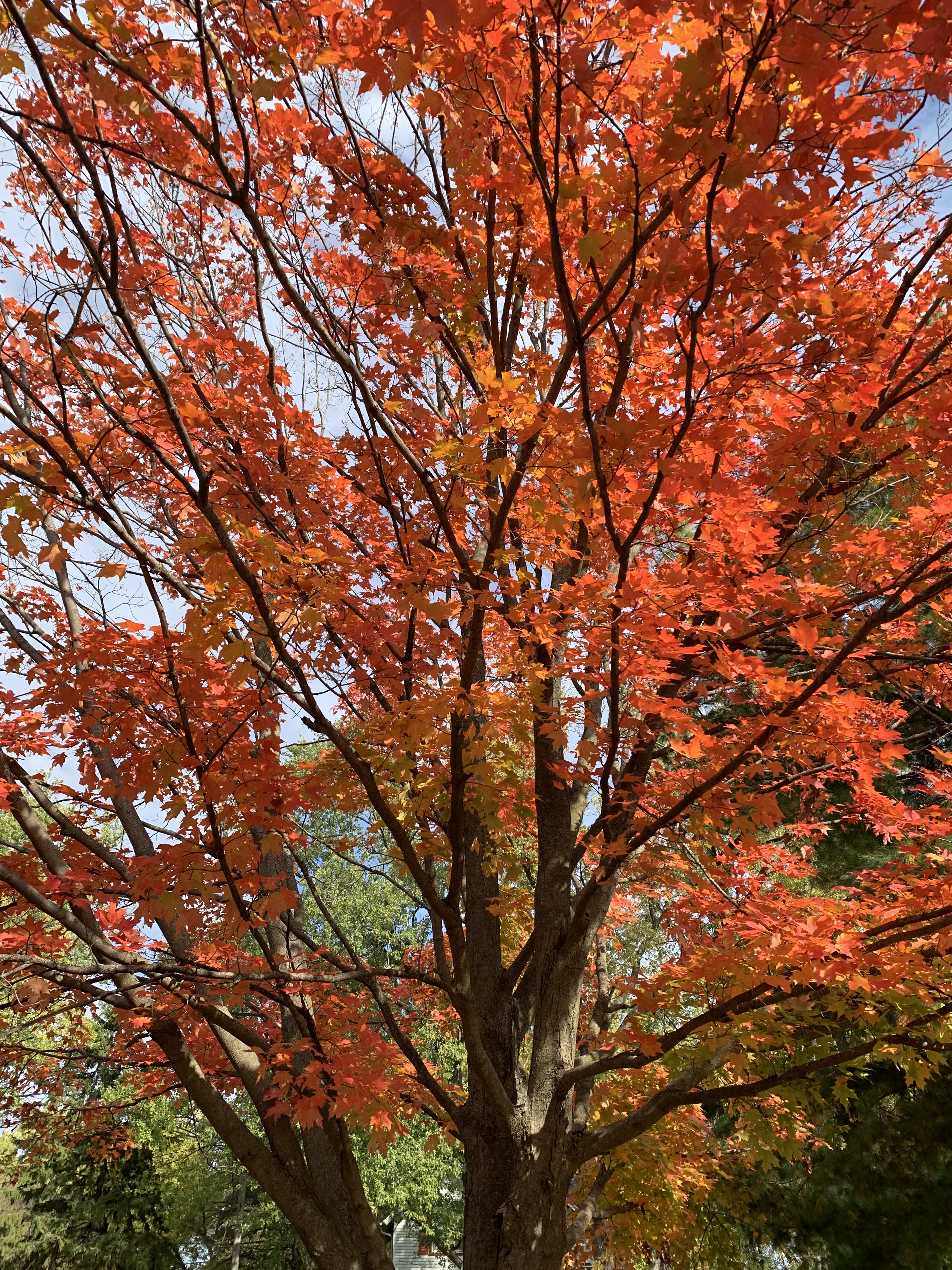
a tree in autumn – also called by God (I would guess) – photo by Mary Elyn Bahlert, 10/2024
community, memories, reflecting, remembering

Showing Up

Over the years of my life, I have come to value something that is rarely mentioned. Although this quality is not often mentioned, it is of inestimable value. At least it has been in my life. Many years ago, I committed to memory the “gifts of the Spirit,” and sometimes before I go to sleep at night, I say them to myself: “love, joy, peace, patience, kindness, goodness, faithfulness, gentleness, self-control.” And to that holy list I would add: “showing up”.

I remember the day of my mother’s funeral in Milwaukee. Jeff and I had accompanied my mother’s body back to Wisconsin to have her honored there, a funeral, and to have her buried there, alongside my father. Like many important memories of days and times in my life, “snapshots” appear in my mind of that day, a cold, cold February day, bleak in that way mid-winter days are bleak in the Midwest. I can sense myself sitting there in the sanctuary, aware of the folks who were sitting there along with me, my mother’s casket before us. Jeff’s mother and brother Randy were there, along with many of my friends, and some of my mother’s friends – those who were still alive, my mother having passed her 80th year, her friends, also. Some of those gathered were friends of my mother and some were my friends, there to be present to me.

Clearly, I remember myself walking away from the grave as the small group of us had gathered at the graveside for a few words to be said, and as we walked away so that her burial could be completed by the waiting workers. My friend Vicki walked beside me, and she said to me: “you had neat parents.” Her comment was so simple, and yet I have not forgotten her presence beside me, and I have not forgotten the words she said. With those words, she was telling me that she, too, had loved my parents, and that they had been a part of her life.

I remember Vicki’s presence that day and I remember the presence of many others. I remember reaching out to Joanne to join me in throwing some earth onto my mother’s casket at the burial. I remember my mother-in-law, Betty, taking my left arm as I walked down the steps to the gathering in the church basement that followed the funeral. I remember Jeff, who read the words I had written in honor of my mother, and who had traveled with me to be with her friends and mine on that day.

I will always love the people who were present that day. They showed up. My cousin Rudy and his wife Mary, now in their late 80’s and early 90’s, attended the funeral. I remember them especially because Rudy and Mary carry with them the value that I have come to love: they showed up. They were there at my wedding to Jeff, the first day of spring, when the guests traveled through another snow storm to be present with us. They were there when my father died after his long struggle with colon cancer. They were there on the day that Jeff read a short story of his at the little church in Kiel that his grandfather had pastored, many years before.

Last week, when I was in Wisconsin, I made sure to drive out of my way to see Mary and Rudy in their home. I wanted to show up for them, as they had shown up for me and for so many I loved, over the years. As we talked and talked, our conversation remembering so many that have passed, and including those who are still with us, I made sure to remind Rudy and Mary, as I have before, in other visits, that I have not forgotten that they had showed up.

Rudy and Mary personify that blessed quality, “showing up.” To me, they do. When I told them – again – they told me that they had visited my mother when she was living alone in the apartment on Appleton Avenue, alone after my father had died, alone in the place she lived until Jeff and I moved her to be closer to us in the Bay Area. I had not heard that story before.

I haven’t read accolades about “showing up.” I doubt I will, in this time of Artificial Intelligence and driver-less cars. Some of the simplest, most concrete things in life will not be mentioned.

But I remember all of you. I think of you often. I see your faces, those who showed up for me at just the moment I needed you to show up. Thank you.

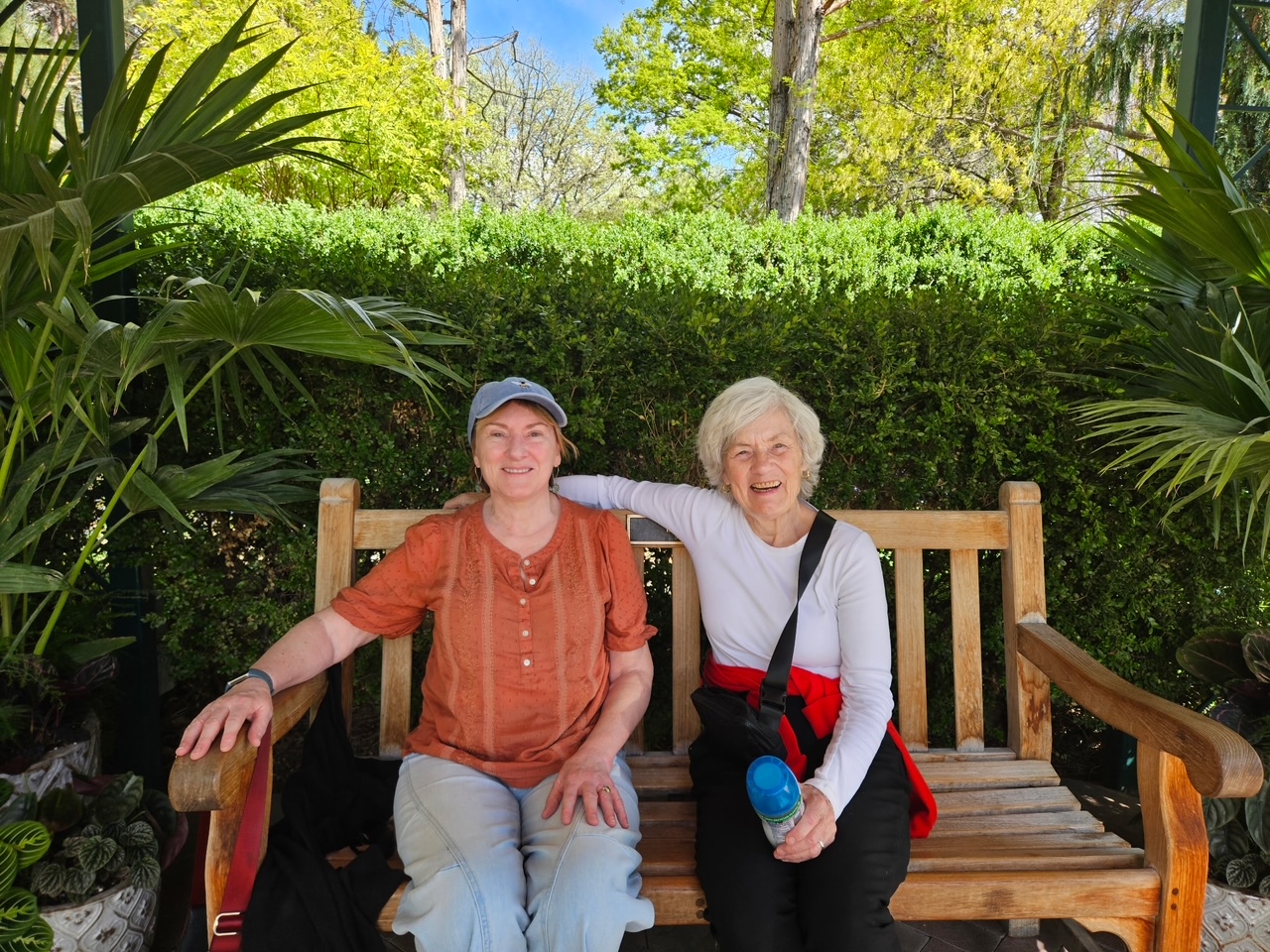
Cousin Rudy and Me, circa 2014, Kiel, Wisconsin

Uncategorized

It’s Easter

Very early this Easter morning, a couple of hours before sunrise, Jeff and I were both awake to hear the screeching sounds of a “sideshow” somewhere close to our street in Oakland. Young people connect with one another via text to set a time and place to come together at an intersection in the city, where bystanders watch as the fast moving cars in the intersection screech around and around the circle formed by the intersection itself. One disturbing memory I have of having served as a pastor in Oakland is of the day I received a distraught phone call from the mother of a teenage girl who had been killed the night before while she watched a sideshow from the side of the street, a bystander, an observer. The sanctuary was full the day we held the teenager’s funeral, her casket open as the community gathered to mourn her passing.

When I heard the screeching tires last night, I was reminded of that day.

Last night Jeff and I listened as the screech of tires on pavement made its way into our bedroom through the open windows, open to bring in the beautiful night air of spring. The sound of a sideshow is another thing: the tires of the cars screech as they circle the chosen intersection. Today as we drove home from church, we looked carefully at each intersection until we saw the one with tire marks that marked the activities of the night before Easter. The sideshow last night was only two blocks we from our house.

And we honored Easter today by going to Mass at a parish in North Oakland, where the people sang and shouted: “Christ is Risen!” And Christ, indeed, was risen in that place, a colorful group of worshippers remembering and honoring the High Holiday of the Christian faith. In worship we remembered the people of the world who are struggling to survive in the midst of horrific wars: Ukraine, Palestine. We like this parish for its diversity: class diversity, racial diversity, diversity of acceptance of Catholicism – or not. To us, the people there represent the diversity that is Oakland, which has been an important part of our making our home here for many years.

We chanted together with the other worshippers, laughed and sang with them, and when we left, we felt as if we had, indeed, worshipped on this day, on Easter Day, remembering the old, old story, so badly abused and harmed by well-meaning and damaged human beings. Even so, the story remains. We have known its message to be true in our lives.

It’s Easter.

Easter time in the desert, Joshua Tree Park, Mojave Desert. photo by meb: 3/2024

Uncategorized

Winter car wash

Over the course of my college years, while I lived at home and attended school at the University of Wisconsin-Milwaukee, I worked weekends as a cashier in a car wash, 20 hours per week, Friday, Saturday, and Sunday. There, I was introduced to people and cultures outside my personal experience, people I came to respect for their hard work, their ability to make their way in the complex situations which arise when working with the public.

Many of the young men who worked on the cars, who wiped them down before driving them onto the belt that took the car through the wash were men, African-Americans, who had arrived in Milwaukee from the Jim Crow South, although I didn’t know that at the time. When work in the car wash was slow, I talked to Acey, who spoke in a slow Southern drawl, and who said again and again, as if to himself: ”we just good friends, that’s all.” I knew that he was poor, and now, years later, I think that he was illiterate, as well. He spoke about his wife and children, at home in some neighborhood I did not know, where he took a city bus to home every day.

I met a smart, likable young man with a good manner. After a time, he quit working at the car wash, and one day he arrived with a brand new car, dressed to the nines in a suit and tie. We chatted for a moment as he paid his bill, and I asked him what he was doing now. Looking at me, he said: ”I’m a pimp.”

I’ll never forget the kindness and people-smarts of two of the managers – who managed both the employees who cleaned the cars, and the various problems that came with dealing with the public. One, Jim, was a white man with a quiet manner, kind, and well-spoken. Another, Montell, was a black man who’d survived throat cancer and spoke by putting his fingers over the hole in his throat, the result of a layrngectomy. His dark eyes danced as he teased and talked, sometimes, as if he had a secret that he could not share. Both men were excellent at disarming confrontations with customers, and they stood behind the men who worked for them on the wash line. They were loyal to the man who owned the car wash, and both worked for him for many years. 

Marilyn, who was the bookkeeper and secretary who worked full time during the week, came to be a role model to me of a woman who was so different from my mother, Marilyn, who laughed and was cheerful – all the time, it seemed to me. I admired her extraversion, her ability to do more than one thing at a time, and her kindness and acceptance of us all. At the holidays, she was the one who purchased gifts for us all on behalf of the owner. 

Summer weekends, I could bring a book or even two with me to sit behind the counter to read where the cash register and I waited for a few customers. 

Winter was the busiest time, especially weekends that followed a week of snow storms. The salt on the roads of city streets was damaging to cars, and it was easier to have a car washed in the machine than to do it in the driveway or on the street in front of the house. And so my fingers flew over the rows of the keys of the cash register I operated manually, adding up as many as 100+ customers/hour, most who paid cash, and an occasional credit card payment. One Saturday in a cold January when we’d had a week of snow storms, I stayed standing at the cash register for hours, taking payment; I had to take a “powder room” break, but the owner, who passed through several times an hour, couldn’t spare a moment of my fast and accurate work with the customers, so I waited until the last car went through the wash, the doors to the business locked, before I used the rest room.

“I made it!” I said as I came out, thinking of all the hours of hard work we’d all accomplished. The owner laughed as I said it, clearly thinking I’d made it to the restroom in time. That, too!

I first saw my future husband, Jeff, at the carwash, but I didn’t know it at the time. Like all the other men who worked hard during the week and wanted to prevent damage from salt on their cars, his dad brought Jeff and his brother Randy with him to the wash, stopping at the cash register and walking through the long hallway of windows, watching their car go through the loud machines. 

At the end of my shift, I tallied up the profits for the day, totaling the money in the cash register, balancing the books to what the register had recorded, and I left for the day, to take the city bus back home.