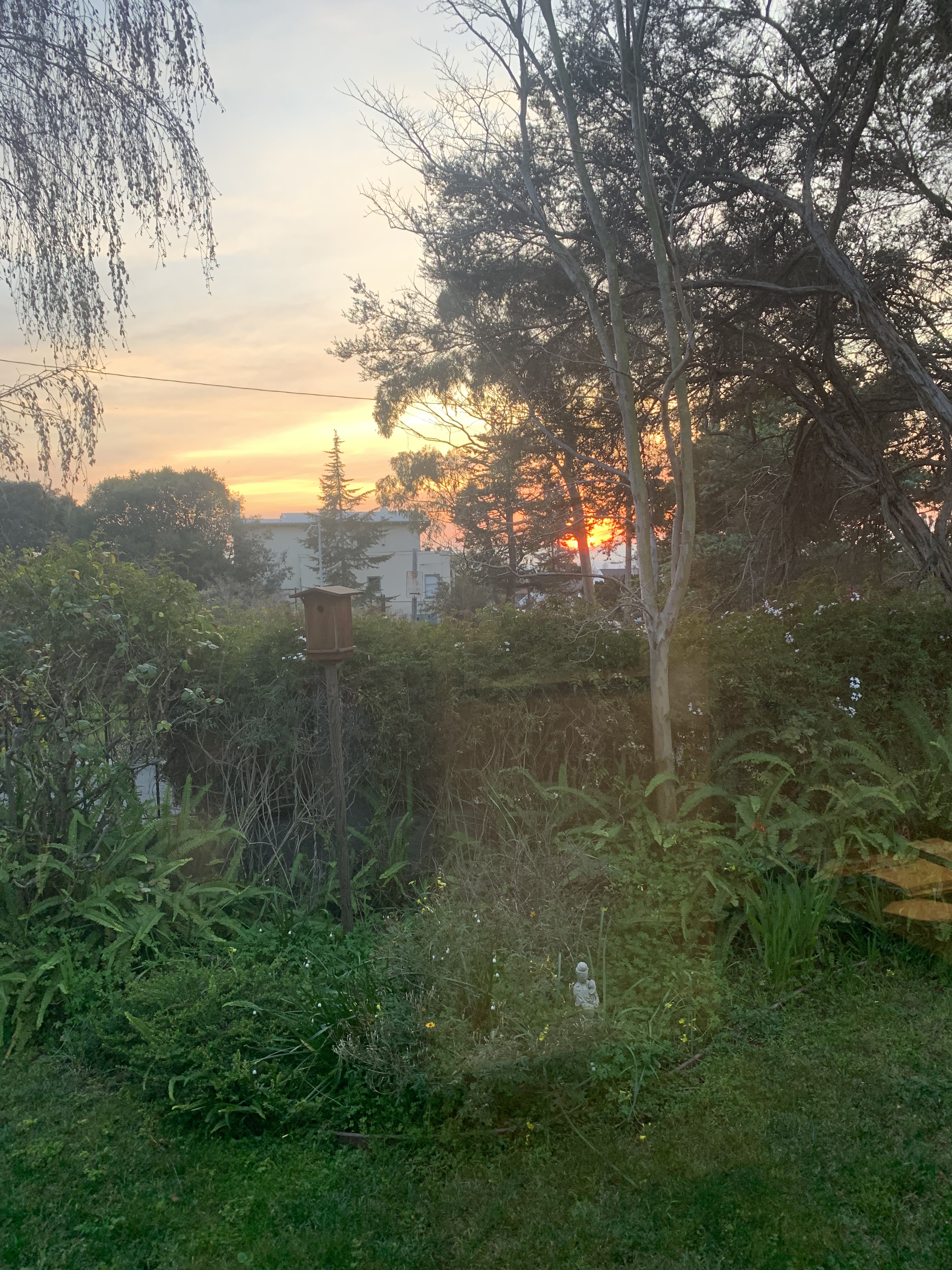
Jeff and I are watching the birds again. Our 100+ year old Craftsman home sits on its lot high above the sidewalks on our street, and so we have no window coverings. Our home is a birdhouse of its own! Outside the front window is a small grey birdhouse, currently uninhabited. Outside the windows of the kitchen stands a lovely crepe myrtle, joined by a beautiful birdhouse made by our friend Jim, and added to the yard this past winter. A circle of wooden lawn chairs in the yard gives the best view of who is moving into the wooden house in the side yard.
Jeff and I sit as quietly as we can in the wooden chairs, watching the titmice make a new home for their nest. The birds are busy; they don’t seem at all interested in us, the bigger creatures who also inhabit this part of the world. And so even as we move around, the couple does not stop their hard work, making room for eggs and soon, little titmice who will be coming into the big world that surrounds them.
I always like the little birds. Most find me unimportant as I observe them. But when the hummingbirds come into the yard, they are aggressive little creatures, sometimes buzzing close to my head as they observe this other strange, big – huge – creature. Quickly enough, the hummingbirds continue buzzing on to other places, out of sight.
I don’t think I have the patience to go about being a true bird watcher. I’ve tried. And I’ve seen some wonderful feathered creatures over the years, some who have seemed as interested in me as I am in them. But I do like to notice the birds who are our neighbors in our place in the city. They’re crafty – finding exactly what they need to make a cozy home in this busy urban area.
The new home of our titmouse neighbors! Photo by Mary Elyn Bahlert, 2/2026
“You’ve always had good friends,” my mother once told me. She was right. I’ve always had good friends, friends I find interesting, friends who listen to me as much as I listen to them, friends who are readers and travelers, friends who have a keen interest in life.
As I get older, I think I value my friendships even more than I ever did. Or maybe I realize now that our lives are short – we don’t know when we will lose another friend, or when we might face our own demise – and so each moment, each encounter, becomes more important as the years pass.
A few years ago, I received an email from a former student at Clarke Street School in Milwaukee, where I’d gone to 5 and 6 grades. She had written as part of the outreach to let me know about an event honoring Washington High School in Milwaukee. “Did you go to Clarke Street School?” she had written. When I looked at the name, the signature said Fran xxxxx. I knew her as Frances, and I sent my email response right away. “Are you Frances xxxxx?” I asked. I’d found her, my best friend in the few years before we entered Junior High, before I entered the Pilot Program for “smart” kids, and she skipped a grade, instead. I’d often wondered about Frances, how her life had unfolded. A few months later, Jeff and I were privileged to have a meal with Frances – now she’s Fran – and her husband, Jakov, in Milwaukee. And our staying in touch has been important to me in this season of my life.
Some friendships seem to last a long time, other friendships seem to last for a season, a short time in life. My husband, Jeff, makes friends with everyone he meets. He’s an extravert, and there are times I’ve teased him about the easy and comfortable way he makes friends. He’s got good friends, as I do. I’m grateful to be married a man who values male friendships as much as I value my female friends. I like to tease him that he’s the world’s “most extraverted man.” That’s not an exaggeration! And I have to say that Jeff and I are good friends as well as life partners. That’s a gift in my life, to be sure.
I’m grateful now to be making new friends as the years unfold. I’ve connected with a woman pastor I’ve known for many years, and at our yearly clergy gathering, we make time to spend with each other. Another colleague – we went to seminary together – and I have decided to make sure to have lunch once a month. A woman I’ve known since the 1980’s and with whom I share an August birthday, have dinner together at least two times a year – before Christmas and during our birthday month. Just as we have for a long time, we each come with a small gift for our long time friend. One of my good friends is making end-of-life plans for herself as a single woman, carefully laying out what she wants and intends as she lives in her 80’s. I’m just one of the people she is bringing into her planning. Even though she is single, her friendships reassure her that she is not alone. Some of my friends are friends I share with Jeff – couples – and others are solo friends.
For a few years, I led a group at a local Senior Center in Oakland, which I called “Life’s Reflections.” Although the group has ended, the faithful members met for a Christmas sing-fest at my house during the holidays. And I count them among my friends.
Over the past few years, since a former parishioner and new friend to me, Margret, died suddenly, her widower Jim has been a good friend to both Jeff and me. Jim likes to cook, and he has Jeff and me for breakfast at his house once a week. We’ve never had a repeat breakfast in two years!
I can still see Joanne’s face as she sat at my desk in Green Bay, Wisconsin, for the first time, in 1973, and asked me: “Do you golf?” I hadn’t golfed – still haven’t golfed – I told her I’d try to golf! – but Joanne and I have been friends ever since.
I have lunch dates a couple of times a week, even in my elder years. Lunch together is a good way for me to connect with my friends. I learn which friends text, and who likes to communicate via email. Or a phone call.
One or two of my friends are women I’ve met through taking part in spiritual retreats overseas. Sometimes we plan for a phone call or a zoom call to connect, since we live a long distance from one another.
I’m grateful for them all. As I reflect on my friendships, I see I could add others. I’m grateful to each one. And yes, I have always had good friends. Mom was right.
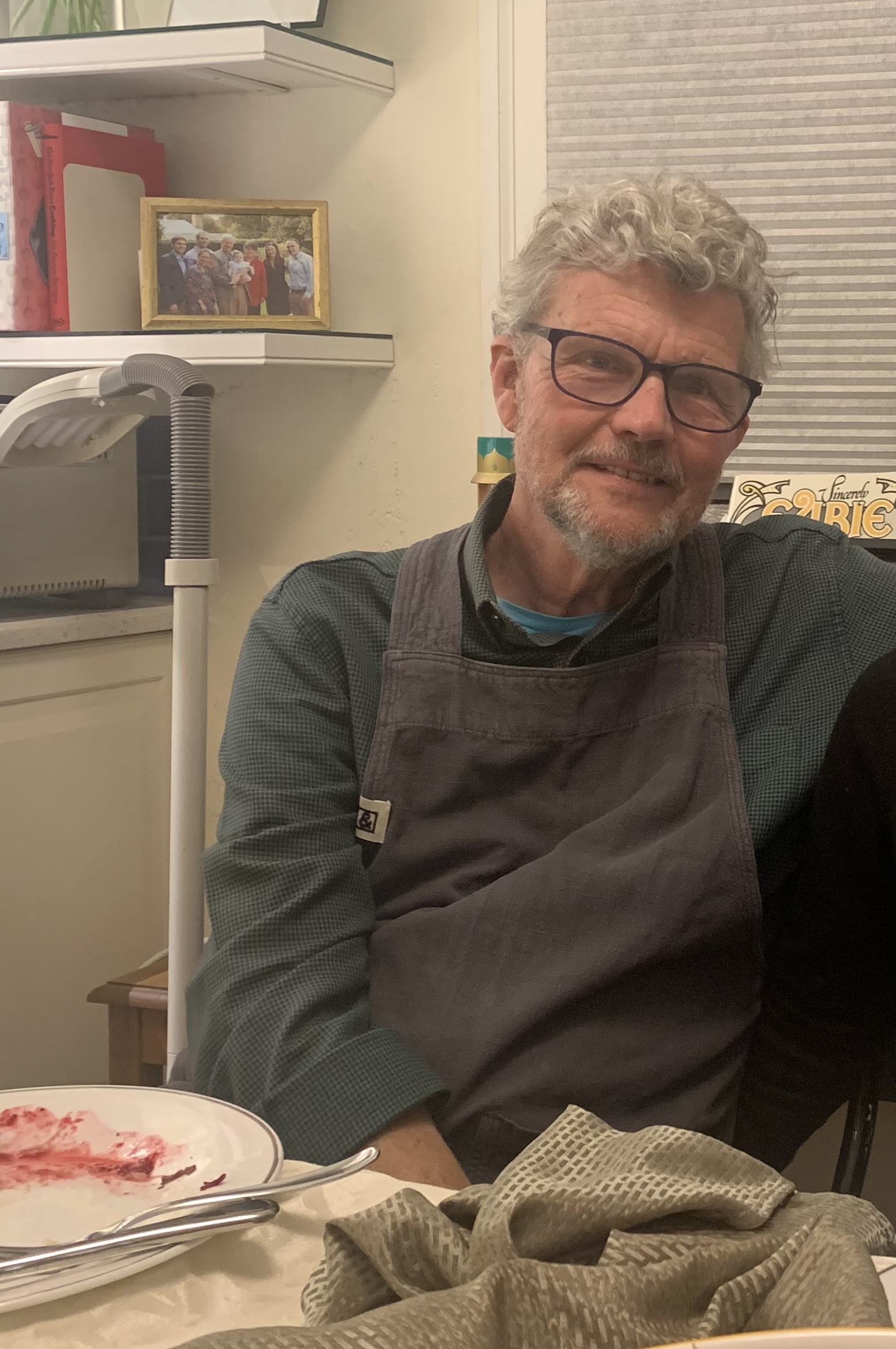
Jeff, Thanksgiving Day at the Bahlerts’ in San Francisco, 11/2025
I met Jesu 15 years ago. He arrived to worship on a Sunday, and after church – like so many refugees who came to church – he asked me for a Bible to take with him to the small apartment he shared with several other men, also refugees, separated from their families. I gave him a Bible – a King James Version – and then I fretted about it all week, the fact that I’d given him a Bible in archaic language. I understood he’d want to learn to read and to speak English well. He showed up again the next Sunday with the Bible I’d given him in his hands. Jesu had realized quickly my mistake. We traded Bibles that day. This time, I handed him a Revised Standard Version, the better to learn a new language.
I learned that Jesu had had to flee his country overnight after being threatened with death by the Tamil Tigers, a terrorist group who was active in Sri Lanka at the time.
My memory of Jesu in the early days of knowing him is that he looked like a deer in the headlights. I am often reminded of what I call the “greater wisdom” of the United Nations to have sent him to such an expensive part of the country. But he adapted well, and quickly, and to becoming a citizen of the United States.
Jesu was a fast learner. And he also worked quickly to bring his wife, Letchumi, and first born daughter to the United States. They arrived some time later. When Simiya stepped off the plane at San Francisco International Airport and walked with her mother to her father, she was surprised. From pictures she’d seen, she had thought that everyone in the United States was white, and there stood her waiting father – as dark-skinned as could be!
Jesu, Letchumi, and Simiya moved into a one bedroom apartment in a neighborhood not far from Lake Merritt United Methodist Church. And from that one bedroom apartment, they have built a new life in their new land. A year later, a second daughter arrived. Letchumi had been surprised when the women of the church gave her a baby shower after worship one day. In her country, the family that was having the child gave the gifts! And so, Saumiya joined the family.
In Sri Lanka, Jesu had been a pastor. He had met Letchumi in the village in which he had his church. In the United States, he is pursuing another path. He has nearly completed his education to receive his license to be a Certified Public Accountant. His elder daughter, Simiya, also attends University to become a CPA. Having been raised so poor, she has her sights on another life for herself. I could see it unfolding in her even before she finished high school. And Jesu and Letchumi see their life now as the stepping stones for the life their daughters will live.
When the new baby girl was still in a car seat, I picked Letchumi up at the apartment one day and drove to the Jamba Juice in my neighborhood in North Oakland. I had spoken to the manager, who I’d come to know, as a regular customer. He agreed to meet Letchumi, to give her a job. While she went to meet with the manager, I walked up and down the sidewalks lining the Safeway parking lot with little Saumiya toddling at my side. And so, Letchumi – who has several degrees from her own country – started at Jamba Juice. That was almost 14 years ago. Since then, Letchumi has become a manager at Jamba Juice. And her beautiful, smart daughter, Simiya, has joined her as a worker at the same store.
*
Jesu and I share a birthday – August 2. In the years since he and Letchumi and their daughters have been here, we have celebrated our birthdays together each August. We also gather during the Christmas holidays, when Jesu and his family bring us a complete, generous, home-cooked Sri Lankan meal. As we sit around the table, we catch up on the activities of Jesu and Letchumi and family, we hear about their hard work and studies to make a new life in a new land. Soon, Jesu will have completed the test to receive a CPA license, and he’ll be looking for a firm in which to work. Letchumi sees her daughters’ futures ahead of them, and she and Jesu watch with pride as their daughters make their way successfully in this place.
Jeff and I think of Jesu and Letchumi and their family as part of our extended family. As we talk around the dinner table at holiday time, we talk about the day in the future when we might travel to Sri Lanka to meet the family there. This year, Jeff teased about our getting too old to make such a trip!
Who knows where our paths will lead us? – Photo by Mary Elyn Bahlert, 12/2025
The year was 1981. That was the year I declared my intention to be ordained as a minister in the United Methodist Church at my local congregation, Kenwood United Methodist Church in Milwaukee. I had plans to attend the Pacific School of Religion in Berkeley, California. Marjorie Matthews, the first woman to be consecrated a Bishop in the Church – the whole Church, across the world, across history – was Bishop of the United Methodist Church, Wisconsin Annual Conference.
At the time, I was still working as a Public Affairs Officer for the Food and Drug Administration, a position I’d taken the year before, after an early career with the Social Security Administration. Through my Sunday attendance and activity at Kenwood UMC I had learned about a trip to England, the “birthplace of Methodism,” where John Wesley, known as the founder of Methodism, had been born, in autumn. I signed up for the trip. I hadn’t been part of the United Methodist Church for very long, and I knew little of the history of the denomination (having been confirmed in the Lutheran Church – Missouri Synod, I knew a lot about Luther and I had even memorized Luther’s Small Catechism) and I thought the timing of the trip was perfect for me as I prepared to leave my career to go to seminary. I signed up for the trip to visit Wesley’s England after securing a passport. I’d never traveled outside of the United States before.
And so the thought of the trip was exciting and well-timed for me. I would be traveling alone, and I hoped to meet a few folks who were also part of the tour. I had learned that Majorie Matthews, the Bishop, would be traveling on the first leg of the trip to London. Knowing this, I’d teased several friends that I’d be traveling with the Bishop, as if she and I were friends.
Apparently, Bishop Matthews was on my flight from Chicago to London Heathrow. When the flight landed, I made my way to the bus that waited for the group to take us to our hotel. As I stepped into the bus, I saw Bishop Matthews standing at her seat. I nodded to her, and she reached out to touch my arm. “Sit with me,” she said. She explained that she’d be in London overnight, as I would, and she asked if I would be interested in being her roommate for the night, to spend some time seeing London. After that night, her obligations would begin, and she would no longer be traveling with my group.
Bishop Matthews loved beautiful clothes. In our free hours that first day, we shopped together in London. I purchased a beautiful black skirt and matching blouse with a floral print that was more elegant than anything else I owned. Bishop Matthews served as my encourager. I was learning by being with her that as an ordained woman, who I was now would be part of who I would become. I could still enjoy the beautiful clothes I loved. I owned that outfit for many years.
And – I had a story to tell my friends when I returned home. Yes – I had traveled with Bishop Marjorie Matthews, the first woman Bishop – ever in history – in the world. I had an outfit to prove it!
*
The following Spring, when I was in Berkeley as a student at PSR, I received a note from Bishop Matthews that she’d be attending a meeting of the Council of Bishops in the Bay Area. She invited me to come to see her. When I did, she introduced me to the Bishop of the Northern California-Nevada Annual Conference, a kind and politic action. I was beginning to learn about the importance of community and how we can be generous to one another.
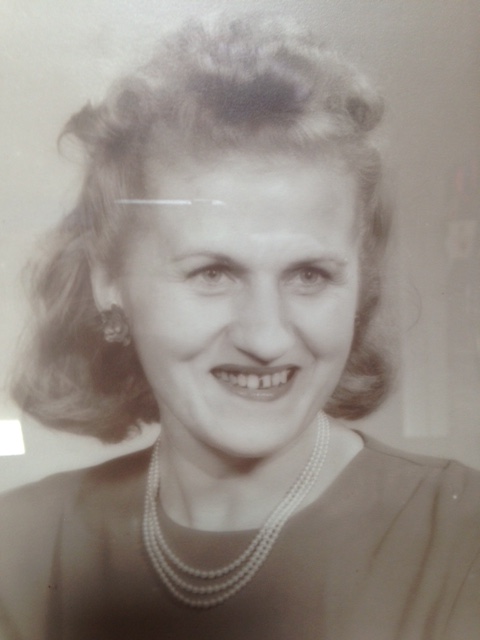
Mom and I stood together in the checkout line of the local supermarket where she shopped in her neighborhood in Milwaukee. I was home on a visit from the Bay Area of California. We always loved those days together, two “Milwaukee girls” who explored the city, finding new and revisiting old sites.
She didn’t say it to me; she said it to herself. In the line ahead of us, an elderly Asian woman and a little boy, who appeared to be her grandson, stood in front of the checker. We heard the checker ask for some amount of change, and the elderly woman, her hand full of coins, turned to the little boy, extending her hand toward him. He peered into her the palm of her hand and chose a coin or two. She handed the coins to the checker.
“And now he feels ashamed,” I heard Mom say to herself. She had seen the moment, just as I had, and I knew then that it had brought forth a memory of some distant moment in her life. She would have been standing at the checkout with her mother, Feodosia, who had never learned to read, and she would have been the child she saw now, looking into her mother’s hand and choosing the right coin. And she had felt ashamed.
I understood then that my mother had a heart for those who are the “other” in our country. I had always known it, having grown up in a house where we did not speak slurs about those who were/are “other.” I grew up learning to respect those who had gone before and to respect those who were different than us, those whose lives had been difficult in ways I could not imagine, those who had left their land and their people so that I could be standing in that aisle that day, a witness.