Uncategorized

You are Shining…

“In Louisville, at the corner of Fourth and Walnut, in the center of the shopping district, I was suddenly overwhelmed with the realization that I loved all these people, that they were mine and I theirs, that we could not be alien to one another even though we were total strangers. It was like waking from a dream of separateness, of spurious self-isolation in a special world. . . .

As if the sorrows and stupidities of the human condition could overwhelm me, now that I realize what we all are. And if only everybody could realize this! But it cannot be explained. There is no way of telling people that they are all walking around shining like the sun. – Thomas Merton, “Conjectures of a Guilty Bystander”

“… if only everybody could realize this…” Merton writes. “If only…”

**

I am more and more taken with the light around me, the light of day, as it creeps into the sky, moment to moment. I often reflect on earlier days of my life, when I was busy, busy with important meetings, busy with preoccupations as I drove from one important meeting to another important meeting, all the time missing, not seeing, the light all around and in me, and in others. Now, I think of my inability to see the obvious all those years as a loss, a loss I can never recover. And now, I want to remember.

Like Merton, I am silently saying: “If only…”

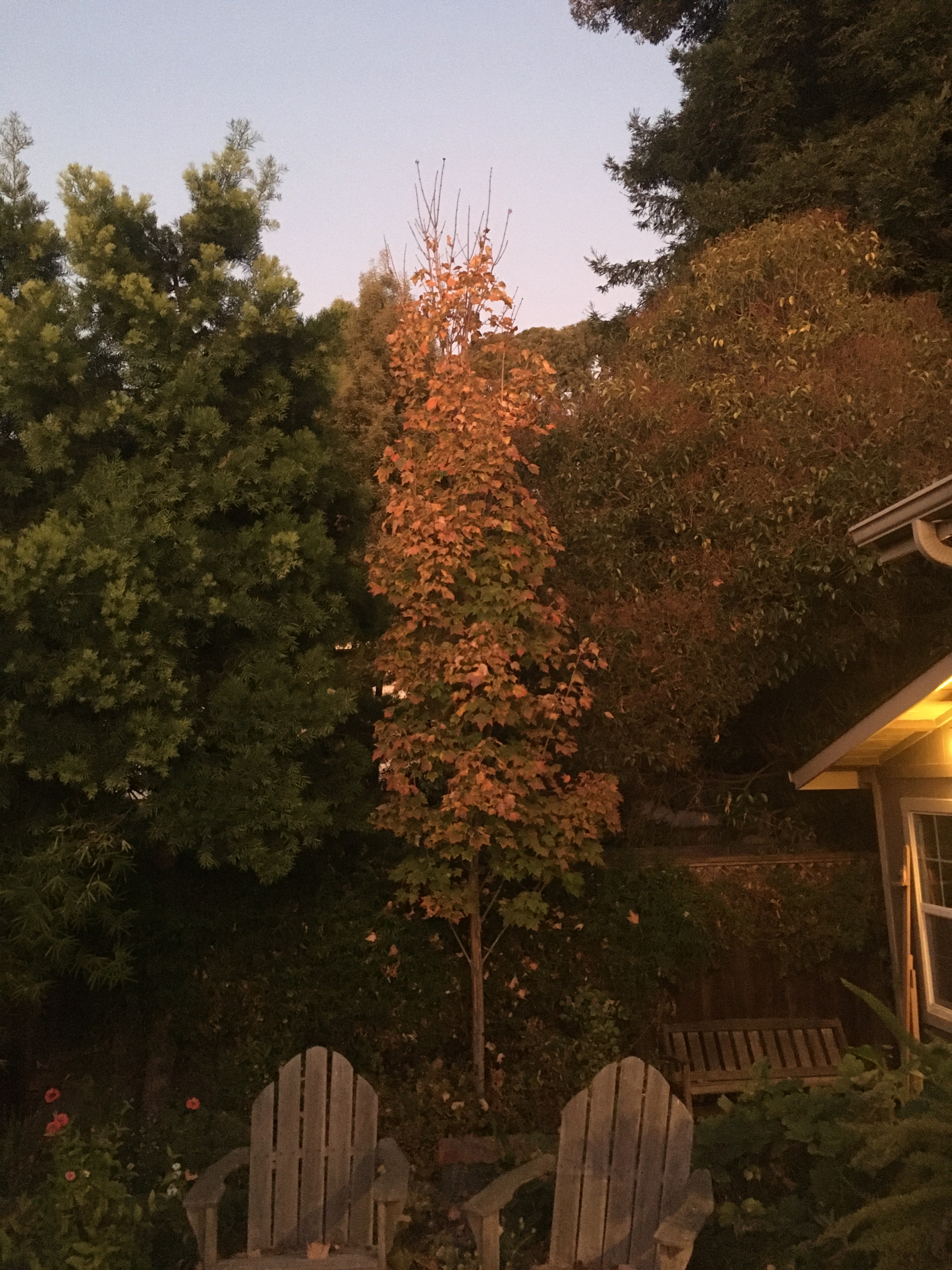
Across from the bedroom window of the home that I live in in Oakland, there is a crimson maple tree.  I love that tree.   I love it, especially, because for just a couple of days, every autumn, and just for a couple of minutes, as the sun sets over San Francisco Bay, the light shines just so on that crimson maple.  And it is lit then, lit with a light that it has at no other time, at no other moment.  I wait for those few moments. sometimes I come out the back door and onto the stoop to wait for the light to hit that tree, just so.

The crimson maple reminds me of the light that is within us. Like the crimson maple, you and I are light. As children, we are that light, but the wounds and frailties of our care-givers, our parents and others, force that light inward – unseen by others – little by little. They do this because their own light has been extinguished. It is our task to use our lives to wipe away all the debris that has hidden that light.

This is not an easy work in life. It’s hard. It hurts. It brings tears, and memories, and losses to our consciousness. You will need courage to embark on this work. If you choose to do this work, you will need a witness, some large and compassionate presence, to give space to the bringing forth of your wounds. There are many paths that allow this work, and you must find yours. That is your mission, if you choose to take it…

I am convinced that it is because we have forgotten the light that is us, that allows for all the hatred and fear in the world. When we look at someone who is not like us in some way – in any way – we see only the outer shell of that person, that person who is suffering, just like us. Murder and war and racism and poverty and greed are only some of the wounds that cover the light. The media is filled with shallow and brittle – and murderous – witnesses to this forgetting.

“It is only with the heart that one can see rightly, what is essential is invisible to the eye.” “The Little Prince,” Antoine de Saint-Exupery

“And now here is my secret, a very simple secret: It is only with the heart that one can see rightly; what is essential is invisible to the eye.” – “The Little Prince”, Antoine de Saint Exupéry

Uncategorized

Sue, Sister, Sweet

I remember when I first named you:  “sister,”
your sisterhood, a gift to me:
you, sitting on the edge of the claw footed bathtub
in the crowded bathroom of an old Milwaukee flat, crying.
Smaller, I sat without a word, until we laughed - again.
Then, I knew:
You are my sweet, sweet sister, Sue.

I remember you, 8 months pregnant – 
	another baby!
- your deep voice, your laughter until dawn
in the Carolina night,
the light from your cigarette, bright in the darkness.
During the day, you were Mom.

I remember you, marching with me to find the classical CD’s in the back 
	of Barnes and Noble.
You bought me Beethovan.
I listened, all spring long, to the minor notes,
mourning another Sue.
Now, these notes are for you.
	I mourn for you.

Sweet, sweet Sue:
Your love was there:
a simple melody in the background of my life.
Your love, that spanned the miles, the years.
I remember, Sue, sweet, sweet Sue.

I remember you.

“I don’t know when I’ll see you again, Sue,” I said into your silence,
your deep hug.
I remember your silent wave:  "goodbye."
(I watched you in the rear-view mirror).
You knew, you knew, you knew, my sweet, sweet sister, Sue.
You knew.

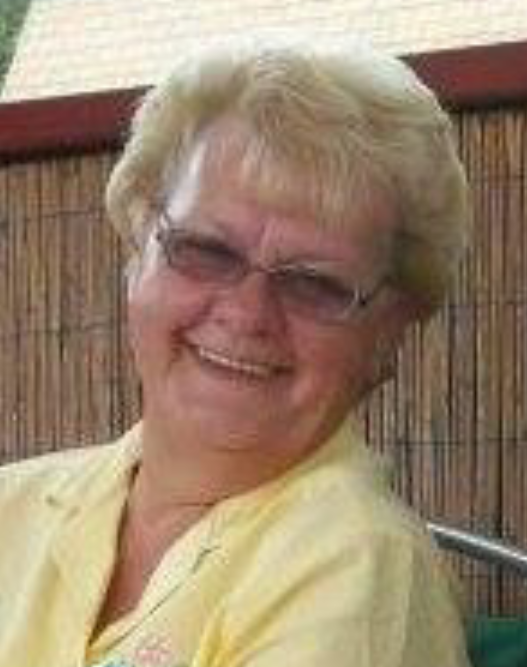
Sue Lass, 1943-2015

Uncategorized

Tribute to Mickey Ganitch – Survivor of Pearl Harbor

“Make a joyful noise to the Lord, all the earth. Serve the Lord with gladness; come into God’s presence with joyful songs. Know that the Lord is God. It is God who made us, and we belong to God. We are God’s people.” – Psalm 100:1-3a

“Mickey’s strong spirit shone through his hard work.  He was ready with a kind word, with a cheerful word.  His eyes lit up as we each were greeted warmly and readily by this man who had known war and spent his life telling the story of what war is like to others. 

When I was the Pastor at Lake Merritt United Methodist Church in Oakland, California, I knew that the community there loved a spirited hymn, and so we sang spirited hymns as often as we could.  One of our favorite hymns as a community was “Marching to Zion.”  I liked to have us sing that hymn as the closing hymn of the worship service, and I would stand at the center front of the sanctuary, just as happy to sing that song as everyone else:

“We’re marching to Zion, beautiful, beautiful Zion,

We’re marching upward to Zion, that beautiful City of God..”

As we stood to sing, a few bars into the hymn, I would see Mickey Ganitch start to march around the perimeter of the sanctuary!  I smile when I remember it, as I smiled then.  Everyone in the sanctuary smiled! Mickey’s joy in life and in service to others was contagious! As Mickey marched, the children would follow, and then the adults, and we’d finish worship in a high spirit, having marched together to Zion! — Mary Elyn Bahlert, Opening Comments, 7/23/2022

Photo taken 7/23/2022, the day of Mickey Ganitch’s Memorial Service aboard the USS Hornet, moored at Alameda Air Station, Alameda, California. Photo credit: Mary Elyn Bahlert

Uncategorized

Darlin’ Be Home Soon

Come
And talk of all the things we did today
Here
And laugh about our funny little ways
While we have a few minutes to breathe
Then I know that it’s time you must leave

But, darling, be home soon
I couldn’t bear to wait an extra minute if you dawdled
My darling, be home soon
It’s not just these few hours, but I’ve been waiting since I toddled
For the great relief of having you to talk to… John Sebastian, 1965

When I was a child, when I was growing up in the flats in Milwaukee, my sister and I were in bed before Mom and Dad. Mom and Dad stayed up to watch the news at 10 pm, and shortly after, the television turned off, they went to bed.

My memory of those days is of the soft, quiet talking they did before they went to sleep. I don’t know what they talked about. In the evenings, after the supper dishes were taken off the table, they sat at the kitchen table and played Canasta, most nights. And from the living room where I watched television, or from my bedroom, where I studied, my back propped up against the headboard of my bed, I could hear their laughter and shouts of happiness at having won.

By late evening they returned to the living room to watch the news of the day. Then, the flat was quiet, except for the soft, quiet talking they did before they went to sleep. I don’t know what they talked about. Dad fell asleep first, of course, and then I could hear his snoring, sometimes having cut the conversation short in the middle of a sentence. And Mom, I know, lay awake for a long time, her anxious mind, her memories filling the space that could have been filled with sleep.

Jeff and I are often quiet in the evenings, reading, chatting a bit, fussing with small tasks around the house, and we both go to bed at about the same time, but we don’t often talk once we go to bed. A few evenings ago, we were talking for a few minutes after we’d gone to bed, and Jeff said: “we’re talking in bed, just like your mom and dad.” He had remembered my telling him about that small intimacy I had known as a child, I expect because his parents didn’t like one another much at all, it seemed. And his remembering recalled those times in my own mind.

From the first time Jeff and I met, I felt as if the John Sebastian’s words, written years earlier than our meeting, were written for us. They still are.

Uncategorized

Big Brother

A few years back, my brother in law, Thom visited my husband and me in Oakland, while Rainier, his younger son lived with us during his college years. One night after dinner, Thom and Rainier, a friend of Rainier’s from school, and Jeff and I sat at the dinner table for a long time after we’d eaten. We were having fun, one of those conversations that happens when we’ve known folks for a long time, when our history together is the framework for a long conversation. At some point, Thom asked me if I was comfortable, sitting there, talking with only men. I was taken aback by the question, and Jeff answered for me. He explained that I’d grown up with a father and brother who liked me, and as a result, I was comfortable with men. As difficult and nuanced as relationships – in particular, family relationships – can be, I was interested and grateful to hear Jeff’s answer. He had said something that brought to consciousness a particular nuance to an important relationship in my life. Within that consciousness is gratitude.

Ronn was nine years older than I was, born to my mother and her first husband at the beginning of World War II. During the War, while Ronn’s father was in the service, Mom was a single mother. My mother’s parents looked out for Ronn when she was working, or when she bowled, one night a week, with the women’s league from Cutler Hammer in Milwaukee. Ronn grew up at a different time, surrounded by different people than me, surrounded by my grandparents, who spoke a different language. After the War, Mom divorced Ronn’s father. He grew up as the son of a single mother.

Nine years older than me, and beginning with my first memory, Ronn was part of what family is to me. Mom told me more than once as a girl that, after I’d spent a week in the hospital because I’d suffered a seizure – a week without seeing my mother or father – she brought me home during the day, and I looked at her out of my big eyes, unsmiling, until Ronnie came home. Then I smiled, for the first time that day.

My sister is almost five years younger than I am, and she has few memories of having her big brother at home. I’ve read that we often grow up in different homes than our siblings – birth order, gender, connection to same and different gender parents playing a big role in how we come to know and relate to “home,” or “family.” I expect Ronn’s experience of home was very different from mine. Those differences would play out in major ways when we grew into adulthood.

Of the handful of memories I have of being very young, a memory that includes me and Ronnie stands out. To this day, it tells me about him,about myself, and about our relationship to one another. The memory must be from around 1958, based on information about Buddy Holly’s life – and death. We were sitting together on the couch, watching Buddy Holly on the black and white television screen. Buddy Holly! (That’s a long time ago!). As Buddy Holly performed, Ronn, sitting next to me on the red velour couch, turned to look at me and said: “He’s wearing glasses!”

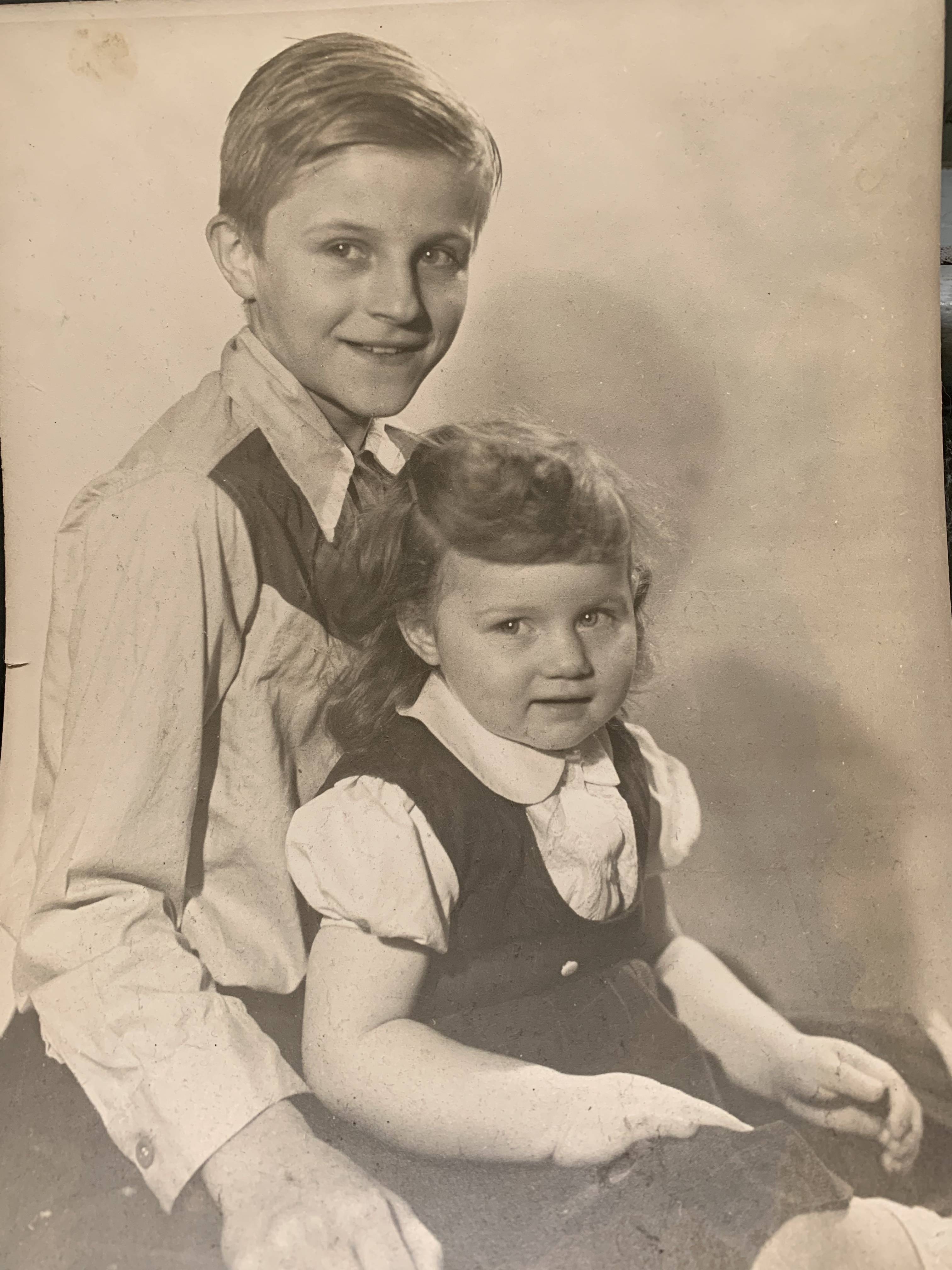
Ronnie and me, circa 1953

Whenever I remember that moment – I am filled with understanding and gratitude. I knew, without his saying so, that my big brother was self conscious about his having to wear glasses. He was a skinny, tall kid (taller than any of the rest of us in the family), and his comment betrayed his insecurity. And I knew, still know, that I was someone important to Ronn, my big brother, so much older, his life a different trajectory, as our lives would attest to, years later. Ronn had difficulties I did not have, as the son of an absent father. I had an intact family. Ronnie was lost, in a way; I grew up knowing that I belonged to this particular family, for better or worse.

Ronn has been gone a long time now. The night before he died, his granddaughter held the phone to his ear in a hospital in Jacksonville, Florida, while I cried and told him I loved him – my big brother. Ronn’s legacy – a large extended family, children and grandchildren and great-grandchildren – continues to grow. My family legacy is small, I often think.