I love to be aware of the changing light as each season gives way to the next: spring to summer, summer to autumn, autumn to winter. Sometimes now, as I grow older, I note the times of sunrise and sunset in my calendar, watching one season gently curve into the next season.
It’s not a coincidence that the date of Christmas follows closely on the heels of the winter solstice. Through the ages, people have observed the changing seasons, the days with darkness fast on their heels, coming before it’s time for dinner. When I was younger and not conscious of how quickly one season rolls into the next, -and how unrelenting the changing of light was/is, I complained as I left work at 4:30 in the afternoon, the sky already in nighttime darkness. Night falls early in northern climates. It takes the strong spirit of a human being to hold on to hope when darkness is the longest part of each day. No wonder the ancient people honoured the darkest days. No wonder they lit fires, bringing warmth to the darkness. No wonder our ancestors danced in the darkness, dancing to remind the light to return!
No wonder that people of different faiths honor this time of darkness, before the Light comes!
Thankfully, each cycle of the year continues to roll in a circular fashion, bringing us back to the time of darkness, not stopping, but rolling on, the end of this year, the beginning of the next.
As Christians, we honor this season of darkness by telling the story of the Child, born into a dark world to bring Light to wounded hearts. We tell the story again and again, because, like human beings of all times and places – we need to be reminded. We hold on to hope, the promise of the child whose life lays before them, and in that way, we hold on to hope for ourselves. In a Season of darkness, we come with our begging bowls, begging for Light.
Merry Christmas!
Reflections at Sunset, 12/2022, photo by Mary Elyn Bahlert
Magic seems to permeate this season of the year, the time when the darkness descends upon us – literally – and we are full into the darkness. In my life and spiritual practice, it is certain that when I descend into the darkest place, the light, the new emerges. The promise of those who have gone before is that there will be light, there will be another day. And another day arrives, new – Magic.
When I was a child, my sense of wonder provided a kind of Magic. On Christmas Eve, my non-churched family attended a church to be present for the children’s program. I was among the children who stood to recite the Christmas story, verse by verse, for the gathered adults, the sanctuary filled with lights, the light of candles, the smells and sounds of a place with a cold winter: cold hands and faces, warm wool outerwear. What I remember about those Christmas Eve times is the sense of Magic I held as a child – that Magic itself something holy, something that would pass away, away from me as I entered puberty and young adulthood. Nothing can replace the Magic of that time and place, still clear in my memory.
A few days ago, as the light of the day was ending, Jeff finished his work on the strip of land we call, “the Panhandle,” where he has lately installed a neighborhood library – a beautiful wooden box complete with a glass door that a friend crafted to suit the vision Jeff and I had. As soon as the library was installed, a few books appeared. One day, I watched as a woman I did not know stopped her car and delivered several books to the library. Our vision has come to life! Our vision is useful! Our vision is beautiful!
That day, as the sun set over San Francisco Bay, barely visible from our windows on View Place, Jeff stepped into the kitchen and looked out to the West as the sun was setting. He had cut the branches of a tree in our yard that had hid the site we were seeing. Jeff called me over to stand with him at the window. And there – there! – as if the moment was for us alone – our own screen on the sun setting over the Bay – the outline of downtown San Francisco, coated in grey fog and lit by the lights of the City – shone before us. Magic! I named our view, “The City of God,” and we stood for a few moments as the vision faded, as the sun sank lower into the Pacific beyond the City. Then – gone.
The simple gifts of light, of a tree with golden leaves about to fall, of my cat who comes to sit close to me on the couch to receive a good petting, of an old recipe for borscht that gives us a week of meals. These simple gifts are Magic to me.
“The City of God,” photo by Mary Elyn Bahlert, Oakland, 12/2022
I lead a weekly group at a center for disabled adults, here in the Bay Area. Each week, we open with a prayer and we talk about something in our lives – our memories, our worries, the people we love who are no longer with us. We close with prayer.
The week before Thanksgiving, we talked about the upcoming holiday season. We remembered what the season was like for us, some of us recalling events that happened decades ago. We talked about what was hard for us during the holiday season. Each of these memories brought back the images, the laughter, and sometimes the sadness, of these times, remembered.
I always wait until everyone else has spoken to share my own answers to the questions. I remembered the yearly outing to buy the Christmas tree, years ago, when my father – he was “Dad” in our family – and one of us, or the rest of us would go to pick the Christmas tree. Winter can start early in Southeastern Wisconsin, and that fact is important to my memories. Dad was real fussy about the tree that we would choose to bring home. So we’d walk down the rows of trees, smelling the pine that was a harbinger of the season to come. Dad would stop, pull a tree that leaned against the others from the row, and hold it up – so we could get an idea of how tall it stood. When I was little, the trees were really tall – clear to the ceiling of our old Milwaukee flat. As my siblings and I left home and Mom and Dad were alone in the apartment on Appleton Avenue, the trees seemed to grow shorter. Or maybe it was me…
Finally, as we endured the cold, the smell of the fir trees, the sound of bells – always – and the darkening sky – sometimes flurries of an early snow – we’d find the right – the perfect – tree. Dad would secure it in the trunk of his Chevy BelAir, and we’d drive home.
When Suzie and I were really little, Mom and Dad decorated the tree after we went to bed on Christmas Eve – in the old-fashioned, European way – so that we awoke on Christmas morning to the beautiful tree, decorated, icicles hanging, thick and luscious, standing tall in the corner of the living room. The smell of the pine needles we’d smelled in the tree lot now filled the room. Mom was careful about the icicles on the tree. Every evening during the season, she’d get up from her chair and arrange the hanging silver strings so that they were perfect, not resting on the branch below, but hanging in the air, like the huge icicles that hung from the edge of the roofs. Late at night during winter, from time to time I would hear an icicle fall, flying past the window to the snow covered ground that wound around the side of the house.
As we grew older, Suzie and I helped decorate the tree, and over the years, the tree began to appear in the front window earlier and earlier in December.
Every year, the same ornaments were hung on the tree. When some of the ornaments were taken from their careful packing and placed on the tree, even when silver trees and flocked trees were popular, our house boasted an “old fashioned tree”. We never tired of it. I never tire of a green tree, recently cut, even now.
The tree stayed up, decorations and all, until Epiphany – Mom called it “Russian Christmas.” Epiphany marks the celebration of the birth of the Christ in the Orthodox tradition of the Christian Church, Epiphany the event when the Child was presented to the world, visited by the Three Wise Men. After the holiday, the pain-staking work of removing the ornaments, the oval lights of many colors, and the icicles began, each item carefully packed in the boxes that had been around since before I was born, and set aside in the attic until next year.
Next year doesn’t come anymore, at least in that old way. I still like a real tree, and the ornaments that Jeff and I remove from the boxes each come with a story, like the days when they hung on my mother’s tree. We remember who gave us the ornaments, we guess the time in our own history when they were added to the family’s tree, and we note the newer ornaments, too, those given to us by friends or the people in our parishes. Some lie in the box, wrapped in the same paper Mom had wrapped them in, years ago. Like my parents’ ornaments, each one comes out of the box with a story, and with the story, a memory. A bit of sadness comes along with the decorating of the tree, as the people we love are remembered, along with funny stories that probably weren’t funny at the time. Now, we laugh often as we remember. We feel sadness, too.
This year, Jeff will hang lights on one of the trees that stand at the side of our house. We want to bring a bit of holiday light to the neighborhood, to the neighbors who pass our house every day, and to their guests. We know now that the season of the Coming of the Light is honored by many traditions, not just ours, and knowing of the festivals of others enriches our own. Here in the Bay Area, we respect these differences by saying, “Happy Holidays” to one another. Our youngest niece honors the season with her mother as they light the candles for Hanukkah on the menorah, standing next to their Christmas tree. Some of the old traditions remain; new traditions are made. On Christmas Eve, when we go to bed, I’ll leave a local radio station playing on the radio in the living room, the empty room – empty except for the beautiful tree – filled with the sound of holiday music as we sleep.
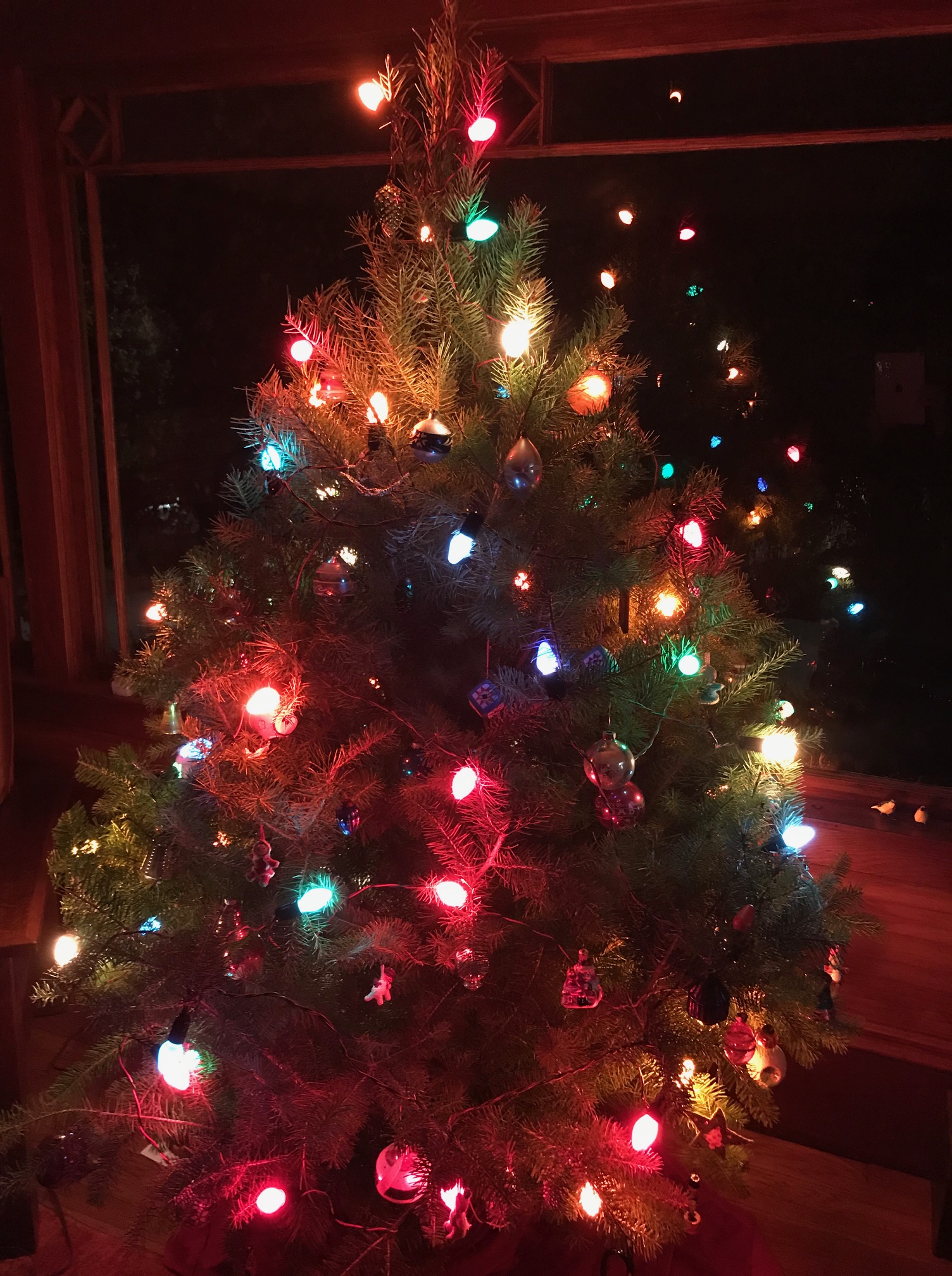
Photo by Mary Elyn Bahlert, December 10, 2020 – COVID Christmas Tree
In the Mediterranean climate in the Bay Area, we know the weather, the sky, the light is changing, heralding the coming holiday time. The changes are subtle here, but the leaves fall from some of the trees, and the color is changing – the color not only of the trees, but the light in the sky, the early darkness. It’s winter now. The Season of Holidays has arrived.
The Bay Area is a diverse area of the country, and here we respect many traditions and the holidays they honor. Many of them reflect this time of darkness, this season. In my own faith tradition, we enter the liturgical season of Advent, four Sundays before Christmas Eve and Christmas Day, four Sundays filled with stories of those ancient, ancient people who longed for a Messiah – waited for the Coming of the Messiah. In the darkest time of year, we honor the Coming of the Light, the Holy One. In the darkest times of our lives, we long for someone to save us, for someone to come to us who will fulfill our longing.
I have always loved the time of Advent, those four Sundays before Christmas. As a pastor, I worked as hard as I could to have the good church folks “stay put” in the season of Advent, to have them hear the stories of the faith as if the Light had not come, to sing the songs that tell the story of the people who wait. As the autumn gives way to winter, we watch the days grow shorter. The sun falls earlier each day into the west. The last rays of each day come earlier, day by day, until we know the longest night. We are fully in the darkest time, then, we exist within it. Although we know the Light will come – as it has before – we still must live within this darkest time.
Advent is a time of darkness. In our lives, we know Advent well. A marriage ends. A depression has its hold on us – longer than we can bear, it seems. A relationship that is floundering goes on and on until its participants are exhausted with the ending. An illness has us in its grip, and though we long for it to end, it does not. The times of emptiness go on and on, without subsiding. We know so well these times of Advent, before we come to a time when we will breathe again.
And we are in that season, now. Of course the churches will begin to sing the Christmas Carols – soon. Too soon, for me. I want to honor, to respect this time of waiting, of preparation, of darkness. And there will be time for the lights to be hung on the tree, to be lit each evening as soon as the sky becomes dark. There will be a time for the Light. Are we afraid of the darkness? I want to write: of course we are. Who doesn’t want the times of sorrow, the grief, the depression, so hard to bear, to end? Who doesn’t want the light to come on so that we can see our way down the hall? But there is that moment of darkness, there is that season of darkness – when the promise is held before us – waiting in the wings – but not given.
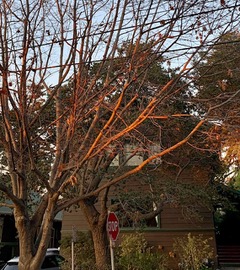
Early Sunset, Autumn. Photo by Mary Elyn Bahlert, November 17, 2022.
In “Fiddler on the Roof,” there is a heart-wrenching scene of the Jewish people of the village Anetevka being forced to leave their beloved village, their home, during the Russian pogroms (massacre or persecution instigated by the government or by the ruling class against a minority group, particularly Jews). The people are packing the few belongings they can carry, along with animals, onto carts and make-shift vehicles. What to take? What can they leave behind? They will leave behind that place they loved – we all love our homes, don’t we? – not only the home, but the place, the land, the sight of light on those trees, the fragrance in spring – and walk away to where? Can somewhere else be home, surely? The tailor, a man with a young family, asks the Rabbi, then: “Rebbe, wouldn’t this be a good time for the Messiah to come?” The old Rabbi looks fully into his eyes and says: “We’ll just have to wait for him somewhere else.”
Wisdom, in the heart of tragedy, of horrific loss.
We wait for the Messiah these days, also, as the War on Ukraine – invaded by Russia – drives on, for many months. How long will the people suffer? We wait for the Messiah when we are ill, or when someone we love is ill, and there does not seem to be an end to it. We wait for the Messiah when the price of gas goes up an up and – up – and although it is expensive to us, it is too much for so many others. We wait for the Messiah to come into the lives of refugees fleeing from war in their own homeland or fleeing because there is no water in their land. Refugees who are walking now, today, this moment. They, too, must be waiting for someone to save them.
We wait for Someone – Something – to save us.
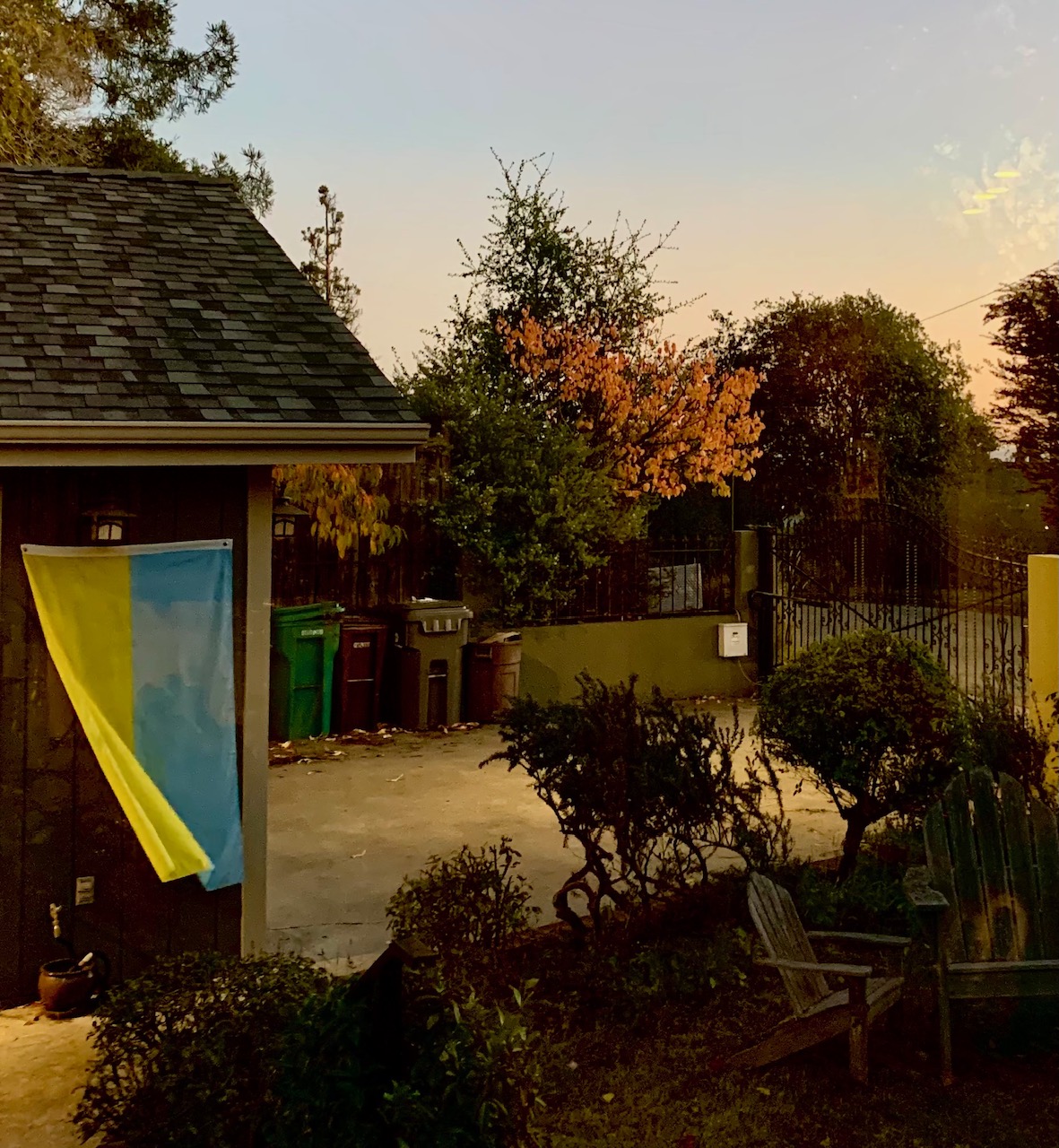
Deep Dusk, Oakland, 11/12/2022 – Mary Elyn Bahlert