memories, remembering, Uncategorized

Auntie Edna

“There are places I’ll remember. All my life, though some have changed. Some forever, not for better; Some have gone and some remain…” Lennon and McCartney

Our yearly trips to Door County seemed to have a pattern, and the pattern included visits to various aunts and uncles – my father’s siblings – who lived close to where they had been born. At some point during the week, we would drive for a visit to Auntie Edna’s house, close to the tip of the Door Peninsula, at Gill’s Rock. The road that ran to the north of Auntie Edna and Uncle Werner’s (we said, “Verner”) place led to the dock to the ferry to Washington Island.

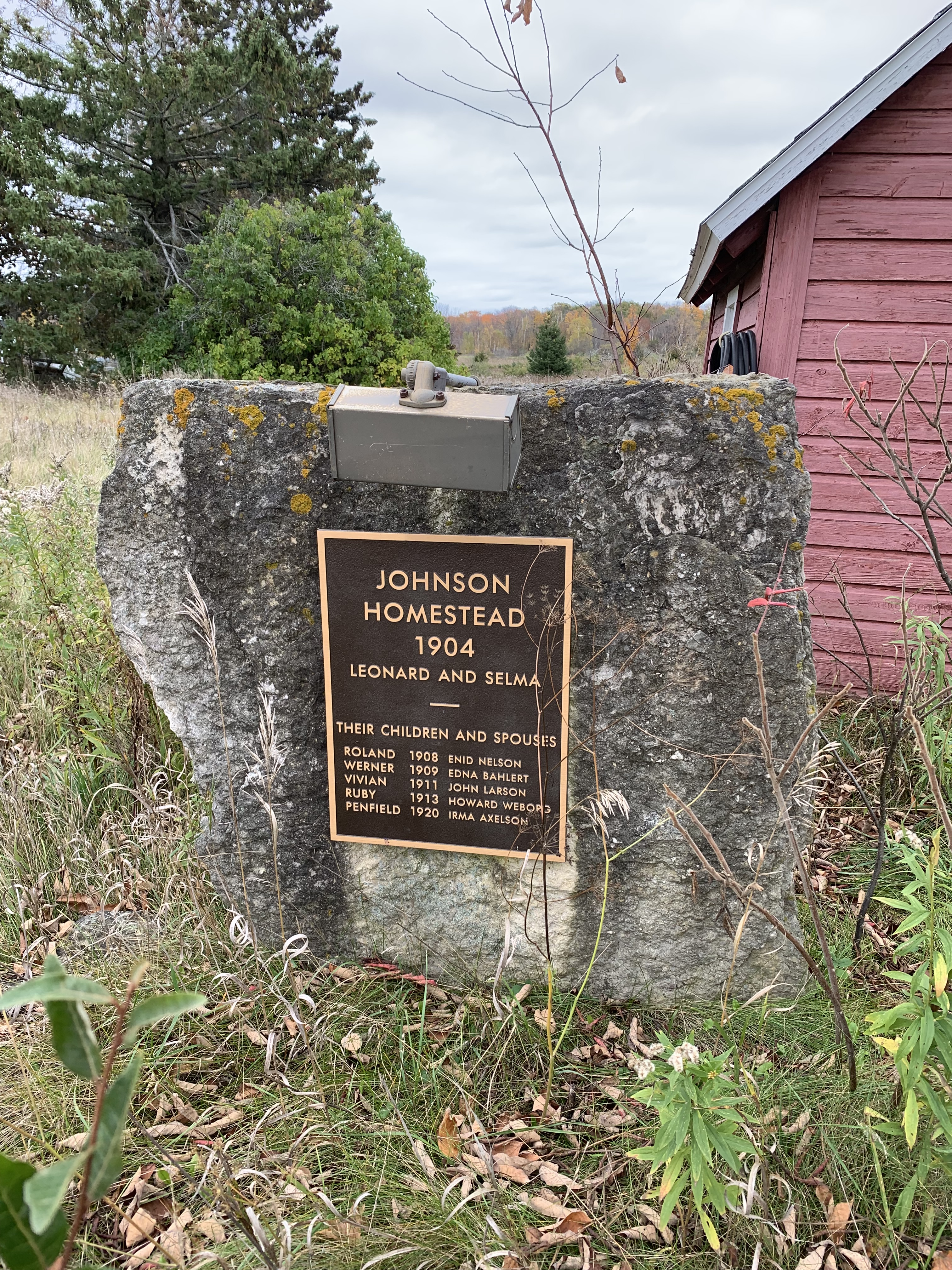
Edna and Werner had lived in that house for many years longer than I had been alive. My cousins Donna and Dean had been born in that place. On my trips to Door County now, I always drive past the brown-shingled house with the cherry orchard to the East. On the edge of the property on which their home stands is a plaque: “Johnson Homestead 1904, Leonard and Selma” the names of their children with years of birth, below. My Uncle Werner, who spoke as if he’d come straight from Sweden, had been born there! Years later, the thought would come to mind that his first language had been Swedish.

For a living, Uncle Werner had fished the tumultuous waters of that part of Wisconsin, Green Bay, Death’s Door to the North ( the native people had named that passage between Green Bay and Lake Michigan). He also raised the sour cherries that grew abundantly in the rocky soil of Door County.

The visit to with Auntie Edna and Uncle Werner began in their living room, with both Edna and Werner seated in their large, comfortable chairs. I sat in the same place each time, also, and I would look to that part of the long, narrow room toward the places we did not sit. Did they ever go into that part of the house, I wondered? Did the Christmas Tree go there?

Dad and Mom, Suzie and I sat formally in that living room, Dad with his cap in his hand, doing most of the talking. Of the lot of us, he was the most extraverted. Uncle Werner seemed to have a twinkle in his eye; I always thought that in his way, he was laughing at us. Auntie Edna was one of the quiet Bahlerts, and so she sat quietly in her chair, asking questions. Gentleness radiated from her presence. After awhile, we’d all get up, and Auntie Edna, Mom, Suzie and I would move to the small, dark dining room, where she served us juice and cookies. I remember her kindness, her ability to listen. When I went to the bathroom before we left the house, I’d glance into their bedroom, and always wondered why they slept in two single beds. At home, Mom and Dad slept together.

Years later, I would come to know my cousin Donna, who worked in Milwaukee and made the trip to the Door Peninsula every week to get her clothes washed, to be home again. Her life was much like my father’s had been, a generation before. While I was in college, I made the trip to Door County with Donna for a weekend, and she took me to her lifelong haunts. After she retired, Donna would marry Jim Thorp, who had lived his entire life on the Door Peninsula. They would live in their double-wide trailer, a short walk away from Donna’s folks.

On the Sunday of our week in Door County, we’d go to church at the Moravian Church just down the road from Werner and Edna’s place, and there she would be, my beloved aunt. In her quiet way, she was a presence.

Once a week, Edna wrote a column for the Door County Advocate about happenings in that place, so beautiful in the summer, with long bleak winters. When we had had our yearly visit, our names were mentioned in her column.

When we are a child, it’s hard to imagine these elders as being young, but sometimes I try to piece together the bits and pieces I heard, often repeatedly, into a pattern. I knew that Edna had graduated from high school, something not all of her siblings had done. She spoke as I spoke, not in the dialect of that place that my father had. Her father, Ginter Bahlert, my grandfather, had wanted her to go to college to be a schoolteacher, but that was not to be. She worked for a time at Bunda’s Store in Sister Bay, an establishment that lasted there until at least the 1970’s, on the West Side of Highway 42, on the South end of town, before she married Werner. I think of her every time I pass the building that once housed Bunda’s Store, the Sister Bay Bowl across the street, still standing.

It is odd, in a way, hard to understand that these places are still there, and the people I loved gone now, so long.

Photo by Mary Elyn Bahlert, October, 2021

Uncategorized

A night visitor

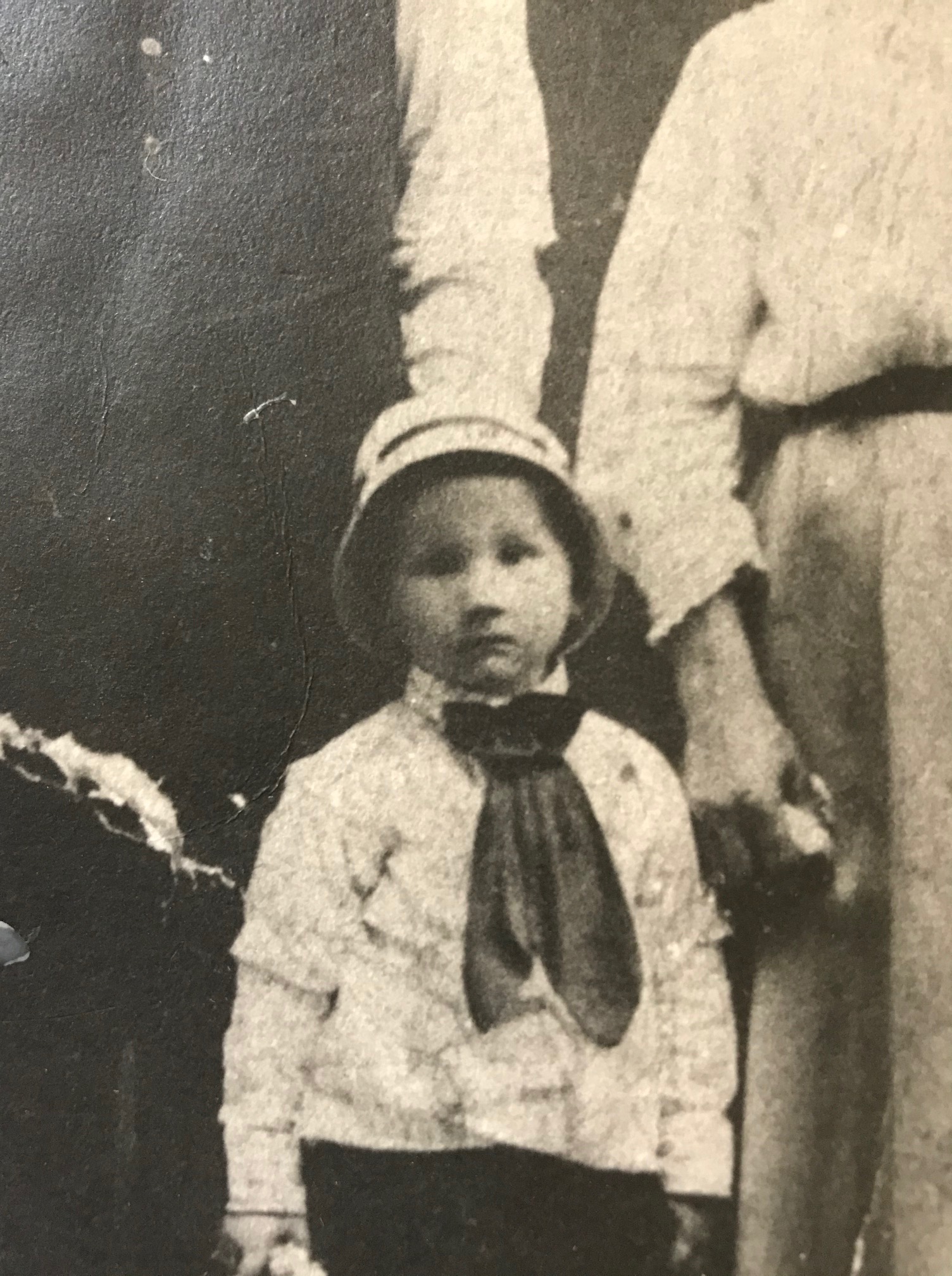
My Grandma, Frances Markowski – Feodosia Machsuda Srebna – had been born in Ukraine and came to the United States in 1914, before the Soviet Revolution that took that land and swallowed it into itself. A picture of her as a young woman with her young son, Ivan/John, and her husband, Vlas/Alex sits on the cabinet under the window in my dining room.

As a little girl, I looked over the railing of the porch on the second floor of the flat on Ring Street to see my grandma walking slowly, head down and covered by a scarf – she was a true “babushka” – her long dark winter coat covering her legs, up the alley to sit with my mother in the kitchen, to have a talk in the language that was native to both. In later years, Mom would often forget much of her Ukrainian first language, only speaking a word or two, sometimes with humor, with her sister, Anne, or one of her brothers.

Grandma died when I was in high school, and her funeral was the last that my parents went to without me and my sister, Suzie. A few months later, my mother’s younger sister died, as if to follow her mother. Years later, her son, my cousin Mark, would tell me that he thought his mother – who was already battling cancer – gave up after her mother died.

After Grandma’s death, my mother went to the cemetery a few times a year to clean up the graves of her father and mother, a sort of homage. When I went with her, she’d send me off with a bucket to the water spout on the road that ran past the graves and I’d come back, the bucket filled with the water, so that she could tend to the dead. A few years ago, Jeff and I returned to the cemetery in Milwaukee, and when we drove into the gates, I provided directions that took us right to the graves. I have not forgotten.

***

I wasn’t thinking of Grandma at all when I entered seminary in 1982 in Berkeley. One early morning, before sunrise, as I lay sleeping in my small room in the dormitory apartment that I shared with two other women, I was awakened by a presence in the room. I knew it was Grandma. I knew. She came into me that early morning. Frightened by this unbidden presence, I called out to Jesus.

Was I haunted? Why did she come to me? I asked the questions, longing to know, in a conversation with a friend. “Who else would she go to?” Her answer.

Jeff speaks of that time as a “haunting,” but I’m not sure. I do know that she lived with me, in me, for a number of years. And over the course of that time I wrote the series of poems I call “The Feodosia Poems.” They are her poems, not mine. She was an illiterate woman from the Old Country, and I am a woman of the New World, privileged, educated.

My mother told me she did not remember her dreams. But she remembered a dream one morning when I was visiting in her apartment. Just before she awoke, she dreamed she was standing looking at the back of a truck. The back of the truck rolled up, and there, looking at my mother, was a Matryoshka doll, a nesting doll. The doll’s face was her mother, my grandmother. She winked at my mother! And Mom woke up. She recounted the dream to me when we talked over coffee that morning.

A black and white photo from the 1950’s is the only photo I have of Grandma with a light in her eye. She sits between me and big brother Ronn, already a teenager, trying to look “cool.” Maybe we brought some joy to her.

How I wish I knew her better, my Grandma, my babusya. And maybe, I do.

Me, Grandma, Ronn, circa 1955

Uncategorized

O, the Places You’ll Go!*

These days, O’Hare Field in Chicago is just another airport. Since many flights have changed over the course of the years we’ve all been living with Covid-19, Jeff and I fly into O’Hare and drive to Wisconsin on our trips “home.”

Flying into and out of O’Hare Field is a sort of home-coming – and a home-leaving – to me.

O’Hare Field stands in my mind as a character of its own. O’Hare Field holds a particular place in my memories. I was in my late teens before I flew in an airplane, and I was in my early 20’s before I met O’Hare Field. As I walked through the terminals – everything so much bigger than in Milwaukee, 80 miles to the north – and I observed the people in that crowded, crowded airport – I was transported into another life, a life filled with a kind of diversity that I had not seen in my coming up life.

I loved it! I loved all the different people, people traveling from other parts of the world, distant places that I was not sure I would ever see. Turks, their heads held proud, covered, and women, long skirts around them as they herded their children from one gate to another. Strangers with their eyes focused ahead of them, focused on where they were going, eyes and hearts reflecting where they had been. I didn’t imagine my life at that point, a life that would include trips to foreign places, distant places that I was not sure I would ever see! And I have seen some – many – of them.

And so my world was opening, before I knew it was, before I was aware. The life that someone had dreamed for me – maybe I dreamed it myself – was beginning to lay itself out before me. I’ve lived most of my life in the Bay Area, a long way from Milwaukee, a long way from O’Hare Field. I often say that the weather is more interesting back in Wisconsin, but the people are more interesting here, the diversity of people who land here in the Bay Area from around the world.

*thanks to Dr. Spock

Uncategorized

Tears and a gift

Several years ago, Jeff and I initiated scholarships in our names at the University of Wisconsin-Milwaukee, where we both received our BA’s in the 1970’s. Later, each of us would make our way to seminary, Jeff to Garrett Evangelical Seminary in Evanston, Illinois, and me, to Pacific School of Religion in Berkeley. How our journeys connected to form the journey of our bonding is another story, for another time.

I graduated from UW-M in the winter of 1973 and was hired almost immediately to train as a Claims Representative for the Social Security Administration. In a way, that’s when my life as an adult began, when my world began to open, to grow, and finally, to flourish. I left government service to enter seminary at the end of 1981, which marked my move from the Midwest to California. Sometimes even now, I have to stop to remind myself that I am in another place, that most of my life has been lived at a distance from my personal roots. And in my case, that is fitting.

As Jeff and I look to our past and our future, we both have held the value to serve – and to give back. I listen when I hear someone else use that expression: “I want to give back to the community where I came from…” And so, after I retired, I endowed a scholarship in my name, to be given annually to a student who is the first generation of their family – a student of color – to go to university.

The Office of Planned Giving at UW-M connects with the two of us at least once every year. Through our connections, we think of the University representative as our friends. Often, when we return to Wisconsin to visit family or to return to the places we still hold in our hearts, we have a visit. In the course of COVID-times, of course, we’ve had to meet online, to continue the connection.

This spring, Jeff and I met the new woman who is assigned to the Office of Planned Giving. Over the internet, we introduced ourselves. When it came time for me to talk about my scholarship, to explain what it meant to me, I had a surprise: tears. (Maybe the tears surprised her, also)!

I’m not a crier. I don’t think of myself that way, although I have, over the course of a lifetime, cried many tears. And I suppose there is something deeper that is touched in me, that I have this privilege, that I’m able to give back, that I want to give back, that I want to offer to open the door for another young person, whose times and life will be very different from mine, to be able to walk through that door.

As always, as I am often am these days, I am grateful.

Like my life, our spring garden has flourished! photo by Mary Elyn Bahlert, 6/2023

Uncategorized

What does this mean?

During Junior High, besides my studies in school, I attended weekly, Saturday morning classes at an Evangelical Lutheran Church. For two years, the teacher of our Confirmation Class was a Deaconess, probably the highest position a woman could serve in that particular denomination. In the third year, our teacher was the Pastor of the congregation, Reverend Hoffman. Because I went to a public Junior High, I was expected to study for three years in preparation for Confirmation as an adult member of the congregation. My good friend Nancy, who lived with her grandparents in the neighborhood near my house and the church, also attended the classes.

One year, we studied the travels of St. Paul, whose work figured highly in the denomination. We looked at large maps that hung from the wall of the classroom, and the Deaconess used a pointer to chart out the travels of Paul as missionary to those faraway lands, in what we now call the Middle East. And, over the course of the three years of weekly classes, we memorized Luther’s Small Catechism. “I believe in God the Father Almighty, Maker of Heaven and Earth…” and: “What does this mean?”

Nancy must have had a hard time sitting through those three hours of study on Saturday mornings, in addition to a week of public school. She expressed her having a hard time by acting out in some way. One Saturday morning, the Deaconess had had enough of Nancy, and so she sent her home, early. Later, as I left the building to walk home the two blocks to Medford Avenue, I met Nancy, sitting on the front steps of the Church. She had no intention of going home early to her grandparents’ house!

***

My family were not church-going people, and so, I was not a church-going young person. I survived – easily – the grueling “examination” before the Congregation, led by Pastor Hoffman, the week before we were to be confirmed. It was a large class of Confirmands, and the Pastor would call out a name and ask a question about the studies we had completed. The following week, on Palm Sunday, we were confirmed as adult members of the church. We received our Certificates of Confirmation, and a little box of envelopes for our tithes.

My family were not church-going people, and I was not a church-going young person, and so I attended church one or two times on my own before I stopped going entirely. A year or two later, I received a visit from the Deaconess, who had the charge to learn why I had “fallen away.” I recall bits of our conversation, my explanation that it seemed to me that the Hippies, with their talk of “love,” were expressing something like the Church’s teachings. I recalled that at one time during Confirmation Class, the Deaconess had used me as an example to the class of someone who would never drift away from Church! Now, I’d apparently failed her. I never did receive the visit from the Pastor, the next in line to question my failing faith.

Several years later, while I was studying at University, a surprising idea came to mind: “why couldn’t I be a Pastor?” I tell people now who inquire about my journey that I had not seen or even heard of a woman pastor! It would be several years before I found my way to a United Methodist Church with a thriving young people’s ministry led by a charismatic, politically involved Young Adult Minister who gently “took me by the hand” and led me into the Church. The Reverend Harvey Stower, had invited me, by his gentle guidance, to have a relationship with Jesus, and to show my faith by my life and actions in the world. And on one occasion, he asked me a question – no one had asked before: “Do you ever think about seminary?” His question allowed my unspoken yearning to come to the surface. His example of ministry, his work for justice, always, his walk with Jesus, was far-removed from the memorization and testing I’d encountered in Confirmation Class.

Still, I’m always grateful for the sound sense of theology and Biblical understanding I’d received during those three years of classes in the Lutheran tradition. As I grow older, looking back, I see that my life has had a trajectory of its own. Often, I was too anxious to trust that trajectory. But here I am, a fulfilling life of service behind me, and a deepening spiritual journey, still. As I like to say, “I’ve taken a drink from many cups.” I’m grateful.

A respect for all faiths: The Blue Mosque, Istanbul, 5/2023, photo by meb