At the Center Street Library Larry Bartis and I Strained our necks To read the titles on the row of books At the top.
“A Man’s Journey,” Larry said. “Rising to the Moment,” I read. “At the End,” he whispered.
As each book introduced itself to us We giggled, louder and louder: Gleeful, happy, Shoulder to shoulder – I felt joy in my whole body And shyly looked at the laughing boy:
I love the diversity of the Bay Area, where I’ve lived for over half my life. As I walk on the busy shopping street in my neighborhood, I’m happy when I hear languages spoken by the people who pass me on the street. As I walk past the store fronts that line the street, most of the languages I hear I can’t identify. All the better!
For many years, I said, from time to time, that in the Midwest, the weather was more interesting – and more rugged, of course! – than the Bay Area of California. But the people were more interesting in the Bay Area. They still are, to me.
As a pastor in downtown Oakland, I was enlivened by the diversity of folks who arrived to worship with us – folks who brought their diverse backgrounds, languages, music, dress, and all the gifts of another culture – to the mostly white congregation that had chosen to stay in Oakland when there were other choices they could have made. I loved the heart of that place, where in years past the people had decided to cast their lot in the city, a city with its share of problems, of poverty, of violence. I loved them for choosing to stay in Oakland.
Today was Pentecost Sunday, and I had the honor of preaching for an anniversary celebration at Oakland Chinese Community United Methodist Church in Chinatown, Oakland. I read my sermon in English, paragraph by paragraph, and the Pastor of the congregation followed each paragraph with a Cantonese translation. The two of us, each speaking our own language, brought to mind the myriad of languages that were spoken when the disciples left the Upper Room and became apostles who went out to tell others about what they knew of God, and of Jesus. “Now there were staying in Jerusalem God-fearing Jews from every nation under heaven. 6 When they heard this sound, a crowd came together in bewilderment, because each one heard their own language being spoken. 7 Utterly amazed, they asked: “Aren’t all these who are speaking Galileans? 8 Then how is it that each of us hears them in our native language?” (Acts 2:1-8).
Jeff accompanied me to the celebration, and we were the only white people in worship. Many times here in the Bay Area, we are minorities – seldom in other places, or in Wisconsin, our birthplace. As we said the Lord’s Prayer in English, I listened for the voices of most of the others, praying in Cantonese, at the same time. A young man who had been raised in China read his statement of faith to the congregation, recounting how he had found his way to the Church, followed by the Pastor translating into English; then, he was baptized. A holy moment.
Diversity has its problems, to be sure. But it’s good to be in a place where people who are different are not afraid, where folks can speak in their own language as they shop or as they walk down the street, and be safe. That’s not true in many places in the United States now, or in so many other places.
As we walked to our car after worship and after receiving the generous meal we all shared together in the fellowship hall, Jeff and I stopped to wait at a corner for the light to change, across from a Buddhist Temple that brings the Holy to those others who do not worship as we do. I’m grateful that they are here.
We crossed the street and drove home to our little house on a quiet street in another part of the city.
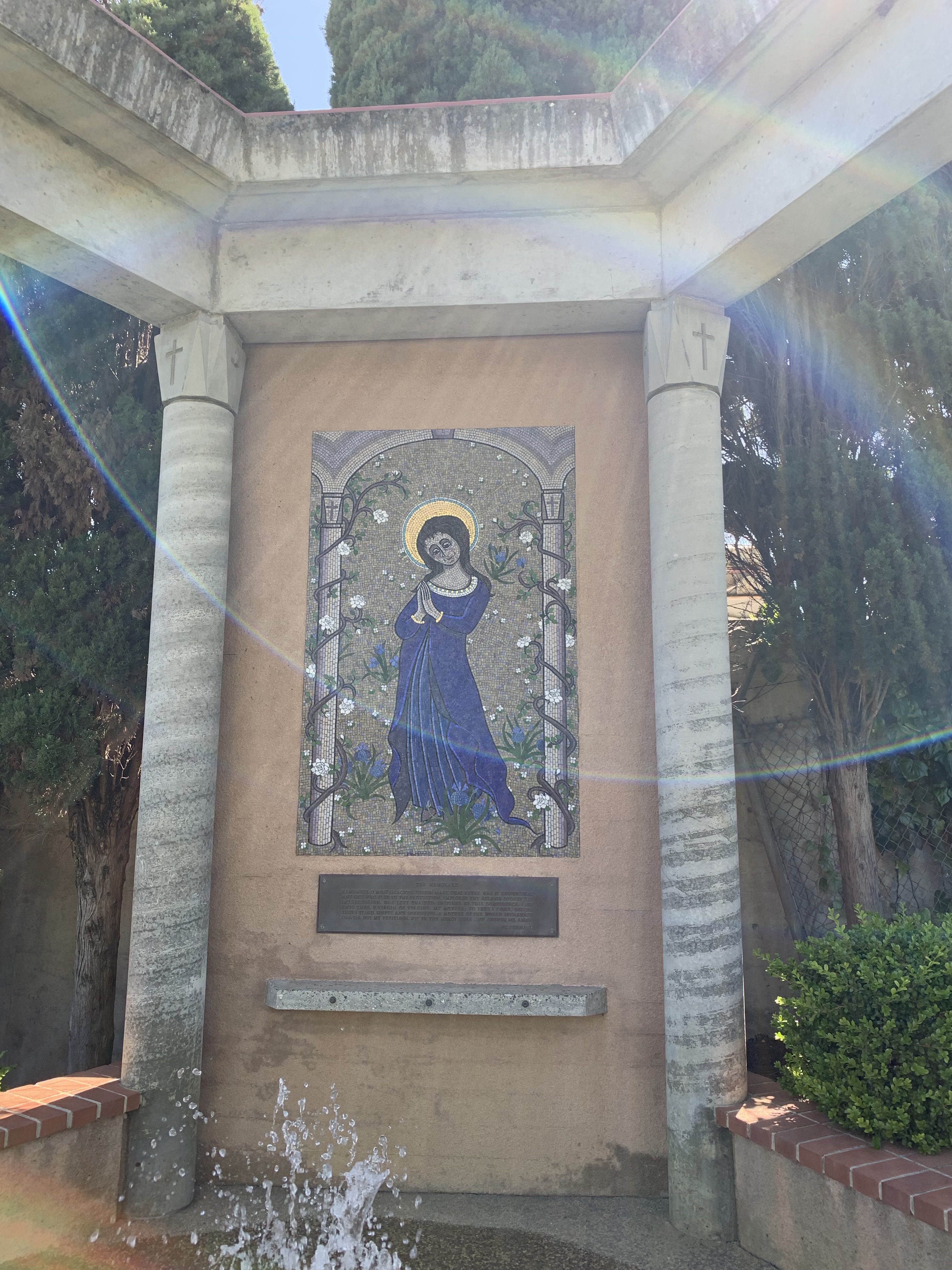
In St. Mary’s Cemetery, Oakland. Photo by Mary Elyn Bahlert, 4/2024
Our mothers have passed, many years ago, now, but we remember that for many others, this day of honoring mothers is being celebrated. For Jeff and for me, though, it’s another Sunday when neither of us has the work of the Church on our minds, a Sunday all to ourselves, a Sunday to fill with moments that belong to us alone.
And so we get up early – as we do every day – and our early morning is filled with getting ready for the day, like any other morning. And then, we drive to Martinez, to walk along the Carquinez Strait, a series of walking paths along the Strait, with its view of the hills and the water. Other faithful folks walk on Sunday mornings, also, and most are friendly, passing with a smile and a few kind words.
The paths are level, the hills are in the distance, green, turning now to brown again after a winter with a lot of rain. As we walk, we see a ship, returning from the Pacific, coming through the strait. When I see a ship, I’m reminded that I’m not in Wisconsin anymore, haven’t been, for over half my life.
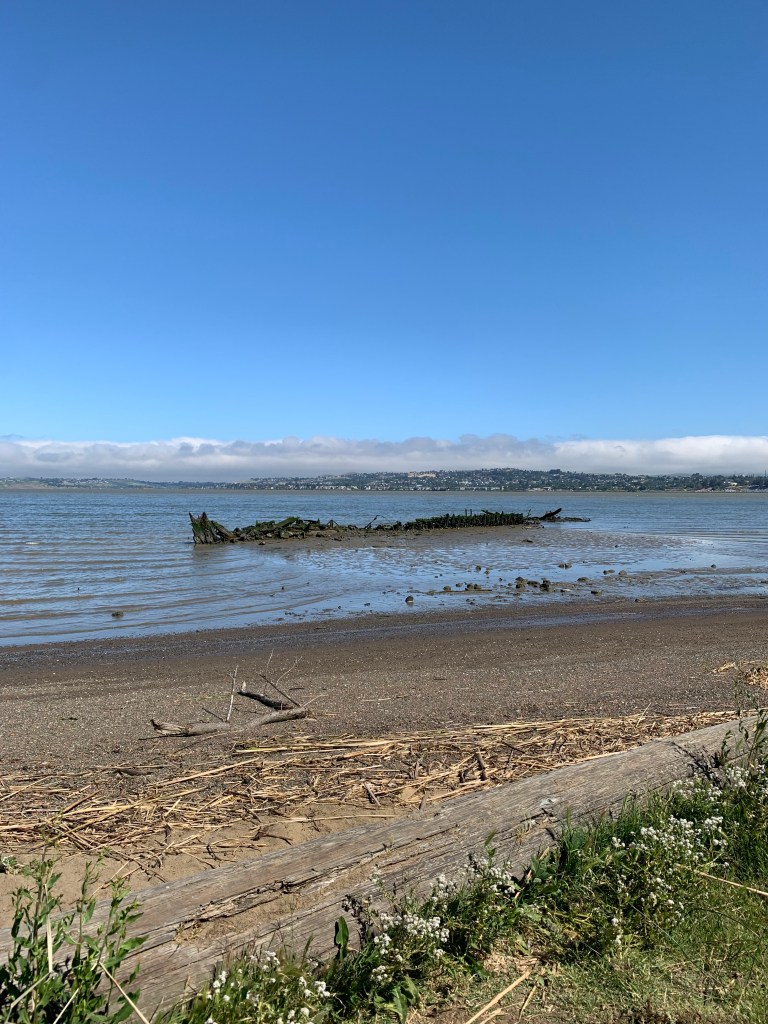
We pass the ruins of a shipwreck from the last century, and read again the plaque with its story, its history of how it ended up deserted, sometimes hidden by the tide when we walk past. Today was lovely, a wind gliding past us, making the air a bit cool until the sunlight got the best of the temperature and we were warm.
The remains of a shipwreck, stranded here for the last century, Martinez, California
Photo by Mary Elyn Bahlert, 5/2024
We’ve walked at the Slough many times over the past four years. In the early months of Covid-Time (a season of its own in our lives), we felt strongly the freedom of Sunday mornings – mornings without churches to go to, mornings without sermons to deliver – and we set out to walk in some place outside our own very walkable neighborhood in Oakland. We walked through almost twenty neighborhoods in San Francisco over the course of many months. We walked along the Bay in Oakland, where we discovered a new development right on the water – Brooklyn Basin. We walked at the sea shore in Half Moon Bay, looking down on the Pacific from a high path. Usually, when the walk had ended, we’d find a cafe to sit outside, to continue our luxurious Sunday morning, to have a cup of coffee, before getting back into the car to return home.
When our friend Joanne arrived from Wisconsin to stay with us for a few days last winter, I took her to the Martinez Strait to enjoy the paths there.
We loved the paths and the breeze we discovered at Martinez, and we have returned there again and again, now that life is back to a “new normal” after the ravages of Covid-Time. Often after our walk, we drive closer to downtown where the main street is bustling with a Sunday morning Farmers’ Market. We leave with a couple of bags of fresh vegetables to enjoy the rest of the week.
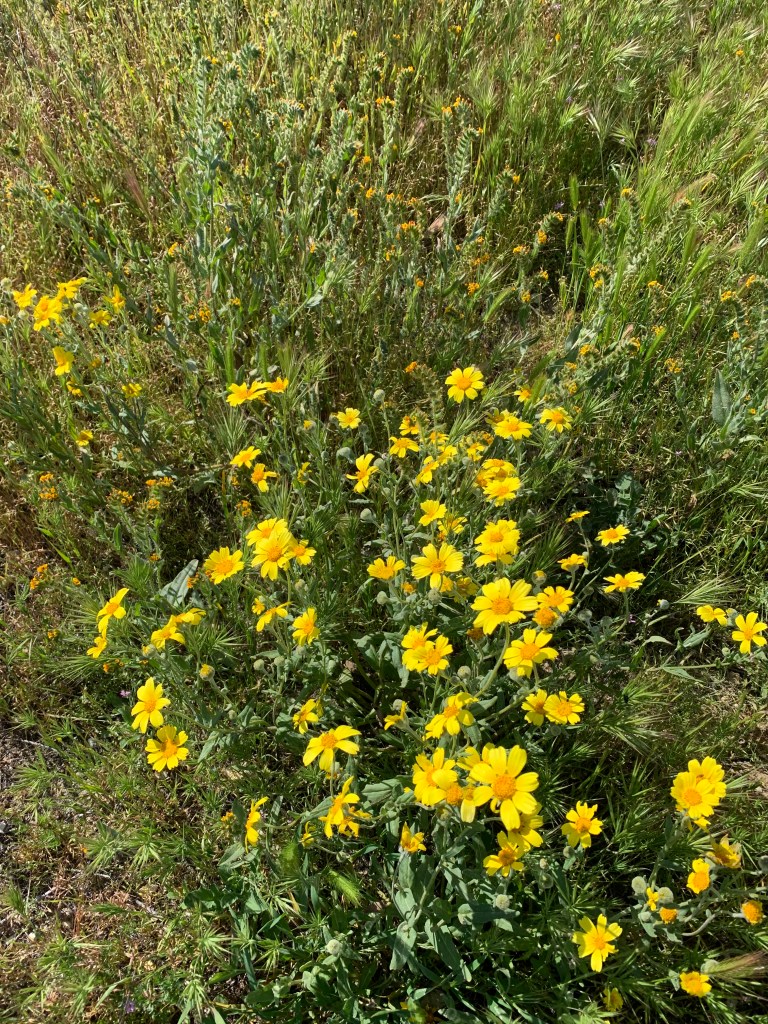
Along the path, along the slough…
Photo by Mary Elyn Bahlert, Martinez Slough, 5/12/2024
From time to time, I reach into my mind and bring out the lines – sometimes many lines – of poems that I memorized during my Junior High years at Peckham Junior School in Milwaukee. I’ve written that I lived – literally – on the other side of the tracks, and I walked the mile or so every day with other kids from my neighborhood.
As I walked that mile, I left one world and entered another – I entered the world that would enlarge my world view even more than the excellent teachers who had been mine in Elementary School. School teachers in that time – the early 1960’s – all seemed to wear, every single day, a navy blue dress with white polka dots, the hem long, almost to the tops of their black, low heeled shoes. At least that’s how Miss Ross dressed.
For three years, Miss Ross was my English teacher. And the great gift she gave me remains with me to this day. Every week, we were assigned a poem to memorize. The poets were American poets, of the old school, poets who wrote in rhyme – iambic pentameter, I learned – educated people of the last century or the early years of my century.
Every Friday, Miss Ross called one of us to the front of the room to recite the poem we’d been assigned to memorize. One by one over the course of a semester, a student, shy and afraid, calm and sure, bumbling or not, walked to the front of the class and spoke the words of a beautiful poem aloud.
Quiet and a bit shy, I did not tremble or even fear that I might be called. I had an inner assurance that stayed with me as I walked to the front of the class, stood in front of the row of seats close to the window, and recited aloud the poem I’d learned by heart.
Now, I hold onto the gift that Miss Ross gave us all. I can be with a small group of friends and begin to recite aloud the rhyming lines of a poet from another time. As I recite aloud, my friends are silent, listening. We all know something beautiful is being offered to us all in that moment – to me, enjoying again the rhythm, the carefully chosen words, the image that comes to mind as those words are repeated aloud, to my listener, who knows they are receiving something grand, something well-crafted.
During the holiday times, between Thanksgiving and New Year’s, I make sure to recite for some small audience “‘Twas the Night Before Christmas,” a poem I memorized after I’d moved on from Miss Ross and into High School. The joy she’d brought me by making an assignment I was sure to complete is mine, to this day. And the joy belongs to others, to those who listen.
One Christmas Eve, as we ended the candlelight service of carols and the reading of scriptures that told the ancient story, once again, of the Holy coming into the world, I closed the service to the rhythmic stanzas of “Stopping by Woods on a Snowy Evening” (Robert Frost). The gathered worshippers listened as we held our candles high above our heads, silent, listening. We have no snow here in the Bay Area, but the words, the sentiment, were silent and deep, too, as the poet writes:
“the woods are lovely, dark and deep, but I have promises to keep, and miles to go before I sleep, and miles to go before I sleep…”
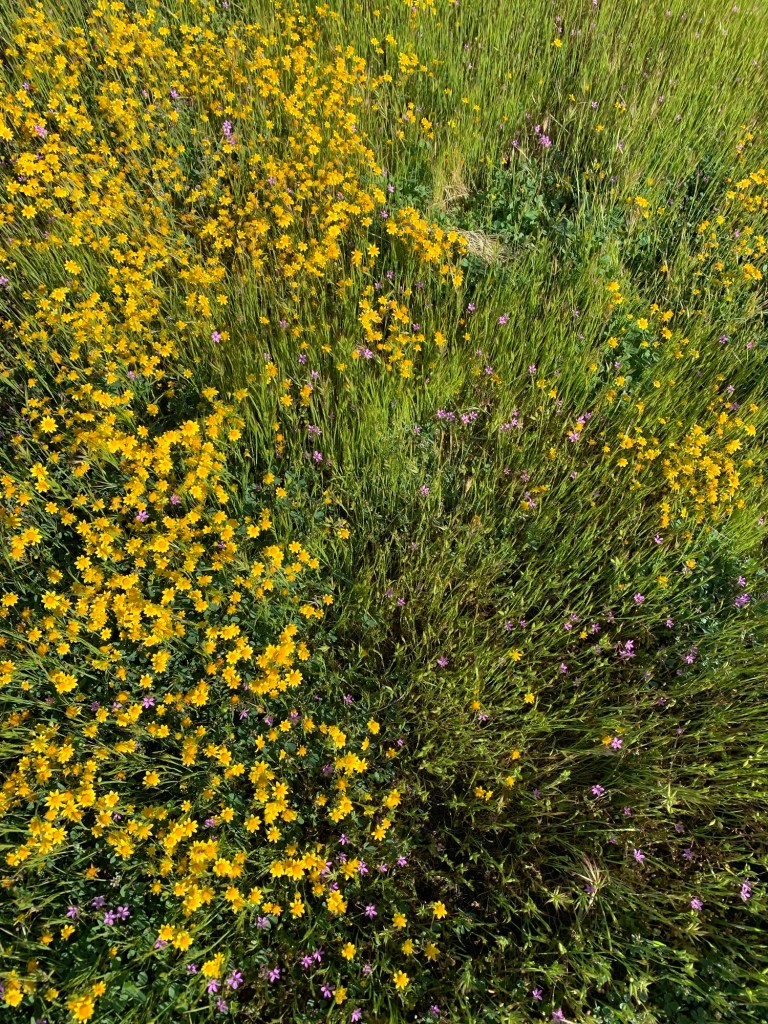
“I will be the gladdest thing under the sun. I will touch a hundred flowers and not pick one.” – Edna St. Vincent Millay, “Afternoon on a Hill,” photo by Mary Elyn Bahlert, 4/24
Sometimes when I think about my life, I think I came from what we called “The Old Country.” The Old Country was how my mother referred to people who – like her parents from Ukraine – had immigrated to the United States. Many of the customs and much of the way we lived then, in the 1950’s and 1960’s – were ways that had strong connections to the Old Country.
Summers in the Midwest can be brutally hot and humid. By the late afternoon, we tried to find respite from the heat by running an electric fan near the screen door that led to the front porch of the upper flat on Milwaukee’s North Side. Even the whirring fan did not change the oppressive heat in the flat. Several days during the summer, after Daddy came home from his job in the steel mill, Mom and Daddy and Suzie and I set off for a secluded, leafy spot on the Milwaukee River. Daddy had changed into bermuda shorts – he’d been liberated from wearing long pants all summer some time in the 1950’s – and the car was quiet except for his talking, all the way across town to our spot.
We carried wooden poles and Daddy carried a silver bucket with water sloshing against the insides, and a package of raw liver – bait for the cray fish we were about to catch.
I never did like to touch the sharp edge of the hook at the end of the fishing line, so Daddy baited the hook with a bit of slimy liver, and I dropped my line into the river, and waited. Soon enough, the line would be pulled down a bit into the brown water and I’d pull up my end of the pole, a crayfish holding tight to the liver on the hook. I’d swing my pole toward the shore – hoping to not hit Suzie or Mom – and drop the writhing crayfish as close to Daddy as I could. He’d pick the crayfish up by sliding his fingers along the fishing line, pull, and drop the catch into the silver bucket.
Then, he’d bait the hook for me again, and I was back at it.
We still made it home to the flat in time for an early supper, after Daddy had carried the silver bucket, now heavy with crayfish, into the basement. One time, a crayfish found its way out of the bucket – how did that happen? – and he had to chase it around the cool floor of the basement until he picked it up again and dropped it into the bucket with its companions.
The next day, Mom boiled a big pot of water on the stove, and one by one, the cray fish were dropped into the steaming water where they stopped their frantic moving and turned bright red. Mom served the crayfish to Daddy while she made supper for the rest of us.
I never did get to taste a crayfish. I didn’t want to. But I can still find the place where the leafy path led to the river, down a few steps from the sidewalk, where the lush trees muffled the sounds of passing traffic.
Now my summer adventures are to the desert in California. Photo by Mary Elyn Bahlert, 04/2024, at Joshua Tree National Park in Southern California – where two deserts meet.