When I was growing up in the 1950’s, children still went out to play with the other children in the neighborhood. From our upper flat, Mom could keep an eye out for me while I played. I expect most other Moms did the same. In the summer time, she could step into the back hall from the kitchen and take a look at me through the screen door that opened to a small porch on the second floor. Then, she could go back to her own day.
The streets and alleys were full of little people then, children riding tricycles, older children giving orders to younger ones. I can still picture the house where Michelle Froehlick lived – they had the whole house! – and I can see the back of Randy Larsen’s flat that faced the other street when we all met to play in the alley. Randy Larsen – who gave me my first kiss in the alley, and whose name is on the Vietnam Memorial in Washington, D.C.
One of my first memories is of me taking a bath, and Mom helping me to take a bath at the end of a day of playing. As she cleaned me up with a washcloth dripping with soap, Mom reached across me and without looking at me, as if her words were an aside, she said: “I saw you hit another little girl while you were playing today.”
I can touch the sense I still have of the little girl in that moment, her mind moving quickly, her clarity as she answered: “It must have been another little girl who looked just like me.”
And I saw the smile appear on Mom’s face as she turned her head away from me to hide that smile. I don’t remember another word spoken between us then.
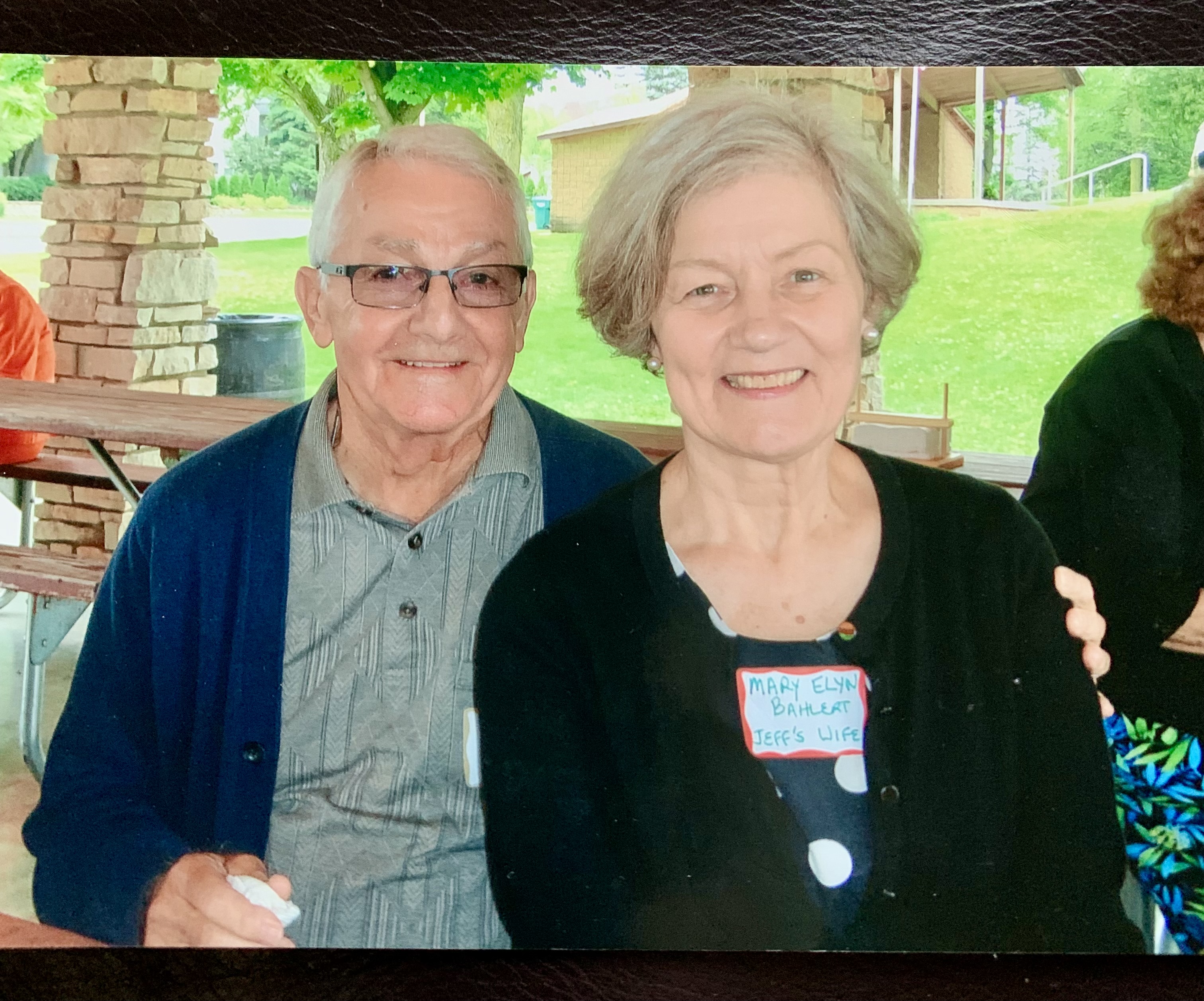
Hoping to not get caught… photo by Mary Elyn Bahlert, 8/18/2024
My niece Vicki Sue is a new grandma now, her first daughter, Heather, having provided her the title with the arrival of Savannah several weeks ago. Every day, I receive new photos on my phone, with Grandma and Grandpa holding the little one.
Which is why I share this Thanksgiving story, a story which takes place at the time when now Grandma Vicki was the smallest, the youngest member, of our family.
Our family – Mom, Dad, sister Suzie, brother Ronn and Sue and their family, which consisted at the time of David, Alicia – and Vicki Sue, were all together to enjoy the meal about to be served. Mom worked hard in the kitchen all morning, and, as was our custom, the table was set for the Thanksgiving Feast at about mid-afternoon. The upper flat on 49 Street on the North Side of Milwaukee was crowded, those little rooms stuffed with the adults and little ones as we awaited the feast.
Suddenly, someone noticed that the littlest member of our Happy Thanksgiving Gathering (the mood about to change…) was missing. Mom, Sue, Ronn walked through the front rooms and into the kitchen, and into the tiny hall where the bathroom and two small bedrooms emptied, calling out: “Vicki Sue!?” “Vicki Sue?!” Mom Sue or Dad Ronn – I don’t know which – heard a small voice, behind the closed door to the bathroom!
“She’s in the bathroom!” someone yelled.
The door handle was tried. The door didn’t budge. The door handle was tried – again. Then the real antics began. Mom Sue and Dad Ronn and Big Brother David and Big Sister Alicia and Grandma and Aunt Suzie and Aunt Shugie all gathered in the small hallway, all bending at the waist, mouths as close to the height of a toddler as we imagined, loudly giving the toddler – who was locked in the bathroom (!) – instructions for how to unlock the door.
We tried. We really did. As situations like these do, the moment escalated, the voices getting louder, and more voices joining in the yelling – the yelling that was an explanation, of course, to the little one on the other side of the door. She didn’t cry. After all, she had plenty of attention; it’s just that the attention was all on the other side of the – locked – door.
Grandpa must have stood on the outside of the crowd gathered in the small hallway outside the bathroom with the locked door. Sometimes, while he loved the little ones, loved to visit with them, hold them in his lap, talk to them – the noise that a house full of little ones provided was a bit much for him. It was now, anyway.
Grandpa marched from the hallway to sit at the head of the dining room table, his designated place for the holiday. He sat in this chair, picked up his knife and fork, which were carefully set in the appropriate places at the festive holiday table, and yelled: “Let’s eat!”
By this time, someone was dialing the phone that sat in the nook right inside the small hallway that led to the bedrooms and the bathroom. One or two adult voices continued to give instructions to the toddler, Vicki Sue, who was still locked on the other side of the bathroom door.
A few minutes later, a fire engine rumbled up to the front of the house. A couple of kids ran to the front window, and Grandma went down the front stairs to talk to the tall fireman at the door, doing his civic duty on the national holiday. In a few more minutes, we all heard the sound of a ladder being pushed against the side of the house, right up to the bathroom window. Which was easily opened, of course, and through which a tall, handsome fireman (they are always handsome) dropped from the ladder and into the bathtub. As he stepped out of the bathtub, he leaned over the little blond girl who was all alone in the bathroom. He unlocked the bathroom door.
Barbara and I sat together on a low bench in the Visitor Center at Chichén Itzá in Yucatan State, Mexico. We were waiting while our husbands, Frank and Jeff, worked on the phone with the car rental company in Merida, where we’d started our journey in the Yucatan. It was going to be a long wait. As I sat, I opened up the paperback I’d brought with me from the United States, a book of short biographies about celebrities. Good holiday reading!
From time to time, I looked up from my reading to look over at Frank and Jeff, or Barbara and I exchanged a few words. One time as I glanced up, a slender woman with long brown hair passed in front of us. I did a double-take. It was Diane Keaton – I was sure of it! And I’d just finished reading a chapter on her, a short while ago! I’d read that she was often kind to her fans when she was spotted in public. But that didn’t matter now. I nudged Barbara. “That’s Diane Keaton!” I whispered, excitedly. Barbara looked over at the woman, who had moved away from us, along with her companion. Barbara, also excited now, agreed. We had spotted Diane Keaton!
We were beside ourselves! Barbara and I raced over to our husbands, still working things out over the phone about our car, our transportation. “We saw Diane Keaton!” we giggled, excited, excited! We pointed out the “incognito” celebrity in our sights. “Go over and say hello to her,” my extraverted husband advised. “Oh no – I couldn’t do that!” I whispered. Barbara nodded, agreeing with me. “OK, then” – Jeff took my hand and walked toward Diane and her companion, who were slowly looking at the exhibit along the walls of a room off the main room.
When we got to the room with Diane and her friend, we walked up to her and greeted her, acknowledging that she’d been spotted. I stood for a moment looking at her, as she turned to us. “I appreciate your work,” I said. Then Jeff and I backed out of the room she was in and into the main hall. We walked over to Barbara, who was already shaking her head, saying, “I”m going to hate myself for not going with you.”
Finally, Frank and Jeff worked out some sort of arrangement with the car rental company, and the four of us set out to walk over to see the ruins of what had been a city teeming with life from about AD 600 to AD 900 (thanks go to wikipedia whose information is at my fingertips as I write!). We followed the lines of other people walking around the ruins, as I watched carefully for Diane Keaton at every opportunity. She was not in view at the moment.
The four of us entered a small opening on the side of one of the pyramids and followed the long line of other folks who were making their way to the center, down and in, the path led us, one after the other, close together. At a certain point, I began to feel uncomfortable, and I realized that I was beginning to feel claustrophobic. I turned halfway around, far enough to tell Barbara that I’d have to go back, still using the narrow passageway we’d walked in. She said she’d go back with me, and the two of us simply turned our bodies and walked alongside the line of tourists going into the pyramid.
Barbara is a tall, beautiful black woman, self-contained, shy. When Barbara spoke, we all listened. She had a kind of authority about her. Not that day. At one point, Barbara came face to face – chest to chest, really – with Diane Keaton, on her way in the semi-darkness to explore the pyramid. “I appreciate your work,” Barbara said. Diane Keaton nodded, silent, and she continued into the pyramid. In a few moments, Barbara and I were back in the sunshine.
*
When we returned to the United States, we all went right back to work. It happened that I was set to go off to a retreat of the United Methodist Clergy Women in my Annual Conference, so a day or so after I’d arrived home, I was at the retreat center. The retreat began with all of us – 40 or more – sitting in a large circle. We were invited to introduce ourselves to the group. When the time came for me to speak, I told the story of my “event” at Chichén Itzá. After I’d shared a few sentences, the questions came from this group of serious, work-minded women. “How tall was she?” “Who was she with?” “What was she wearing?” “Was she friendly?” The questions went on and on. My introduction took up a lot more time that day than anyone else’s. I guess my life was the most interesting – for the time being.
For years afterward, when Jeff and I spent time with Barbara and Frank, remembering our interesting journey to the Yucatan, we’d laugh again at how nervous Barbara and I had been. Frank loved to mimic how he remembered the two of us, one time standing on top of a fire hydrant to deliver the story to us again. His imitation of our voices, high and excited like children’s voices, was particularly entertaining. We’d laugh and laugh.
Sometimes I think I’m a closet Catholic. I didn’t grow up Catholic, like so many of my friends in Milwaukee. I grew up understanding that my family wasn’t Catholic. In the 1950’s and 1960’s, many families still went to church together, although mine did not. I understood that we were not church people, because I had friends who were “church people,” whose families went to church together every week. As I got older, I came to understand and to accept my family’s distrust of “church.” They had their reasons.
Still, when I was in Junior High School, my mother made sure I was enrolled in Confirmation Class at a neighborhood Lutheran Church. Every Saturday morning for two school years, I studied – and memorized – Luther’s Small Catechism with the Deaconess, and then I studied once a week with the Pastor for a year before I was confirmed with a large Confirmation Class, on Palm Sunday, when I was 14. Almost immediately, I stopped going to church.
I was a University student in the late 60’s and early 70’s, that time of anti-war protests and hippies marching in the streets, and so it was a strange quirk inside of me that set my mind on becoming a woman pastor, at a time when there were few women pastors, at a time when I had not heard of such a thing as a woman pastor. At least I had the idea, with no plans in sight, to go to seminary to study.
I still had to find a church, and I found a place for myself in the United Methodist Church, where I met Harvey Stower, a Young Adult Minister, who asked me: “have you ever thought about going to seminary?” My answer: “I think about it all the time, but I don’t tell anyone about it.” Within a year, I was on my way to seminary in Berkeley, on my way to being ordained, on my way to a life in the Church.
And so it must seem odd to think of myself as a Closet Catholic, since the Roman Catholic Church has still not seen its way to ordaining women.
I tell people that “I love the Mass.” I love liturgy. There is something in the rhythm of the Mass, of the reciting of the words that have been recited for centuries, across the world, that touches me. Maybe it’s because my ancestors were Catholic, on another continent, at another time, before they were harmed by the Church. Maybe it’s my love of poetry, of the sounds of things that are beautiful sounds. Maybe it’s my deep connection to the life of faith, that deep connection that had me searching before I knew I was searching.
I do come to Mass with my own judgements: where are the women here? where are the women-priests? What of the damage the Church has done – is doing – in so many people’s lives?
And I set those judgements aside when I go to Mass. I feel a connection there, a connection that is not dependent on the others who are worshipping with me. The connection is deep, deep inside of me, and deep inside the words, the recitations, the incantations. The connection is there, in spite of me. I don’t get it. My understanding does not matter to me.
And so I show up from time to time at Mass, responding when I can, taking in the sanctuary where I sit, the crucifix high in front, the Altar with the elements central to the sanctuary. I listen to the words and I feel myself there – a bit out of place, but still – not out of place at all.
A winter’s day, Martinez – photo by Mary Elyn Bahlert, 1/2023
While talking to my friend Susan, who lives in another state, she mentioned the years after she had graduated from nursing school and before she was married. Her then-fiance’ discouraged her from going to Vietnam to serve the armed forces. And she was remembering.
I remembered, too, as she mentioned Vietnam; a small lurch in my chest remembered Vietnam, another presence in my life.
In the spring of 1970 at the University of Wisconsin-Milwaukee, I was in sitting in a philosophy class, thinking about what the professor was saying to the small group, seated in a circle. What I thought is that we should all be silent, and sit in the silence. When I left that day, crowds and crowds of students filed out of the student union as protestors with beards and ragged clothes shouted slogans: “end the war! end the war!”
Then, classes were suspended for the rest of the semester.
Vietnam was a presence to my generation, a conflicted, horrible presence. All the young men I knew waited for their number to come up. One was gone, then another. When we tell the stories of those times to one another, Vietnam is mentioned, along with the names of friends, of people we know who are gone now, some too soon, in that war – never declared a war. Some are stories of the young men who were not called to serve as they watched their friends go off.
Protest songs filled the air waves, along with the news of casualties. Photos brought the conflict to our homes. Our minds were never far from the news of casualties. And young men we would know later in our lives told the stories of their time in Vietnam.
Today, Vietnam is a popular vacation spot for Americans. We like to visit that place, exotic and beautiful. From time to time a photo from that era will show up online, the shooting at Kent State, a young Vietnamese girl running for her life. I hope we have not forgotten the people there and those who are still with us, who saw that place in another, war-torn time. Some of the soldiers who served there are still dying from their exposure to chemicals, to Agent Orange. Our friend Richard was buried a few years ago, his cancer related to his time in Vietnam. A childhood friend has his name inscribed on the wall in Washington, D.C.
My hope is that we all have that place inside us that tugs at us when we remember. “Ain’t gonna study war no more,” an anthem of that time repeats. “Ain’t gonna study war no more…”