When I was growing up in Milwaukee in the 1950’s and 1960’s, the Christian holidays were honored culturally. We sang Christmas Carols during December at school. We had the week following Easter off – always – as spring break – whether or not the weather honored the season. And although my family were not church-going people, we celebrated the Christian festivals along with everyone else.
For weeks before Holy Week, Mom carefully decorated pysanky, the Ukrainian decorated Easter eggs. I had the job of blowing out the eggs before Mom sat at the kitchen table and carefully applied wax and coloring to the empty shells.
I was still small – maybe 6 or 7 – when Mom told me that a man had been hung on a cross to die. The streets were quiet that Good Friday – stores were closed to honor the somber day – when she let me go out to play on the front steps of the flat on Ring Street, alone. I ran up and down the steps. My instructions were to stay in front of house. And as I played alone on the steps, I wondered about that man who had been left on a cross to die. I thought he was somewhere not far away, but out of my hearing, in the quiet city.
Part of me was taken with the story, which in later years I would tell, again and again, to congregations in California, a long way from those narrow, bleak streets. I imagined the man into existence, in a way: captivated, wondering.
On Easter Day, Grandma Markowski would be making her way up the alley to our house, and we’d try to tap each other’s eggs colorful eggs – not pysanky, but regular decorated, hard-boiled eggs – to see whose egg didn’t break. They were the winner!
Later, Auntie Anne and Uncle Harvey, Mark, Patty, and Johnny would arrive for the dinner, ham and all the trimmings. Later still, the women would go into the kitchen to talk and talk as they washed and dried the dishes, while the men sat together in the living room, drinking beer, and waiting for the holiday table to be cleared so that the Sheepshead playing could begin.
Soon enough, Easter was over, and soon enough, the well decorated, hollow eggs that had been carefully decorated and displayed, were set aside, to come out another year. This year, like all the rest, a dish of the beautifully decorated eggs will grace my table, just as they did Mom’s table.
Pysanki by Mary Bahlert (Mom), Jeff Kunkel, Ronn Lass
When I was five years old – five years and one month old – I started the long walk from 11 and Ring Street in Milwaukee to 9 and Ring Street, where I entered kindergarten at LaFollette Grade School. Those two blocks were long walks for a little girl. I expect – although I don’t remember – that my mother must have anxiously walked with me the first day or so, pushing in a stroller my baby sister, Susan, who had been born that March. After that first day or two or three, I walked those blocks with the other children from my neighborhood.
When I return to drive through those streets now, I see how short the blocks were, moving west to east, toward “the Lake:” Lake Michigan. I think of myself as growing up on the shores of Lake Michigan; it’s not too much of a stretch to think that way. The shore of Lake Michigan formed my compass-point, my sense of direction, for many, many years. “The Lake is on the east,” I think, “so I must be facing north, and to get there, I have to turn left, to the west…” etc. Years later, when I land in the Bay Area of California, I find that directions are expressed differently. “Turn right at the second gas station, then get into the left lane. You’ll turn left at the next stop light.” When I work at my first job in graduate school, someone hears me giving directions and says: “You must be from the Midwest.” Good guess.
That’s how our lives grow, how the edges of our lives expand: by walking those few blocks to kindergarten, leaving home for the first time. The edges widen by talking to kids whose lives inside their narrow flats are different. I hear about dads who are mean, for example, and I hear about mothers who laugh a lot. Until I leave my house in September of 1954 to walk those few blocks, my imagination does not hold space for those possibilities.
I am nostalgic for those streets, for those city spaces, for the shadows under the big elms that line the streets, for those narrow stairs with the small window on the right at the top, that lead to the second story flat with its small front room, tall windows, its small bathroom with the clawfoot tub that was used by 5 people without a thought that it could be otherwise. My nostalgia wants to be satisfied, so I ride my laptop via google earth to the front of that flat; I walk with google the two short blocks to La Follette School. I still see the beauty that was there, and I see the poverty, the simplicity of those flats, as well.
On the way to school one day, I learn that I am not Catholic. Michelle, my neighbor across the alley (which runs next to my house), a year older then me, asks me one day, as we walk to school: “Are you a Catholic?” I don’t know. That night, I ask my mother if I am Catholic, and she tells me no. I do not know the fraught history that lies behind her answer, and I will not know, for many years, the fraught history and longing that goes with not being Catholic, in me.
At LaFollette School, I am introduced to a kind of diversity, for the first time. I sit near the front, always, our seats assigned alphabetically by teachers in navy blue polka dotted dresses. In those narrow rows, in those wooden desks with holes for ink pots still marking the right hand side, I sit beside the children of first and second generation immigrants. I do not know that many of my classmates speak a different language at home. In my house, I often hear Ukrainian words, spoken with a kind of mysterious wink; from time to time, when my grandma visits, she and my mother speak their native tongue.
In the autumn, the elm trees that line Ring Street turn bright colors, and as I walk, I often try to catch a maple seed – a helicopter to enchant children – as it floats to the ground. Over the street, the trees meet to form a ceiling that arches from one street to the next. In later years, Dutch Elm disease would take the elms away, and when I see these streets now they are just beginning to be tree-lined again, after many years.
In winter, snowbanks form a path for children, four foot high, on the strip of land between the road and the sidewalk. After a winter storm, the tops of the snowbanks form a hardened, frozen, flat sidewalk parallel to the cement sidewalk. At the corner, I climb that tall bank of snow and stand taller than any adult, until I take the steps – made by other children – down again, at the place the alley meets the street. After the alley, I climb the snowbank again.
In spring, I walk to school as the glorious, wide, lilac bushes float their purple flowers, their scent into the air.
*
One summer day when I was 13, I walked down the steps in the narrow front hall, from the second floor, to look out the screen door that led to the downstairs porch. I looked out on that street, with its maples, its curbs with green grass growing beside the asphalt, the tall, spindly houses that held families – broken, near poor – the sound of traffic from the busy street a block over in the air. I don’t know what happened, then. Was it hope, speaking to me? Was it a barely covered wish, from inside of me, speaking to me? Was it the thought that my mother, my grandmother, held deeply inside, beneath the bright mind, the hand-sewn clothes? I heard a voice. The voice was clear, not to be ignored. “I don’t belong here,” it said.
The streets are not nearly as pretty now as they are in my memory. Milwaukee can be a bleak place, from December to late May. Grey clouds hang over the streets, over the city, for way too long each year. And the houses that line the streets – 50 or so years old when I lived in upper flats – are 100 years old now.
Those narrow streets formed me. I left them behind, many years ago. Still, they are my home.
Judy and I were in love with the same guy. We were fifteen, and we’d been friends since we were in kindergarten together at La Follette Elementary School on the north side of Milwaukee. Judy’s family had moved to West Allis, a suburb of Milwaukee, which put them closer to her dad’s work at Allis-Chalmers Company. We’d come from the same kind of people: hard-working, working-class people.
Judy was sitting across from me the day I returned after getting a vaccine shot by the school nurse, and she saw me throw up what was in my stomach – as it happened. But she was my friend, anyway.
And we were living on the other side of Milwaukee in 1964, when the Beatles “invaded” the United States, and the world. Of course, all the young girls had watched the debut on the Ed Sullivan Show – a favorite of mine for many years – and had decided, at once, who was their favorite Beatle, as we watched the girls our age in the studio shouting, crying, screaming.
My family’s stereo system was on a large cart on wheels, and for some reason, Mom allowed me to have the stereo system in my bedroom, the already-cramped room that I shared with my little sister, Suzie. And so I played the few records – 45’s and albums – that I had, over and over – and over again.
Every few weeks, I’d take the money I’d earned from baby-sitting the three little kids next door, and I’d walk down Medford Avenue to the Sears-Roebuck Store on 24 and Fond du Lac, passing my friend Nancy’s house on the way. As I walked, I had in mind what I intended to buy that day: another single to add to the box I kept on the floor next to the hi-fi setup in my room. All week, I’d listened to WOKY – a Milwaukee radio station that played the kind of music kids like me listened to – so I knew what I wanted to bring home. Sometimes, I had enough money to buy an album, and so I started a small collection, which I propped up against the wall. I listened and I sang along with the records I played (my husband, Jeff, is still surprised when I burst into another song – complete verses – from the 50’s and 60’s – some of which he has never heard before). I can sing through whole albums of the Beatles, The Animals, the Dave Clark Five. Yes, I can!
Later, my taste turned to Motown Records, out of Detroit, and I can sing all the words to those songs, too.
And of course, we knew the birthday of our favorite Beatle. Judy and I talked every few days on the phone, sharing our latest news about John, what we’d read about the Beatles in the paper that week. We knew for sure that John’s birthday was October 9. In those days, this kind of information was common knowledge to Beatle-lovers.
We hatched a plan. Whose idea was it? We hatched a plan: We would bake a cake for John on his birthday. And we’d deliver the cake to the person we knew that was as close to John Lennon as we’d ever get: Bob Barry of WOKY radio in Milwaukee!
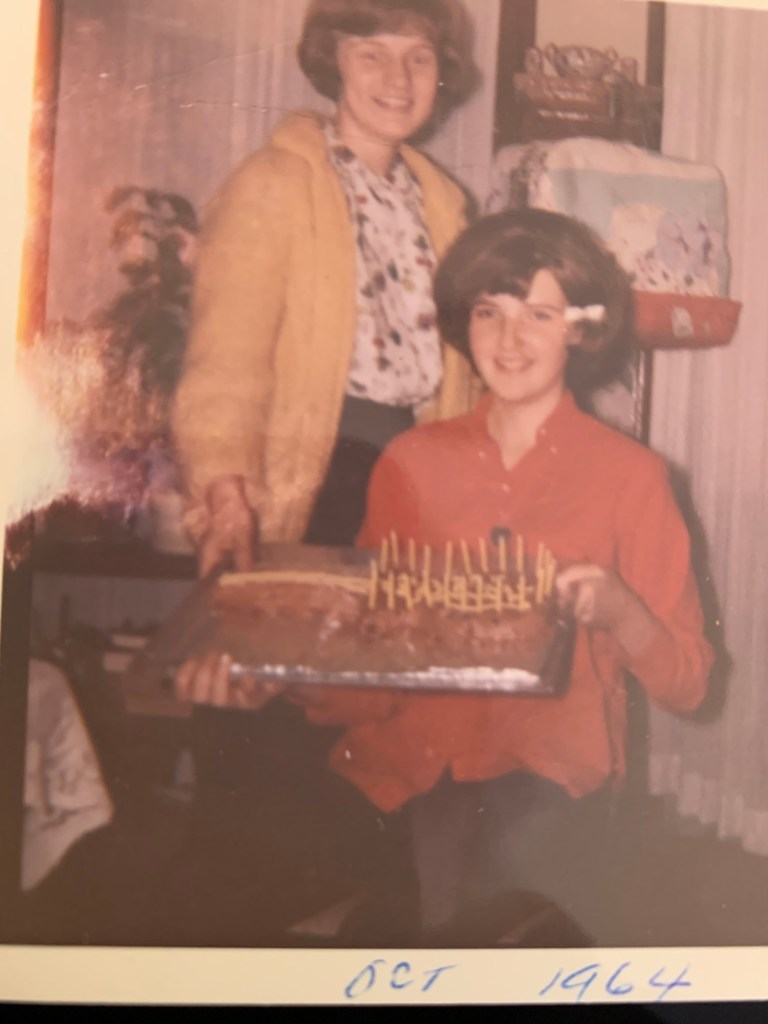
And so, on the morning of October 9, 1965, Judy and I met in the kitchen of my family’s flat on Medford Avenue to bake a birthday cake for John Lennon. We were careful as we cut the cake into the shape of a guitar (!) and decorated it with chocolate frosting, and as we added yellow frosting highlights. We were proud of our concoction! My Mom even took a picture of us together, holding the birthday cake for John Lennon!
And we delivered it to WOKY radio on Fond du Lac Avenue in Milwaukee, to be given to Bob Barry.
We had to go to school on Monday, so we didn’t hear whether Bob Barry mentioned our cake or not. And we are fairly sure the cake never made it to our favorite Beatle. But it came as a shock, years later, when John would be killed. The world was changing. And Judy and my worlds were changing, too, as we outgrew our favorite Beatle and each moved into our different lives.
There was always room for a sewing machine in our upper flat. Looking back now, I see how cramped those working class houses were, their windows covered with curtains to keep out the cold of the freezing winters in the Midwest. But there was always room for Mom’s sewing machine.
Well, it was Mom’s sewing machine until Suzie and I learned to sew. Then, if I was working on an outfit with a Simplicity or McCall’s pattern, chances are that either Mom or Suzie was working on something too, and when I stepped away from the machine to get another piece of fabric, carefully looking at the directions – I’d find a spool of thread in a color that didn’t match my material already in the machine. The sewing machine was ours – the three of us.
Like a lot of mothers over time, Mom was happy to have two daughters for her to make homemade clothes from the patterns. She must have worked many hours when we were at school and when Daddy was at work in the steel mill. And because she was happy to have two daughters, she was extra happy (I expect) to be able to make them matching outfits. To make us matching outfits – Suzie and me.
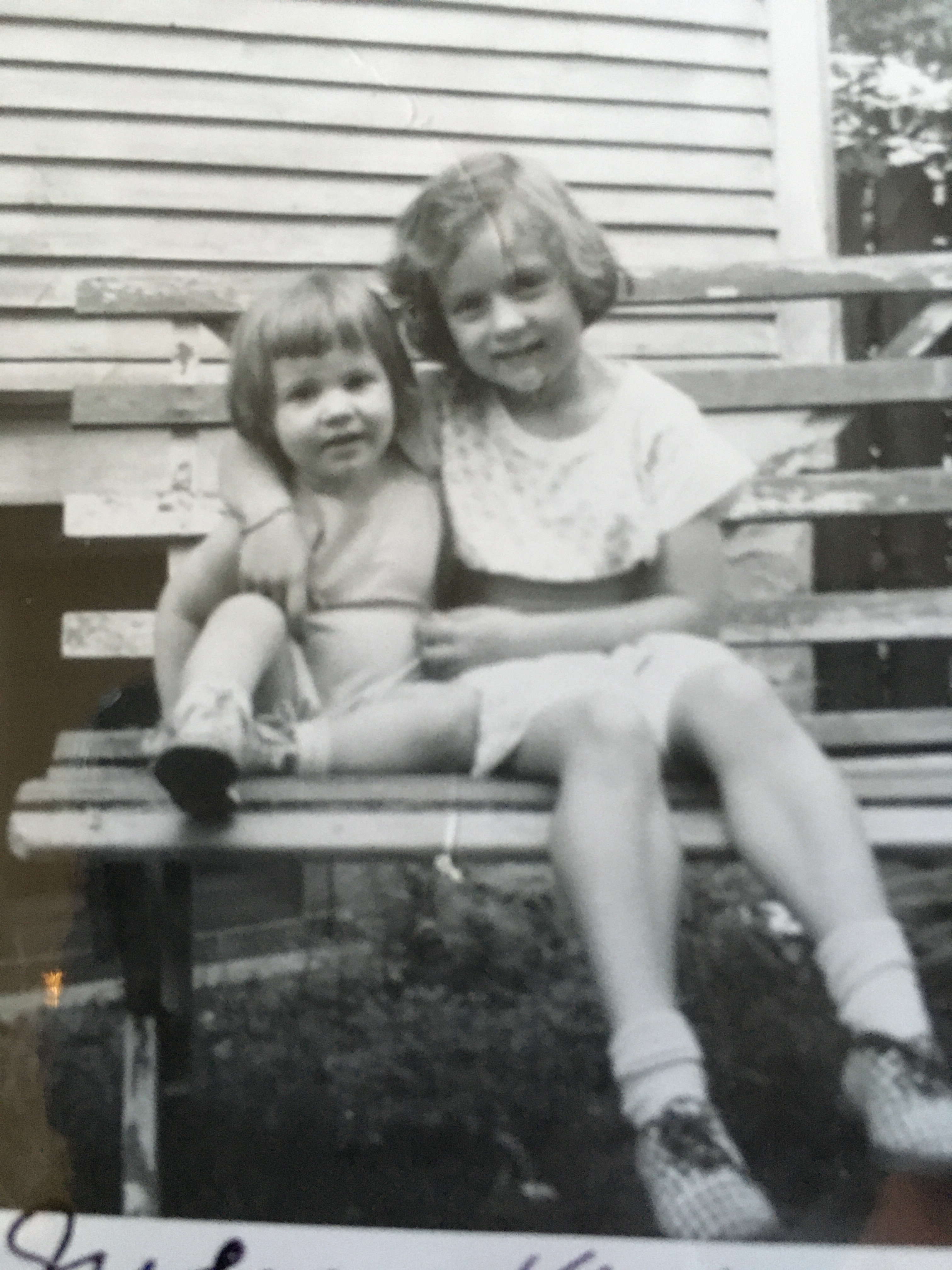
One Easter, Mom made Suzie and me matching dresses, including capes lined in pink fabric. She bought matching Easter hats – “in your Easter bonnet…” and Suzie and I were models, standing together on the front lawn of the flat, looking into the camera.
Mom made us matching outfits, that is, until I told her at some point that I didn’t want to be dressed like my little sister. Thankfully, Mom agreed – or at least understood – because I heard her tell the story to my Auntie Anne not long after. And so the days of matching outfits came to an end.
+
We are well into the 21st century now, and those days in the cramped flats – winter and summer, and fall and spring, when the fragrance of lilacs in the huge bushes in front yards that adorned the streets wafted down to walk with us – are well in the past. It’s interesting that some of the feelings remain, filtered through the grief at remembering all those who are gone now, and how they loved us, each in their own way. How their dreams still live in us.
And I’m grateful for my mother – coming from poverty and abuse – and how she crafted the best life she could for us, for us all. How she protected us, to the best of her ability, how she made a home for us, and how happy she must have been to sew Easter outfits for her two daughters.
My most vivid memory of my Grandma Bahlert is seeing her – tall and thin – as she opened the door of the little cabin that Uncle Erdreich had built for her and Grandpa, right behind his and Auntie Irene’s house, on the road in Baileys Harbor that led from Highway 57 to a gravel road deep in the woods, a swamp.
Daddy and I had made the long drive from Milwaukee to Baileys Harbor on a Friday night, and we had left Momma and the baby and Ronnie back at home in Milwaukee. Momma and Daddy must have agreed – and known – that this was to be an important trip, and so Daddy drove the four + hours along Lake Michigan when darkness had already descended, to see his Mother. I didn’t feel well on the way, and so I lay down in the back seat, and when we entered Door County, I watched the shadows of the trees that stood, tall and deep, dark, along the highway. Daddy drove on.
When we arrived at the house, Daddy and I walked up to the door of the cabin, and Grandma Bahlert stood at the door to “greet us,” she would have said.
Auntie Irene’s buoyancy, her love of children, must have greeted us first. Later that evening, I would lay on a couch in the living room of the pieced-together house that Erdreich had built – a house that grew longer and more filled with furniture and knick-knacks as the years passed. And when I couldn’t get to sleep, Auntie Irene went next door to get my Daddy, who lay with me cuddled up against him as he fell asleep on the couch.
In her letters – written in a primitive, elementary school handwriting – to my folks, my Grandma Bahlert had mentioned, again and again, “my little Mary.”
A few months later, she was gone. Auntie Edna – who always took charge of such things – had called us on the telephone, and when Daddy came back to sit in his chair, he cried.
Years later, I would ask to see Grandma in a dream, before I fell asleep. She didn’t come for many nights, but then I had a dream! I was standing at a grave, Grandma Bahlert’s grave, and I was alone. When I awoke, I knew the message of the dream to me: “she’s really dead.”
+
From where I sit at the dining room table where Jeff and I eat dinner together every evening, I look out onto the beautiful trees that fill my sight at the dining room windows. In the center of the windows, on the counter on which I place beautiful things to enjoy, I have placed two black-framed photos, both in black and white. The photos are old, and the manner of dress attests to that. On the right are my Grandpa Markowski, Grandma Markowski, John – Ivan, about 4 years old – standing in front of them in an old-fashioned sailor suit. They are not smiling, as seems to have been the custom when taking pictures at that time.
To the left is another photo, a photo of the Bahlert family. They were good-looking people, all. The year was 1910, judging from the ages of the children. On my grandmother’s lap is a baby with big brown eyes, looking, like the rest, into the camera. The baby is my father, Frank. His twin, Carl, had already died, only a few months old. Grandma has a small smile on her lips as she holds her baby. Maybe it was for the picture, or perhaps she was happy to be surrounded by the little ones she loved so well.
I think of them often, I remember my Grandma Bahlert’s love for me, always. When I return to Door County, filled with tourists now, I go by the quiet, less traveled roads to the graveyard at the Sister Bay Moravian Church, and I always stand at the graves for many minutes, thinking of them having come to this place, at the end.
A few years ago, I messaged my first cousin’s son, Eric, to tell him what I remembered of his Grandpa, my Uncle Johnny – Ivan – my mother’s eldest sibling. I told Eric how his Grandpa had loved him so much. To my message, Eric replied: “I remember the love.”