community, memories

Lambing

I’m definitely a city person – a “city girl,” as my husband likes to say. In my early twenties, when I was in my first professional position in the Federal Government, I had been assigned to live in Green Bay, Wisconsin: too small for my taste, I tell others now, “I almost died in Green Bay.” A bit of an exaggeration, of course, but I like to tell the story that way so others get the drift of what living in that cold, gray place had meant to me. “Get the drift” – as in snow drift – I suppose.

I digress. Over the years as a pastor, I came to learn about many mission activities, some in the United States, others in places overseas. I spoke often about mission to the congregations I served; I reminded them, again and again, of how those of us who are privileged to live our lives in warm and clean houses, our tables set always with a warm meal, health care – now more than ever a privilege – everything we want and need to be safe in our lives, had not only the ability but the need to give to those others whose lives had not afforded them the luxuries we take for granted. And over the years I became familiar with ways – call them opportunities – for us to give.

A favorite of mine is Heifer Project International. I’ll tell you why it’s a favorite. HPI provides animals and education to people in impoverished circumstances by giving them animals, by giving them the education they need to care for the animals, and to give them a future that these animals provide. You can take a look at the website for HPI here: heifer.org

“Giving an animal gift at the holidays is like giving someone a small business, providing wool, milk, eggs and more. Every animal gift comes with a free honor card to let your gift recipient know their holiday gift is providing families access to medicine, school, food and a sustainable livelihood.
Your animal gift will support the lives of families in need.” – from the HPI website

*

Once a year, HPI offered a weekend for women, “Women’s Lambing Weekend,” a gathering at the carefully timed birth of the lambs at the HPI farm outside of Little Rock, Arkansas. (As I checked out the HPI website to write this post, I found that they no longer ofter the Women’s Lambing Weekend. It’s a loss, I think). Joanne – my long time, faithful friend – who had grown up on a farm, and I were roommates that weekend. From the time we arrived, we attended classes that provided information about the mission and the people who HPI served. The work of Heifer Project came to life during those sessions. I was sold on their mission forever!

As the weekend progressed, we all waited for the lambing to begin. Veterinarians were on site, as teachers to our sessions, and available, always, to the animals.

One morning, the gathering of women sat in the chairs in the small classroom that was ours when we weren’t being introduced to the farm. The instructor had just begun when someone walked quickly into the room and in an excited tone of voice, yelled: “the lambs are here!”

We all jumped up from our seats and ran over to the field outside the main barn, where one of the vets was gently cradling a lamb in her arms, Mother Sheep lying close by, her eyes on her baby. As occupied she was with the beautiful lamb, the vet told us about the birth, and she told us how the mother and lamb would be cared for now.

I was so happy to see the new baby lamb! Even Joanne, with her years of growing up on the farm (where she and her brothers were usually out in the field, picking rocks), was happy to see the new lamb.

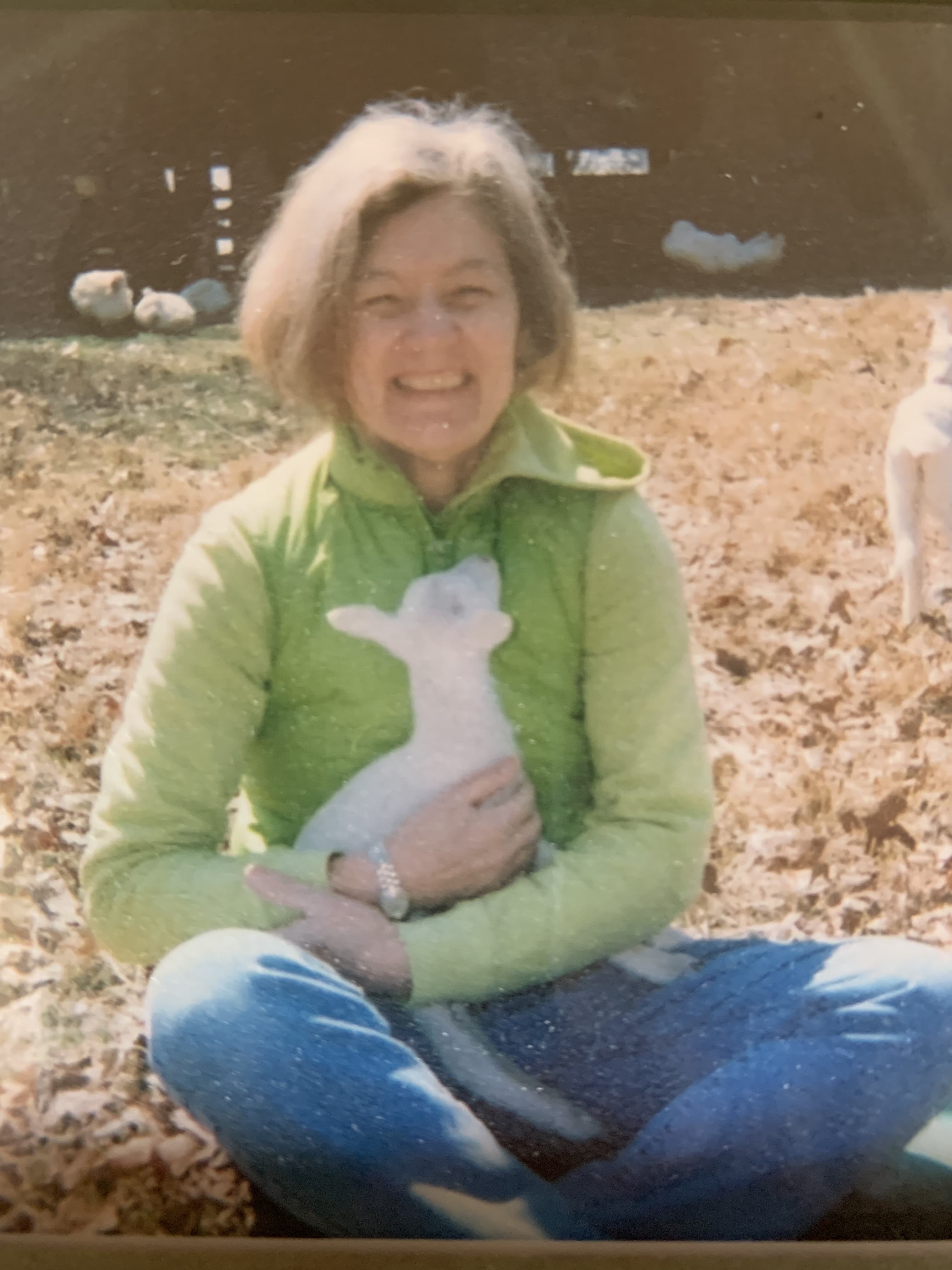
My weekend at Heifer Project was a joy I often remember. On our mantel, in front of the window above the fireplace, there’s a picture of me, holding a baby sheep – a lamb. I loved that moment, when the littlest lamb was placed into my arms.
beauty, community, Uncategorized

Living with diversity

I love the diversity of the Bay Area, where I’ve lived for over half my life. As I walk on the busy shopping street in my neighborhood, I’m happy when I hear languages spoken by the people who pass me on the street. As I walk past the store fronts that line the street, most of the languages I hear I can’t identify. All the better!

For many years, I said, from time to time, that in the Midwest, the weather was more interesting – and more rugged, of course! – than the Bay Area of California. But the people were more interesting in the Bay Area. They still are, to me.

As a pastor in downtown Oakland, I was enlivened by the diversity of folks who arrived to worship with us – folks who brought their diverse backgrounds, languages, music, dress, and all the gifts of another culture – to the mostly white congregation that had chosen to stay in Oakland when there were other choices they could have made. I loved the heart of that place, where in years past the people had decided to cast their lot in the city, a city with its share of problems, of poverty, of violence. I loved them for choosing to stay in Oakland.

Today was Pentecost Sunday, and I had the honor of preaching for an anniversary celebration at Oakland Chinese Community United Methodist Church in Chinatown, Oakland. I read my sermon in English, paragraph by paragraph, and the Pastor of the congregation followed each paragraph with a Cantonese translation. The two of us, each speaking our own language, brought to mind the myriad of languages that were spoken when the disciples left the Upper Room and became apostles who went out to tell others about what they knew of God, and of Jesus.  “Now there were staying in Jerusalem God-fearing Jews from every nation under heaven. When they heard this sound, a crowd came together in bewilderment, because each one heard their own language being spoken. Utterly amazed, they asked: “Aren’t all these who are speaking Galileans? Then how is it that each of us hears them in our native language?” (Acts 2:1-8).

Jeff accompanied me to the celebration, and we were the only white people in worship. Many times here in the Bay Area, we are minorities – seldom in other places, or in Wisconsin, our birthplace. As we said the Lord’s Prayer in English, I listened for the voices of most of the others, praying in Cantonese, at the same time. A young man who had been raised in China read his statement of faith to the congregation, recounting how he had found his way to the Church, followed by the Pastor translating into English; then, he was baptized. A holy moment.

Diversity has its problems, to be sure. But it’s good to be in a place where people who are different are not afraid, where folks can speak in their own language as they shop or as they walk down the street, and be safe. That’s not true in many places in the United States now, or in so many other places.

As we walked to our car after worship and after receiving the generous meal we all shared together in the fellowship hall, Jeff and I stopped to wait at a corner for the light to change, across from a Buddhist Temple that brings the Holy to those others who do not worship as we do. I’m grateful that they are here.

We crossed the street and drove home to our little house on a quiet street in another part of the city.

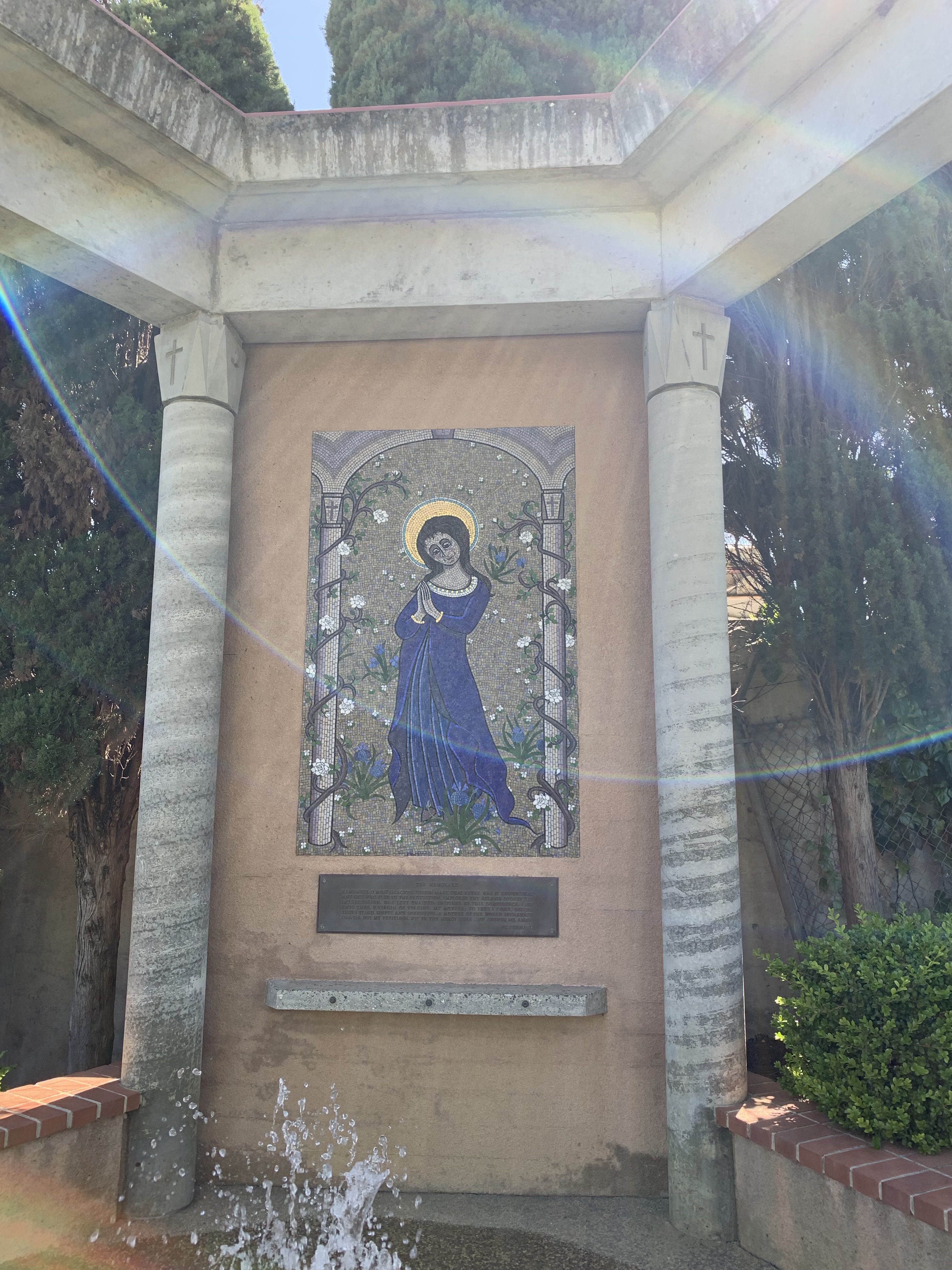
In St. Mary’s Cemetery, Oakland. Photo by Mary Elyn Bahlert, 4/2024

community, reflecting

Little Free Library

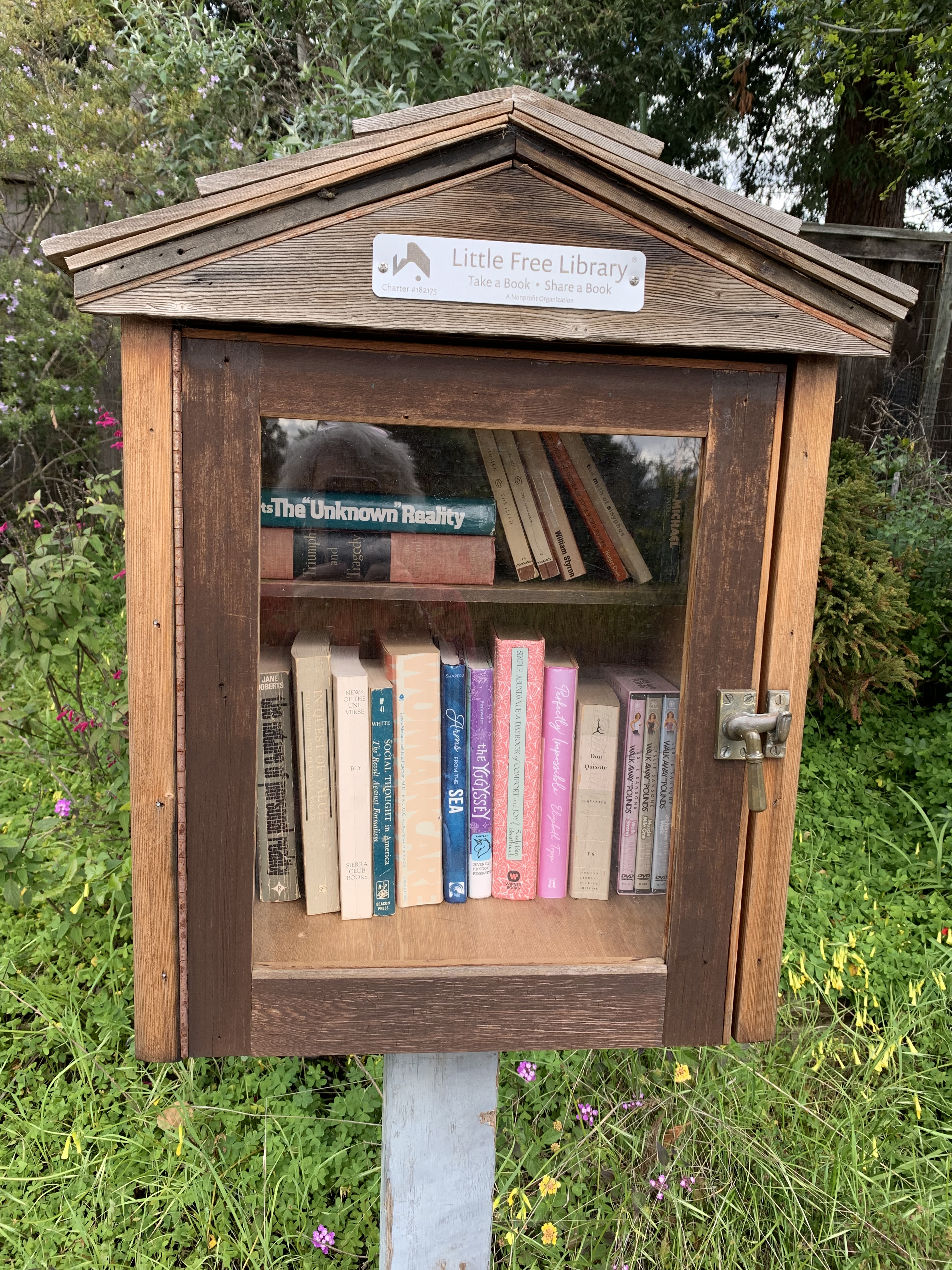
I was walking in my neighborhood late last year when I discovered a Little Free Library a few blocks from home. I stopped and looked through the books, enchanted. When I arrived home, I looked for the website that I’d seen on a little plaque attached at the top of the library: littlefreelibrary.org

I was ready to go! Jeff and I have a friend who can build anything, our friend Jim. So we asked Jim to build the library for us, and within a couple of weeks, we had our library, perched on a cement post on the strip of land we call “the panhandle,” that’s part of our property.

From the very first days of our hosting the Little Free Library, books began to appear. Jeff and I supplied a couple of books to get started. One day soon after, as I watched from the kitchen window, a car stopped, a woman I did not know got out, and she walked over to the Little Free Library to deposit some books. We were live!

I had followed up on my research, too, and so I went to littlefreelibrary.org and ordered a plaque that would put my library on the map. The Little Free Library that we are hosting is #125791. Little Free Library #125791 appears on a map on the website, and now we’re connected to other folks who host a Little Free Library in their neighborhood. I’m happy to be present to my community in this way, in a way that is important to me, and to Jeff: we’re both avid readers, mostly of nonfiction.

A few days later, I posted a picture of our Little Free Library on the Facebook page for Little Free Libraries, and I was set to go! I’m still receiving notes of welcome from other Little Free Librarians!

The story doesn’t end there, however. I was all set to go into a ZOOM meeting last week, when the doorbell to our house rang. I had to hurry clear to the other end of the house to answer, and I checked out the window before I opened the door, to make sure the door-ringer was still there. A young man I didn’t recognize was waiting for me to answer. When I did, he asked me if I was the person who was hosting the Little Free Library on the street. I told him that yes, I was.

He wanted to let me know that he’d found a book, The Freedom to Be, by A. H. Almaas, in the Little Free Library on our street. He had read the book. And – he said, looking into my eyes: “it changed my life.” He told me that he was on his way to meet with a teacher, an adherent of Almaas, right after his stop at my house. I had read a bit of Almaas over the years, and I told him that. We exchanged names. Before he turned to go, I suggested he stop over to see me again some time, when we could talk more. Smiling at me before he walked back down the stairs, he said yes.

Our Little Free Library! photo by Mary Elyn Bahlert, 4/2024

community, remembering, Uncategorized

baby girl

Nancy and Norm (names changed) were so excited when they were able to announce to the congregation that they were expecting a baby. I always remembered the first Sunday Nancy had brought Norm to her church community for worship, her eyes lit up as he had followed her into the sanctuary. From that day on, and after they were married, they were faithful worshippers – and choir members – at the diverse congregation in downtown Oakland. 

And – from the time they knew they were pregnant, they invited the congregation into their joy. The day after their baby girl was born, I met Norm outside the church as we both arrived. ”The baby is here!” he said, jubilant. He showed me a picture on his phone of the newborn, beautiful baby girl. We were all excited for the little family that day.

When baby girl was a few months old, a friend of the couple’s expressed concern for the baby to them. She didn’t seem to be developing the way other babies grew. Respecting their friend’s observation – she had two young ones – Nancy and Norm took their little girl to the doctor, and not long after, she was diagnosed with mitochondrial disease. Nancy and Norm brought the news to their church community, and their news was the beginning of a journey for both the couple and their baby girl and for the congregation. 

Baby girl was hospitalized many times over the course of her short life. Her mother, who had been a school teacher, quit her job to spend her days and nights at the hospital with the little one. One or two faithful friends from the church visited them in the hospital, offering what kindness and comfort they could offer. Each week, we offered prayers for the little one and her parents.

Finally, the baby was hospitalized for several weeks. We all knew, without saying , that she would not leave the hospital, and that her short life was going to end, very soon. I visited baby girl and her mother the day before I was set to leave for a trip to Wisconsin with Jeff. Before I left that day, I said to Nancy, at the same time as I looked at the baby: ”wait for me.” The baby and I locked eyes as I said those words, and I left the hospital, knowing that Nancy and her little girl would have other caring visitors during my absence.

Two weeks later, my plane touched down at the airport in San Francisco, and I arrived back in Oakland to the message that the baby girl had passed, at her home, in her crib, her Mommy and Daddy with her, a few moments before. When I walked into the house, I was met by Joan, a tall, striking white woman from the church congregation who had been a caring and helpful presence to the family during their ordeal. Joan told me that when 911 was called to take the baby away, she had met the police at the door to their home, telling them: ”this baby has been ill, hospitalized many times in her short life.” She knew that she was protecting the family from unwanted accusations about her having died at home.

When I saw Nancy, when we hugged, she looked into my eyes and said: ”She waited.” Indeed, it seemed as if baby girl had waited for me to arrive back in Oakland before she passed. Her parents were surrounded by a loving community of people who would be with them as they grieved. 

Then, there was the matter of announcing the news to the congregation. I was nervous as I stood before them the next morning, before worship began. I told them that baby girl had died. The community was silent, stunned – I suppose – although we had all known that this word would come to us, someday, sometime soon.

After I preached – what did I say to them all that day? – Dan, a gospel singer from the congregation spontaneously stood and sang acappella, a gospel song. As he sang, I heard a loud sob from someone in the congregation.

*

One of the moments as I pastor that I hold dear, that I can see clearly in my mind, is the day we all gathered to mark baby girl’s life, to remember her. I saw her parents, sitting in the front row of chairs, their eyes looking up toward the pulpit. What did I say? I don’t remember. Baby girl, cherished baby girl, was gone. What hope could touch them?

I’ve only returned to visit the congregation a couple of times since I retired, but I see photos of Norm on Facebook sometimes, holding a little one who is in the church congregation now. The little ones come to him, and they are his favorites, as the other folks know. And when I returned for a memorial service a few months ago, Nancy and Norm came up to me, hugging me with warmth, remembering, always. 

“Blessed are those whose strength is in you”. - Psalm 84:5 (photo by Mary Elyn Bahlert, 1/2024)

community, memories, reflecting, Uncategorized

A good friend

This past year, I have emailed my friend David every few months to see if he has time to have lunch with me. He always has time. We like to meet at a restaurant in Berkeley or Oakland.

In 1995, I suffered a major depression. At the time, it seemed as if life was collapsing in on me, loose ends fraying, so many things uncertain. After I’d been diagnosed and was placed on anti-depressants, I was granted three months leave with pay from the part time position I held in a little church on the Peninsula South of San Francisco. So now, the days that had once been filled with so many things – important to me – were quiet, empty. I sat often in a comfortable chair in the little room at the back of our flat on Sunnyslope Avenue in Oakland, looking out the window, drawing, reading.

And when they were able, friends would join me, for a walk, for a talk. I will always remember those who were so faithful in their friendship, whose kindness helped me get through.

Even when I was young, I had good friends. One time, Mom mentioned that to me: “you’ve always had good friends, Mary Elyn.”

David was one of those friends. He was still working at the time, as a therapist and as a writer. Every week, I walked from our house down Grand Avenue toward Lake Merritt, and over to Lakeshore Avenue, to a little greasy spoon. David and I would have lunch. The time we spent together was a gift to me, and I have not forgotten. I remember his kindness. I remember his friendship.

Over the course of COVID, I made sure to connect with David once again, and now we’ve been seeing one another for lunch – every few months now – in the same neighborhood as before, the old place gone. The last time we had lunch, as David and I stood on the street, before returning to our cars, he looked down at me (David is tall!) and said: “you’re a good friend.”

He’s the good friend, the good, solid, long time friend, of infinite value.