Uncategorized

Darlin’ Be Home Soon

Come
And talk of all the things we did today
Here
And laugh about our funny little ways
While we have a few minutes to breathe
Then I know that it’s time you must leave

But, darling, be home soon
I couldn’t bear to wait an extra minute if you dawdled
My darling, be home soon
It’s not just these few hours, but I’ve been waiting since I toddled
For the great relief of having you to talk to… John Sebastian, 1965

When I was a child, when I was growing up in the flats in Milwaukee, my sister and I were in bed before Mom and Dad. Mom and Dad stayed up to watch the news at 10 pm, and shortly after, the television turned off, they went to bed.

My memory of those days is of the soft, quiet talking they did before they went to sleep. I don’t know what they talked about. In the evenings, after the supper dishes were taken off the table, they sat at the kitchen table and played Canasta, most nights. And from the living room where I watched television, or from my bedroom, where I studied, my back propped up against the headboard of my bed, I could hear their laughter and shouts of happiness at having won.

By late evening they returned to the living room to watch the news of the day. Then, the flat was quiet, except for the soft, quiet talking they did before they went to sleep. I don’t know what they talked about. Dad fell asleep first, of course, and then I could hear his snoring, sometimes having cut the conversation short in the middle of a sentence. And Mom, I know, lay awake for a long time, her anxious mind, her memories filling the space that could have been filled with sleep.

Jeff and I are often quiet in the evenings, reading, chatting a bit, fussing with small tasks around the house, and we both go to bed at about the same time, but we don’t often talk once we go to bed. A few evenings ago, we were talking for a few minutes after we’d gone to bed, and Jeff said: “we’re talking in bed, just like your mom and dad.” He had remembered my telling him about that small intimacy I had known as a child, I expect because his parents didn’t like one another much at all, it seemed. And his remembering recalled those times in my own mind.

From the first time Jeff and I met, I felt as if the John Sebastian’s words, written years earlier than our meeting, were written for us. They still are.
Uncategorized

Big Brother

A few years back, my brother in law, Thom visited my husband and me in Oakland, while Rainier, his younger son lived with us during his college years. One night after dinner, Thom and Rainier, a friend of Rainier’s from school, and Jeff and I sat at the dinner table for a long time after we’d eaten. We were having fun, one of those conversations that happens when we’ve known folks for a long time, when our history together is the framework for a long conversation. At some point, Thom asked me if I was comfortable, sitting there, talking with only men. I was taken aback by the question, and Jeff answered for me. He explained that I’d grown up with a father and brother who liked me, and as a result, I was comfortable with men. As difficult and nuanced as relationships – in particular, family relationships – can be, I was interested and grateful to hear Jeff’s answer. He had said something that brought to consciousness a particular nuance to an important relationship in my life. Within that consciousness is gratitude.

Ronn was nine years older than I was, born to my mother and her first husband at the beginning of World War II. During the War, while Ronn’s father was in the service, Mom was a single mother. My mother’s parents looked out for Ronn when she was working, or when she bowled, one night a week, with the women’s league from Cutler Hammer in Milwaukee. Ronn grew up at a different time, surrounded by different people than me, surrounded by my grandparents, who spoke a different language. After the War, Mom divorced Ronn’s father. He grew up as the son of a single mother.

Nine years older than me, and beginning with my first memory, Ronn was part of what family is to me. Mom told me more than once as a girl that, after I’d spent a week in the hospital because I’d suffered a seizure – a week without seeing my mother or father – she brought me home during the day, and I looked at her out of my big eyes, unsmiling, until Ronnie came home. Then I smiled, for the first time that day.

My sister is almost five years younger than I am, and she has few memories of having her big brother at home. I’ve read that we often grow up in different homes than our siblings – birth order, gender, connection to same and different gender parents playing a big role in how we come to know and relate to “home,” or “family.” I expect Ronn’s experience of home was very different from mine. Those differences would play out in major ways when we grew into adulthood.

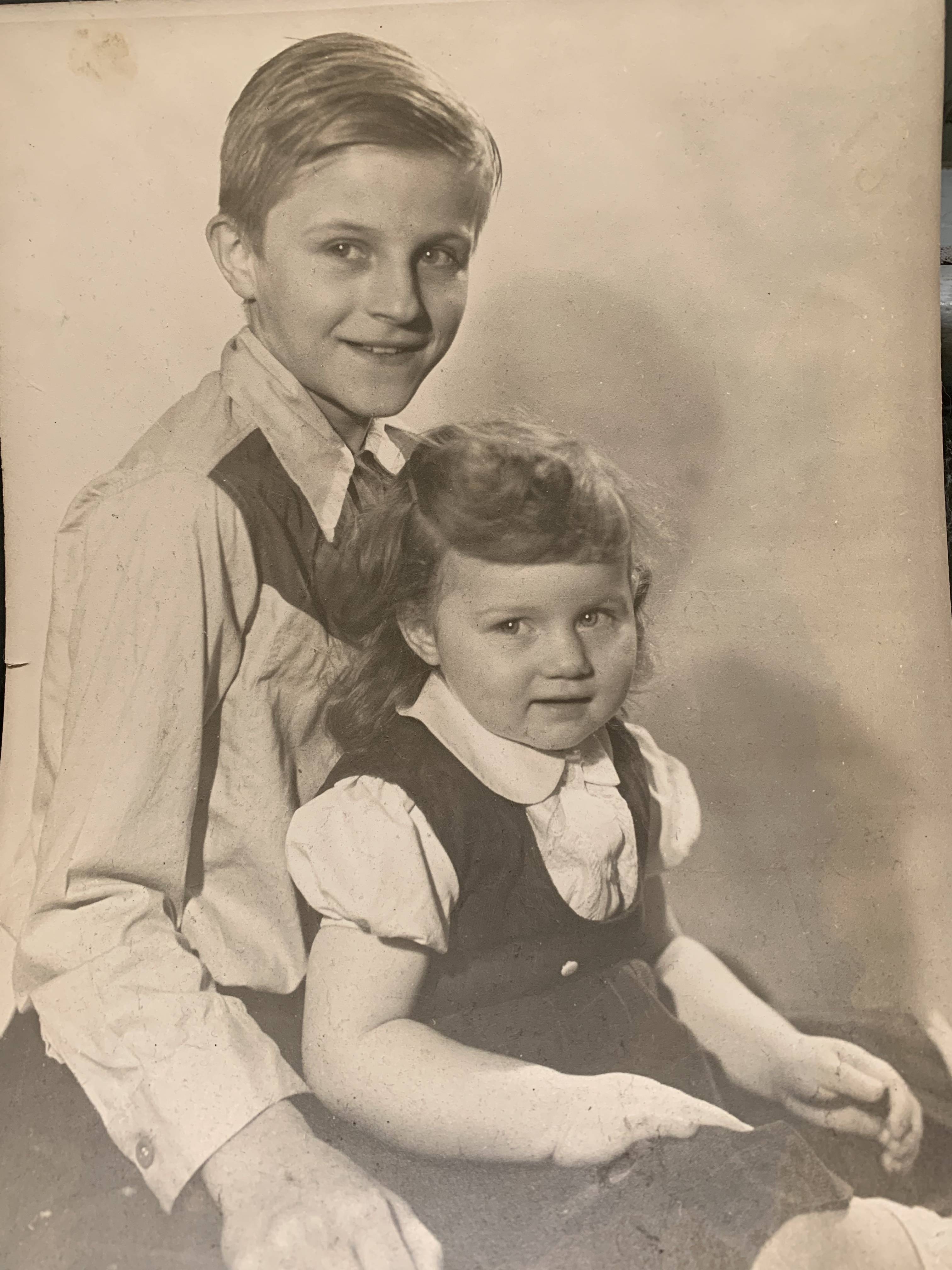
Of the handful of memories I have of being very young, a memory that includes me and Ronnie stands out. To this day, it tells me about him,about myself, and about our relationship to one another. The memory must be from around 1958, based on information about Buddy Holly’s life – and death. We were sitting together on the couch, watching Buddy Holly on the black and white television screen. Buddy Holly! (That’s a long time ago!). As Buddy Holly performed, Ronn, sitting next to me on the red velour couch, turned to look at me and said: “He’s wearing glasses!”

Ronnie and me, circa 1953

Whenever I remember that moment – I am filled with understanding and gratitude. I knew, without his saying so, that my big brother was self conscious about his having to wear glasses. He was a skinny, tall kid (taller than any of the rest of us in the family), and his comment betrayed his insecurity. And I knew, still know, that I was someone important to Ronn, my big brother, so much older, his life a different trajectory, as our lives would attest to, years later. Ronn had difficulties I did not have, as the son of an absent father. I had an intact family. Ronnie was lost, in a way; I grew up knowing that I belonged to this particular family, for better or worse.

Ronn has been gone a long time now. The night before he died, his granddaughter held the phone to his ear in a hospital in Jacksonville, Florida, while I cried and told him I loved him – my big brother. Ronn’s legacy – a large extended family, children and grandchildren and great-grandchildren – continues to grow. My family legacy is small, I often think.

remembering, Uncategorized

The Center Street Library

The Center Street Library was close to the flat my family rented on Medford Avenue. To get there meant crossing two very busy streets: 27th Street, that cut from North to South, one of the busiest streets on the North Side of Milwaukee before the freeways went in, and Fond du Lac Avenue, which angled to the Northwest, like Medford Avenue, one street to the West. As a girl, my little sister and I walked to the Center Street Library with Mom once a week, in the late spring, summer, and fall, before the snow and freezing temperatures came.

Like so many things Mom did for us, the walk to the library with Mom was one of those things she had not experienced as a child herself. She wanted things for us she had not had. Both of her parents were illiterate – the ancestors of freed serfs from Ukraine – and she had taught her own father to read English when she was in grade school in Milwaukee, in neighborhoods to the south and east of where I grew up. Poor people, they lived among poor people, and the flat she grew up in served as a boarding house for other men who came from Ukraine, hoping for work and a better life. My grandfather had returned to his own country to bring back his wife, Feodosia (Frances), and their eldest son, Ivan (John). By my measure, the better life they dreamed of did not manifest in the new land.

So Mom made sure we knew the inside of the library, and with her as an example we had library cards and, during the summer, we were members of the Billy the Bookworm Reading Club. To make progress in the club, I had to answer a series of questions to show I’d read the required books. One day, as I stood at the librarian’s desk, my cousin Mark whispered the answers to her questions in my ear. I’m not sure if I heard him right, and I’m not sure if the answers I gave were right, but she gave me the sticker to the next level.

I discovered my first crush at the Center Street Library. I stood in the aisles with Larry Bartis. He and I walked along, looking up – to the highest shelf! – where we read the titles of books out loud to one another! Oh – how we laughed! Once – only once – I glanced over at him, and to my surprise, I realized as I watched him throw back his head and laugh: “I like him! A boy!” I kept it to myself (years later, after we connected on Facebook, Larry confessed he’d had a big crush on me). But I had noticed, noted my first crush.

I still love libraries. In high school, I worked in the library at Washington High School in Milwaukee. In seminary, I worked in the Graduate Theological Union library in Berkeley. I love the smell of libraries. I love the little nooks with tables and chairs, places to relax into reading a good book, or places to write the first outline of an important essay for school. I love the tall stacks. I love to sit for hours, working on a paper, surrounded by the books that hold the answers to my questions. I love – loved – the card catalogs, that held directions to the answers to so many mysterious questions of interest. I love to take my questions to the Reference Librarian, who, I’m sure, loves to discover something new along with me, as he moves his mouse around the big screen on his desk that takes the place of the card catalogs. I love to sit in a corner with a magazine I’ve taken off the shelf to enjoy. I love libraries.

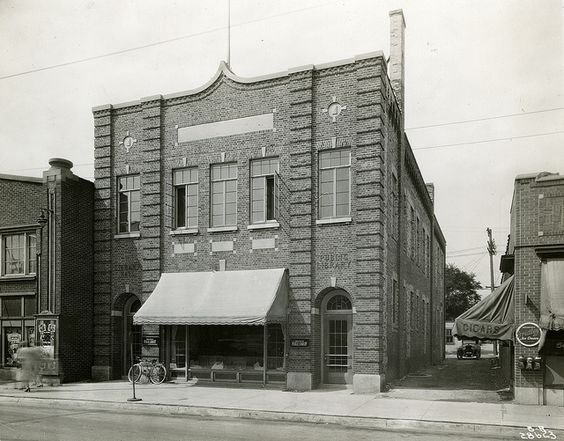
The building that was the Center Street Library in Milwaukee is now home to The Wisconsin Black Historical Society/Museum. The Museum “opened its door and its heart to the community, city, and state in 1987. Based on the premise that a people who know their history will grow to love and appreciate themselves more, the Society is striving to create a bright future out of a heart breaking past.”

Milwaukee Public Library opened the Center Street branch library in the former firehouse in 1927 (from “Urban Spelunking,” Bobby Tanzilo, December 12, 2017).

As I write today, I picture in my mind’s eye myself, my mother, and my little sister, Suzie, walking those streets again. What I picture is a scene from long, long ago. I’m grateful to my mother, who thought in a larger way for us than anyone had thought for her, as she introduced us to something greater than the life we knew, in that library. Maybe she knew it; maybe she didn’t. I’m grateful, anyway.

Uncategorized

Where I’m From


I am from
frame flats with steep staircases, lining city streets.
Daddy's eyes, sparkling. Momma's worries.
Baby sister, big brother.

The smell of yeast bread as I climb the narrow steps,
Cozy.
The smell of beer, always.
Cereal for breakfast,
peasant borscht for supper at 5.
On the back porch, tracing Sputnik across the sky.

Shame: "we don't say that."

I am from
Steelworkers Union 19806,
Bargaining rights and hoping for overtime.

Snowy drifts. Winter winds. Slow springs, long awaited:
lilacs in big dishes, coleus leaves and hollyhocks.

Moving - again.

Up north and cooler by the Lake,
Humid nights, thunderstorms crashing from east to west,
short, languid summers,
sheets fresh from drying in the sun.

I am from
hanging with the smart kids,
The Center Street Library,
laughter, and lots of tears.
Anger that never cooled. Warm and loving folks.

Books. Books. Books.

Old World people and me,
tiptoeing into the New World.

* "Where I'm From," Mary Elyn Bahlert, after George Ella Lyon,"Where I'm From" *


Photo by Mary Elyn Bahlert, May, 2022, Cedarburg, Wisconsin
Uncategorized

Winter Mornings at Home

The alarm clock in Mom and Dad’s room went off every weekday morning at 6 am, all year, except for weeks when Dad had vacation from the steel mill. Mom, who was never a good sleeper, would jump out of bed at the sound of the alarm, pull on her bathrobe, summer or winter, and head into the kitchen. In the kitchen, she reached to the top of the refrigerator to turn on the electric radio, and she started to make Dad’s breakfast – bacon and eggs, every morning. And coffee – Dad liked his with evaporated milk and a spoonful of sugar. As part of her morning routine, Mom made sure these were on the table, ready for him.

I listened to this routine over the course of my years as a child, and on through my college years, when I commuted to the University of Wisconsin-Milwaukee.

On winter mornings, the routine had an added wrinkle: after my dad dressed in his work clothes, I’d hear him open the door from the kitchen into the back hall, then I’d hear his footsteps start down the steps that led from our second floor flat, past the door of the flat that was home to another family, right below us, and down another flight of steps into the basement. There, Dad shoveled coal from the coal bin into the furnace, stoked the fire, and climbed the steps again to find his breakfast waiting.

Sometimes now, I miss the heavy, heavy blankets that covered me in my narrow bed, pushed up against my sister Suzie’s narrow bed, the heavy blankets that kept me cozy warm. I miss the smell of the heat coming through the register in our room, making the room cozy.

I miss snow days, too.

We grew up hearing stories of the Winter of ’48 – before I was born, when the snow lasted for days, cars were marooned miles from home, covered with snow and parked in a snow bank. Some would not be discovered by their owners, who walked home that day, until the snow had melted enough for them to be seen. Pictures of that winter storm are still available to see on the Internet. (So, it was true…)

One day, I listened and listened to the school closings on the radio, waiting and waiting for “The Milwaukee Public Schools” to be called. They never were. Still, the wind was blowing, the snow was falling, and it was cold – real cold. So Mom told us we didn’t have to go to school. From the window of our living room, I watched the kids who still went to school that day, saw my friend Nancy, her head down as she faced the wind, walking from her grandparents’ house, two blocks to the east, to our school on 28th and Clarke Streets.

That was unusual for us Mid-westerners, though: if our school system had not made the list on the radio that morning, we’d be up and getting ready, like any other day.

After Dad had gone to work, Suzie and I got up and dressed for school in the warm room. When we got to the kitchen, our breakfast dishes and choice of cereal was waiting for us: cold cereal with milk, a glass of orange juice. While we ate, Mom stood at the kitchen counter, making our lunches: cold cuts on white home made bread, slathered in butter, an apple or a banana, and if we were lucky, a home made cookie or piece of cake – all wrapped in wax paper and carried to school in a brown paper bag.

After the storm days, on cloudy winter days, we children walked to school on the snow banks that stood four feet high between the street and the sidewalk, left there by the snow plows. At the end of the block, we’d take the steps that had been carved out in the snowbank by the children who’d walked there ahead of us, and climb the snow bank when we’d crossed the street, walking high above the sidewalk, taller than any adult, all the way to school, where we’d take off our layers of winter wear and park them in the cloak room between the classroom and the hall, along with all the other children’s winter trappings. All day, the cloakroom smelled of wool from the warming coats hanging there.

For a long time, I didn’t miss cozy, here in Northern California, but sometimes now, when it’s hot and dry – even in January – something deep in my memory yearns for that time and place, the warm house, the smells, the sounds of slushy roads, the scrape of folks shoveling snow, even the bleak, gray skies. I see my parents in my mind’s eye, as if they were from another time – indeed, they were – and I miss them. I even miss the cold, the gray. And the cozy.