I am a spiritual seeker, a seeker who has "taken a drink from many cups." I love to accompany others on the deeper journey to witness to their True Self. Now a writer, photographer and poet, I have retired from full-time ministry as a pastor in downtown Oakland, CA.
In the days and weeks before Christmas, when I’m alone and at home, often sitting in front of the Christmas tree, I remember more vividly each person who, once a part of my life, is gone now. And small moments with each one of them seem to be replayed, over and over, in my mind.
Dad liked to have fun. He loved to laugh, and he loved to hear us laugh.
Every year, in the few days right before Christmas, Dad would head out to the Capitol Court Shopping Center – in those days, an outdoor shopping center, not the Malls of later years. He had thought ahead to what he would buy Mom for Christmas, and he headed straight for the place to shop.
By December, the evenings are already dark, and undoubtedly, were cold, in Wisconsin. And the houses – cozy. I can hear now my Dad’s footsteps coming up the back stairs, bringing the cold of the evening with him, and as he turned to the second floor landing, I hear his voice: “don’t be so nosy!” His arrival and his greeting meant that he carried under his arm that important package, the package that held his gift to Mom for Christmas. I can see his eyes, also, sparkling, as he came into the kitchen, saying again: “don’t be so nosy!”
Jeff likes to repeat those words now, every year. A few days ago, I sat in his large and interesting studio in the yard behind our house, and I noticed two holiday-wrapped boxes on the shelf next to the deer’s head. I looked at Jeff. Jeff looked at me: “don’t be so nosy!” he said. And we laughed, remembering.
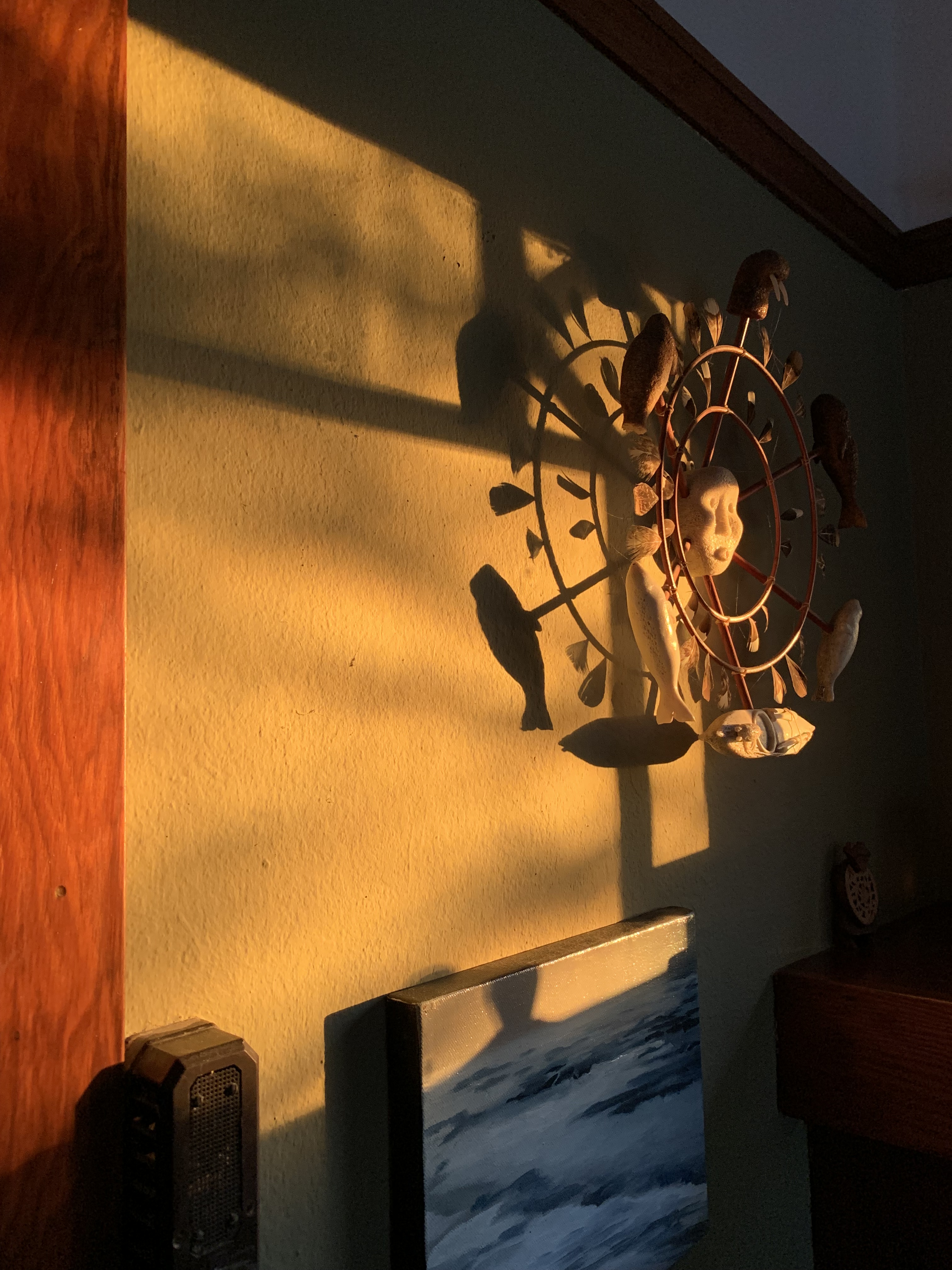
Nature decorated: photo by Mary Elyn Bahlert, 11/2023
The liturgical season of Advent begins four weeks before Christmas Eve and Christmas Day. It is always interesting to me that the scriptures for Advent mark events and people who were already present before the Birth of the Child. Advent itself is a more sombre time, as we “wait upon the Lord” to arrive as a child, a poor child, a child born in a manger, because there was no room for him and for Mary his mother and Joseph, her husband, in the inn. We’re reminded of refugees today, walking from their homes, walking to places unknown and probably unfriendly. We’re reminded of refugees today leaving the only place they know to wander, to hope – against hope – that somewhere, somewhere there will be a new life, a safe life.
I expect most folks know the Christmas story, the child, the Star, the Wise Men who traveled far to see this holy One. But Advent? We don’t care about Advent, that sombre season, that season of hope that hopes against hope. When I was a Pastor, it was clear to me that beginning in December, regular church-goers wanted to sing the Christmas Carols, to light the lights, to make Christmas cookies to share with one another. But Advent? There is no place for Advent in our lives, in our culture. We don’t want to wait to see what happens. We want what we want, now.
One Advent, Jeff and I visited together a monastery on the Pacific Coast, and there, among the monks, we heard the Advent scriptures chanted, the voices ringing out into the simple chapel, only a cross on the altar. The monks honored Advent. That was clear.
I tried as hard as I could in each parish I served, to wait until Christmas Eve to sing the Christmas carols, and to sing the Advent songs during the four weeks before Christmas. It didn’t work. I learned to be light hearted about it, as I stuck to the scriptures of Advent as my preaching texts.
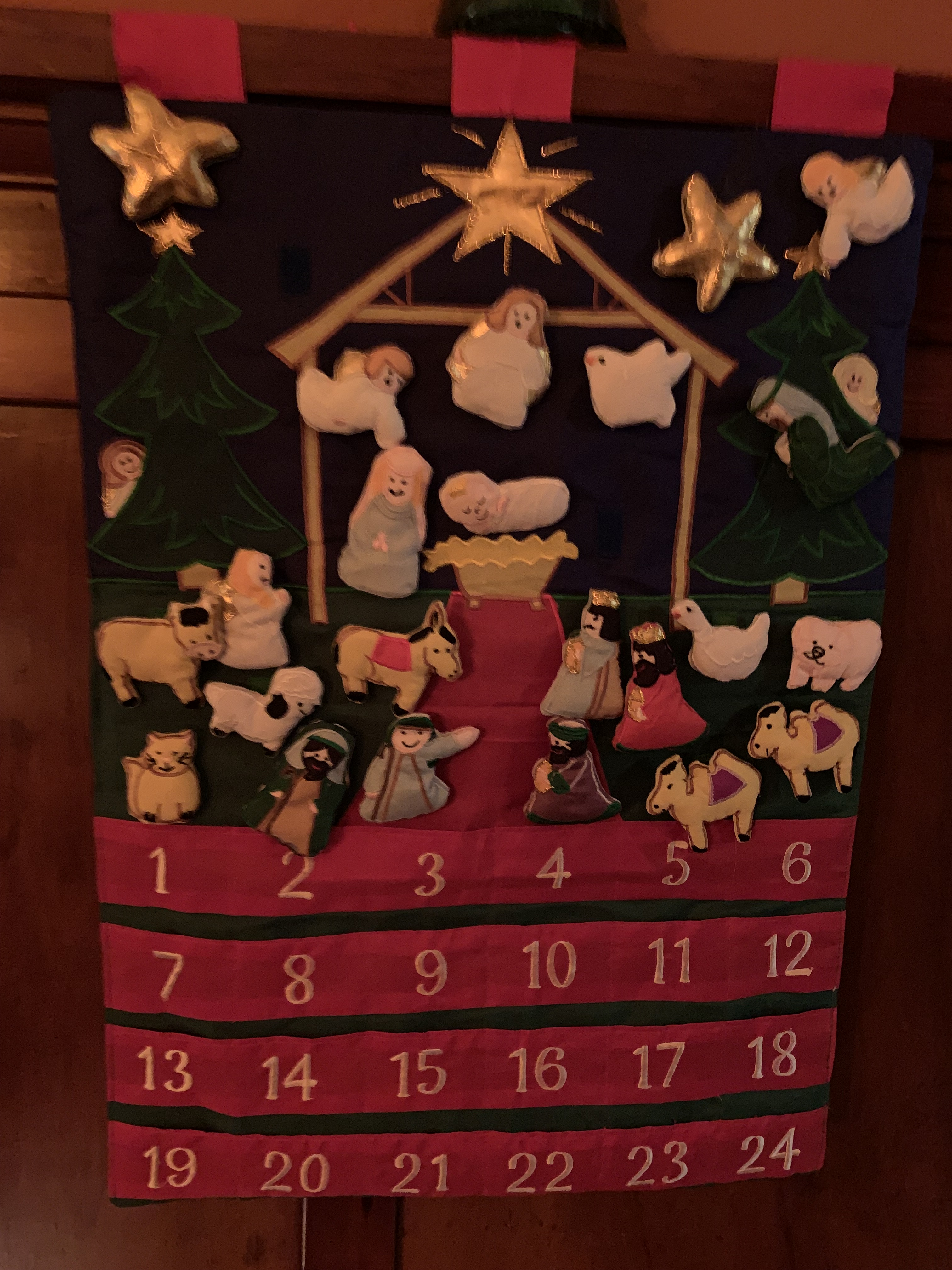
In the early 1990’s, Jeff and I served for two years as co-pastors of a United Methodist congregation in Tracy, California. Beginning in December, the sanctuary was decorated with glistening stars and Christmas lights, lights hung along the walls, lights of all colors. And I found, in a little, unused room off the sanctuary, a creche, complete with animals, Mary, Joseph, a baby. And a crib for his bed, filled with straw from the manger.
And so the creche was placed carefully on the top of the piano at the front of the sanctuary. Every week, as I checked out the sanctuary for the coming Sunday, I walked past the piano with the simple creche on top. I noticed as soon as the manger scene appeared, that the baby was in the manger, center stage in the creche. And so I carefully picked up the child and placed him in the little room to the side of the sanctuary. Right inside the door, on a shelf, I placed the child. I knew I would not forget to place him in the manger right before the Christmas Eve service – right where he belonged! But not before! The scene was waiting for the arrival of the Child, as we wait for so many important things in our lives.
Early Sunday morning, the first Sunday of Advent, I walked into the sanctuary through the side door. As I entered, I was greeted with lights – the lights of many colors, like a Christmas tree – the lights on, and Christmas music – loud – coming from the speakers placed all over the sanctuary. And I was greeted by the sight of Pele and his son- our usher and his young son – sitting with smiles of joy on their faces, in the last row, nodding their heads to the beautiful Christmas music blaring over the speakers.
Seeing them made me happy to be there!
I was greeted also – by the presence of the Child, already in the Manger. We were still waiting – I thought! We were in the season of Advent, the Coming – not the arrived!!! So carefully, when I knew that Pele and his son were busy with other things, I moved the baby in the manger to the shelf in the little room to the side of the sanctuary.
I never said a word about it, but each Sunday, I found the babe again, in the manger, in the middle of the creche scene. Each Sunday, I carefully moved him out again, moved him out to arrive again on Christmas Eve. I never said a word about it, and no one else said a word, either.
I love the holiday season, which begins with Thanksgiving Day. When I was pastor in downtown Oakland, the congregation marked the day of thanks by offering a wonderful, complete Thanksgiving Dinner to anyone in the community who wanted to join. Homeless folks, people who did not speak English, people without family or even friends, joined the day’s gathering to sit at a table and to be served by other grateful folks. For many years, that tradition became part of my personal Thanksgiving, as I looked out at the gathered people and said to myself, again and again: “these are my people!”
And Jeff and I mark the holiday every year now by arriving at Norman and Cheryl’s cottage on a hill in San Francisco, climbing the narrow stairs to the top of a hill, our arms filled with pies – our contribution! – and to sit at the long, narrow table filled with an assortment of Bahlert-related people every year. As the day progresses and the dusk and darkness come, families with little ones begin to gather their belongings and leave, with much ado. The tiny kitchen which produced the feast we’d all enjoyed is full of helpers bumping into each other, cleaning up, continuing the dinner-time conversation. And then – just like that! – we all descend the steps and walk to our cars on the quiet streets and drive home, mentioning to one another moments from the day, who had grown, who talked to who, how much older everyone is (except for us, of course!), and probably feeling a bit of sadness that another holiday has passed.
In the Midwest, the shorter days and long evening of dark and cold have begun by this time of year. There’s a sense of “cocooning” that we don’t know in the same way here in California. And missing now, also, is the childhood sense of a quiet and light filled season, beginning with Thanksgiving, that won’t end until after Epiphany, in January.
My mother honored the season of holidays each year by hosting Thanksgiving Dinner at our upper flat, and by creating for my sister Suzie and me a holiday tradition. In the 50’s and 60’s (of the last century), the holiday season did not officially begin until Thanksgiving. On the day after Thanksgiving, my mother and Suzie and I took the 23 bus from the North Side to downtown Milwaukee, now mysteriously decorated with lights and ribbons along Wisconsin Avenue, still a booming shopping district at the time.
We’d step off the bus at 3rd and Wisconsin to walk through the Boston Store, which anchored the downtown at that time. My mother held tightly to each one of us as we walked through the crowded store, the lights and music having followed us from the street into the store.
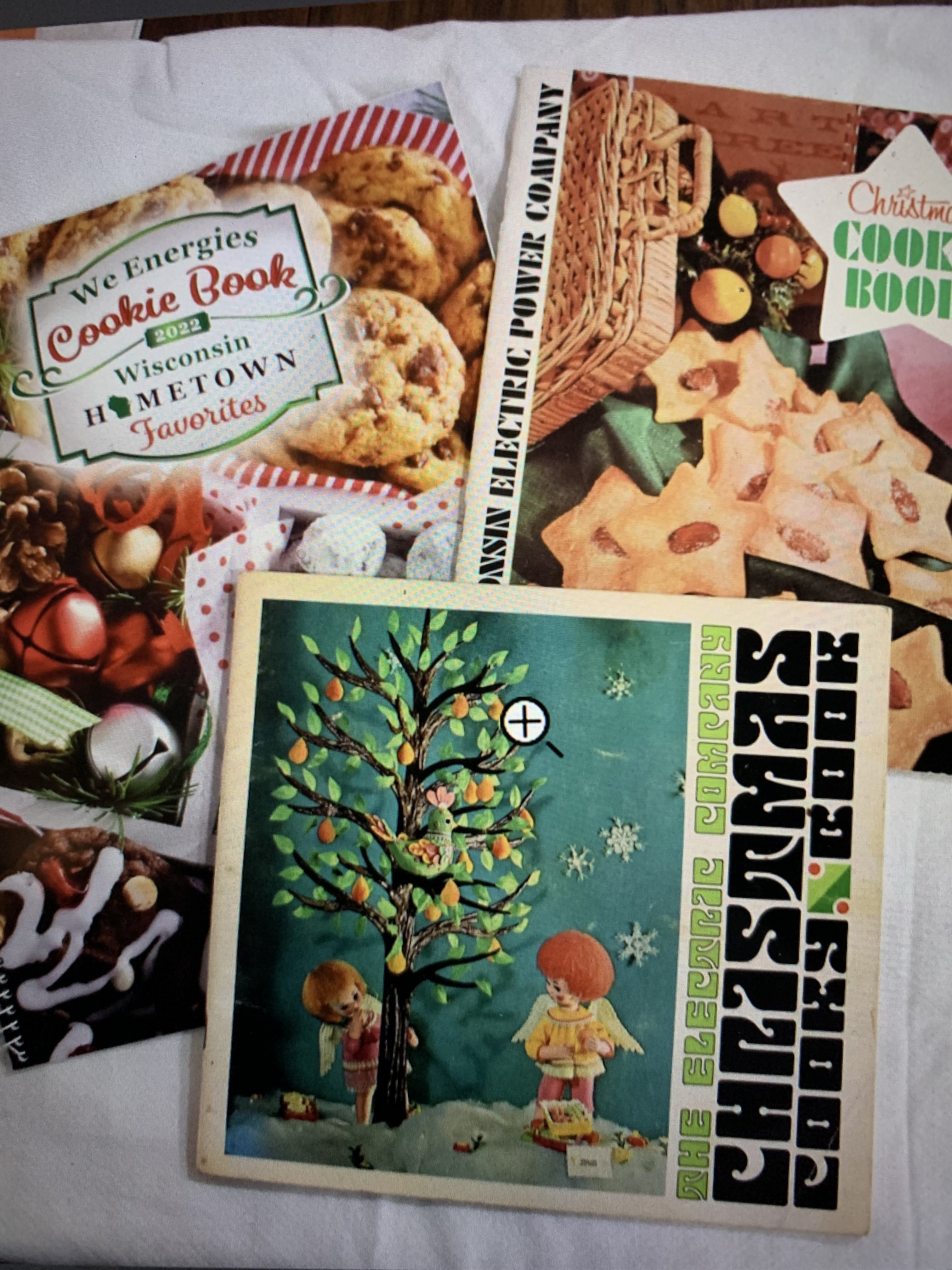
Then, we’d walk, first to the Wisconsin Electric Company, and then to the Gas Company, to take in the cookie displays at each one. My mother made sure that at each place, she was provided with 3 copies of the new cookie book published by each company each year. She loved to try new recipes, and she loved to re-create those that had been her favorites – or dad’s favorite, or mine, or Suzie’s. Unknown to me, she wrote notes as she baked: “a favorite,” “takes a bit less powdered sugar than called for,” “makes a big batch!”
I didn’t discover the notes until years later, when I had my own apartment in Green Bay, and when Mom presented me with the collection of cookbooks she’d saved, just for me.
I’m not a great baker, although the family in San Francisco allows me to bring pies as my contribution to Thanksgiving. My mother loved to bake: “that’s the fun of it,” she’d say. And I expect she envisioned some sort of future for me and for my sister, based on her own life. Neither of us grew to have quite that future, I expect; it was her dream for us, regardless. The year after I retired, I baked a few batches of cookies, looking for a new way to fashion my life after an adulthood of work, often in a “man’s world.” That’s the year I reached high onto the kitchen shelf reserved for our cookbooks, and retrieved the cookbooks Mom had saved so carefully for me. And that’s when I saw her notes, in her particular hand-writing, written with me in mind, written with the relationship between the two of us holding us together.
I shop locally at a big supermarket. Over the years, I’ve come to know who is a “regular” on staff. A favorite checker is Terri, who cheerfully greets each customer. She’s not only my favorite – lots of folks line up to go through her lane, passing up the Self Check area for a kind exchange. Terri will retire next year – and we’ll miss her.
The large supermarket chain hires “extras,” often developmentally disabled young people who stock shelves, bag groceries, and have a look out for stray shopping carts in the large parking lot. Over the years, I’ve come to recognize these workers, also, watching them grow in confidence, watching them exchange a word with the checker. Terri is friendly to them all.
Most of the time, these young people don’t look at me – at all. I am, after all, a white woman with white hair – old, old, old. “What could we have in common?” – they might think. Or rather: “what should I say?” They are comfortable with the checkers, though, carrying on quiet conversations with one another as they work. And although I like to be able to carry my groceries to the car without help, these day the rampant thefts in the city are a reminder to me to ask one of the young people to accompany me to my car. And when I shopped for more than I intended to buy that day last week – certainly more than my short shopping list! – I asked the tall young man I’d noticed many times before standing at the end of the checking line to walk with me to my car.
He walked slowly, and I walked beside him as he pushed the cart, silent. From time to time, I’d make a comment, or ask a question: “you’ve worked here a long time, haven’t you?” His answer: “yes.” We continued to walk in silence. As we neared my car, I popped the trunk before we arrived, and he and I together transferred the bags of groceries from the cart into the trunk.
As he turned away to walk back to the store with the cart, I said: “see you soon!” At that, he turned to me and asked: “when?” – I stopped short, then. “I’m not sure,” I said. He walked away.
I smiled as I walked to the driver’s side door and started the car. I smiled later when I told Jeff about the encounter. I smiled all day as I thought about that tall, hard-working, earnest young man. His presence was a gift in a city that is often unfriendly.
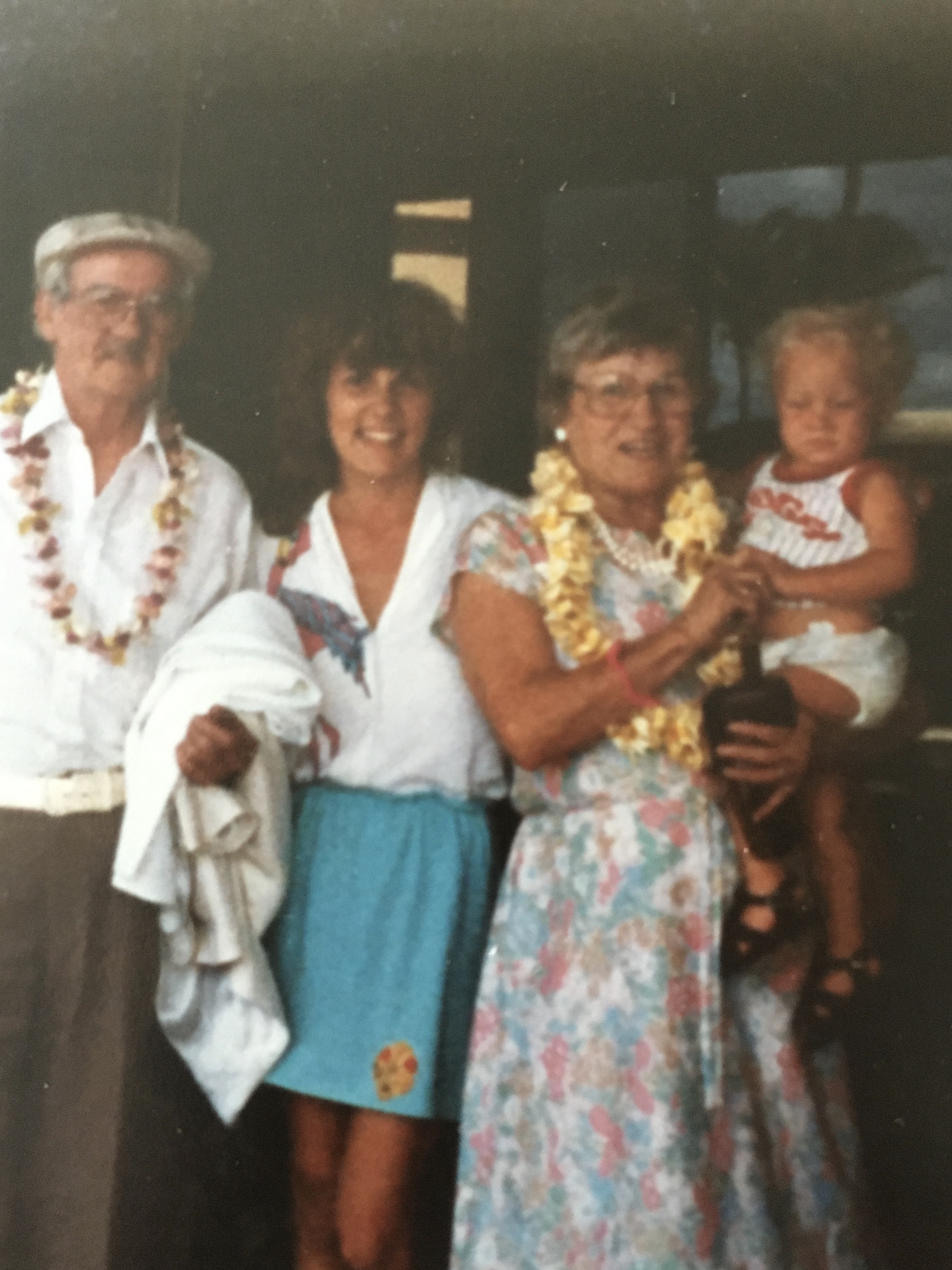
I came up with a nickname for my Dad during my high school years. I began by calling him, “FRB,” his initials. And then the nickname stuck, as others in my family began to call him FRB.
FRB loved his family, loved his work, and FRB loved “I Love Lucy.” Every week, we all watched the episodes – repeats, after the late 1950’s – on our little tv screen in the living room, FRB’s comfy chair directly across from the screen. FRB would laugh and laugh at the ridiculous and wonderful scenes of Lucy and her cohorts – all over-the-top silly folks. And vivid in my mind in those moments, FRB would turn to one of us – Suzie, Mom, or me – from time to time as he exploded again with laughter at scenes he’d seen before, and, his eyes sparkling, say: “Fun, isn’t it, honey?”
Over the years, I saw FRB angry, I saw him enjoying life, I saw him have fun, I saw him being nervous and serious, and I saw his eyes – one blue, one brown – sparkle as he looked at one of us. And I saw him cry, as he realized that the cancer he’d been diagnosed with at 65 had returned in his early 70’s, and as he realized that the cancer would take his simple, kind, and quiet life.
I’m grateful. When I think about my own life, and as my world has expanded to be able to get intimate views into the lives of many, many other folks, I know that I was raised in love. For as many things I did not receive, I received love – not always unconditional, but a good dose of love.