Mr. O’Reilly was my Junior High Science teacher. I don’t remember much about him, except that he was old – most of my teachers were old by my standards… after all, I was in Junior High, and that he had gray hair and always wore a suit. Teachers dressed formally in those days. Other than the memory I’m about to share, all I remember about Mr. O’Reilly is that, on a warm, warm autumn day, when the windows of Peckham Junior High School were open to let in the clean, fresh air of the city, he sat at his desk, and – commenting on a fly that had flown into the window – told us a strange bit of information: if the fly were to land on a piece of food we were eating, whatever the fly had lit on before – the edge of a bedpan in a nearby nursing home, for example, and if said fly then landed on our hand, and if we did not wash our hands before we ate a meal – the germs that germy fly carried would transfer from the edge of the bedpan onto our food. And then into us/me.
Ugh. Enough of that memory – except to say: I’ve never forgotten that particular lesson. Wash your hands, people…
By the time I entered Junior High School, my school day began early and ended late in the afternoon. In Junior High I brought my lunch each day in a brown paper bag I carried along with my books. In each bag was a sandwich made with homemade bread, a piece of fruit, and maybe a sweet treat that Mom had baked. And by the time I entered Junior High, walked under the viaduct at 35th and Fond du Lac Avenue, I was in classes with young people who were, really, from the “other side of the tracks.” My classmates were no longer all the children of working class factory workers. My classmates often came from homes where Dad had a job that required a suit, and where Mom was not simply a housewife, but a woman who worked in an office, or who had been a nurse before she stayed at home, a home that the family owned.
And I was sensitive to all these things. I noticed.
One day, Mr. O’Reilly called my name as I passed him and another teacher, on my way to my assigned chair at a table in the cafeteria. I stopped in front of the tall teacher as he stood next to another teacher, a younger woman. They had been talking, and I somehow knew that they had been comparing the students they taught. Mr. O’Reilly – apparently to make a point – asked me where I lived. I understood completely in that moment that he expected me, a student of his in an accelerated program, to give him an answer other than the answer I gave: “I live on 28th and Locust.” Mr. O’Reilly looked at me with a surprised look on his face.
In Junior High, I was already sensitive to the homes and the kind of work my schoolmates’ parents had. I understood that I was not one of them. Later in college, I would take a class in the humanities about social class. In Junior High, I felt the tug of my difference, I saw the quality of the clothes my classmates wore – different from my often home-made clothes, and I expect I felt ashamed. I did not feel shame wash over me, wash over my body and mind as well as my emotions, in that moment in the school cafeteria, as I answered Mr. O’Reilly’s question. But I was keenly aware of what that moment was about.
In college, I would take a class about social class. These days, I’m rereading a text from that class: The Hidden Injuries of Class, Jonathan Cobb and Richard Sennet, 1972.
After my encounter with Mr. O’Reilly, I sat at the table with my friends and ate my lunch, ate my sandwich made of homemade bread. And I have never forgotten the sting of being from the other side of the tracks, for all the life of privilege I have lived.
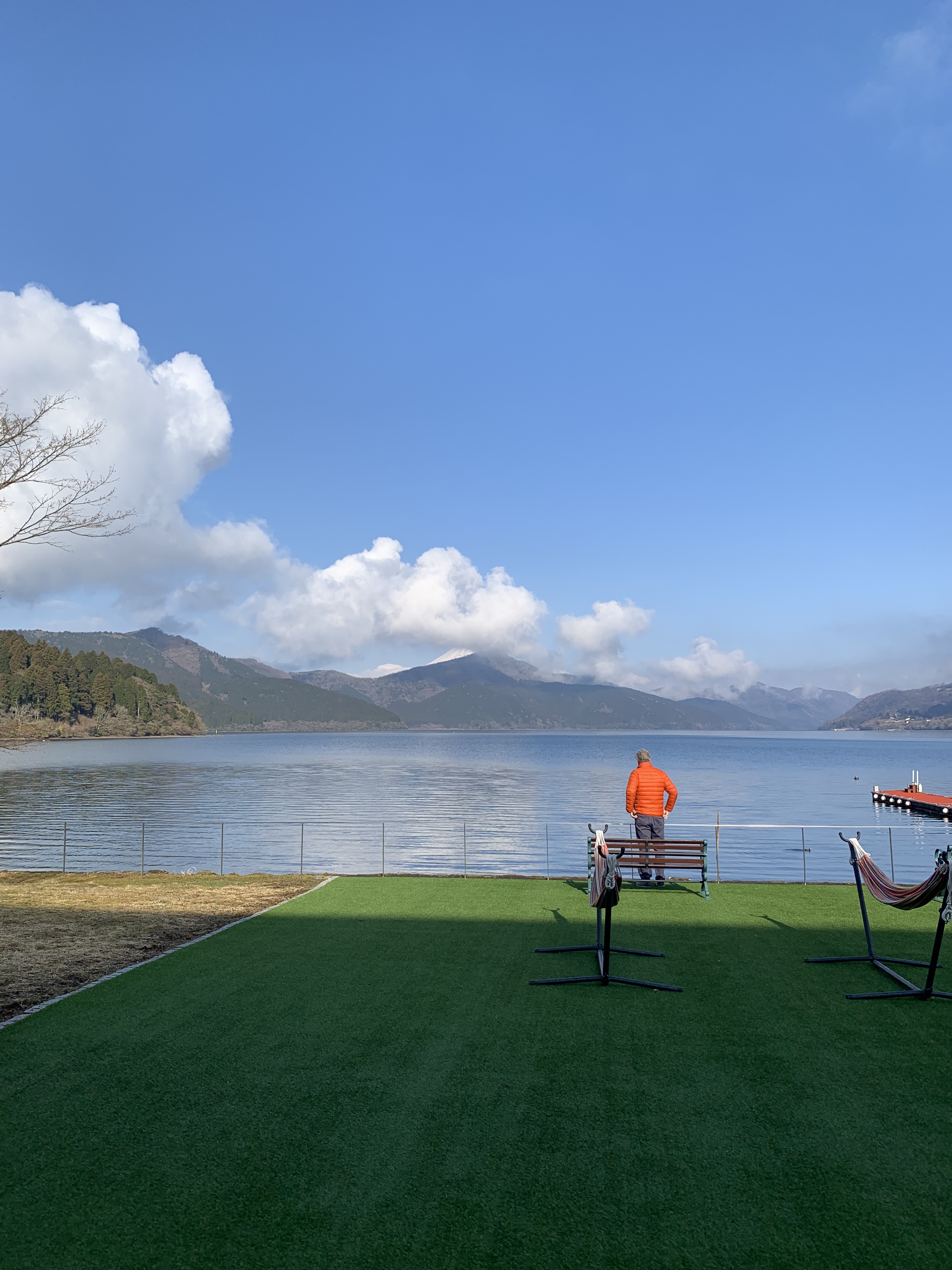
A view of Mt. Fuji from Hakone, Japan, 2026. That’s Jeff in the bright orange jacket, seeing “the shy one” as she chose to show herself to us before we left to travel to Kanazawa. My own photo.
