Uncategorized

place

So much poetry, so many beautiful views, graves of the beloveds at which to stand, roads that are familiar and dear: this is my place.

When I was in my twenties and I lived for a couple of years in Green Bay, Wisconsin, I often drove 100 or so miles north along the shore of Green Bay to Sturgeon Bay, and further, into the part of Door County I knew so well from the time I was a child. I can remember the drive north from Milwaukee as a child with my dad driving, as I lay in the back seat of the ’49 Chevy, sick with the beginning of the measles. I remember the stand of trees north of Jacksonport, on our way to Baileys Harbor, on our way to Sister Bay, on our way to Ellison Bay and Gills Rock.

I remember the faces and even the voices of the beloved family I would see in Door County. I remember Irene, with her giant hugs and never-ending chatter. I remember standing in a cherry orchard, carefully picking the sour cherries, while Daddy – standing by – filled a bucket in a few minutes. I remember exactly where the gas station is in Sister Bay – on the Green Bay side – and where Bunda’s Store – now another department store fills its space – stood across the street from the Sister Bay Bowl.

I know the names of taverns along the peninsula, too, along with memories of stories I’d been told as a child.

Although Door County has now become an “it” place, its two lane roads often lined bumper to bumper with folks from Chicago who’ve “discovered” the Door, I say I know the “old” places, the quiet places to go. And when I’m in Door County, I take the quiet roads to the quiet places.

Folks talk about a sense of place. Door County satisfies that sense of place for me. In my life, I’ve been privileged to travel to foreign places and I’ve been privileged to take many roads across the United States, beautiful places, all. But in my heart, in my memory, in my blood – it seems – I return always to Door County. At some moment in time, I promised myself that no matter how far away I might go in life, I would return to my place. I’ve kept that promise.

Each place I see again holds a memory for me, and as I stand at the graves of my beloved family – the Bahlerts were warm, gentle people – I see the faces of those who have passed. I can hear their voices. I can stand at exactly the places we stood.

When my beloved Auntie Irene was dying, I sent her a card, and included the words: “wait for me.” I wanted to see her again before she passed. And she did wait. I’d arrived in Door County later than expected after a hospitalization in Milwaukee, and I arrived, along with Jeff and my mother, in time to be at Auntie Irene’s funeral in the old, frame sanctuary of the Lutheran Church north of Baileys Harbor, to stand outside the church with many of my Bahlert cousins, to see them once again.

Several times in my life I have returned to Door County as a place to mark a change. I wrote my application to seminary in the autumn of 1981 in a rustic cabin along the shore of Lake Michigan. When I was heartbroken in earlier times, I went to Door County to heal, and in a cottage I pass along the highway to the north of Baileys Harbor – I remember as I drive past – I heard a voice call me by name.

And I am blessed, blessed by that voice, blessed by a sense of place.

I’ve lived many years in the West. I’ve lived a life I could not bring into my imagination when I was a child and a young person, trying to find my own way in life. And through all those years, I have kept my promise to myself: to return to this beloved place, as often as I am able.
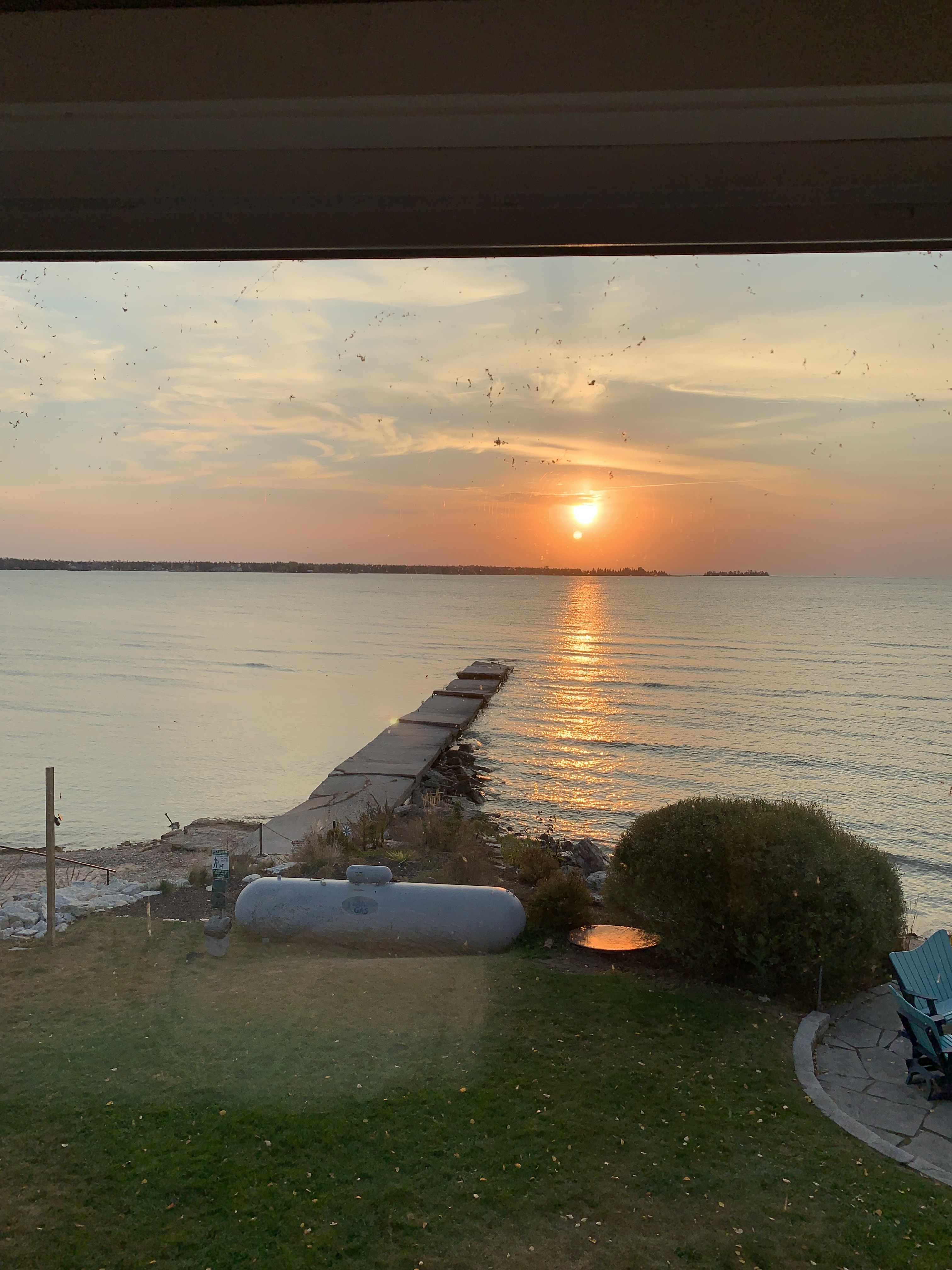
Photo of sunrise over Lake Michigan, photo taken by Mary Elyn Bahlert, 10/24. From a window in Baileys Harbor, WI.

memories, reflecting, remembering, Uncategorized

Easter

When I was growing up in Milwaukee in the 1950’s and 1960’s, the Christian holidays were honored culturally. We sang Christmas Carols during December at school. We had the week following Easter off – always – as spring break – whether or not the weather honored the season. And although my family were not church-going people, we celebrated the Christian festivals along with everyone else.

For weeks before Holy Week, Mom carefully decorated pysanky, the Ukrainian decorated Easter eggs. I had the job of blowing out the eggs before Mom sat at the kitchen table and carefully applied wax and coloring to the empty shells.

I was still small – maybe 6 or 7 – when Mom told me that a man had been hung on a cross to die. The streets were quiet that Good Friday – stores were closed to honor the somber day – when she let me go out to play on the front steps of the flat on Ring Street, alone. I ran up and down the steps. My instructions were to stay in front of house. And as I played alone on the steps, I wondered about that man who had been left on a cross to die. I thought he was somewhere not far away, but out of my hearing, in the quiet city.

Part of me was taken with the story, which in later years I would tell, again and again, to congregations in California, a long way from those narrow, bleak streets. I imagined the man into existence, in a way: captivated, wondering.

On Easter Day, Grandma Markowski would be making her way up the alley to our house, and we’d try to tap each other’s eggs colorful eggs – not pysanky, but regular decorated, hard-boiled eggs – to see whose egg didn’t break. They were the winner!

Later, Auntie Anne and Uncle Harvey, Mark, Patty, and Johnny would arrive for the dinner, ham and all the trimmings. Later still, the women would go into the kitchen to talk and talk as they washed and dried the dishes, while the men sat together in the living room, drinking beer, and waiting for the holiday table to be cleared so that the Sheepshead playing could begin.

Soon enough, Easter was over, and soon enough, the well decorated, hollow eggs that had been carefully decorated and displayed, were set aside, to come out another year. This year, like all the rest, a dish of the beautifully decorated eggs will grace my table, just as they did Mom’s table.

Pysanki by Mary Bahlert (Mom), Jeff Kunkel, Ronn Lass

Uncategorized

Holy Week

Quiet now, this early spring into which we fall,
a few days of sunshine and green rising from earth.
Quiet now, we enter the Holy Week
- watch the sombre procession - with unknowing eyes -
unaware of what will pass, what is passing.
We line the streets,
shake the bells into sound,
strike the cymbals,
shout:
"Hosanna! Hosanna!"

The people cried out
as we have cried out into the night for Something to Save us:
these earthy bodies,
this pain,
this solid march from life to death -

All in stark relief against the clouding sky.
---Mary Elyn Bahlert, 4/2025

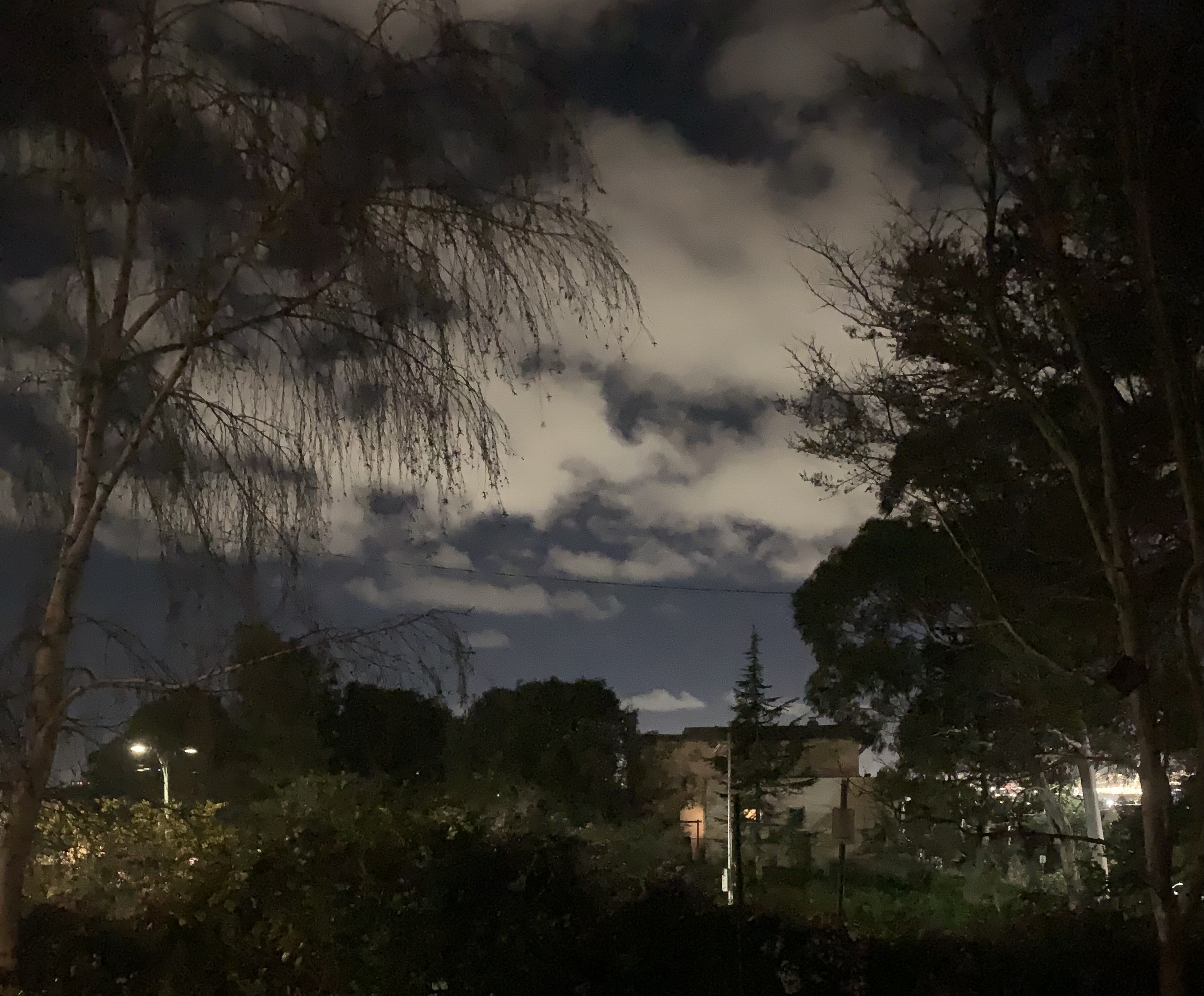
Night sky over Oakland, photo by Mary Elyn Bahlert, 3/2025

memories, reflecting, remembering, Uncategorized

When I was five years old…

When I was five years old – five years and one month old – I started the long walk from 11 and Ring Street in Milwaukee to 9 and Ring Street, where I entered kindergarten at LaFollette Grade School.  Those two blocks were long walks for a little girl.  I expect – although I don’t remember – that my mother must have anxiously walked with me the first day or so, pushing in a stroller my baby sister, Susan, who had been born that March.  After that first day or two or three, I walked those blocks with the other children from my neighborhood.

When I return to drive through those streets now, I see how short the blocks were, moving west to east, toward “the Lake:”  Lake Michigan.  I think of myself as growing up on the shores of Lake Michigan; it’s not too much of a stretch to think that way.  The shore of Lake Michigan formed my compass-point, my sense of direction,  for many, many years.  “The Lake is on the east,” I think, “so I must be facing north, and to get there, I have to turn left, to the west…”  etc.  Years later, when I land in the Bay Area of California, I find that directions are expressed differently.  “Turn right at the second gas station, then get into the left lane.  You’ll turn left at the next stop light.”  When I work at my first job in graduate school, someone hears me giving directions and says:  “You must be from the Midwest.”  Good guess.

That’s how our lives grow, how the edges of our lives expand:  by walking those few blocks to kindergarten, leaving home for the first time.  The edges widen by talking to kids whose lives inside their narrow flats are different.  I hear about dads who are mean, for example, and I hear about mothers who laugh a lot.  Until I leave my house in September of 1954 to walk those few blocks, my imagination does not hold space for those possibilities. 

I am nostalgic for those streets, for those city spaces, for the shadows under the big elms that line the streets, for those narrow stairs with the small window on the right at the top, that lead to the second story flat with its small front room, tall windows, its small bathroom with the clawfoot tub that was used by 5 people without a thought that it could be otherwise.   My nostalgia wants to be satisfied, so I ride my laptop via google earth to the front of that flat; I walk with google the two short blocks to La Follette School.  I still see the beauty that was there, and I see the poverty, the simplicity of those flats, as well.

On the way to school one day, I learn that I am not Catholic.  Michelle, my neighbor across the alley (which runs next to my house), a year older then me, asks me one day, as we walk to school:  “Are you a Catholic?”  I don’t know.  That night, I ask my mother if I am Catholic, and she tells me no.  I do not know the fraught history that lies behind her answer, and I will not know, for many years, the fraught history and longing that goes with not being Catholic, in me. 

At LaFollette School, I am introduced to a kind of diversity, for the first time.  I sit near the front, always, our seats assigned alphabetically by teachers in navy blue polka dotted dresses.  In those narrow rows, in those wooden desks with holes for ink pots still marking the right hand side, I sit beside the children of first and second generation immigrants.  I do not know that many of my classmates speak a different language at home.  In my house, I often hear Ukrainian words, spoken with a kind of mysterious wink; from time to time, when my grandma visits, she and my mother speak their native tongue. 

In the autumn, the elm trees that line Ring Street turn bright colors, and as I walk, I often try to catch a maple seed – a helicopter to enchant children – as it floats to the ground.  Over the street, the trees meet to form a ceiling that arches from one street to the next.  In later years, Dutch Elm disease would take the elms away, and when I see these streets now they are just beginning to be tree-lined again, after many years. 

In winter, snowbanks form a path for children, four foot high, on the strip of land between the road and the sidewalk.  After a winter storm, the tops of the snowbanks form a hardened, frozen, flat sidewalk parallel to the cement sidewalk.   At the corner, I climb that tall bank of snow and stand taller than any adult, until I take the steps – made by other children – down again, at the place the alley meets the street.  After the alley, I climb the snowbank again.

In spring, I walk to school as the glorious, wide, lilac bushes float their purple flowers, their scent into the air.

*

One summer day when I was 13, I walked down the steps in the narrow front hall, from the second floor, to look out the screen door that led to the downstairs porch.  I looked out on that street, with its maples, its curbs with green grass growing beside the asphalt, the tall, spindly houses that held families – broken, near poor – the sound of traffic from the busy street a block over in the air.  I don’t know what happened, then.  Was it hope, speaking to me?  Was it a barely covered wish, from inside of me, speaking to me?  Was it the thought that my mother, my grandmother, held deeply inside, beneath the bright mind, the hand-sewn clothes?  I heard a voice.  The voice was clear, not to be ignored.  “I don’t belong here,” it said.

The streets are not nearly as pretty now as they are in my memory.  Milwaukee can be a bleak place, from December to late May.  Grey clouds hang over the streets, over the city, for way too long each year.  And the houses that line the streets – 50 or so years old when I lived in upper flats – are 100 years old now. 

Those narrow streets formed me.  I left them behind, many years ago.   Still, they are my home.

Me and my baby sister, circa 1955