memories, remembering

Vicki Sue’s Thanksgiving

My niece Vicki Sue is a new grandma now, her first daughter, Heather, having provided her the title with the arrival of Savannah several weeks ago. Every day, I receive new photos on my phone, with Grandma and Grandpa holding the little one.

Which is why I share this Thanksgiving story, a story which takes place at the time when now Grandma Vicki was the smallest, the youngest member, of our family.

Our family – Mom, Dad, sister Suzie, brother Ronn and Sue and their family, which consisted at the time of David, Alicia – and Vicki Sue, were all together to enjoy the meal about to be served. Mom worked hard in the kitchen all morning, and, as was our custom, the table was set for the Thanksgiving Feast at about mid-afternoon. The upper flat on 49 Street on the North Side of Milwaukee was crowded, those little rooms stuffed with the adults and little ones as we awaited the feast.

Suddenly, someone noticed that the littlest member of our Happy Thanksgiving Gathering (the mood about to change…) was missing. Mom, Sue, Ronn walked through the front rooms and into the kitchen, and into the tiny hall where the bathroom and two small bedrooms emptied, calling out: “Vicki Sue!?” “Vicki Sue?!” Mom Sue or Dad Ronn – I don’t know which – heard a small voice, behind the closed door to the bathroom!

“She’s in the bathroom!” someone yelled.

The door handle was tried. The door didn’t budge. The door handle was tried – again. Then the real antics began. Mom Sue and Dad Ronn and Big Brother David and Big Sister Alicia and Grandma and Aunt Suzie and Aunt Shugie all gathered in the small hallway, all bending at the waist, mouths as close to the height of a toddler as we imagined, loudly giving the toddler – who was locked in the bathroom (!) – instructions for how to unlock the door.

We tried. We really did. As situations like these do, the moment escalated, the voices getting louder, and more voices joining in the yelling – the yelling that was an explanation, of course, to the little one on the other side of the door. She didn’t cry. After all, she had plenty of attention; it’s just that the attention was all on the other side of the – locked – door.

Grandpa must have stood on the outside of the crowd gathered in the small hallway outside the bathroom with the locked door. Sometimes, while he loved the little ones, loved to visit with them, hold them in his lap, talk to them – the noise that a house full of little ones provided was a bit much for him. It was now, anyway.

Grandpa marched from the hallway to sit at the head of the dining room table, his designated place for the holiday. He sat in this chair, picked up his knife and fork, which were carefully set in the appropriate places at the festive holiday table, and yelled: “Let’s eat!”

By this time, someone was dialing the phone that sat in the nook right inside the small hallway that led to the bedrooms and the bathroom. One or two adult voices continued to give instructions to the toddler, Vicki Sue, who was still locked on the other side of the bathroom door.

A few minutes later, a fire engine rumbled up to the front of the house. A couple of kids ran to the front window, and Grandma went down the front stairs to talk to the tall fireman at the door, doing his civic duty on the national holiday. In a few more minutes, we all heard the sound of a ladder being pushed against the side of the house, right up to the bathroom window. Which was easily opened, of course, and through which a tall, handsome fireman (they are always handsome) dropped from the ladder and into the bathtub. As he stepped out of the bathtub, he leaned over the little blond girl who was all alone in the bathroom. He unlocked the bathroom door.

There!
community, memories

Lambing

I’m definitely a city person – a “city girl,” as my husband likes to say. In my early twenties, when I was in my first professional position in the Federal Government, I had been assigned to live in Green Bay, Wisconsin: too small for my taste, I tell others now, “I almost died in Green Bay.” A bit of an exaggeration, of course, but I like to tell the story that way so others get the drift of what living in that cold, gray place had meant to me. “Get the drift” – as in snow drift – I suppose.

I digress. Over the years as a pastor, I came to learn about many mission activities, some in the United States, others in places overseas. I spoke often about mission to the congregations I served; I reminded them, again and again, of how those of us who are privileged to live our lives in warm and clean houses, our tables set always with a warm meal, health care – now more than ever a privilege – everything we want and need to be safe in our lives, had not only the ability but the need to give to those others whose lives had not afforded them the luxuries we take for granted. And over the years I became familiar with ways – call them opportunities – for us to give.

A favorite of mine is Heifer Project International. I’ll tell you why it’s a favorite. HPI provides animals and education to people in impoverished circumstances by giving them animals, by giving them the education they need to care for the animals, and to give them a future that these animals provide. You can take a look at the website for HPI here: heifer.org

“Giving an animal gift at the holidays is like giving someone a small business, providing wool, milk, eggs and more. Every animal gift comes with a free honor card to let your gift recipient know their holiday gift is providing families access to medicine, school, food and a sustainable livelihood.
Your animal gift will support the lives of families in need.” – from the HPI website

*

Once a year, HPI offered a weekend for women, “Women’s Lambing Weekend,” a gathering at the carefully timed birth of the lambs at the HPI farm outside of Little Rock, Arkansas. (As I checked out the HPI website to write this post, I found that they no longer ofter the Women’s Lambing Weekend. It’s a loss, I think). Joanne – my long time, faithful friend – who had grown up on a farm, and I were roommates that weekend. From the time we arrived, we attended classes that provided information about the mission and the people who HPI served. The work of Heifer Project came to life during those sessions. I was sold on their mission forever!

As the weekend progressed, we all waited for the lambing to begin. Veterinarians were on site, as teachers to our sessions, and available, always, to the animals.

One morning, the gathering of women sat in the chairs in the small classroom that was ours when we weren’t being introduced to the farm. The instructor had just begun when someone walked quickly into the room and in an excited tone of voice, yelled: “the lambs are here!”

We all jumped up from our seats and ran over to the field outside the main barn, where one of the vets was gently cradling a lamb in her arms, Mother Sheep lying close by, her eyes on her baby. As occupied she was with the beautiful lamb, the vet told us about the birth, and she told us how the mother and lamb would be cared for now.

I was so happy to see the new baby lamb! Even Joanne, with her years of growing up on the farm (where she and her brothers were usually out in the field, picking rocks), was happy to see the new lamb.

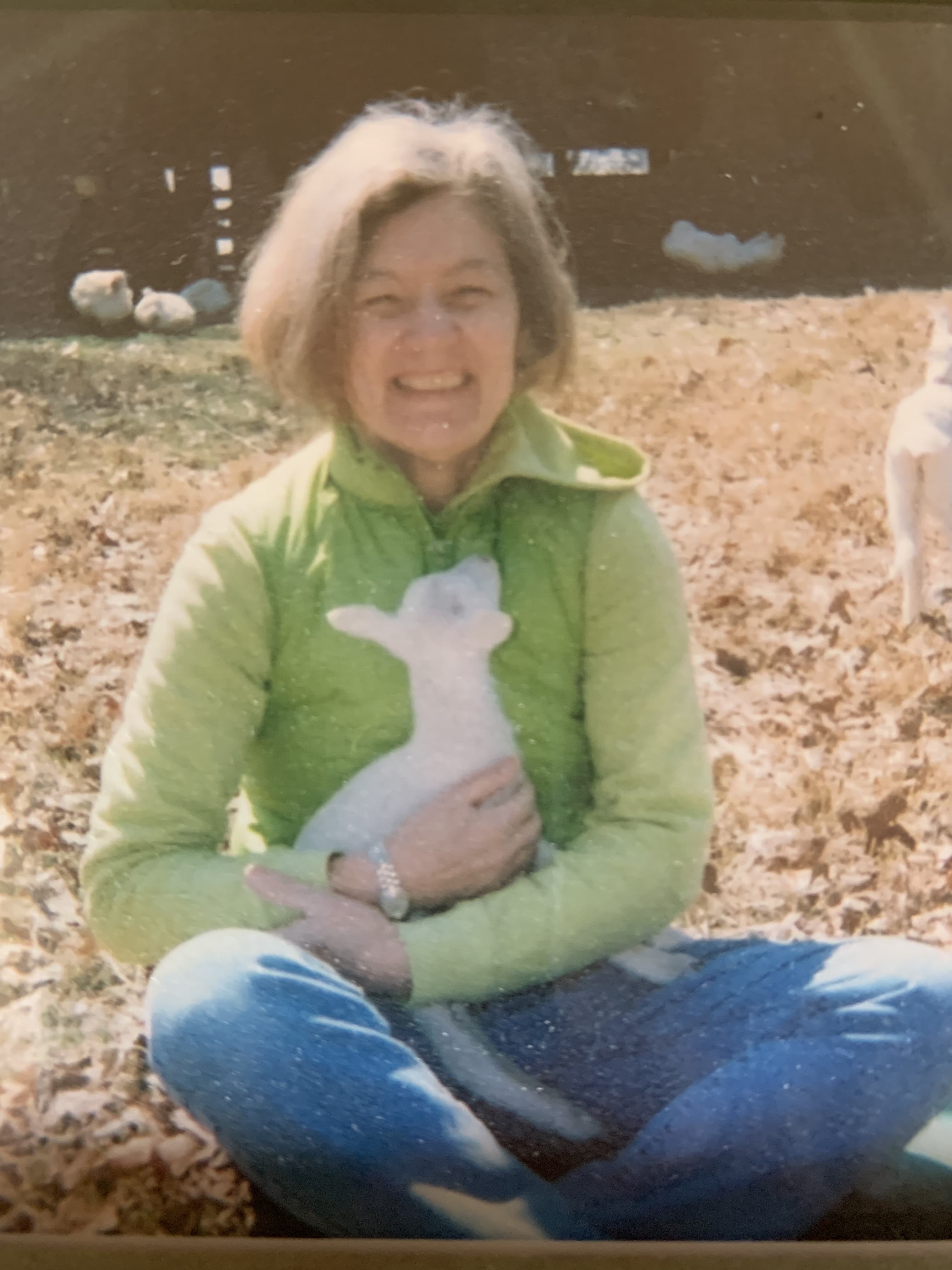
My weekend at Heifer Project was a joy I often remember. On our mantel, in front of the window above the fireplace, there’s a picture of me, holding a baby sheep – a lamb. I loved that moment, when the littlest lamb was placed into my arms.

memories, remembering, Uncategorized

Meeting Diane Keaton

Barbara and I sat together on a low bench in the Visitor Center at Chichén Itzá in Yucatan State, Mexico. We were waiting while our husbands, Frank and Jeff, worked on the phone with the car rental company in Merida, where we’d started our journey in the Yucatan. It was going to be a long wait. As I sat, I opened up the paperback I’d brought with me from the United States, a book of short biographies about celebrities. Good holiday reading!

From time to time, I looked up from my reading to look over at Frank and Jeff, or Barbara and I exchanged a few words. One time as I glanced up, a slender woman with long brown hair passed in front of us. I did a double-take. It was Diane Keaton – I was sure of it! And I’d just finished reading a chapter on her, a short while ago! I’d read that she was often kind to her fans when she was spotted in public. But that didn’t matter now. I nudged Barbara. “That’s Diane Keaton!” I whispered, excitedly. Barbara looked over at the woman, who had moved away from us, along with her companion. Barbara, also excited now, agreed. We had spotted Diane Keaton!

We were beside ourselves! Barbara and I raced over to our husbands, still working things out over the phone about our car, our transportation. “We saw Diane Keaton!” we giggled, excited, excited! We pointed out the “incognito” celebrity in our sights. “Go over and say hello to her,” my extraverted husband advised. “Oh no – I couldn’t do that!” I whispered. Barbara nodded, agreeing with me. “OK, then” – Jeff took my hand and walked toward Diane and her companion, who were slowly looking at the exhibit along the walls of a room off the main room.

When we got to the room with Diane and her friend, we walked up to her and greeted her, acknowledging that she’d been spotted. I stood for a moment looking at her, as she turned to us. “I appreciate your work,” I said. Then Jeff and I backed out of the room she was in and into the main hall. We walked over to Barbara, who was already shaking her head, saying, “I”m going to hate myself for not going with you.”

Finally, Frank and Jeff worked out some sort of arrangement with the car rental company, and the four of us set out to walk over to see the ruins of what had been a city teeming with life from about AD 600 to AD 900 (thanks go to wikipedia whose information is at my fingertips as I write!). We followed the lines of other people walking around the ruins, as I watched carefully for Diane Keaton at every opportunity. She was not in view at the moment.

The four of us entered a small opening on the side of one of the pyramids and followed the long line of other folks who were making their way to the center, down and in, the path led us, one after the other, close together. At a certain point, I began to feel uncomfortable, and I realized that I was beginning to feel claustrophobic. I turned halfway around, far enough to tell Barbara that I’d have to go back, still using the narrow passageway we’d walked in. She said she’d go back with me, and the two of us simply turned our bodies and walked alongside the line of tourists going into the pyramid.

Barbara is a tall, beautiful black woman, self-contained, shy. When Barbara spoke, we all listened. She had a kind of authority about her. Not that day. At one point, Barbara came face to face – chest to chest, really – with Diane Keaton, on her way in the semi-darkness to explore the pyramid. “I appreciate your work,” Barbara said. Diane Keaton nodded, silent, and she continued into the pyramid. In a few moments, Barbara and I were back in the sunshine.

*

When we returned to the United States, we all went right back to work. It happened that I was set to go off to a retreat of the United Methodist Clergy Women in my Annual Conference, so a day or so after I’d arrived home, I was at the retreat center. The retreat began with all of us – 40 or more – sitting in a large circle. We were invited to introduce ourselves to the group. When the time came for me to speak, I told the story of my “event” at Chichén Itzá. After I’d shared a few sentences, the questions came from this group of serious, work-minded women. “How tall was she?” “Who was she with?” “What was she wearing?” “Was she friendly?” The questions went on and on. My introduction took up a lot more time that day than anyone else’s. I guess my life was the most interesting – for the time being.

For years afterward, when Jeff and I spent time with Barbara and Frank, remembering our interesting journey to the Yucatan, we’d laugh again at how nervous Barbara and I had been. Frank loved to mimic how he remembered the two of us, one time standing on top of a fire hydrant to deliver the story to us again. His imitation of our voices, high and excited like children’s voices, was particularly entertaining. We’d laugh and laugh.

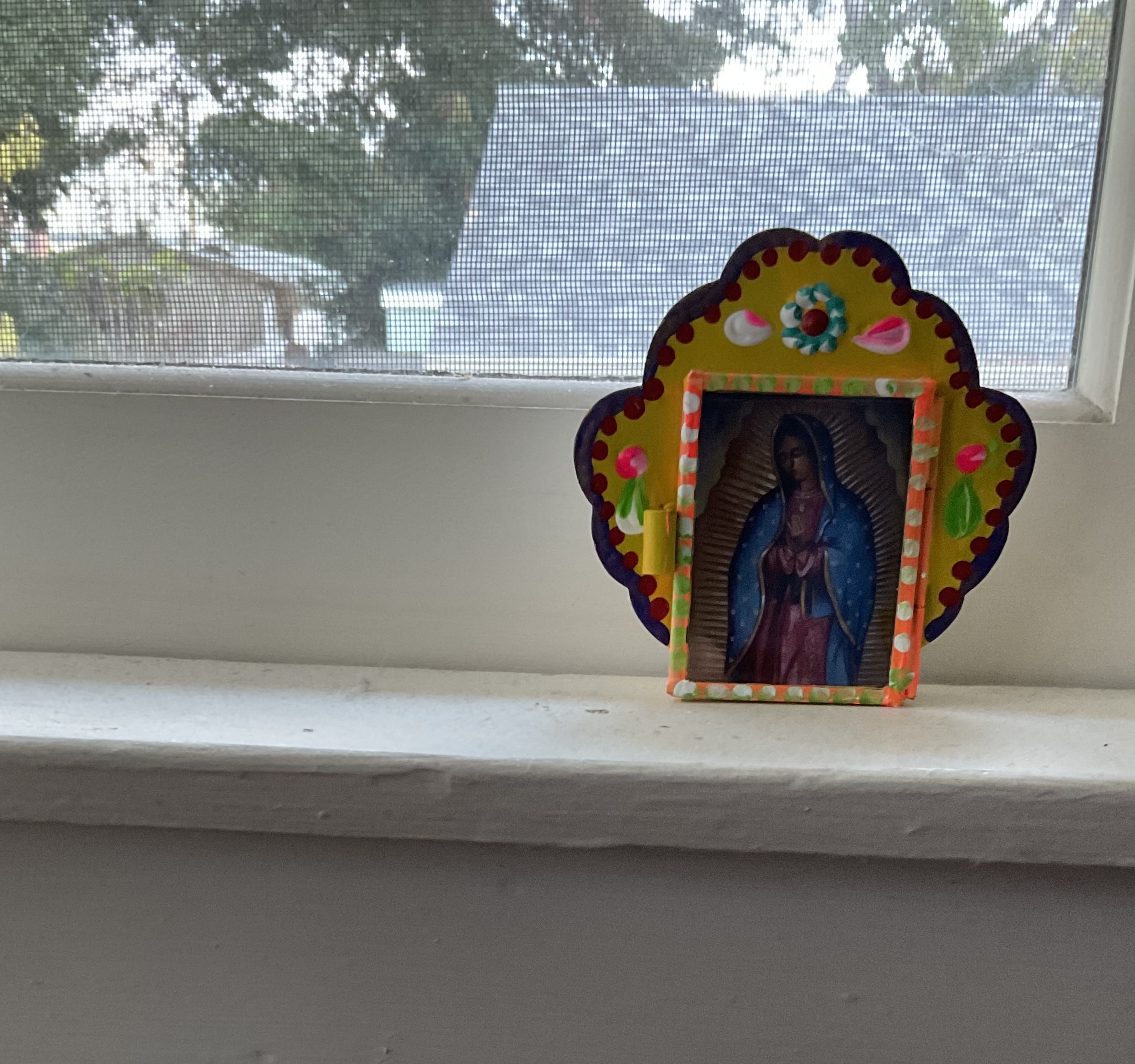
Guadalupe Photo by Mary Elyn Bahlert, 05/2024

Uncategorized

Acedia

Acedia: spiritual or mental sloth

Monks in their cells in the Middle Ages
rose before dawn to pray.
Instead, they walked that narrow room,
     back and forth, back and forth, all day.
Some called this a sin,
     this rocking in their stiff chairs,
     the unwillingness to kneel, to pray.

The days of cloistering went on eternally, it seemed.

We’ve been sheltering for months,
the agitated monk inside us growing, growling,
longing to be free.
Still he paces, frantic and passive.
Call it a sin.
Call it malaise, a fever.
Acedia has risen from the ashes
to mark this time.


Mary Elyn Bahlert
10/2020

beauty, reflecting, Uncategorized

Martinez Slough

As the months and then years of the COVID-19 pandemic entered our lives – and then stayed – and stayed – and stayed, we all found ways to deal with the time of social isolation and the range of activities we had come to take for granted: visits to museums, concert venues, movie theaters. And we all survived – for years. As I look back now, it seems a dream. I wonder: how did we do it? how did we journey for those long months that stretched behind and ahead of us?

Jeff and I began a tradition that we did not know would become a tradition, early in 2020, after the quarantine – “sheltering in place” – began in March of 2020. Every Sunday morning – we felt so free of our long years of pastoral ministry, when every Sunday was filled, with worship, with meetings, with visits. Sunday mornings rose quiet and free of schedules. We woke and got our first cups of coffee at 5:30 AM for most of the pandemic, a habit we hold today. On Sundays, though, we thought about where we could go for a walk, a change of scenery, a gift to us as we looked to the long days ahead of us that week.

We walked in San Francisco. We drove to the shore of San Francisco Bay at Brooklyn Basin and walked amid the growing development of apartment buildings there. We walked on the beach at Half Moon Bay. And we discovered the Martinez Slough.

The tide comes into the slough, which is something still new and strange, something note-worthy, to this Midwestern raised couple. When we first drove the 30+ miles to park at the ranger station at the slough, we discovered paths, some along the water, some further in toward the City of Martinez, whose downtown was less than a mile from the shoreline. Some times, we’d watch the water lapping along the beach, the tide in, the tributaries filled to the brim. Sometimes, we’d see the wetlands with the muddy shores and the sea flowing outward toward the Bay. Some days, we’d catch sight of a ship coming through the passage from San Francisco Bay and into the inlet, on the way to Stockton seaport. A train often roared past us after we’d crossed the tracks to the edge of Martinez and parked in the small lot near the water.

One Sunday in May, the sky was filled with kites and the voices of children and happy adults accompanied the floating delights, the holders of the kites’ strings on the shore nearer the Martinez Strait. Every time we walked, we were delighted again, as we passed early morning dog-walkers who greeted us, happy, as we were, to see others out during this difficult time. And every time we walked, we noted the tide – in or out – and called out to one another as we watched the sea birds, the geese.

We talked about going to the slough again today, and we left our home early to drive on the quiet highways, east out of Oakland and north to Martinez. We talked the whole way there, and we talked as we walked. Today we stood on a walker’s bridge and saw the pussy willows; we were reminded of Wisconsin, then.

So this time, when the world seemed to stand still for a time – did that really happen? we wonder now – is behind us. But we continue to go out early some Sunday mornings to that place, where walking and talking comes easily, where the sea breeze accompanies us as we walk.

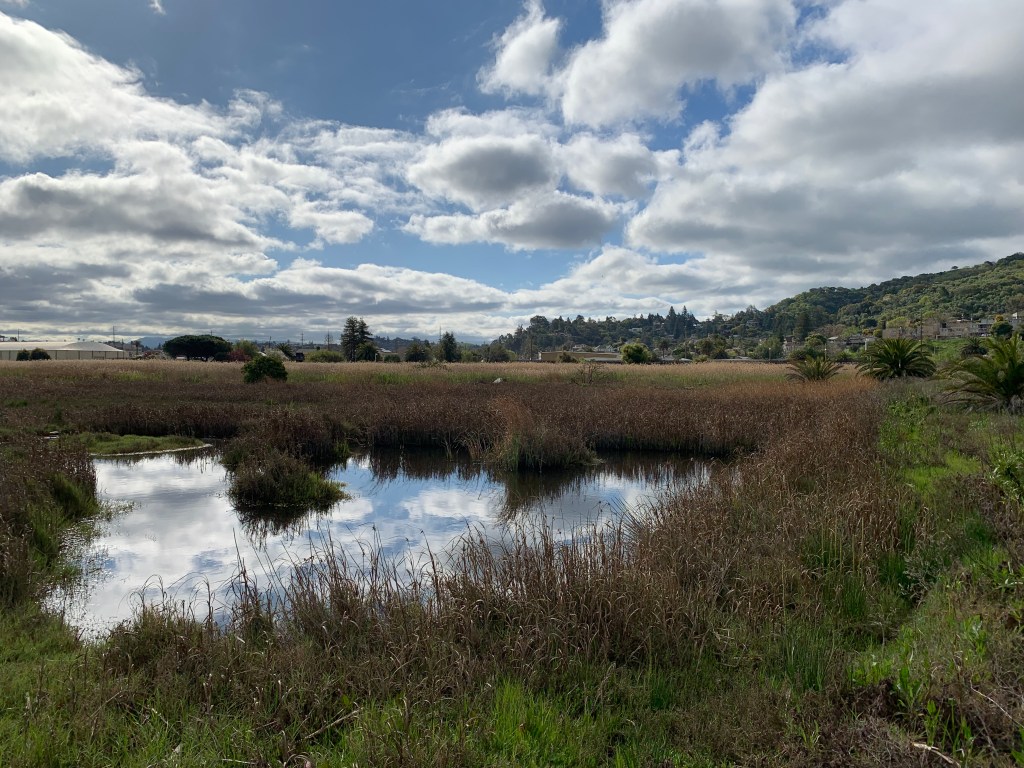
Martinez Slough, photo by Mary Elyn Bahlert, May 27, 2024.