“There are places I’ll remember. All my life, though some have changed. Some forever, not for better; Some have gone and some remain…” Lennon and McCartney
Our yearly trips to Door County seemed to have a pattern, and the pattern included visits to various aunts and uncles – my father’s siblings – who lived close to where they had been born. At some point during the week, we would drive for a visit to Auntie Edna’s house, close to the tip of the Door Peninsula, at Gill’s Rock. The road that ran to the north of Auntie Edna and Uncle Werner’s (we said, “Verner”) place led to the dock to the ferry to Washington Island.
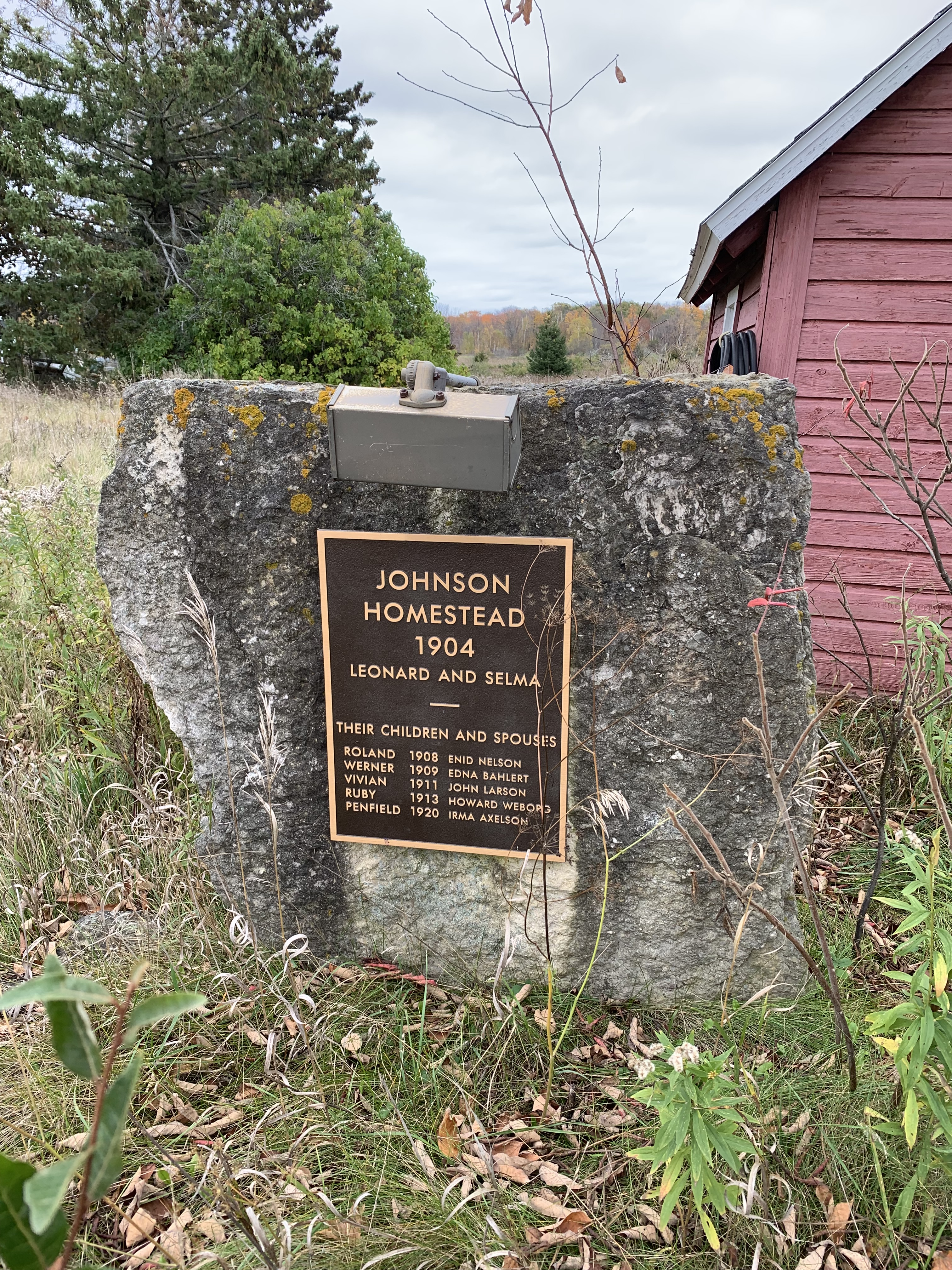
Edna and Werner had lived in that house for many years longer than I had been alive. My cousins Donna and Dean had been born in that place. On my trips to Door County now, I always drive past the brown-shingled house with the cherry orchard to the East. On the edge of the property on which their home stands is a plaque: “Johnson Homestead 1904, Leonard and Selma” the names of their children with years of birth, below. My Uncle Werner, who spoke as if he’d come straight from Sweden, had been born there! Years later, the thought would come to mind that his first language had been Swedish.
For a living, Uncle Werner had fished the tumultuous waters of that part of Wisconsin, Green Bay, Death’s Door to the North ( the native people had named that passage between Green Bay and Lake Michigan). He also raised the sour cherries that grew abundantly in the rocky soil of Door County.
The visit to with Auntie Edna and Uncle Werner began in their living room, with both Edna and Werner seated in their large, comfortable chairs. I sat in the same place each time, also, and I would look to that part of the long, narrow room toward the places we did not sit. Did they ever go into that part of the house, I wondered? Did the Christmas Tree go there?
Dad and Mom, Suzie and I sat formally in that living room, Dad with his cap in his hand, doing most of the talking. Of the lot of us, he was the most extraverted. Uncle Werner seemed to have a twinkle in his eye; I always thought that in his way, he was laughing at us. Auntie Edna was one of the quiet Bahlerts, and so she sat quietly in her chair, asking questions. Gentleness radiated from her presence. After awhile, we’d all get up, and Auntie Edna, Mom, Suzie and I would move to the small, dark dining room, where she served us juice and cookies. I remember her kindness, her ability to listen. When I went to the bathroom before we left the house, I’d glance into their bedroom, and always wondered why they slept in two single beds. At home, Mom and Dad slept together.
Years later, I would come to know my cousin Donna, who worked in Milwaukee and made the trip to the Door Peninsula every week to get her clothes washed, to be home again. Her life was much like my father’s had been, a generation before. While I was in college, I made the trip to Door County with Donna for a weekend, and she took me to her lifelong haunts. After she retired, Donna would marry Jim Thorp, who had lived his entire life on the Door Peninsula. They would live in their double-wide trailer, a short walk away from Donna’s folks.
On the Sunday of our week in Door County, we’d go to church at the Moravian Church just down the road from Werner and Edna’s place, and there she would be, my beloved aunt. In her quiet way, she was a presence.
Once a week, Edna wrote a column for the Door County Advocate about happenings in that place, so beautiful in the summer, with long bleak winters. When we had had our yearly visit, our names were mentioned in her column.
When we are a child, it’s hard to imagine these elders as being young, but sometimes I try to piece together the bits and pieces I heard, often repeatedly, into a pattern. I knew that Edna had graduated from high school, something not all of her siblings had done. She spoke as I spoke, not in the dialect of that place that my father had. Her father, Ginter Bahlert, my grandfather, had wanted her to go to college to be a schoolteacher, but that was not to be. She worked for a time at Bunda’s Store in Sister Bay, an establishment that lasted there until at least the 1970’s, on the West Side of Highway 42, on the South end of town, before she married Werner. I think of her every time I pass the building that once housed Bunda’s Store, the Sister Bay Bowl across the street, still standing.
It is odd, in a way, hard to understand that these places are still there, and the people I loved gone now, so long.